Is Hopstack the Right AI-Powered WMS for Your Warehouse?
Take This 2-Minute Quiz to Find Out!
Key Takeaways
- AI-Powered Intelligence: Hopstack transforms warehouses from reactive to proactive management using machine learning for dynamic optimization
- Proven ROI Results: Businesses typically see 20-40% labor cost reduction and 99.9%+ order accuracy within 12-18 months
- Enterprise Security: SOC 2 Type II certified with comprehensive data protection and compliance support
- Seamless Integration: Pre-built connectors for major ERP systems and e-commerce platforms with vendor-agnostic automation support
- Rapid Implementation: 8-12 week deployment timeline with dedicated support and comprehensive training programs
What is Hopstack and how does it differ from traditional Warehouse Management Systems?
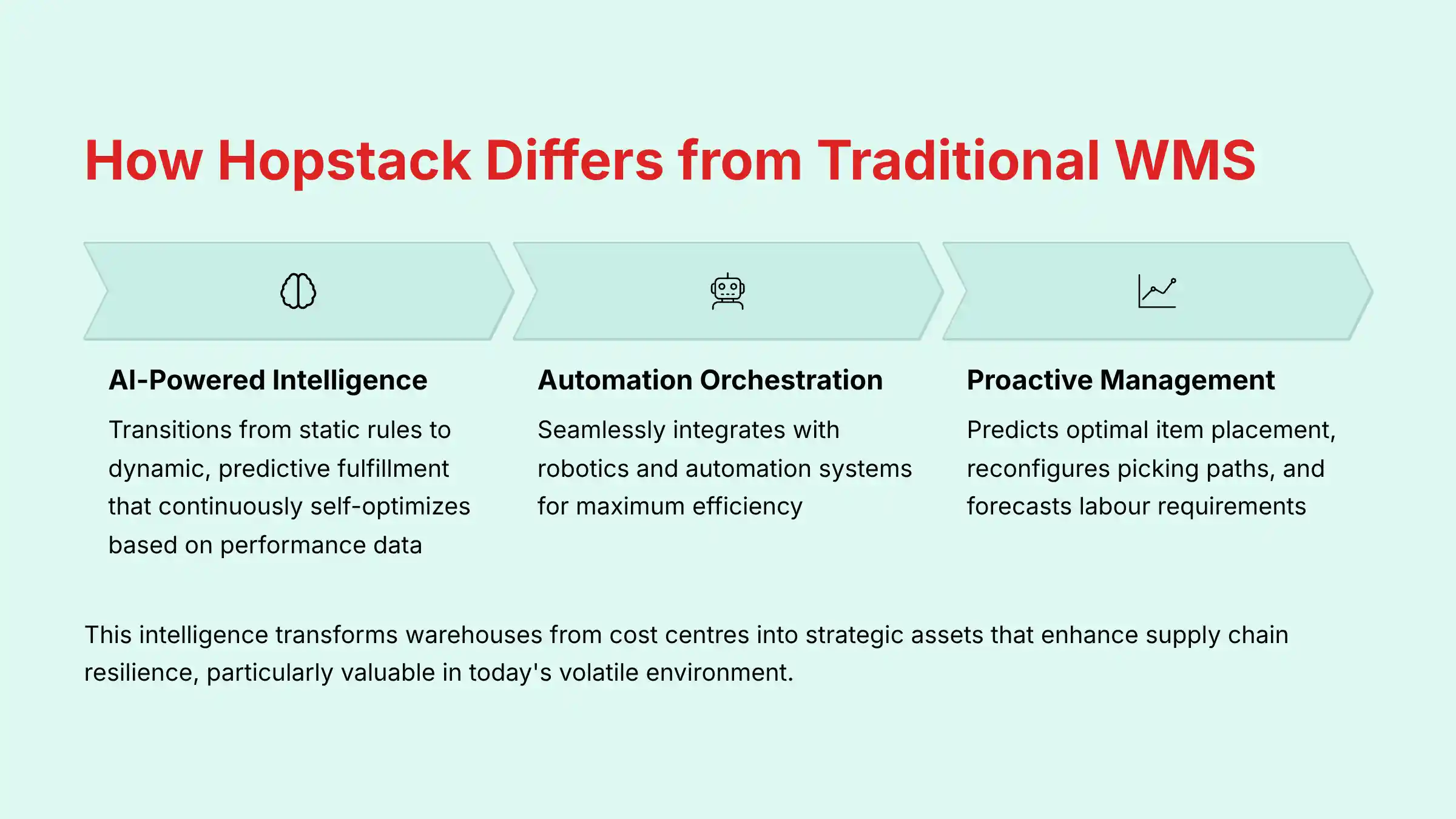
Hopstack is an AI-powered warehouse and inventory management platform designed to transform conventional warehouse operations into intelligent, data-driven ecosystems. Unlike traditional Warehouse Management Systems (WMS) that operate on static rules and manual decision-making, Hopstack leverages artificial intelligence and machine learning to create a dynamic, predictive fulfillment environment.
The fundamental difference is Hopstack's ability to transition warehouse operations from reactive to proactive management. Traditional WMS platforms can track inventory location and basic movements, but Hopstack's AI analyzes operational patterns to:
- Predict optimal item placement through dynamic slotting algorithms
- Automatically reconfigure picking paths based on real-time order batches
- Forecast labor requirements to prevent operational bottlenecks
- Orchestrate robotics and automation systems for maximum efficiency
- Continuously self-optimize based on performance data
This intelligence transforms warehouses from cost centers into strategic assets that enhance supply chain resilience. By applying AI to warehouse operations, Hopstack enables businesses to simultaneously reduce operational costs while improving fulfillment speed, accuracy, and adaptability to market disruptions.
The platform's real-time optimization capabilities are particularly valuable in today's volatile supply chain environment, where the ability to rapidly adjust to changing conditions can provide significant competitive advantages in inventory turnover, labor utilization, and customer satisfaction. For those looking to explore comprehensive Hopstack Overview and Features, this foundational understanding becomes crucial for making informed technology decisions.
Who is the ideal customer for Hopstack?
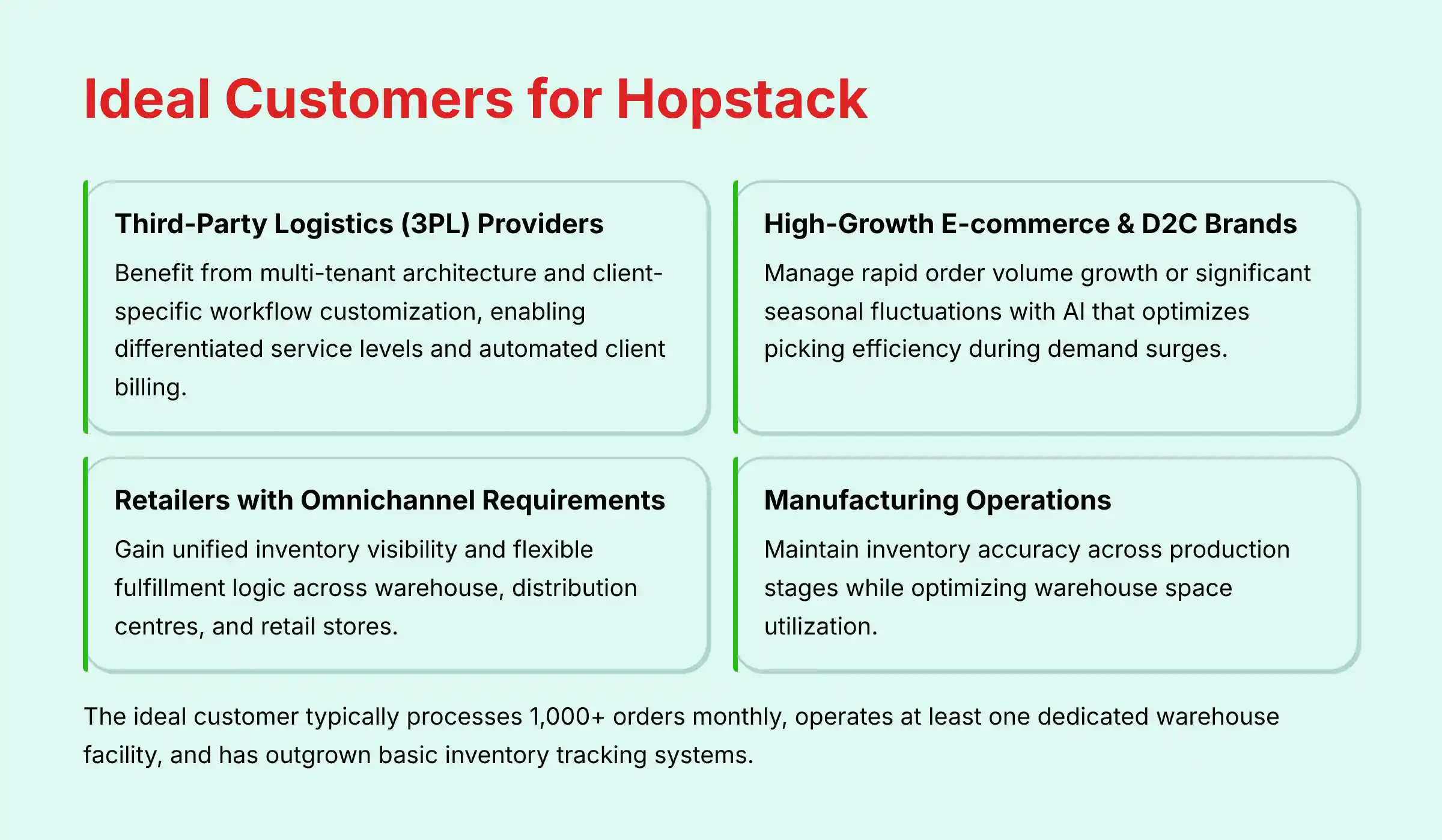
Hopstack is designed for businesses whose competitive advantage depends on efficient, scalable, and resilient fulfillment operations. The platform delivers maximum value to:
Third-Party Logistics (3PL) Providers: 3PLs managing inventory for multiple clients benefit significantly from Hopstack's multi-tenant architecture and client-specific workflow customization. The platform enables differentiated service levels, automated client billing, and the operational flexibility needed to handle diverse product portfolios under one roof.
High-Growth E-commerce & Direct-to-Consumer (D2C) Brands: Businesses experiencing rapid order volume growth or significant seasonal fluctuations need systems that scale gracefully under pressure. Hopstack's AI helps manage labor resources, optimize picking efficiency during demand surges, and maintain accuracy when conventional systems would falter.
Retailers with Omnichannel Fulfillment Requirements: Companies fulfilling orders across multiple channels (warehouse, distribution centers, and retail stores) require unified inventory visibility and flexible fulfillment logic. Hopstack provides the end-to-end transparency needed to effectively manage Buy Online, Pick Up In-Store (BOPIS), ship-from-store, and traditional distribution models within a single platform.
Manufacturing Operations with Complex Inventory Requirements: Manufacturers dealing with raw materials, work-in-progress, and finished goods inventory can leverage Hopstack to maintain inventory accuracy across production stages while optimizing warehouse space utilization.
The ideal Hopstack customer typically processes 1,000+ orders monthly, operates at least one dedicated warehouse facility, and has outgrown basic inventory tracking systems or spreadsheets. These organizations face challenges with order accuracy, labor efficiency, inventory visibility, or scalability that directly impact their bottom line and customer satisfaction metrics. To understand how this might apply to your specific situation, exploring detailed Hopstack Tutorials and Usecase examples can provide valuable insights into real-world implementation scenarios.
How does Hopstack's AI actually optimize warehouse operations?
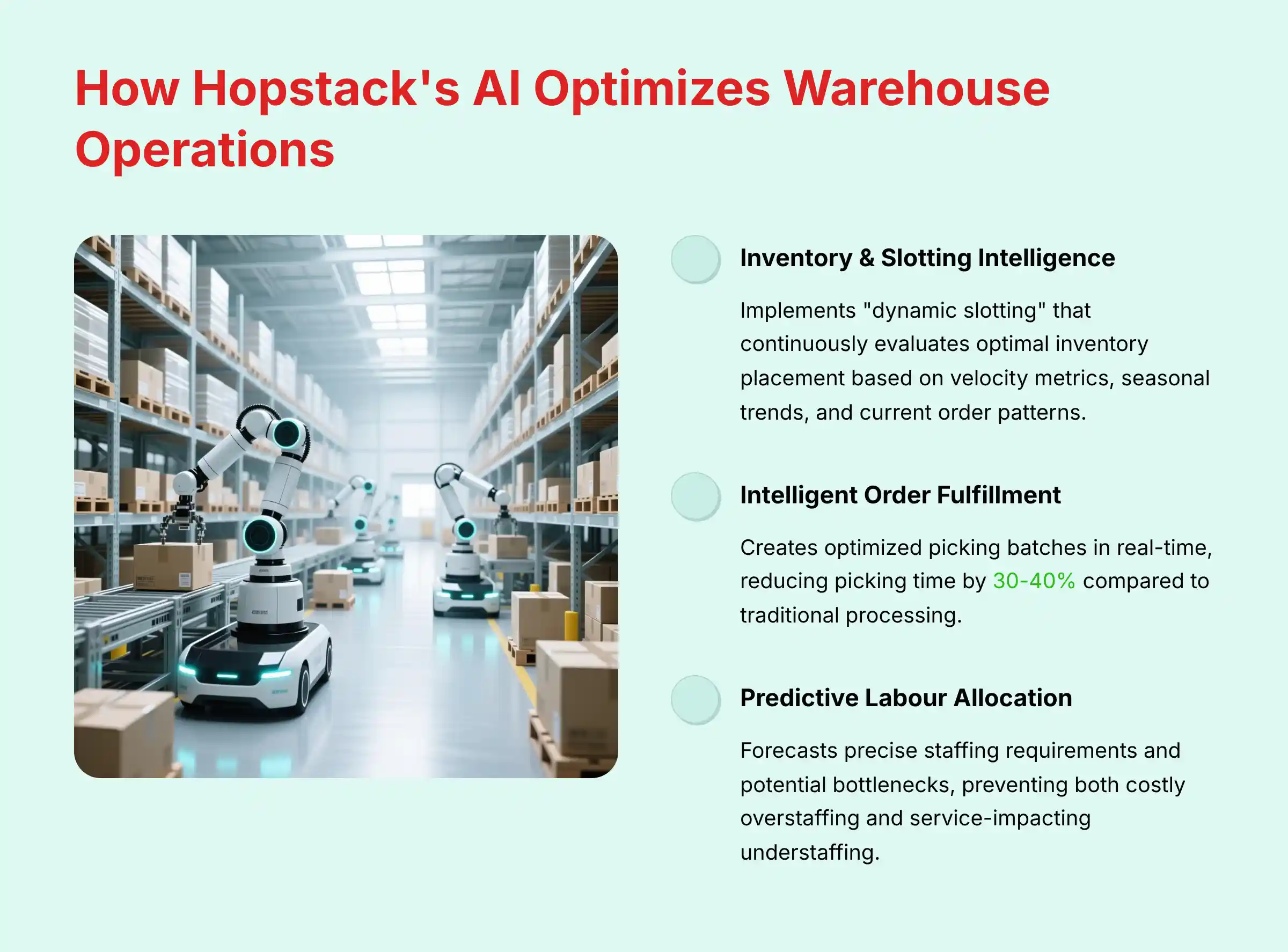
Hopstack's AI engine transforms warehouse operations by applying sophisticated machine learning models to real-time operational data, automating complex decisions that traditional systems leave to manual processes or rigid rules. The AI optimization focuses on three critical warehouse components:
Inventory & Slotting Intelligence: Unlike static location management, Hopstack implements “dynamic slotting” that continuously evaluates optimal inventory placement based on velocity metrics (how quickly items sell), seasonal trends, physical characteristics, and current order patterns. The AI ensures fast-moving SKUs are positioned in golden zones—easily accessible locations that minimize travel time—while automatically repositioning inventory as demand patterns shift.
Intelligent Order Fulfillment Orchestration: The system analyzes incoming orders in real-time to create optimized picking batches based on location proximity, item characteristics, shipping deadlines, and current warehouse conditions. It then calculates the most efficient pick paths for workers or Autonomous Mobile Robots (AMRs), reducing unnecessary movement through the facility. This wave planning intelligence can reduce picking time by 30-40% compared to traditional sequential processing.
Predictive Labor & Resource Allocation: By analyzing historical order patterns alongside current order queues, Hopstack forecasts precise staffing requirements for upcoming shifts and potential bottlenecks in the fulfillment process. This allows warehouse managers to dynamically allocate resources where they're most needed, preventing both costly overstaffing and service-impacting understaffing scenarios.
The platform also employs machine learning to continuously improve its own performance. As the system processes more orders and collects more data, its predictive models become increasingly accurate, creating a self-optimizing warehouse ecosystem that becomes more efficient over time. This adaptive intelligence allows warehouses to maintain high performance even as business conditions, product catalogs, and order profiles evolve.
Is Hopstack SOC 2 certified, and what data security measures are in place?
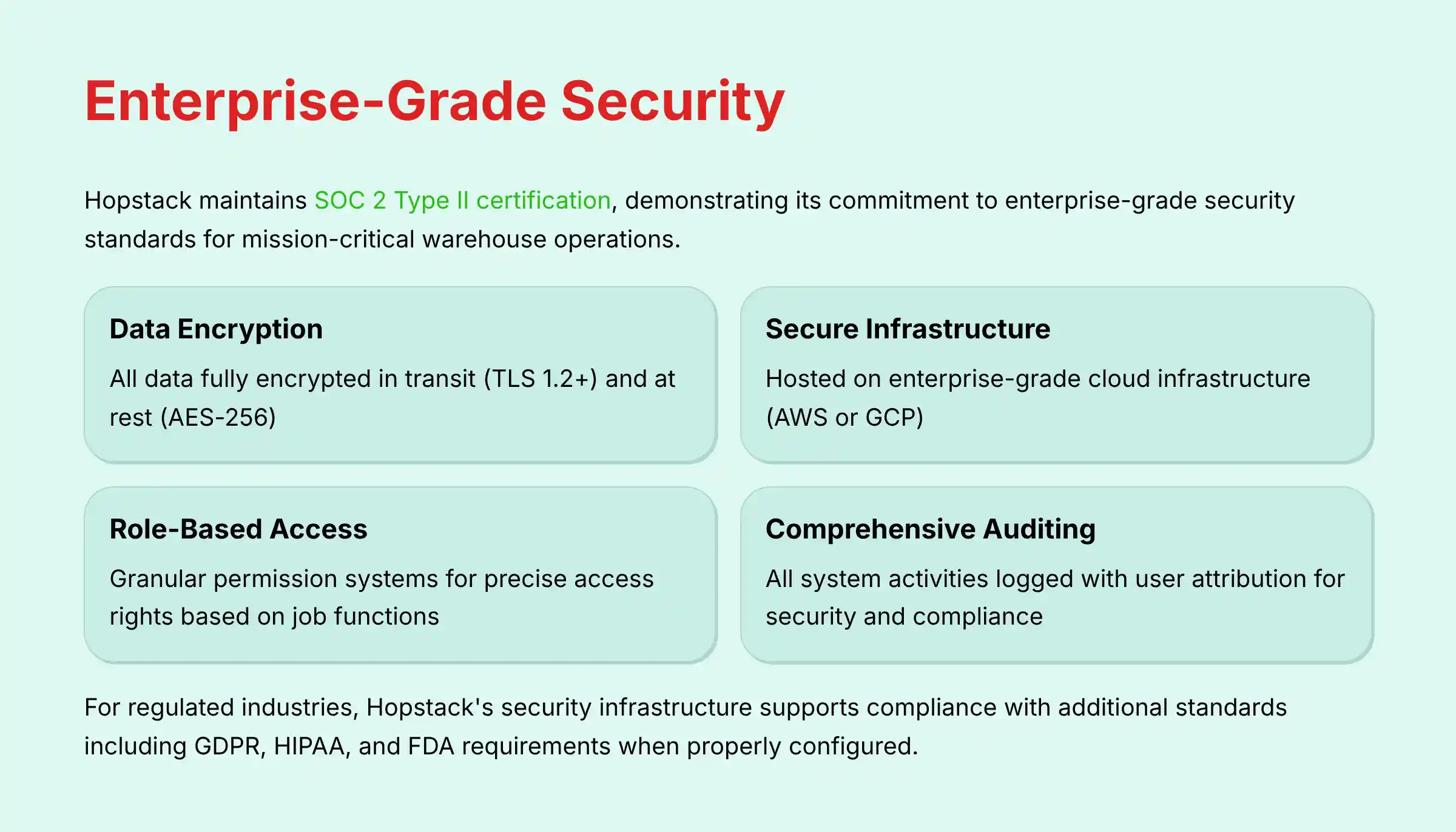
Yes, Hopstack maintains SOC 2 Type II certification, demonstrating its commitment to enterprise-grade security standards for mission-critical warehouse operations. This certification verifies that Hopstack has undergone rigorous independent auditing of its controls related to security, availability, processing integrity, confidentiality, and privacy—essential considerations for any system handling sensitive inventory and order data.
Hopstack's comprehensive security framework includes:
Data Encryption: All data is fully encrypted both in transit (using TLS 1.2+) and at rest using AES-256 encryption standards, ensuring information remains protected throughout its lifecycle.
Secure Cloud Infrastructure: The platform is hosted on enterprise-grade cloud infrastructure (AWS or GCP), leveraging their robust physical security, network protection, and compliance certifications as a foundation.
Role-Based Access Control (RBAC): Hopstack implements granular permission systems allowing administrators to define precise access rights based on job functions. This ensures warehouse associates, supervisors, managers, and executives only access the specific data and functionality required for their roles, protecting sensitive operational and financial information.
Audit Logging & Monitoring: All system activities are comprehensively logged with user attribution, creating an immutable audit trail for security investigation and compliance reporting.
Regular Penetration Testing: Hopstack conducts regular third-party security assessments and penetration testing to identify and remediate potential vulnerabilities before they can be exploited.
Business Continuity: The platform incorporates robust disaster recovery capabilities with automated backups and redundancy measures to ensure warehouse operations can continue even during infrastructure disruptions.
For companies in regulated industries (pharmaceutical, food, etc.), Hopstack's security infrastructure supports compliance with additional standards including GDPR, HIPAA, and FDA requirements when properly configured. This comprehensive security approach ensures that critical warehouse operations and sensitive supply chain data remain protected while maintaining the availability needed for 24/7 fulfillment operations.
How does Hopstack integrate with existing ERP systems like NetSuite or SAP and e-commerce platforms?
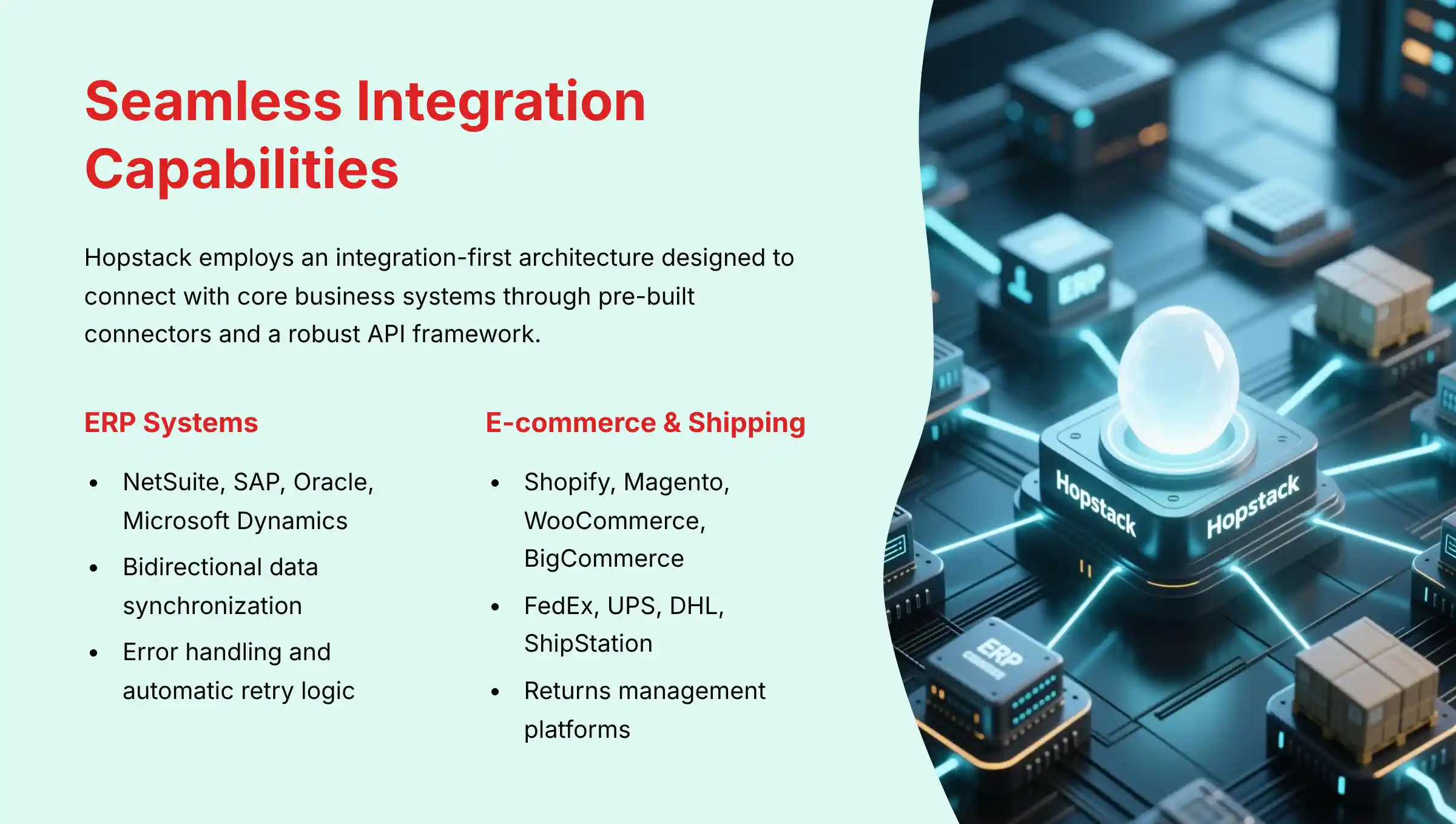
Hopstack employs an integration-first architecture designed to seamlessly connect with core business systems, functioning as a specialized extension of your existing technology ecosystem rather than an isolated silo. This connectivity is achieved through a combination of pre-built connectors and a robust API framework.
For major Enterprise Resource Planning (ERP) systems like NetSuite, SAP, Oracle, and Microsoft Dynamics, Hopstack offers deep, bidirectional integrations that maintain real-time data synchronization:
- Inbound data flows include sales orders, purchase orders, item master data, customer profiles, and critical business rules from the ERP
- Outbound data flows return inventory adjustments, order status updates, fulfillment confirmations, and operational metrics back to the ERP
This bidirectional communication ensures the ERP remains the authoritative source for financial and master data while Hopstack serves as the specialized engine for warehouse execution. The integration architecture includes error handling, automatic retry logic, and throttling mechanisms to maintain system integrity during high-volume periods or API disruptions.
For e-commerce platforms including Shopify, Magento, WooCommerce, and BigCommerce, Hopstack provides purpose-built connectors that automatically synchronize:
- Order information (including line items, shipping requirements, and customer data)
- Inventory levels across multiple sales channels
- Product catalog updates
- Fulfillment status and tracking information
The platform also integrates with shipping carriers (FedEx, UPS, DHL) and shipping aggregators (ShipStation, ShipEngine) to automate rate shopping, label printing, and tracking information distribution. Additionally, Hopstack connects with specialized systems like returns management platforms, order management systems (OMS), and customer service tools to create a cohesive operational ecosystem.
For businesses with unique requirements, Hopstack's REST API and webhook framework enable custom integrations with proprietary systems. The platform's integration capabilities create a unified data environment that eliminates information silos and provides end-to-end visibility across the entire order-to-delivery process.
Does Hopstack support warehouse automation hardware like robots (AMRs) or RFID scanners?
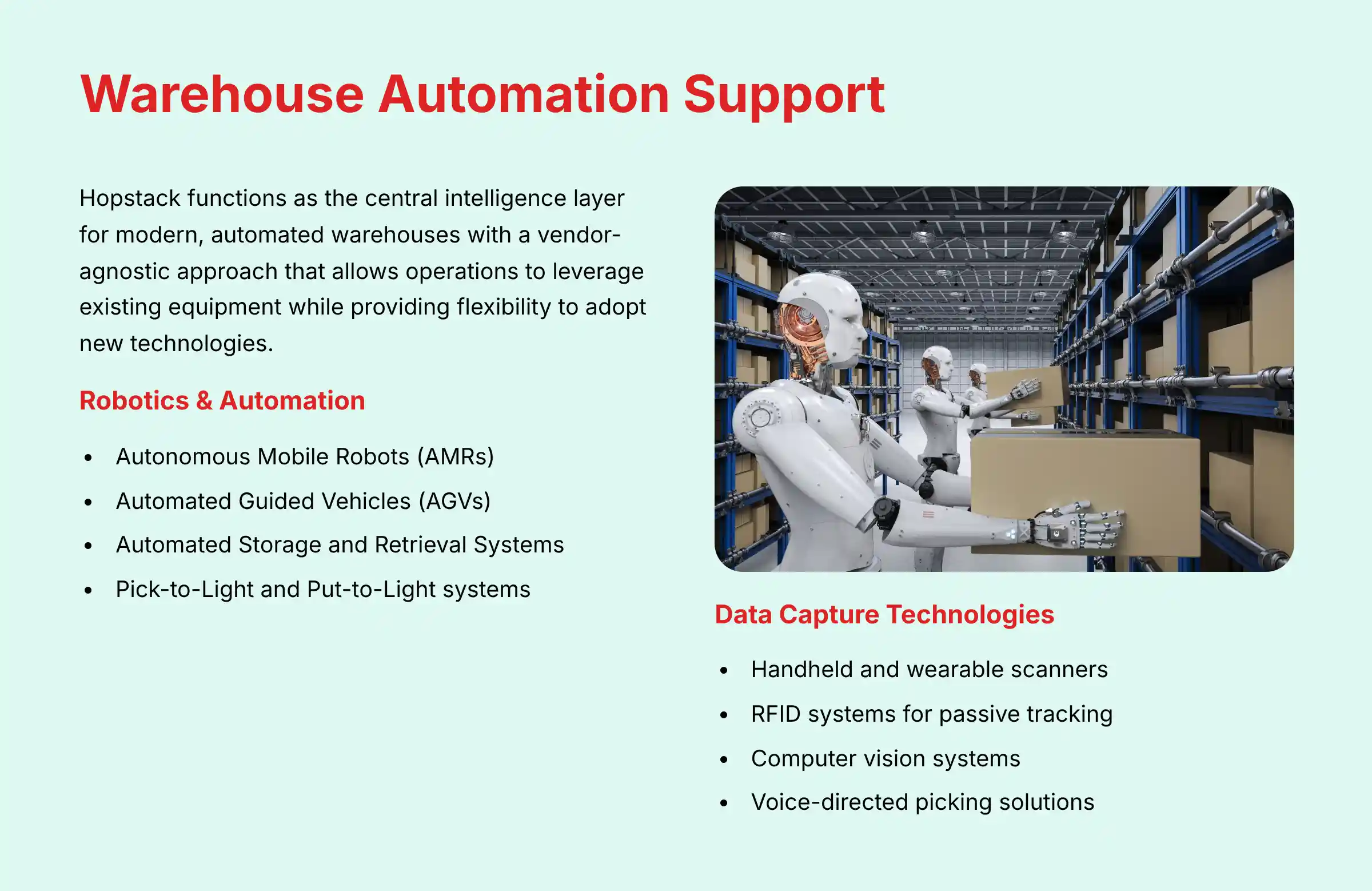
Hopstack functions as the central intelligence layer for modern, automated warehouses by seamlessly integrating with a comprehensive range of warehouse automation technologies and data capture hardware. Its vendor-agnostic approach allows operations to leverage existing equipment investments while providing the flexibility to adopt new technologies as needed.
For robotics and automation, Hopstack serves as the orchestration brain for:
- Autonomous Mobile Robots (AMRs) from providers like 6 River Systems, Locus Robotics, and Fetch Robotics
- Automated Guided Vehicles (AGVs) for materials transport
- Automated Storage and Retrieval Systems (AS/RS) for high-density storage
- Pick-to-Light and Put-to-Light systems for visual direction
- Conveyor systems and sortation equipment for automated material flow
Hopstack's AI determines optimal tasks and routes for each automation asset in real-time, maximizing throughput while preventing congestion or conflicts. The system continuously rebalances workloads across human and robotic resources as conditions change.
For data capture technologies, the platform supports:
- Handheld and wearable scanners running on Android, iOS, or Windows Mobile
- RFID systems for passive inventory tracking and automatic identification
- Computer vision systems for automated quality control and verification
- Voice-directed picking solutions for hands-free operation
- Dimensioning systems that automatically capture package measurements for shipping
- IoT sensors that monitor environmental conditions for sensitive inventory
This hardware-agnostic approach allows warehouses to implement a tailored automation strategy aligned with their specific operational requirements and budget constraints. Hopstack's modular integration framework enables operations to start with basic scanning technology and progressively introduce more advanced automation as their business grows, creating a sustainable technology roadmap that evolves with changing needs.
The platform's ability to harmonize human workers and automation technologies creates a collaborative warehouse environment where each resource is assigned to tasks that maximize its strengths and efficiency.
What is Hopstack's pricing model?
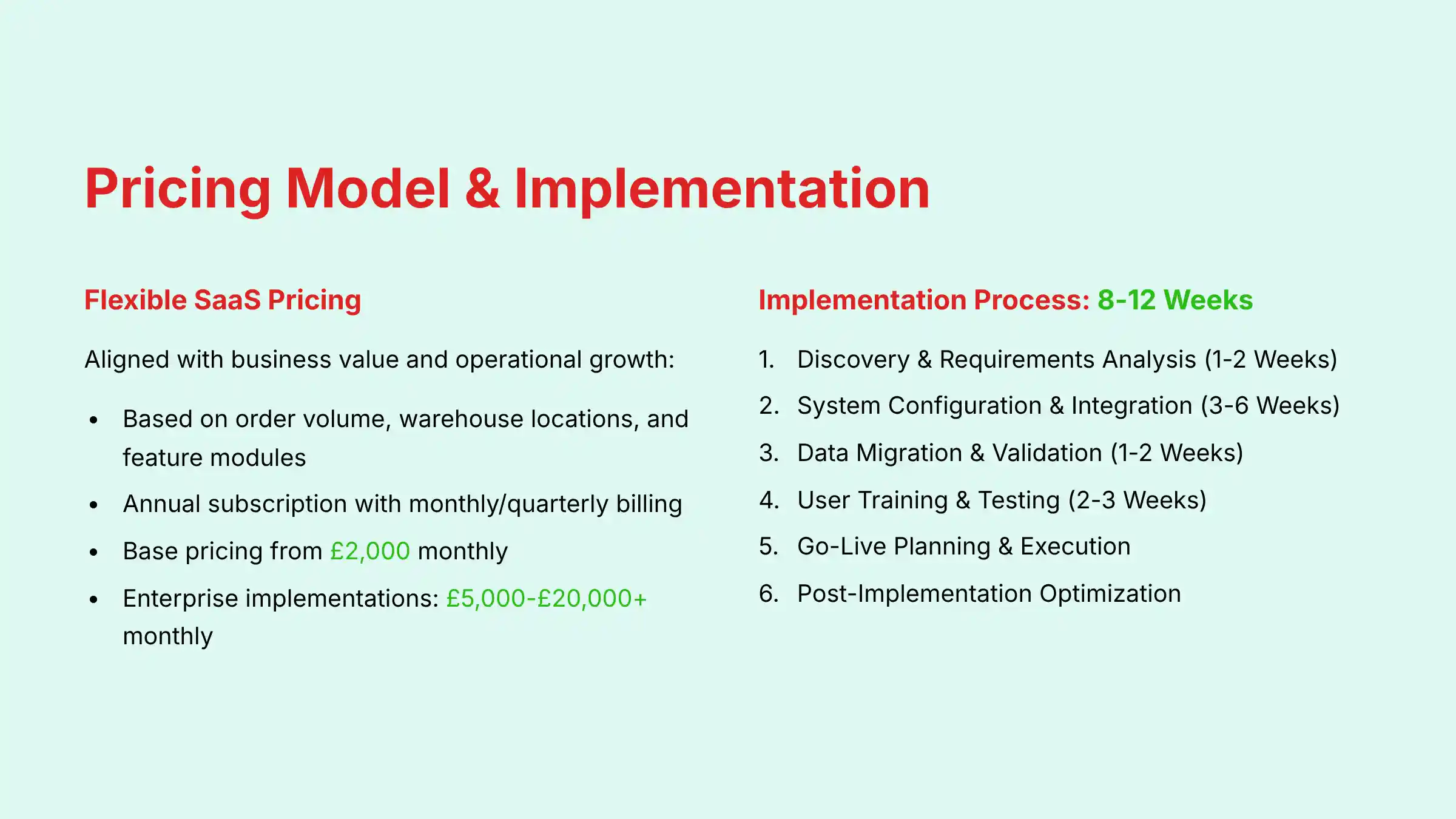
Hopstack employs a flexible Software-as-a-Service (SaaS) pricing model designed to align costs with business value and scale with operational growth. While specific pricing requires a personalized consultation, the model is generally structured around these key factors:
Primary Pricing Metrics:
- Order Volume: The number of orders processed monthly forms the core pricing variable, with tiered pricing that provides economies of scale as volume increases.
- Warehouse Locations: Each physical facility using the system adds to the monthly subscription cost.
- Feature Modules: The platform offers a modular approach with core WMS functionality in the base package and additional specialized modules (Advanced Analytics, Labor Management, Robotics Orchestration, etc.) available as add-ons.
Typical Contract Structure:
Most Hopstack implementations include:
- Annual subscription with monthly or quarterly billing options
- Implementation services (one-time cost)
- Optional professional services for advanced customization
- Ongoing support and maintenance included in the subscription
This SaaS approach eliminates the large capital expenditures associated with traditional on-premise WMS systems, converting them to predictable operational expenses. The subscription model includes automatic updates, ensuring clients always access the latest features and security patches without additional upgrade costs.
For multi-facility enterprises or growing businesses, Hopstack offers enterprise agreements with volume discounts and flexible expansion terms to accommodate changing needs. Third-party logistics providers (3PLs) can also leverage specialized billing options that facilitate client-specific cost allocation and markup models.
While base pricing starts at approximately $2,000 monthly for smaller operations, enterprise implementations with multiple facilities and advanced modules typically range from $5,000 to $20,000+ monthly depending on scale and complexity. Implementation services generally range from $15,000 to $50,000+ based on integration requirements, data migration complexity, and custom configuration needs.
To determine precise costs and ROI projections for your specific operation, Hopstack provides detailed assessment tools during the sales process that analyze your current operational metrics and project potential improvements across key performance indicators. For detailed analysis of how this compares to other solutions, examining Hopstack Top Alternatives and Competitors can provide valuable cost-benefit perspective.
What does the implementation process for Hopstack look like, and how long does it take?
Hopstack's implementation follows a structured, milestone-driven methodology designed to minimize operational disruption while ensuring successful adoption. For most mid-sized warehouses, the implementation process typically requires 8 to 12 weeks from kickoff to go-live, depending on operational complexity, integration requirements, and customer readiness.
The implementation journey progresses through these key phases:
1. Discovery & Requirements Analysis (1-2 Weeks)
- Comprehensive assessment of current warehouse processes and workflows
- Documentation of integration points with existing systems (ERP, e-commerce, etc.)
- Definition of specific business requirements and success criteria
- Identification of key performance indicators (KPIs) for measuring implementation success
2. System Configuration & Integration Development (3-6 Weeks)
- Configuration of the Hopstack platform to match documented requirements
- Development and testing of integrations with ERP, e-commerce, and other systems
- Configuration of user roles, permissions, and workflows
- Setup of warehouse zones, locations, and inventory management parameters
- Integration with hardware systems (scanners, printers, automation equipment)
3. Data Migration & Validation (1-2 Weeks)
- Development of data migration strategy for existing inventory and master data
- Extraction, transformation, and loading of data into Hopstack
- Comprehensive validation to ensure data integrity and accuracy
- Resolution of data discrepancies and cleansing of problematic records
4. User Training & User Acceptance Testing (2-3 Weeks)
- Role-specific training for warehouse staff, supervisors, and administrators
- Hands-on practice sessions with the configured system
- Structured user acceptance testing with documented test cases
- Simulation of daily operations and exception scenarios
- Final system adjustments based on user feedback
5. Go-Live Planning & Execution
- Development of detailed cutover plan and timeline
- Final data synchronization between legacy systems and Hopstack
- Phased or full go-live implementation (depending on operational requirements)
- On-site or remote go-live support from the Hopstack implementation team
- Daily status meetings and issue resolution during the stabilization period
6. Post-Implementation Optimization
- Performance review against established KPIs
- Identification of additional optimization opportunities
- Knowledge transfer to internal system administrators
- Transition to ongoing support model
For complex environments with multiple facilities or extensive customization requirements, the timeline may extend beyond the standard range. To ensure successful implementation, warehouse operations should dedicate internal resources to the project, particularly for data preparation, process documentation, and change management activities.
What is the typical ROI for a business that implements Hopstack?

Businesses implementing Hopstack typically achieve measurable return on investment through improvements across multiple operational dimensions. While specific results vary based on industry, scale, and pre-implementation efficiency levels, customers generally experience ROI within 12-18 months through these key value drivers:
Labor Efficiency Improvements (20-40% Reduction in Labor Costs)
- AI-optimized picking paths reduce travel time by 30-50%
- Intelligent task batching increases order throughput per labor hour
- Dynamic resource allocation eliminates bottlenecks and idle time
- Predictive labor planning prevents costly overstaffing while maintaining service levels
- Reduced training time through intuitive mobile interfaces and guided workflows
Enhanced Order Accuracy (Up to 99.9%+)
- Barcode/RFID validation at every fulfillment step virtually eliminates picking errors
- System-directed tasks remove ambiguity and human decision points
- Digital quality control checkpoints prevent common shipping mistakes
- Reduction in returns, reships, and customer service inquiries
- Preservation of customer lifetime value through consistent order accuracy
Inventory Optimization (15-25% Reduction in Carrying Costs)
- Real-time inventory visibility eliminates phantom inventory and discrepancies
- Reduced safety stock requirements through increased inventory reliability
- Improved inventory turnover through optimized slotting and rotation
- Prevention of deadstock through expiration management and velocity monitoring
- Reduced write-offs from lost, damaged, or expired inventory
Operational Capacity Increase (30-50%)
- Maximized throughput from existing facility footprint
- Delayed or eliminated need for facility expansion
- Ability to handle peak seasons without proportional staffing increases
- Reduced overtime expenses during high-volume periods
- Extended operational window through more efficient processing
Strategic Business Benefits
- Enhanced ability to meet same-day/next-day delivery promises
- Improved OTIF (On-Time In-Full) delivery metrics
- Data-driven decision making through advanced analytics
- Scalability to support business growth without linear cost increases
- Competitive advantage through superior fulfillment capabilities
For a typical mid-sized operation processing 5,000-10,000 orders monthly, Hopstack customers report annual savings of $200,000-$500,000 from labor efficiency and error reduction alone. When factoring in inventory optimization and improved customer retention, the total value creation often exceeds $500,000-$1,000,000 annually for operations of this scale.
To build a customized ROI model, Hopstack provides a detailed assessment process that analyzes your current operational metrics and projects specific improvements based on comparable customer implementations. For comprehensive insights into the solution's performance, reviewing a detailed Hopstack Review can provide additional context on real-world results and customer satisfaction metrics.
What kind of customer support does Hopstack provide after implementation?
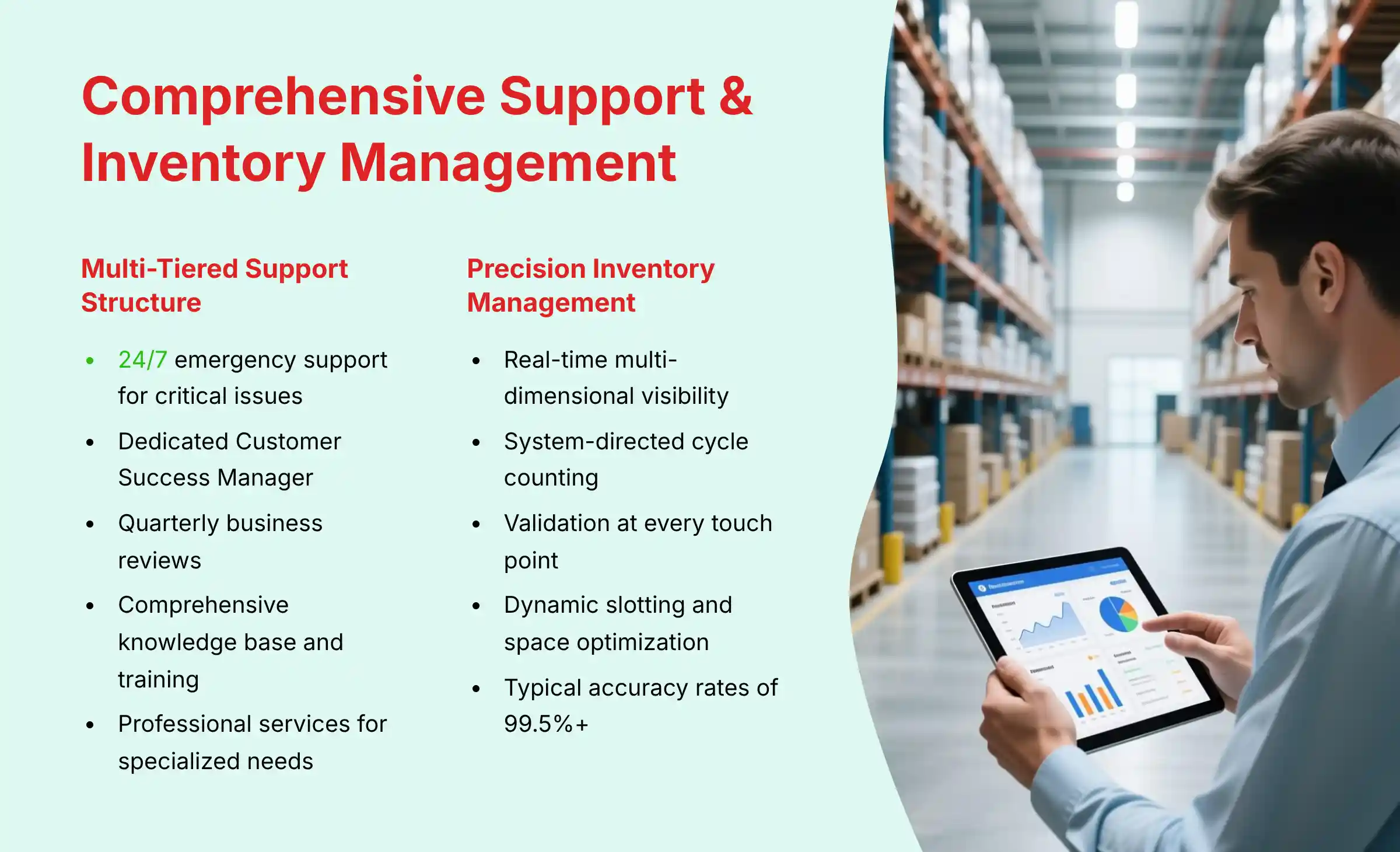
Hopstack delivers a comprehensive, multi-tiered support structure designed to ensure continuous operational success long after implementation. The platform's support approach recognizes that warehouse management systems are mission-critical applications where downtime or performance issues can have immediate financial impact.
Standard Support Package (Included with Subscription)
- Technical Support Channels:
- 24/7 emergency support for critical issues via phone and email
- Standard support desk available during business hours (8AM-8PM in customer's time zone)
- Online support portal with ticket tracking and status updates
- In-app support messaging for contextual assistance
- Response Time Commitments:
- Critical (P1) issues: Response within 30 minutes, continuous work until resolved
- High-priority (P2) issues: Response within 2 hours, resolution within 24 hours
- Standard (P3) issues: Response within 24 hours, resolution plan within 48 hours
- Proactive Monitoring:
- 24/7 system health monitoring
- Automated alerts for potential performance issues
- Regular system health checks and optimization recommendations
Customer Success Program
Beyond reactive support, Hopstack assigns a dedicated Customer Success Manager (CSM) to each enterprise client. This CSM conducts:
- Quarterly business reviews to analyze system performance against KPIs
- Identification of optimization opportunities based on usage patterns
- Planning for capacity changes during peak seasons
- Training for new team members as warehouse staff changes
- Strategic roadmap discussions to align Hopstack capabilities with evolving business needs
Continuous Education Resources
- Comprehensive knowledge base with operational guides and best practices
- Video tutorial library covering all system functions
- Monthly webinars highlighting new features and optimization techniques
- Hopstack Academy with certification programs for warehouse managers and system administrators
- User community for peer-to-peer knowledge sharing and networking
Professional Services (Additional Cost)
For specialized needs beyond standard support, Hopstack offers professional services including:
- Custom integration development
- Advanced workflow optimization
- On-site operational assessments
- Custom report development
- Change management assistance during major operational transitions
This multi-layered support approach ensures that customers can maximize their return on investment throughout their relationship with Hopstack, with support resources that evolve alongside their operational sophistication and business complexity.
How does Hopstack help with inventory management and accuracy?
Hopstack transforms traditional inventory management from a periodic, error-prone process into a continuous, precision-driven system that maintains near-perfect inventory accuracy while optimizing utilization of both inventory and warehouse space.
Real-Time Inventory Visibility
The platform provides instant visibility into inventory status across multiple dimensions:
- Quantity by location, zone, and warehouse
- Inventory segmentation by owner, condition, lot, and expiration date
- Allocation status (available, allocated, on hold, damaged)
- Inventory aging and velocity metrics
- Historical movement patterns and demand trends
This multi-dimensional visibility enables precision inventory management impossible with traditional systems that track only basic quantity and location data.
Inventory Accuracy Enhancement
Hopstack dramatically improves inventory accuracy through:
- System-Directed Counting: AI-driven cycle counting schedules that prioritize high-value, high-velocity items and locations with historical discrepancies
- Validation at Every Touch Point: Barcode/RFID scanning required for all inventory movements
- Exception Management: Automated workflows for resolving discrepancies and investigating inventory anomalies
- Batch/Lot/Serial Tracking: Granular traceability for regulated products and recall management
- Expiration Management: Proactive alerts for approaching expiration dates and FEFO (First-Expired-First-Out) picking logic
Most Hopstack customers achieve inventory accuracy rates of 99.5% or higher, compared to industry averages of 70-80% with manual systems.
Space Utilization Optimization
Beyond accuracy, Hopstack optimizes inventory placement and warehouse space utilization through:
- Dynamic Slotting: Continuous reevaluation of optimal product placement based on dimensions, velocity, and relationships to other products
- Inventory Consolidation: Intelligent recommendations for consolidating partial locations to free up space
- Storage Medium Optimization: Recommendations for the most appropriate storage type (bin, rack, bulk, etc.) based on product characteristics
- Putaway Optimization: AI-driven putaway logic that balances travel time, space utilization, and picking efficiency
- Cross-Docking Intelligence: Automatic identification of opportunities to cross-dock incoming inventory directly to outbound orders
This intelligent approach to inventory management delivers measurable benefits including 15-30% improvement in space utilization, 20-40% reduction in inventory search time, and significant decreases in obsolete inventory through improved visibility and rotation.
The system's ability to maintain accurate perpetual inventory counts often eliminates the need for disruptive full physical inventories, replacing them with continuous cycle counting processes that maintain accuracy without operational shutdowns.
How does Hopstack compare to other warehouse management systems like Manhattan and Blue Yonder?
Hopstack represents a distinct evolution in warehouse management technology when compared to established enterprise WMS solutions like Manhattan and Blue Yonder (formerly JDA). While these legacy platforms have dominated the enterprise WMS market for decades, Hopstack differentiates itself through several key attributes:
Modern Architecture vs. Legacy Systems
Hopstack is built on a cloud-native, microservices architecture designed for flexibility and rapid innovation. Unlike Manhattan and Blue Yonder's older core platforms (though they offer cloud versions now), Hopstack doesn't carry technical debt from code originally designed for on-premise deployment. This allows for:
- Faster implementation (8-12 weeks vs. 6-12+ months for legacy systems)
- More frequent feature updates (monthly vs. quarterly/annually)
- Seamless scalability without performance degradation
- Lower total cost of ownership without expensive upgrade cycles
AI-First vs. Rules-Based Design
While Manhattan and Blue Yonder have added AI capabilities to their platforms, these are often overlays on fundamentally rules-based systems. Hopstack was designed from the ground up around AI and machine learning:
- Hopstack's algorithms continuously adapt to changing conditions without manual reconfiguration
- Legacy systems typically require extensive rule maintenance as conditions change
- Hopstack provides predictive insights rather than just executing predefined logic
- Self-optimization capabilities improve performance over time without consultant intervention
Cost Structure & Accessibility
Enterprise WMS platforms like Manhattan and Blue Yonder typically:
- Require seven-figure investments for full implementation
- Target primarily Fortune 1000 companies
- Need specialized administrators to maintain
- Have complex licensing models with significant professional services requirements
Hopstack offers:
- SaaS pricing models accessible to mid-market companies
- Straightforward subscription structure with predictable costs
- Self-service capabilities that reduce dependence on consultants
- Modular approach allowing companies to start with core functionality and expand
Specialization vs. Breadth
Manhattan and Blue Yonder offer broad supply chain suites covering everything from demand planning to transportation management. Hopstack maintains a focused specialization on warehouse execution excellence while providing robust APIs for integration with other best-of-breed systems. This focus allows for deeper innovation in core warehouse functionality rather than spreading development resources across a wider solution footprint.
User Experience Design
Legacy systems often maintain interfaces designed primarily for desktop use by trained power users. Hopstack prioritizes intuitive mobile-first design for warehouse operators while providing powerful analytics for managers. This dual experience approach dramatically reduces training time and improves adoption rates across both user groups.
For companies requiring highly complex, multi-echelon supply chain orchestration across global operations, Manhattan and Blue Yonder may offer advantages through their broader suite capabilities. However, for organizations prioritizing implementation speed, cost-effectiveness, AI-driven optimization, and modern user experiences, Hopstack represents a compelling alternative that delivers enterprise-grade warehouse capabilities without the traditional enterprise-scale investment and complexity.
To explore additional options in this evolving market, consulting the comprehensive Best 10 AI Warehouse Management Systems (WMS) guide can provide valuable insights into the full spectrum of available solutions and their relative strengths.
For additional questions and answers about Hopstack's capabilities, implementation process, and operational benefits, our comprehensive Hopstack FAQs section provides detailed guidance for making informed technology decisions in warehouse management.

Leave a Reply