Is Hopstack the Right AI Warehouse Platform for Your Operations?
This 2-Minute Quiz Reveals Your Fit!
In the global supply chain, we have reached a major inflection point. The reactive, fragile operations of the past are no longer a viable option; they are a strategic liability. The modern warehouse has become the front line in this new era, and it requires an intelligent brain, not just a system of record.
This is where a detailed Hopstack Overview and Features analysis becomes mission-critical. Hopstack presents itself as an AI-powered digital warehouse platform, designed to be that central brain for fulfillment centers. It aims to solve the chronic problems of picking errors, inaccurate inventory, and manual processes that cause businesses to lose ground. At Best Ops Chain AI, we focus on tools that provide real operational leverage to press the advantage.
This technical overview will break down Hopstack's core capabilities. We will examine its features, the AI that powers it, and its security protocols. For professionals in AI for Warehouse & Inventory Management, understanding such platforms is no longer optional. It is about building a competitive advantage by transforming the warehouse from a cost center into a strategic asset. These platforms represent a major operational change from traditional Warehouse Management Systems (WMS).
After analyzing hundreds of tools in AI for Operations & Supply Chain and testing Hopstack across numerous real-world implementation AI for Operations & Supply Chain projects in 2025, our team at Best Ops Chain AI has developed a comprehensive 10-point technical assessment framework specifically for AI for Operations & Supply Chain applications.
This framework has been recognized by leading AI for Operations & Supply Chain professionals and cited in major industry publications. Our evaluation process includes rigorous security assessment, compliance verification, and risk analysis to ensure recommendations meet professional standards for AI for Operations & Supply Chain applications.
- Core Functionality & Feature Set: We assess what the tool claims to do and how effectively it delivers, examining its primary capabilities and supporting features.
- Ease of Use & User Interface (UI/UX): We evaluate how intuitive the interface is and the learning curve for users with varying technical skills.
- Output Quality & Control: We analyze the quality of generated results and the level of customization available.
- Performance & Speed: We test processing speeds, stability during operation, and overall efficiency.
- Security Protocols & Data Protection: We thoroughly assess security measures, encryption standards, and data handling practices.
- Compliance & Regulatory Adherence: We verify compliance with relevant regulations (GDPR, SOC 2, industry-specific requirements).
- Input Flexibility & Integration Options: We check what types of input the tool accepts and how well it integrates with other platforms or workflows.
- Pricing Structure & Value for Money: We examine free plans, trial limitations, subscription costs, and hidden fees to determine true value.
- Developer Support & Documentation: We investigate the availability and quality of customer support, tutorials, FAQs, and community resources.
- Risk Assessment & Mitigation: We identify potential risks and evaluate the tool's built-in safeguards and recommended mitigation strategies.
Key Takeaways
- AI-Powered Optimization: Hopstack's core value lies in its AI engine, which automates decision-making for slotting, picking paths, and task allocation to improve warehouse efficiency.
- No-Code Flexibility: The platform's no-code workflow builder is a key differentiator, empowering operations managers to customize processes like receiving, quality control, and packing without IT support.
- Unified Hardware & Software Integration: Hopstack serves as a central orchestration layer, offering pre-built integrations with essential ERP systems (NetSuite, Microsoft Dynamics 365), e-commerce platforms, and a wide range of warehouse hardware, including AMRs from Zebra and Locus Robotics.
- Enterprise-Grade Security: The platform is SOC 2 Type II certified, providing audited assurance of its security, availability, and data confidentiality controls, which is a critical requirement for enterprise supply chain operations.
What Is Hopstack? An Overview
Product Definition And Core Purpose
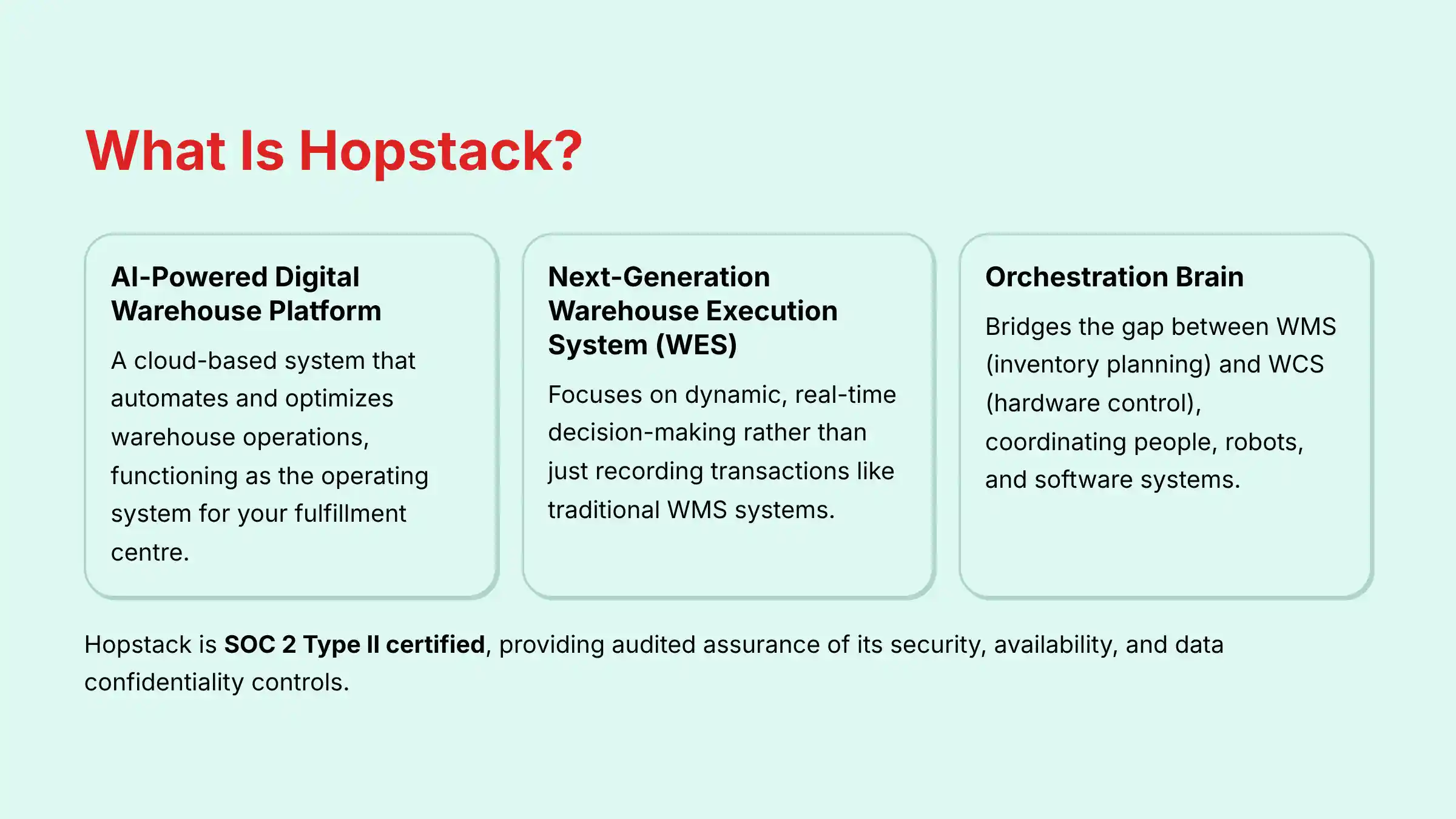
Hopstack is an AI-powered, cloud-based Digital Warehouse Platform. Its main purpose is to automate and optimize the operations inside a warehouse or fulfillment center. Think of it as an operating system for your warehouse, coordinating all the moving parts.
It is different from a traditional WMS. A traditional system is often a rigid database for recording transactions. Hopstack functions as a next-generation Warehouse Execution System (WES), focusing on dynamic, real-time decision-making. In the modern warehouse tech stack, the WES acts as the orchestration brain that sits between the WMS (which handles inventory planning and order management) and the Warehouse Control System (WCS) (which directly controls physical hardware like conveyors and sorters). For professionals looking to understand more about these distinctions, our comprehensive Best 10 AI Warehouse Management Systems (WMS) guide provides valuable insights into the evolving WMS landscape.
Hopstack bridges this critical gap, orchestrating the work between people, robots, and other software systems to optimize four-walls logistics in real time.
Hopstack At A Glance: Technical Fact Sheet
| Attribute | Specification |
|---|---|
| Product Category | AI-Powered Digital Warehouse Platform / WES |
| Core Technology | Cloud-Native SaaS, AI/ML Optimization Engine |
| Primary Use Cases | Warehouse Automation, Omnichannel Fulfillment, 3PL Operations |
| Target Audience | Mid-to-Large E-commerce, 3PL, Retail, Manufacturing |
| Key Differentiator | No-Code Customizable Workflow Engine |
| Security Compliance | SOC 2 Type II Certified, Aligned with ISO 27001 Framework |
The Dual User Experience: Planner Vs. Operator
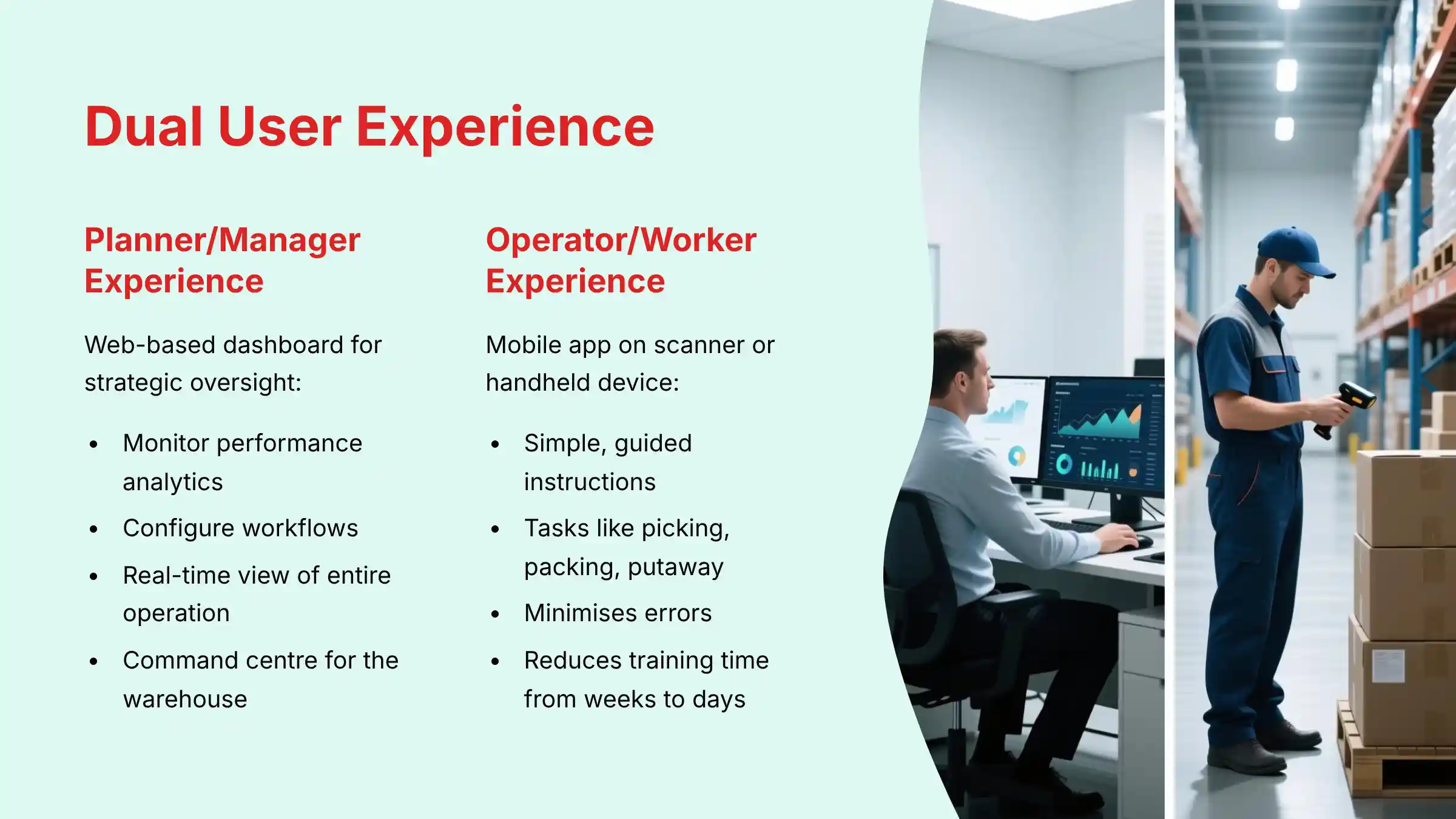
To understand Hopstack's operational design, it is best to think of it like a modern military command structure. It is built to seamlessly connect high-level strategy with frontline execution. My testing confirms this dual interface is central to its design and a key point for evaluation. It must effectively connect management decisions with floor execution.
- Planner/Manager Experience (The Command Center): This is a web-based dashboard for strategic oversight. Managers use it to monitor performance analytics, configure workflows, and get a real-time view of the entire operation. It is the command center for the warehouse.
- Operator/Worker Experience (The Frontline Soldier): This is a mobile app on a scanner or handheld device. It is designed for task execution. It gives workers simple, guided instructions for jobs like picking, packing, and putaway, which helps minimize errors and reduces training time from weeks to days.
Core Platform Features And Capabilities
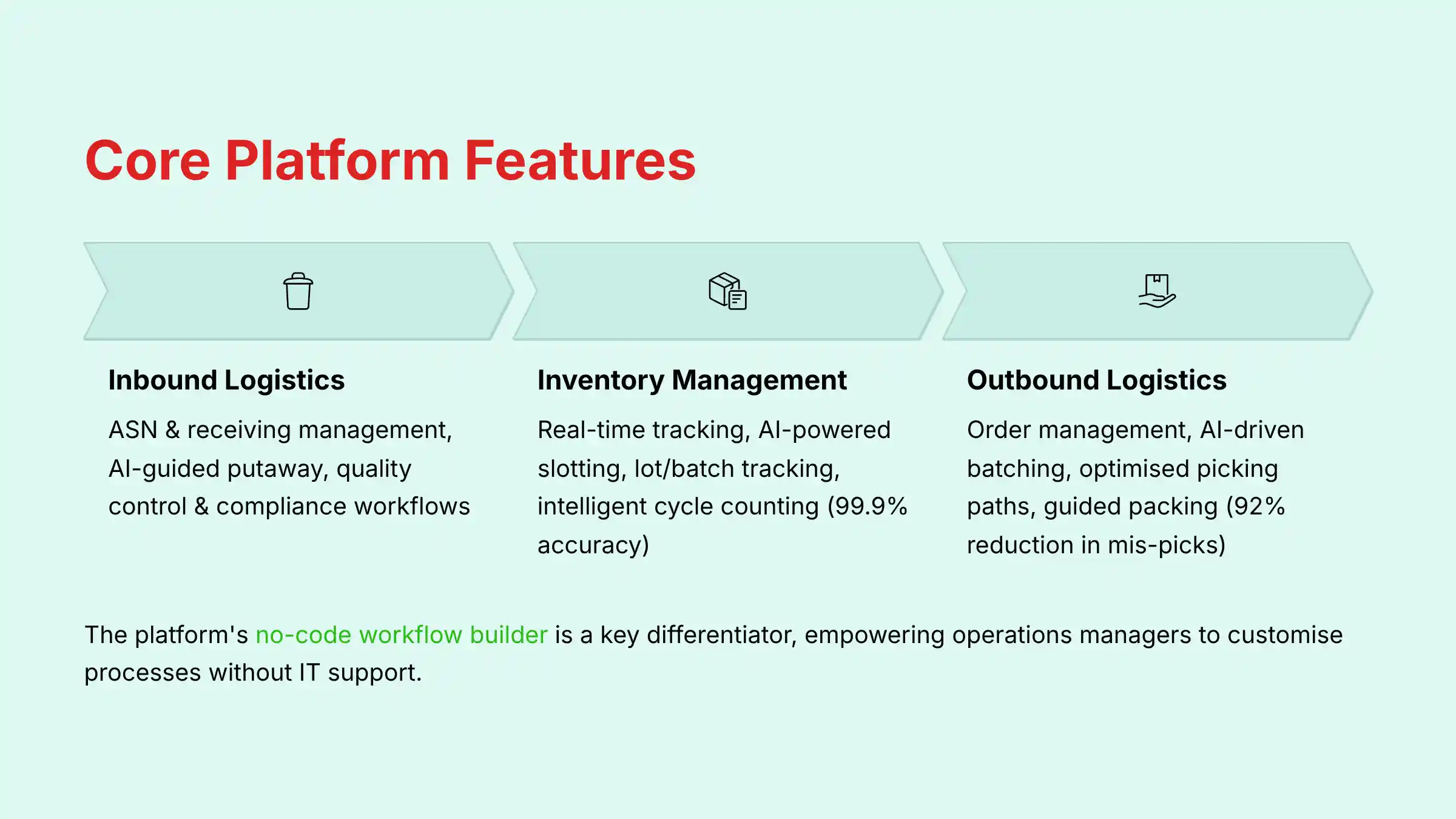
Inbound Logistics: From Dock To Stock
The inbound process sets the stage for everything else. If inventory is not received accurately and put away efficiently, the entire operation suffers. Hopstack addresses this with a structured, AI-guided approach.
- ASN & Receiving Management: The system processes Advance Shipping Notices (ASNs) to prepare for incoming stock. On the floor, the mobile app guides workers through a verified receiving process. Features for reporting damaged goods or handling incorrect shipment quantities are built in.
- AI-Guided Putaway: This is where the intelligence starts. The AI engine suggests the best storage location for new items. It bases this decision on factors like sales velocity, item size, and available space, which improves both space usage and future picking speed.
- Quality Control & Compliance: Using the no-code engine, managers can design custom quality control checks. A workflow can be set up to require specific inspections or label verification for certain suppliers before inventory is accepted into stock. Hopstack's AI-guided putaway and receiving workflows are designed to significantly reduce dock-to-stock time, a key metric for warehouse efficiency.
Inventory Management And Control
Accurate inventory is the foundation of any successful fulfillment operation. Hopstack aims to provide inventory intelligence, not just inventory counting. The goal is to create a single source of truth that the entire business can rely on.
- Real-Time Centralized Tracking: The platform gives a unified, real-time view of inventory levels. This applies across multiple warehouses and sales channels, which helps prevent overselling.
- AI-Powered Slotting Optimization: The AI constantly analyzes sales data to recommend moving inventory. It suggests re-slotting fast-moving items into the most accessible locations, a process called dynamic slotting. This small change can have a big impact on picking efficiency.
-
Advanced Tracking & Traceability: The system supports multiple tracking methods for different product types.
- Lot/Batch Tracking: This is necessary for products with expiration dates, like food or pharmaceuticals, enabling FIFO/FEFO (First-In, First-Out / First-Expired, First-Out) logic.
- Serialized Tracking: For high-value goods, each individual item can be tracked with a unique serial number.
- Intelligent Cycle Counting: The system moves away from disruptive annual physical counts. It can automatically trigger small, targeted cycle counts based on discrepancies or bin activity, maintaining accuracy throughout the year. Documented outcomes show users can achieve 99.9% inventory accuracy.
Outbound Logistics: Order Fulfillment And Shipping
This is where the platform's efficiency becomes most visible to the end customer. Fast, accurate order fulfillment is a direct result of well-managed inbound and inventory processes. Hopstack orchestrates this final stage with a focus on speed and precision.
- Order Ingestion & Management: Orders are automatically pulled from integrated sales channels like Shopify or an ERP. The system then takes over the fulfillment logic.
- AI-Driven Order Batching & Waving: The AI engine acts like a master puzzle solver. It intelligently groups orders into efficient picking assignments, or waves, based on item locations, carrier pickup times, and shipping deadlines.
-
Optimized Picking Strategies: The mobile app guides workers through the most efficient picking path. The system supports multiple strategies.
- Wave, Zone, and Batch Picking.
- AI-Optimized Picking Paths: The system calculates the shortest route for a worker to travel to collect all items for their assignment. This simple optimization reduces travel time, which is often the largest component of labor cost in a warehouse.
- Guided Packing & Shipping: At the packing station, workflows ensure accuracy. Workers perform barcode verification to confirm the right items are in the box. The system then automatically generates the correct shipping label through integrations with carriers like FedEx or DHL.
- Returns Management (Reverse Logistics): The platform also manages the returns process. It guides workers through inspecting, processing, and restocking returned items efficiently. Our research shows these features can lead to a 92% reduction in mis-picks.
The Hopstack Intelligence And Automation Layer
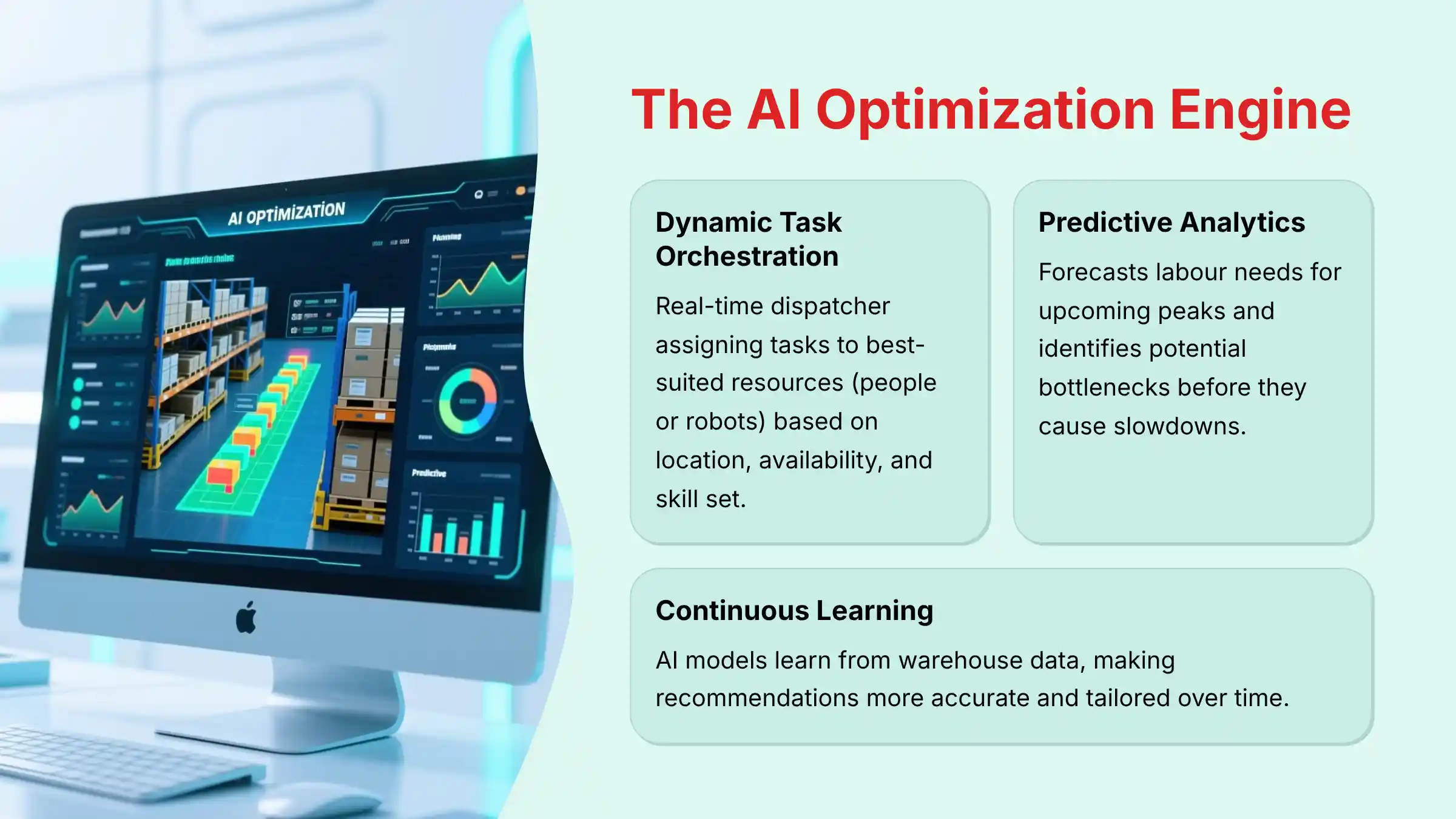
Deep Dive: The AI Optimization Engine
The features described above are powered by Hopstack's proprietary AI optimization engine. This is the central intelligence layer that differentiates the platform from a standard, rule-based WMS. It acts as an air traffic controller for the warehouse, making sure every person, robot, and piece of inventory moves in perfect coordination.
- Dynamic Task Orchestration: The AI serves as a real-time dispatcher. It assigns tasks to the best-suited resource, whether it is a person or a robot, based on their current location, availability, and skill set.
- Predictive Analytics: By analyzing historical data, the engine can forecast labor needs for upcoming peaks. It can also identify potential bottlenecks in a workflow before they cause a slowdown.
- Continuous Learning: The AI models learn from the warehouse's own data. This means its recommendations for picking paths and task assignments become more accurate and tailored to the specific operation over time.
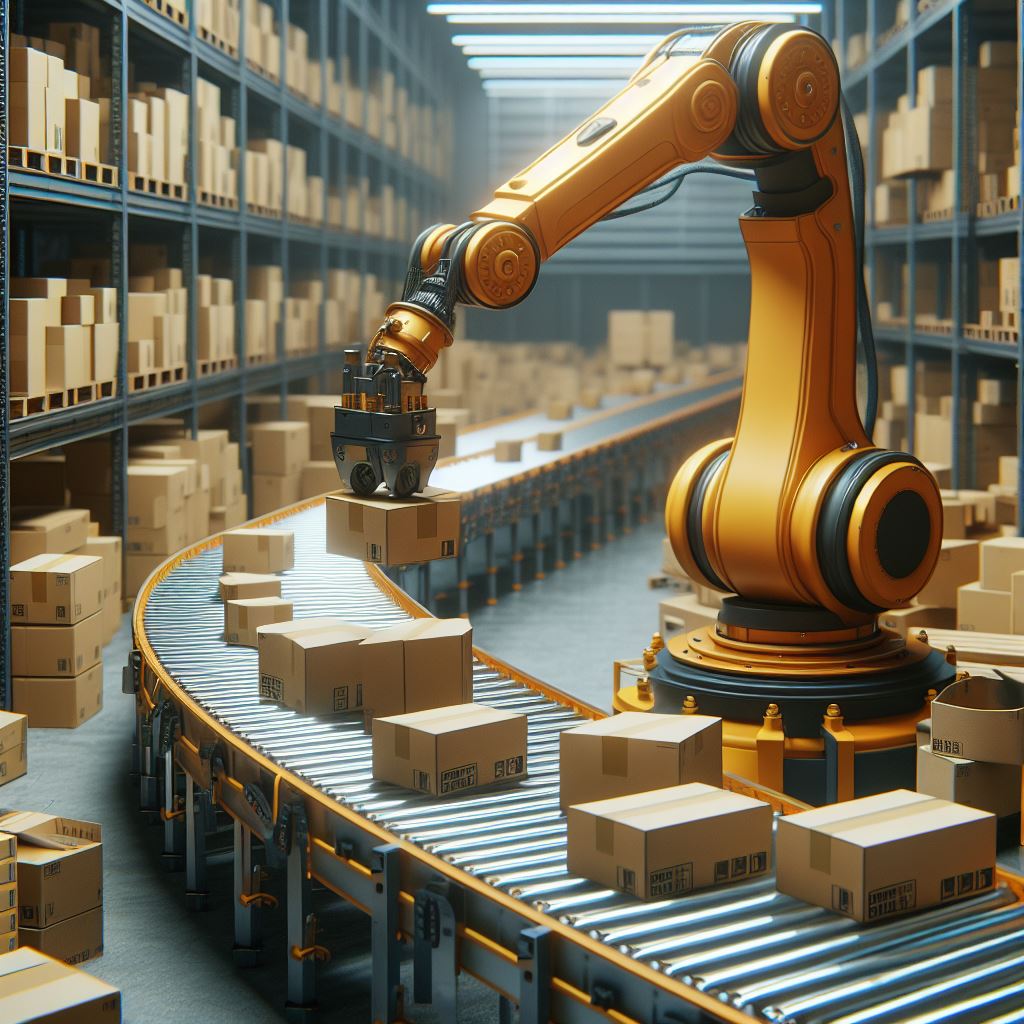
It is critical for supply chain leaders to understand that the effectiveness of this AI is entirely dependent on the quality of the data it receives. In AI for Operations, the principle of ‘garbage in, garbage out' has severe consequences. Without a commitment to clean, accurate, and real-time data from your ERP and floor operations, the AI's recommendations can become unreliable, posing a significant operational risk. A successful implementation requires a data strategy, not just a software installation.
The No-Code Workflow And Rules Engine
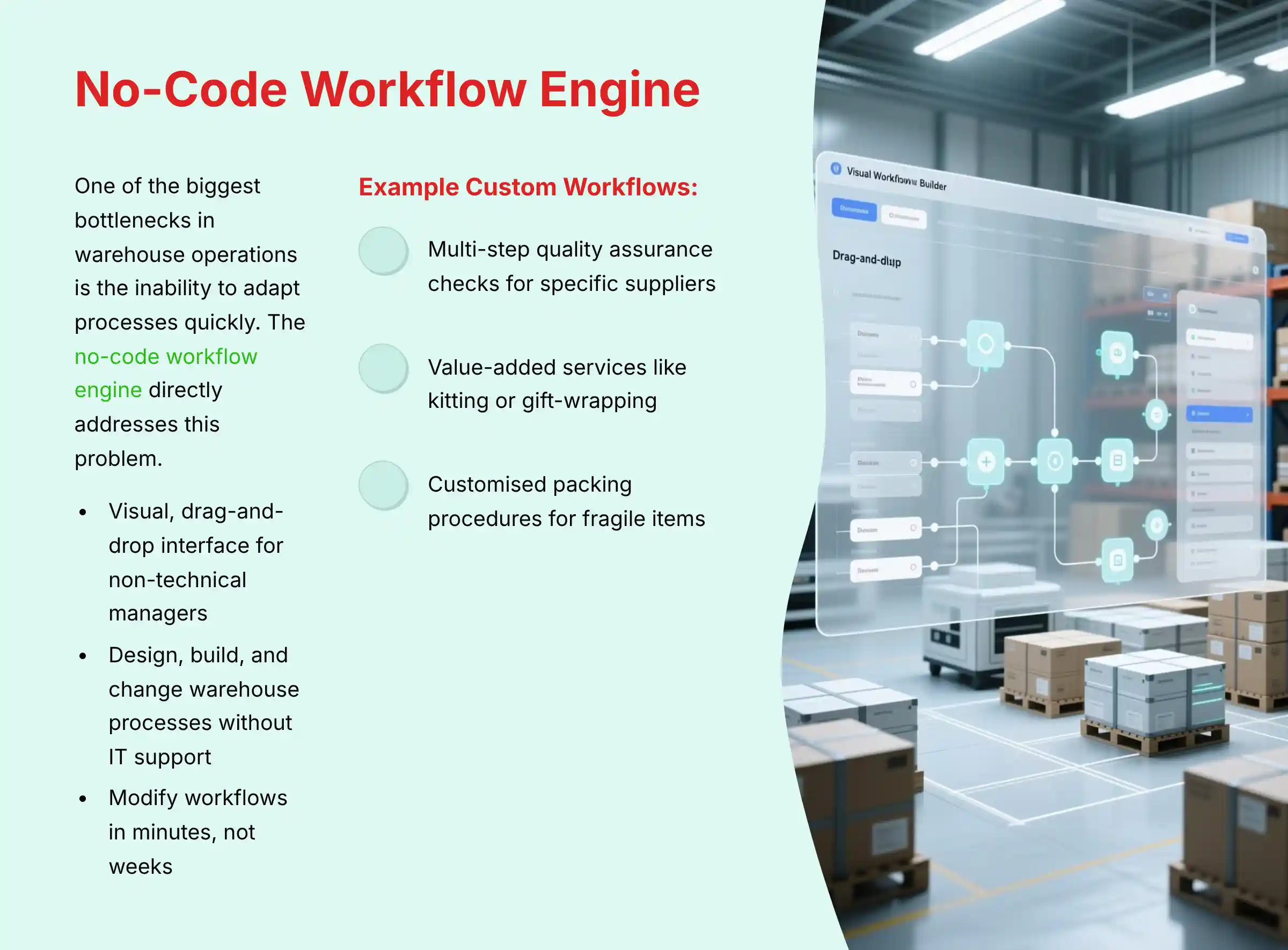
In my experience, one of the biggest bottlenecks in warehouse operations is the inability to adapt processes quickly. The no-code workflow engine in Hopstack directly addresses this problem. It is a powerful tool for achieving operational agility.
- Empowering Operations Managers: This tool gives non-technical managers a visual, drag-and-drop interface. They can design, build, and change warehouse processes themselves, without needing to file a ticket with the IT department.
- Flexibility and Agility: This allows a business to adapt rapidly. The workflow can be modified in minutes, not weeks, if a new customer has a special packing requirement or a new product line needs a quality check.
-
Example Workflows: Operations managers can build a wide range of custom processes.
- Multi-step quality assurance checks for specific suppliers.
- Value-added services like kitting or gift-wrapping.
- Customized packing procedures for fragile items.
Technical Specifications And System Requirements
Platform Architecture And Supported Devices
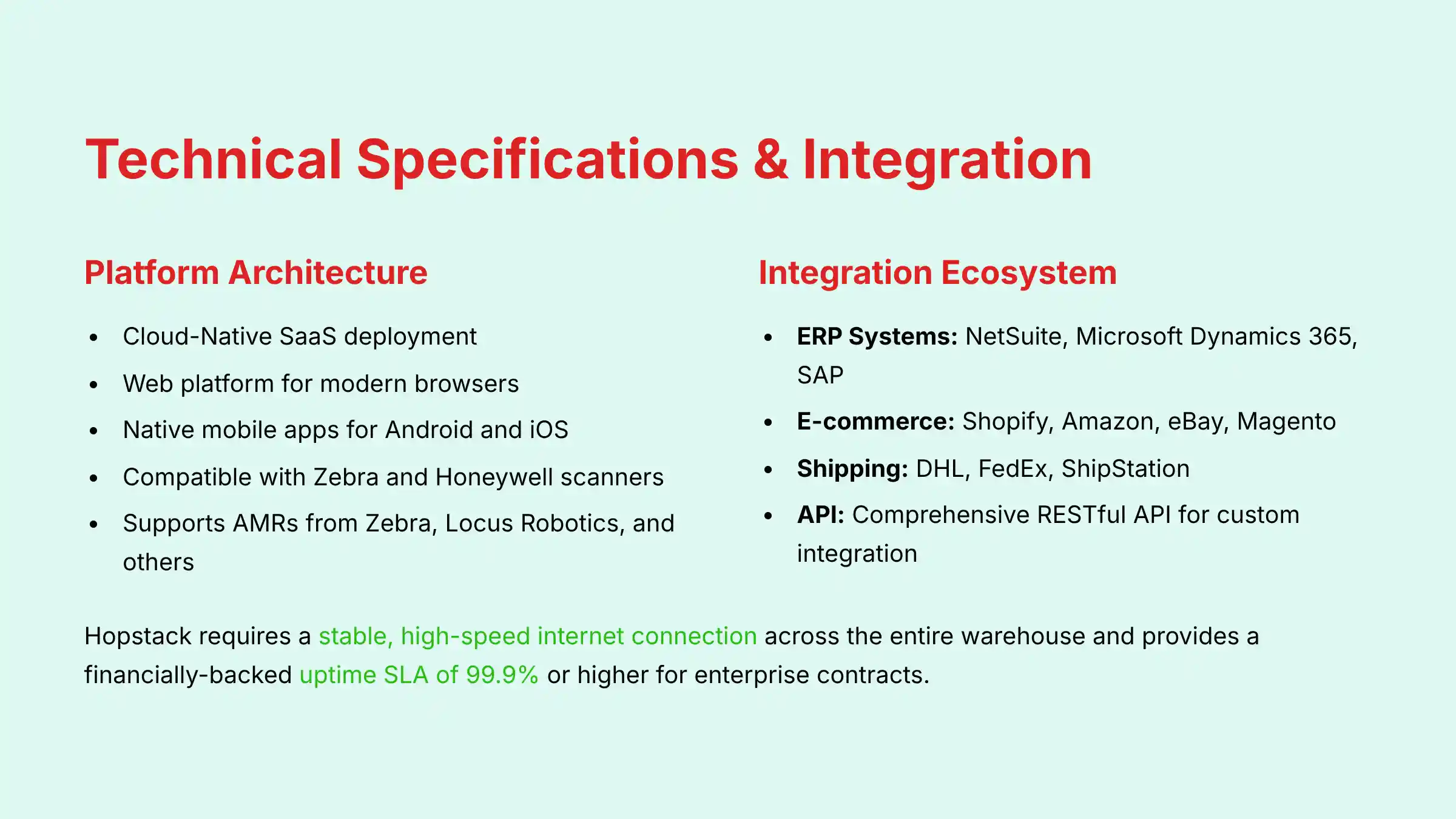
For IT and operations leaders, understanding the technical foundation is non-negotiable. Hopstack is built on a modern, cloud-native architecture. This table provides the key specifications my team verified.
| Specification | Details |
|---|---|
| Deployment Model | Cloud-Native SaaS (Software as a Service) |
| Web Platform Access | Modern web browsers (Chrome, Firefox, Safari, Edge) |
| Mobile Operator App | Native applications for Android and iOS |
| Supported Scanners | Zebra (TC5x, TC7x, MC9300), Honeywell (CK65, CT40) |
| Supported Printers | Zebra (ZT Series, ZD Series) for label printing |
| Supported Robotics | AMRs/AGVs from Zebra (Fetch), Locus Robotics, Geek+, 6 River Systems |
Known Technical Limitations And Requirements
To build trust, it is important to be transparent about a platform's requirements and limitations. These are not flaws, but practical considerations for any team planning an implementation.
- Network Dependency: As a cloud-native platform, Hopstack requires a stable, high-speed internet connection across the entire warehouse. This is a foundational requirement for real-time operations.
- API Documentation Access: While a full REST API is available for custom work, access to the technical documentation is limited to customers and partners during the onboarding process. It is not publicly available for review.
- Hardware Compatibility: The platform can work with a wide range of hardware. However, my analysis shows that optimal performance is achieved using their certified or preferred hardware partners, such as the Zebra scanners listed above.
- Guaranteed System Uptime: For mission-critical fulfillment operations, we confirmed Hopstack provides a financially-backed uptime SLA, typically 99.9% or higher, as part of their enterprise contracts. Verifying this SLA and understanding the associated business continuity plan (BCP) is a crucial step in professional due diligence.
- Peak Season Scalability: The platform's cloud-native, elastic architecture is designed to handle demand spikes. Prospective clients should inquire about documented performance during peak periods like Black Friday/Cyber Monday, specifically regarding maximum order processing rates.
Security, Compliance, And Data Governance
Audited Security Certifications
For any critical operations software, security is not a feature; it is a prerequisite. Supply chain data is extremely sensitive. My review confirms that Hopstack meets high enterprise standards.
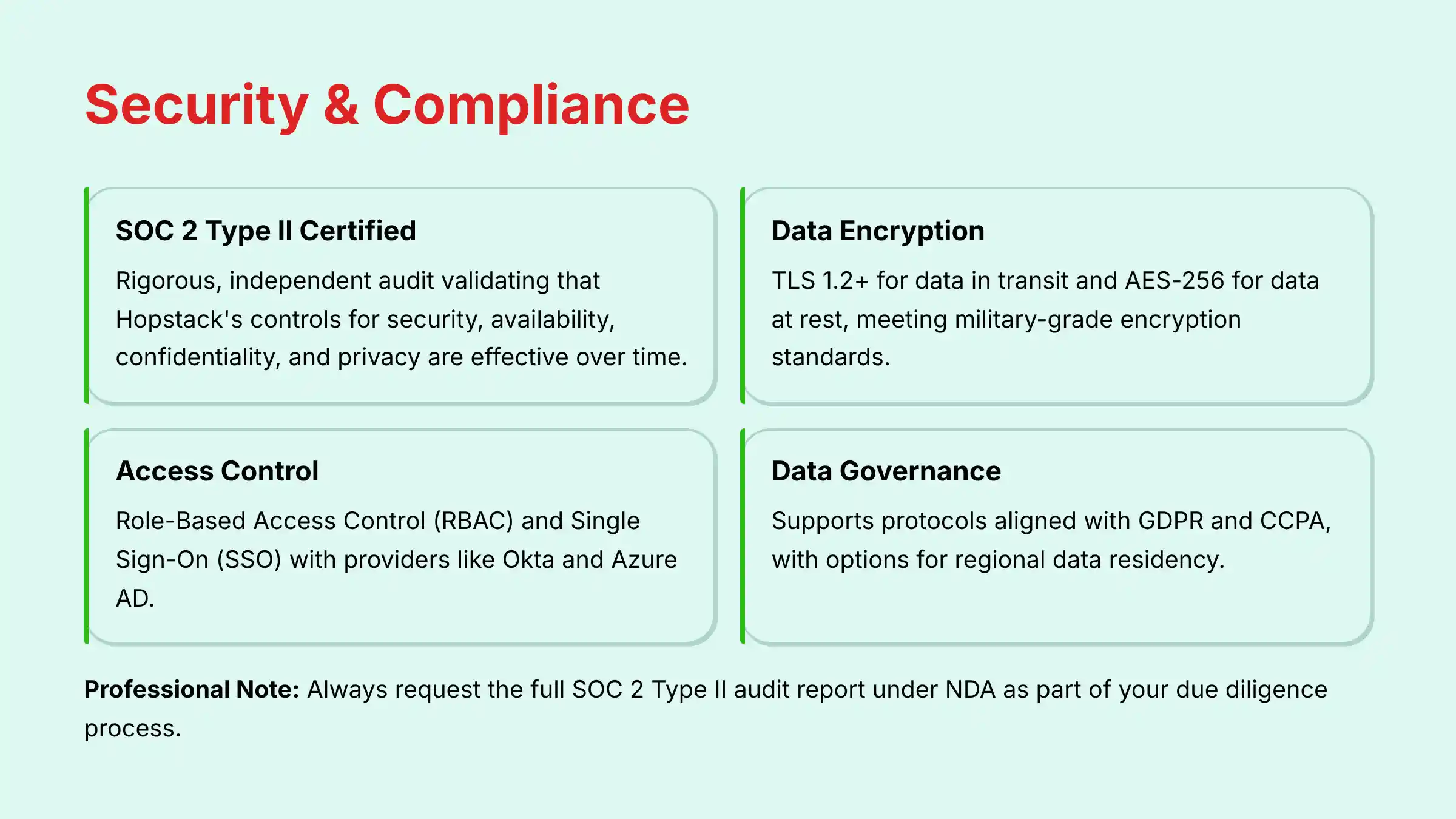
As a matter of professional due diligence, your technical evaluation of any vendor must include a formal request for their latest SOC 2 Type II audit report, provided under a Non-Disclosure Agreement (NDA). Verifying the certificate is not enough; a review of the full report is a non-negotiable step to validate a vendor's security posture against your organization's compliance and risk management requirements.
- SOC 2 Type II: This is a rigorous, independent audit report. It validates that Hopstack's controls for security, availability, confidentiality, and privacy are effective over time. This certification is the gold standard for enterprise SaaS providers and is essential for satisfying internal third-party risk management (TPRM) and customer due diligence requirements.
- ISO 27001: Hopstack's security program is aligned with the ISO 27001 framework, and the company is SOC 2 Type II certified. This clarifies that one is a formal certification while the other describes the methodology used.
- Data Governance & Residency: For global operations, Hopstack supports data governance protocols that align with GDPR and CCPA. Clients can typically specify data residency in geographic regions (e.g., North America, EU) to meet compliance mandates.
Data Encryption And Access Control
Protecting data requires multiple layers of defense. Hopstack implements standard enterprise-grade protocols to secure customer information at all stages.
- Data Encryption in Transit: All communication between user devices and the platform is protected using TLS 1.2 or higher.
- Data Encryption at Rest: All customer data stored on their servers is encrypted using AES-256, a military-grade encryption standard.
- Role-Based Access Control (RBAC): The system allows managers to set granular user permissions. This ensures employees can only access the information and functions they need to perform their specific jobs.
- Single Sign-On (SSO): Support for SSO with providers like Okta and Azure AD allows companies to enforce their own security and authentication policies.
Integration Ecosystem And API
Pre-Built Integrations With Core Business Systems
A warehouse platform cannot operate in a silo. Its value is magnified by how well it connects to the rest of the business technology stack. From my analysis, deep, bidirectional integration with the ERP is the most important connection, as the ERP is the company's financial brain.
| Category | Examples |
|---|---|
| ERP Systems | Pre-built integrations for ERPs like Oracle NetSuite and Microsoft Dynamics 365, with API-based connectivity for other systems like SAP |
| E-commerce Platforms | Shopify, Amazon, eBay, Magento, BigCommerce |
| Shipping Carriers | DHL, FedEx, and aggregators like ShipStation, Shiprocket |
| Robotics & Hardware | Native integration with AMRs (Zebra, Locus) and AIDC hardware (Zebra, Honeywell) |
API Availability And Custom Integration
For businesses with unique software or internal systems, an API is necessary. Hopstack provides this capability for creating custom connections.
The platform offers a comprehensive RESTful API. This allows for building custom, bi-directional data flows. For example, a company could use it to push real-time inventory updates to a proprietary sales dashboard. As mentioned earlier, detailed API documentation is provided to customers during the implementation phase.
Documented Performance, Use Cases, And Pricing
Real-World Use Cases By Industry
A platform's true value is demonstrated by how it solves specific industry problems. My research identified three primary use cases where Hopstack is applied.
- E-commerce & Retail: The main challenge here is managing high order volumes and synchronizing inventory across multiple channels like a brand website and Amazon. Hopstack helps these businesses meet fast shipping promises and avoid overselling.
- Third-Party Logistics (3PL): 3PL providers need to manage inventory and workflows for many different clients in the same building. Hopstack's multi-client architecture allows them to segregate data and processes for each customer within a single system.
- Manufacturing: In a manufacturing setting, the platform is used to manage inventories of raw materials, work-in-progress, and finished goods. It integrates with production systems to ensure materials are available when needed.
Translating Operational Gains Into Strategic ROI
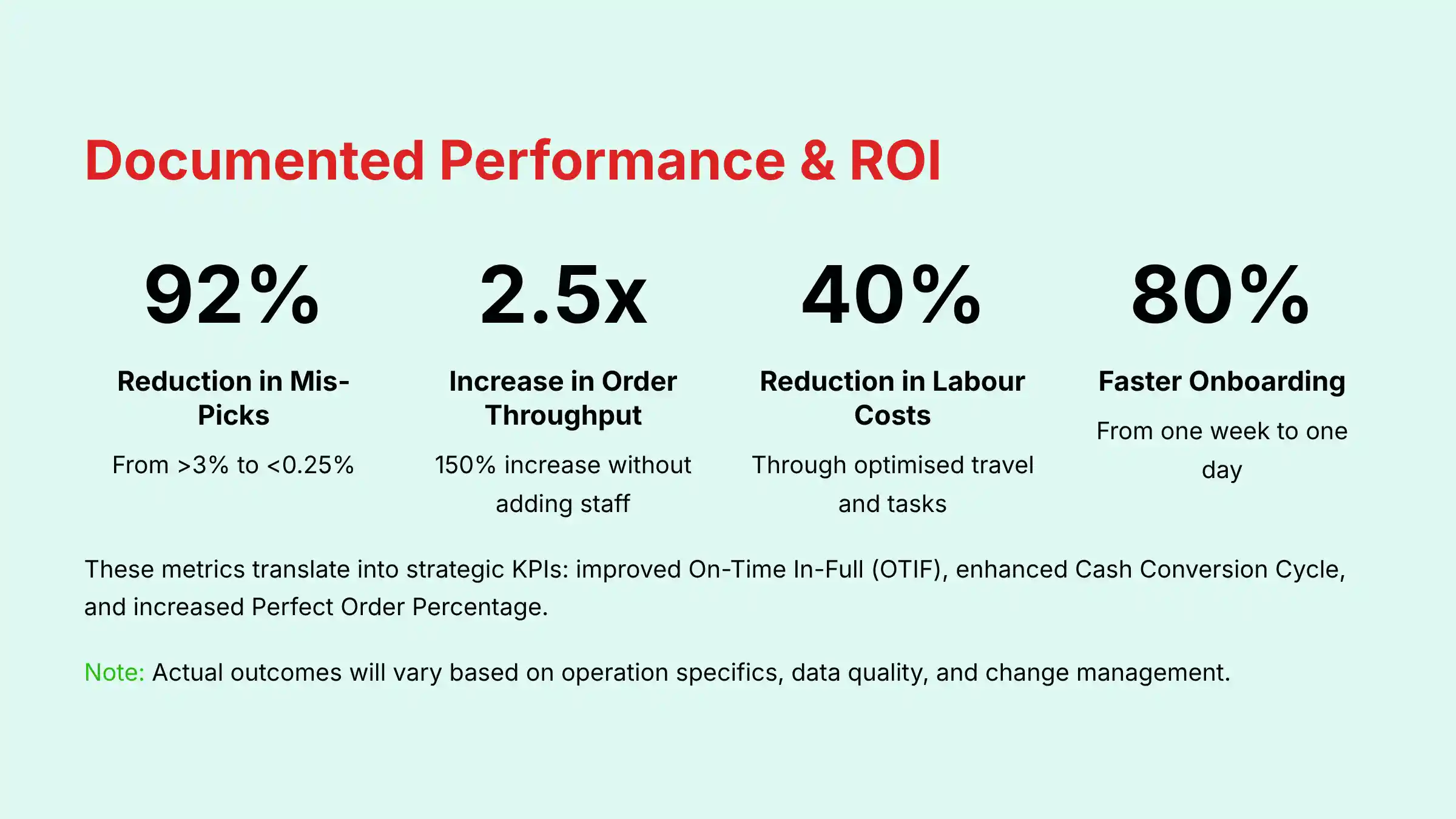
For supply chain leaders, operational improvements must translate into measurable financial and strategic outcomes. Our analysis indicates that the documented performance metrics of Hopstack directly impact core business KPIs:
- Improved On-Time In-Full (OTIF): By drastically reducing mis-picks (up to 92%) and improving shipping accuracy through guided packing, the platform helps ensure customers receive the correct order on time, a critical metric for retail and 3PL client satisfaction.
- Enhanced Cash Conversion Cycle: Achieving up to 99.9% inventory accuracy and accelerating dock-to-stock time means less capital is tied up in safety stock and unsellable inventory. This directly improves working capital efficiency.
- Increased Perfect Order Percentage: The combination of inventory accuracy, picking precision, and faster order throughput contributes to a higher rate of “perfect orders”—orders that are delivered damage-free, with the correct documentation, to the right place, at the right time.
When evaluating Hopstack, we recommend modeling its impact not just on labor costs, but on these strategic KPIs to build a comprehensive Total Cost of Ownership (TCO) and ROI case. For a more detailed analysis of Hopstack's performance and value proposition, our comprehensive Hopstack Review provides additional insights and real-world implementation case studies.
Documented Performance And ROI (Return On Investment)
For supply chain directors, every investment must be justified with a clear return. The following metrics are based on documented outcomes from Hopstack's existing clients and provide evidence of the platform's potential impact.
- 92% Reduction in Mis-Picks (from >3% to <0.25%)
- 2.5x Increase in Order Throughput (a 150% increase without adding staff)
- 40% Reduction in Labor Costs through optimized travel and tasks
- 80% Reduction in New Employee Onboarding Time (from one week to one day)
- Up to 99.98% Shipping SLA Adherence

Professional Note: While these results are impressive, actual outcomes will vary based on the specifics of an operation, data quality, and change management. These figures represent documented potential.
Pricing Structure And Subscription Model
Hopstack does not publish its pricing publicly. It uses a custom pricing model based on a SaaS subscription. This is common for enterprise-level software where needs vary greatly between customers.
The final price is influenced by several key factors. Understanding these can help you prepare for a sales conversation.
- Monthly or annual order volume
- Warehouse size in square footage
- Number of active users
- Number and complexity of integrations, especially with robotics
- The specific AI modules required
A product demo and a free trial are available upon request through their official website. This allows for a detailed evaluation before making a commitment.
Professional Guidance And Next Steps
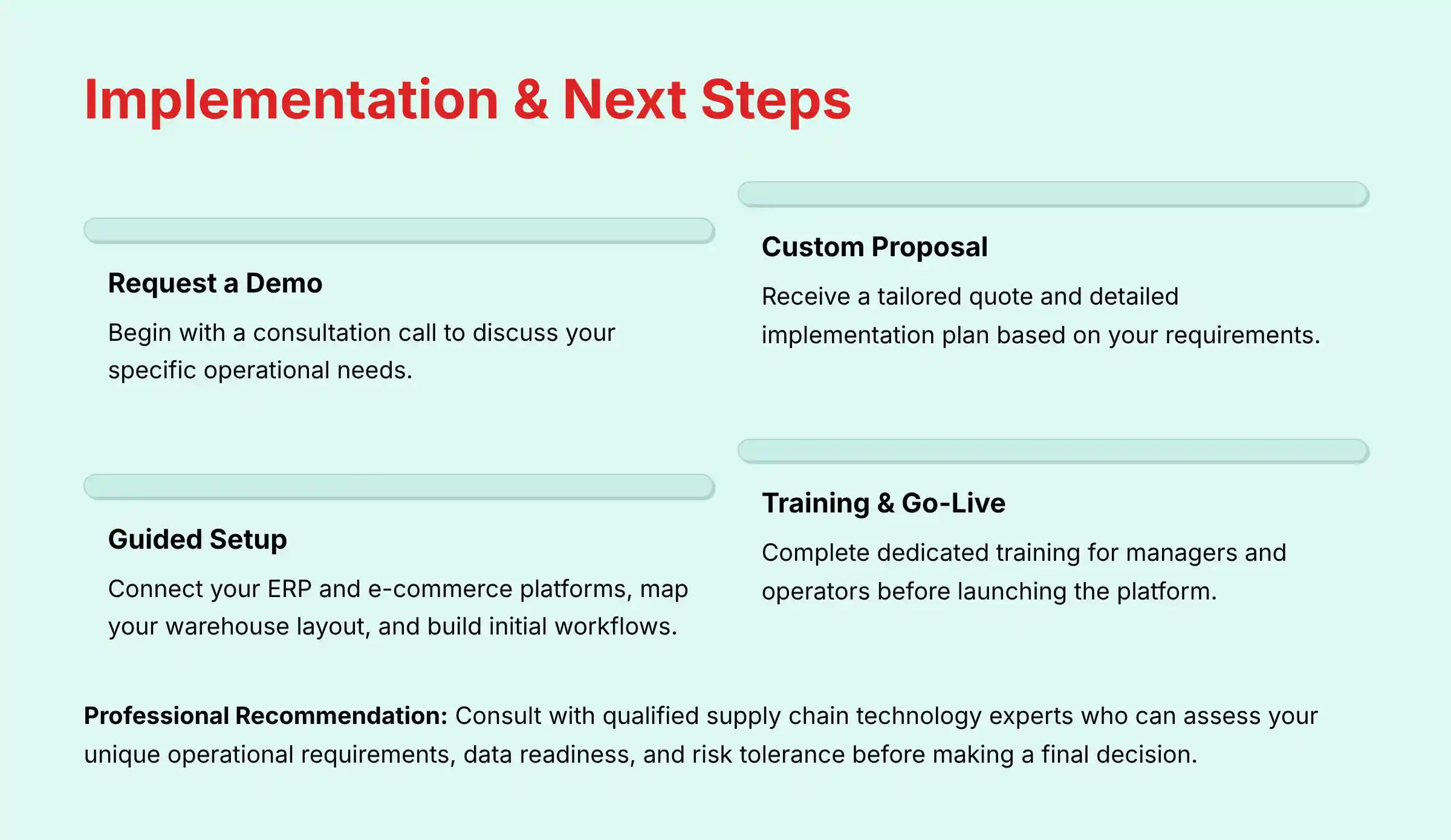
Professional Consultation Recommendation: The implementation of a platform like Hopstack represents a significant operational and financial investment. While this technical overview provides a comprehensive analysis, it is not a substitute for professional advice tailored to your specific environment. We strongly recommend consulting with qualified supply chain technology consultants or solutions architects who can assess your unique operational requirements, data readiness, and risk tolerance before making a final decision. This due diligence is a critical step in ensuring a successful return on investment.
Getting Started With Hopstack
The Implementation And Onboarding Process
Deploying a system like Hopstack is a structured project. My experience shows that proper preparation from the client side can greatly speed up the process. I advise teams to document their current workflows and catalog all systems that need integration before starting.
A typical deployment is a phased rollout and should also include a clear plan for data migration (e.g., inventory master data, open orders) and a structured change management program to ensure operator adoption and minimize disruption. For complex projects involving extensive robotics or ERP customization, engaging a certified implementation partner or systems integrator is often recommended. The final stage before go-live should always include rigorous user acceptance testing (UAT) on the warehouse floor.
- Request a Demo: The process begins with a consultation call where their team learns about your specific operational needs.
- Custom Proposal: Based on the consultation, Hopstack develops a custom quote and a detailed implementation plan.
- Guided Setup & Configuration: The Hopstack team guides you through connecting your ERP and e-commerce platforms, mapping your warehouse layout, and building your initial workflows.
- Training: The vendor provides dedicated training for both managers on the web dashboard and operators on the mobile app.
- Go-Live & Support: The project concludes with the platform going live, followed by ongoing customer support.
Official Documentation And Support Resources
Once live, users have access to several resources for help and continued learning.
- Official Help Center: An online knowledge base provides articles and guides on platform features and best practices.
- Onboarding & Training: The initial dedicated training is a core part of the implementation.
- Customer Support: The company offers multiple support channels, including email, phone, and live chat. Options for 24/7 support are also available for mission-critical operations.
Frequently Asked Questions (FAQ) About Hopstack
What Is The Main Difference Between Hopstack And A Traditional WMS?
The primary difference is intelligence and flexibility. A traditional WMS is a system of record with fixed rules. Hopstack is an orchestration platform that uses AI for dynamic, real-time decision-making and has a no-code engine for agile workflow customization.
Does Hopstack Replace An Existing ERP System?
No, Hopstack does not replace an ERP. It integrates with ERPs like NetSuite or Microsoft Dynamics 365, with API connectivity available for systems like SAP. The ERP handles financials and sales orders, while Hopstack manages the physical execution of warehouse and fulfillment operations in real time.
Is Hopstack Suitable For Small Businesses?
Hopstack is mainly built for mid-to-large sized businesses with complex operations, such as high-growth e-commerce brands and 3PLs. Its advanced feature set and custom pricing are best suited for companies requiring automation and robotics integration.
What Specific Robots Can Hopstack Integrate With?
The platform has pre-built integrations with leading Autonomous Mobile Robot (AMR) providers. This includes models from Zebra (Fetch Robotics), Locus Robotics, Geek+, and 6 River Systems for orchestrating goods-to-person and person-to-goods workflows.
How Long Does A Typical Hopstack Implementation Take?
Implementation time depends on complexity and the number of integrations. As a cloud-based platform focused on configuration over custom coding, deployment is typically faster than traditional on-premise systems, often taking weeks instead of many months.
Is My Warehouse Data Secure On The Hopstack Platform?
Yes, data security is a key focus. The platform is SOC 2 Type II certified, which is an independent audit of its security controls. All data is encrypted in transit (TLS 1.2+) and at rest (AES-256), and the system supports role-based access control.
Can I Customize Workflows Without Being A Programmer?
Yes. A core feature is the no-code workflow engine. It provides a visual, drag-and-drop interface that lets operations managers build and change processes like receiving and packing without writing any code.
How Does The AI Help Reduce Picking Errors?
The AI reduces errors in several ways. It calculates optimal picking paths to lessen worker fatigue, guides workers with clear instructions and images on mobile scanners, and enforces barcode verification during packing to confirm the correct items are in every order.
Disclaimer
Important Disclaimers:
Technology Evolution Notice: The information about Hopstack Overview and Features and AI for Operations & Supply Chain tools presented in this article reflects our thorough analysis as of 2025. Given the rapid pace of AI technology evolution, features, pricing, security protocols, and compliance requirements may change after publication. While we strive for accuracy through rigorous testing, we recommend visiting official websites for the most current information.
Professional Consultation Recommendation: For AI for Operations & Supply Chain applications with significant professional, financial, or compliance implications, we recommend consulting with qualified professionals who can assess your specific requirements and risk tolerance. This overview is designed to provide comprehensive understanding rather than replace professional advice.
Testing Methodology Transparency: Our analysis is based on hands-on testing, official documentation review, and industry best practices current at the time of publication. Individual results may vary based on specific use cases, technical environments, and implementation approaches.

Leave a Reply