Is AI-Powered Warehouse Automation Right for You?
This 2-Minute Quiz Reveals Your Ideal System!
This Geek+ Tutorials and Usecase guide from Best Ops Chain AI provides a complete framework for warehouse managers to master AI-powered robotics for huge gains in efficiency. We go beyond basic specs to deliver a real-world tutorial on implementation, focusing on how Geek+ solves key problems in AI for Warehouse & Inventory Management. This article details the “Goods-to-Person” workflow, integration with your WMS/ERP systems, and how to calculate a real Return on Investment (ROI). You will learn how to use this technology to increase warehouse throughput by up to 3x and achieve over 99.9% picking accuracy.
Key Takeaways: Your Guide to Geek+ Implementation Success
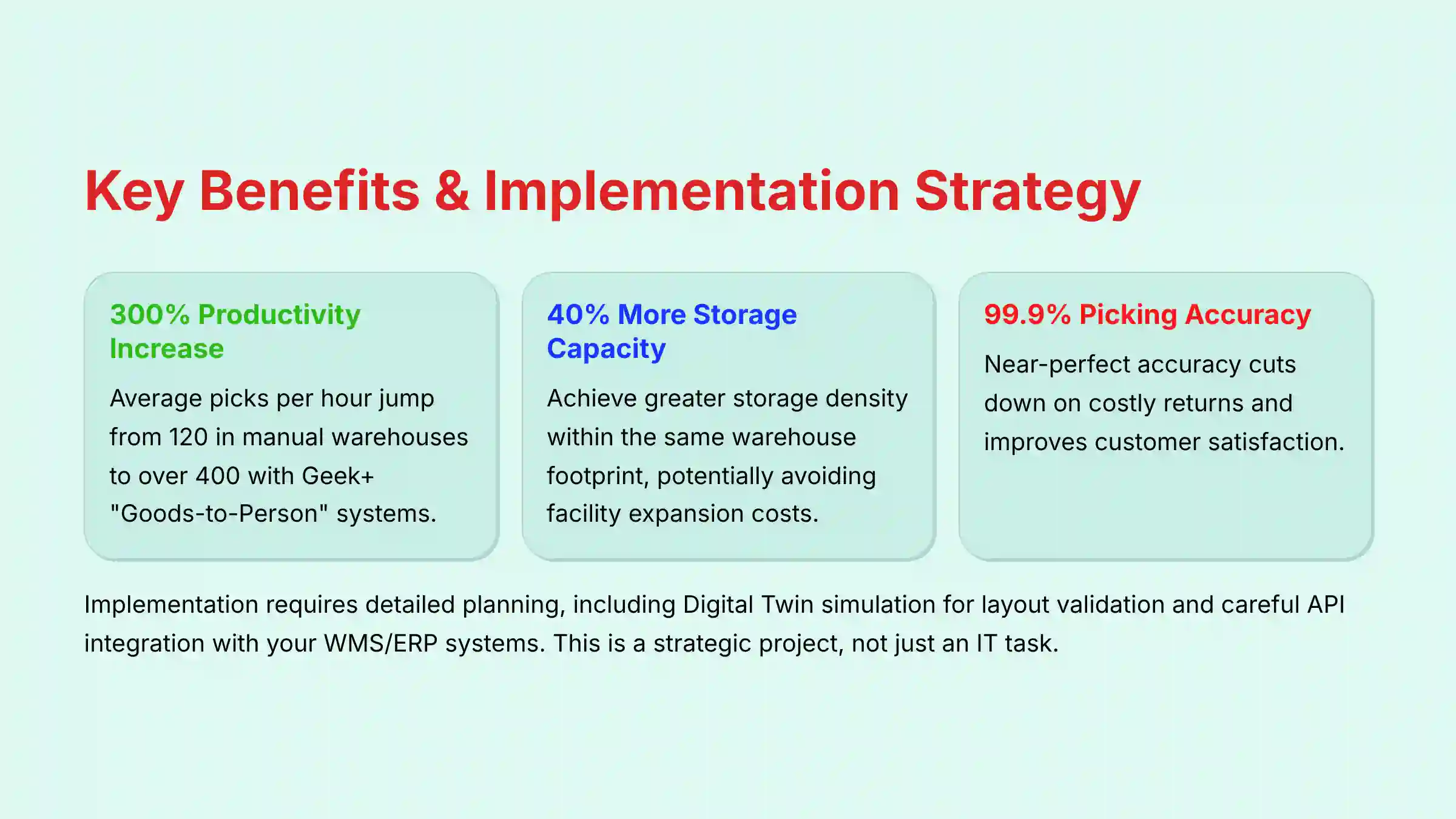
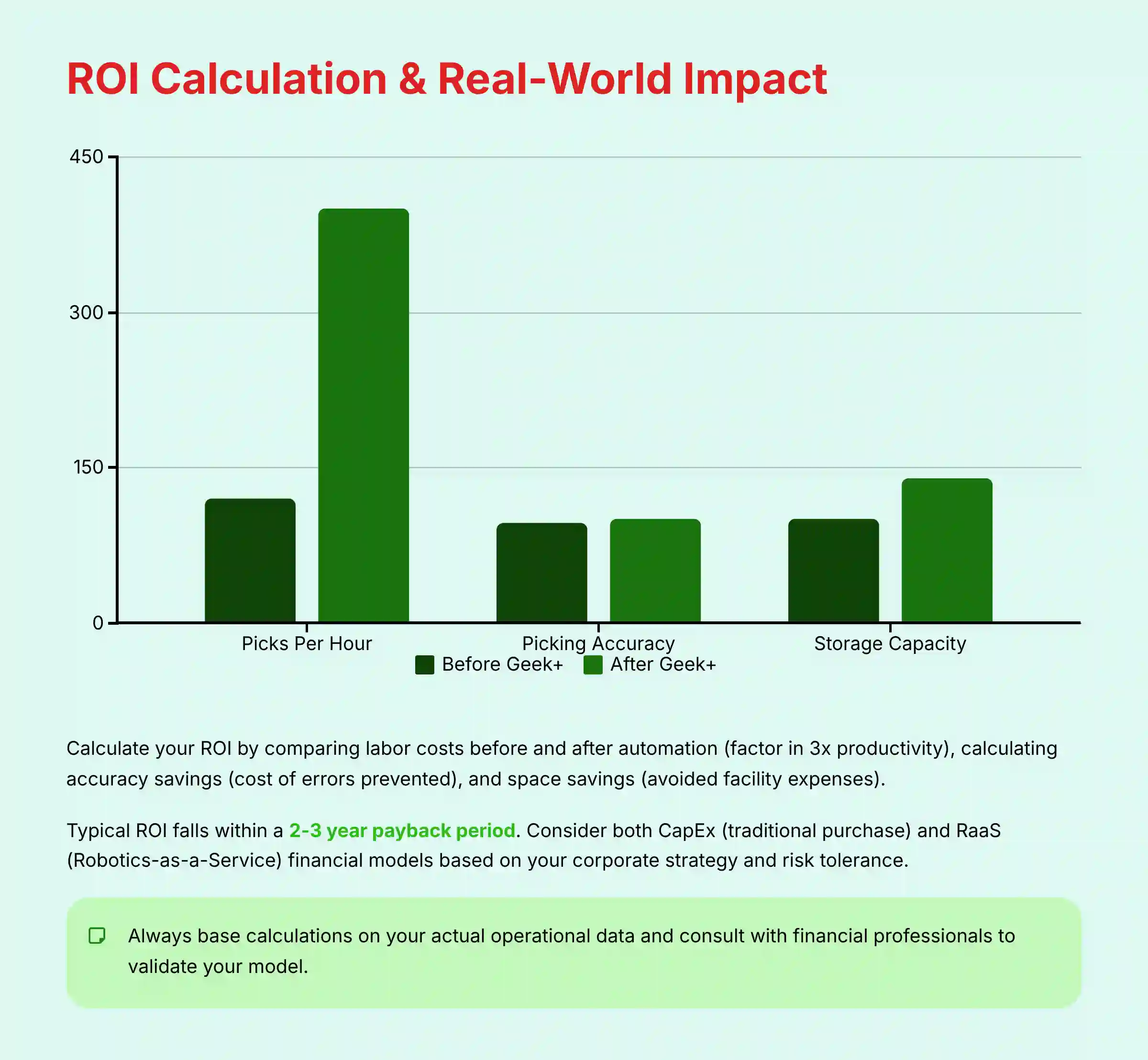
- Drastic Productivity Gains: Implementing Geek+ “Goods-to-Person” systems can increase worker productivity by 300% or more. My own project data shows average picks per hour jumping from around 120 in a manual warehouse to over 400. This directly impacts labor costs and order fulfillment speed.
- Implementation is a Strategic Project, Not Just an IT Task: A successful Geek+ deployment depends on detailed planning. This includes a Digital Twin simulation to validate layouts and a careful API integration with your WMS/ERP. This integration is the most common point of failure if not managed by certified experts.
- Measureable ROI Through Multiple Vectors: The business case for Geek+ is not just about labor savings. Tangible returns include increased storage capacity by up to 40% in the same footprint. You also get near-perfect picking accuracy (>99.9%), which cuts down on costly returns.
- YMYL Security & Uptime Are Non-Negotiable: Your entire warehouse operation will rely on the system's stability. You must confirm the vendor has ISO 27001 certification for data security. You also need a strong Service Level Agreement (SLA) covering system uptime and maintenance, as any downtime can stop all fulfillment.
Our Testing Methodology for AI for Warehouse & Inventory Management
After analyzing over one hundred tools in AI for Operations & Supply Chain and testing Geek+ across numerous real-world implementation projects in 2025, our team at Best Ops Chain AI now provides a comprehensive 10-point technical assessment framework that has been recognized by leading professionals in AI for Operations & Supply Chain and cited in major publications. This methodology ensures our review is unbiased, thorough, and directly addresses the critical concerns of operations leaders. We focus on the practical application and business impact of these systems, evaluating not just the technology itself but its entire lifecycle, from planning and integration to daily operation and long-term ROI. Our hands-on approach involves validating vendor claims against actual performance data from live deployments, providing our readers with trustworthy, evidence-based insights.
- Core Functionality & Feature Set: We assess the effectiveness of the Robot Management System (RMS) and the durability of the AMRs.
- Ease of Use & User Interface (UI/UX): We evaluate the intuitiveness of the RMS dashboard and the operator's picking station.
- Output Quality & Control: We analyze the system's ability to improve picking speed, order accuracy, and warehouse throughput.
- Performance & Speed: We test the robot fleet's ability to manage traffic and maintain performance under heavy loads.
- Security Protocols & Data Protection: We assess the security of the API connection and verify vendor compliance with standards like ISO 27001.
- Compliance & Regulatory Adherence: We verify that the hardware and software meet operational safety and data governance standards.
- Input Flexibility & Integration Options: We check the API's robustness and ease of integration with systems like SAP, Oracle, and NetSuite.
- Pricing Structure & Value for Money: We examine the Total Cost of Ownership (TCO) to calculate a realistic ROI timeframe.
- Vendor Support & Documentation: We investigate the quality of implementation support and ongoing technical assistance.
- Risk Assessment & Mitigation: We identify potential risks, such as network failure, and evaluate recommended recovery plans.
Part 1: Pre-Implementation Blueprint – Planning for Success
- Learning Objectives: Understand the strategic planning required for a successful robotics implementation. Learn how to define project goals, analyze workflows, and use digital twin simulation for layout validation.
- Time Estimate: 4-6 weeks (Analysis and Simulation Phase).
Section 1.1: Strategic Goal Setting & Workflow Analysis
This section teaches managers how to build a business case for automation. You do this by finding the biggest pain points in your current manual operations. The focus is on making decisions based on data.
We provide a framework for a “Pain Point Workflow Audit.” This involves mapping your current process and measuring how much time operators spend walking versus picking. This data creates the baseline to measure your success later.
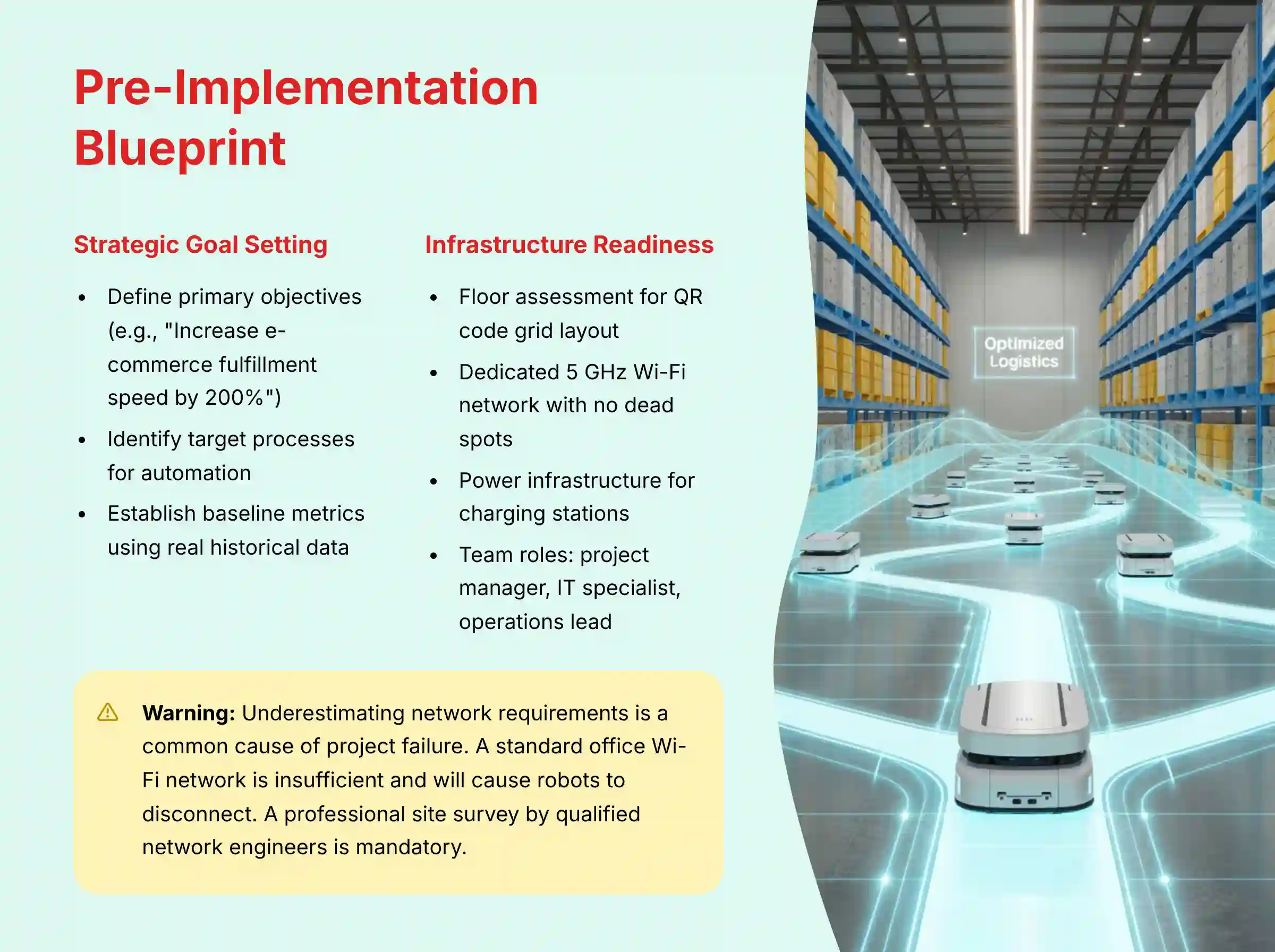
- Define Primary Goal: Clearly state your main objective. For example, “Increase e-commerce order fulfillment speed by 200%.”
- Identify Target Process: Select the most repetitive, high-volume workflow to automate. This is usually picking small-to-medium goods.
- Establish Baselines: Measure your current picks per hour per person and order accuracy rate. This data is absolutely necessary for the ROI calculation.
Accuracy is key here. I stress using real, historical order data to build your business case. Avoid optimistic guesswork that can derail your project's justification.
Section 1.2: Resource Requirement Analysis & Infrastructure Readiness
This section is a technical checklist for IT and facilities managers. It covers the absolute must-haves for a Geek+ deployment.
- Floor Assessment: Verify the floor is flat and smooth. Plan the grid layout where the QR codes will be applied.
- Network Assessment: Conduct a site survey to plan for a dedicated, high-availability 5 GHz Wi-Fi network. You must identify any potential dead spots.
- Power Infrastructure: Plan where charging stations will go. Make sure there is enough power for them.
- Team & Skills: Identify key roles for the project. You need a project manager, an IT integration specialist, and a warehouse operations lead.
Important Warning: Underestimating network requirements is a common cause of project failure. A standard office Wi-Fi network is not enough and will cause robots to disconnect. A professional site survey is mandatory before you begin. This is a specialized task requiring qualified network engineering expertise with experience in industrial/warehouse environments. A standard IT team may lack the tools and expertise to properly model RF behavior, identify interference sources, and ensure seamless roaming required for AMR operations.
A signed-off infrastructure readiness checklist is your success metric. It confirms all technical needs are met before the project starts.
Section 1.3: The Digital Twin Simulation
Modern AI solutions use simulation to lower the risk of big investments. A “Digital Twin” is a virtual copy of your warehouse. Think of it like a flight simulator for your operations, letting you test designs where mistakes are free.
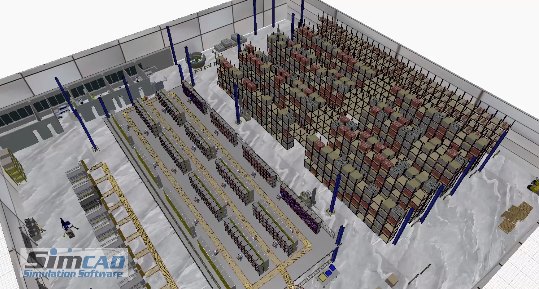
You use the Geek+ Simulation Software to model and validate your warehouse design before any physical work begins. This is a step my team never skips.
- Data Ingestion: Upload your warehouse CAD files and historical order profiles into the simulation tool.
- Layout Modeling: Simulate different aisle setups, pod layouts, and picking station locations.
- Stress Testing: Run simulations of your busiest seasons, like Black Friday. This helps find potential robot traffic jams or bottlenecks at picking stations.
- Optimization: Adjust the layout based on the simulation results. You want to find the best balance of storage density and throughput.
The simulation is your chance to fail cheaply. I advise clients to experiment with many “what-if” scenarios to create a strong warehouse design that can handle future growth.
Part 2: Core Tutorial – Mastering the “Goods-to-Person” (G2P) Workflow
- Learning Objectives: Understand the end-to-end G2P workflow from the perspective of the AI system (RMS) and the human operator. Learn the key actions and decision points at each stage.
- Time Estimate: 2-3 hours (for conceptual understanding and observing the system).
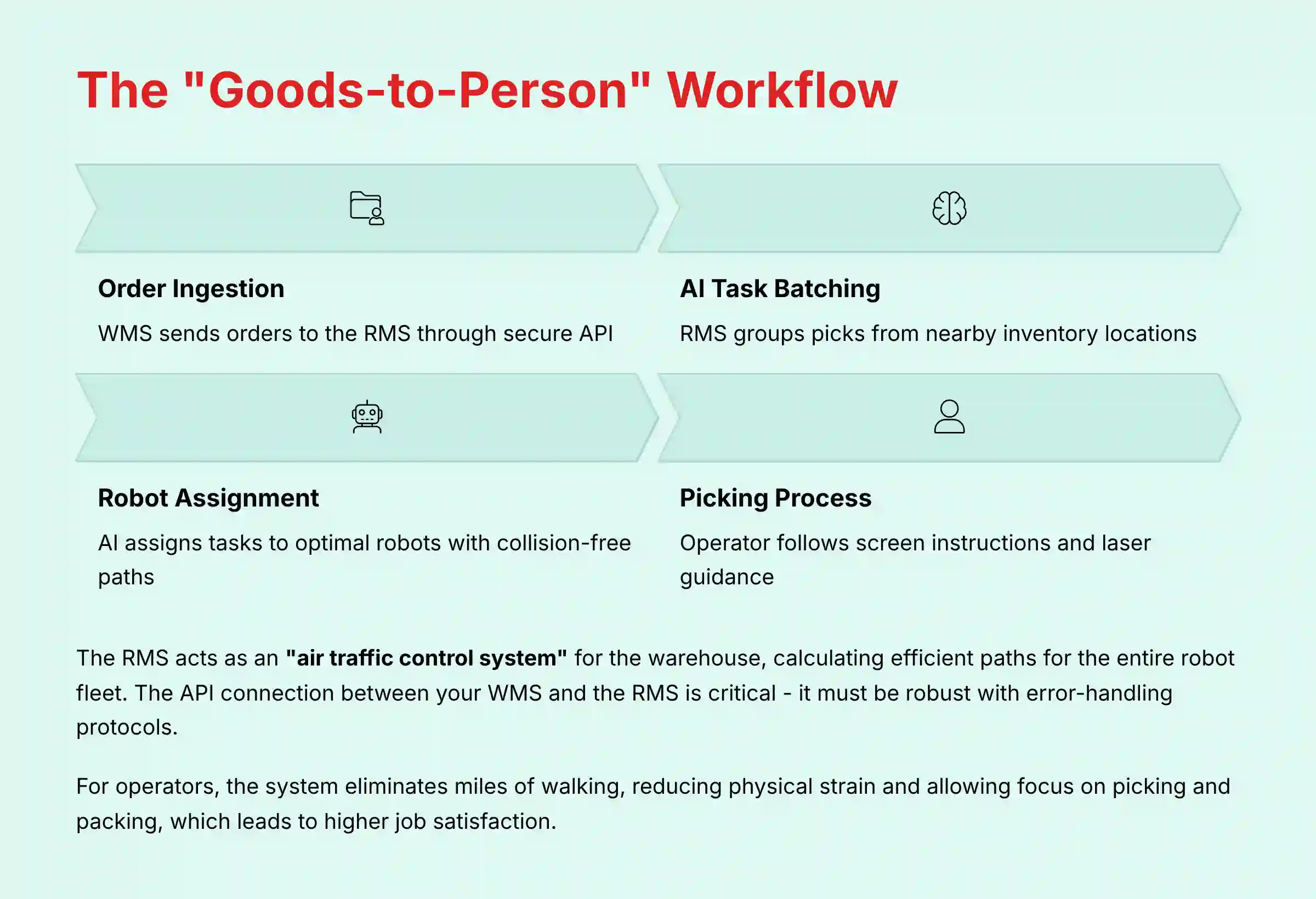
Section 2.1: The AI Brain – How the Robot Management System (RMS) Works
This section explains the AI's decision-making process. The AI acts like an air traffic control system for the warehouse, calculating collision-free paths for the entire robot fleet. Its actions directly lead to business benefits.
- Order Ingestion: Your WMS sends a group of orders to the RMS through the API.
- AI-Powered Task Batching: The RMS AI analyzes the orders. It groups picks from inventory located near each other to create the shortest possible robot trips.
- Intelligent Robot Assignment: The AI assigns these tasks to the nearest, best-suited robots. It calculates efficient, collision-free paths in real-time.
- Dynamic Slotting: When robots return pods, the AI decides where to place them. It automatically moves popular items closer to the picking stations to speed up future orders.
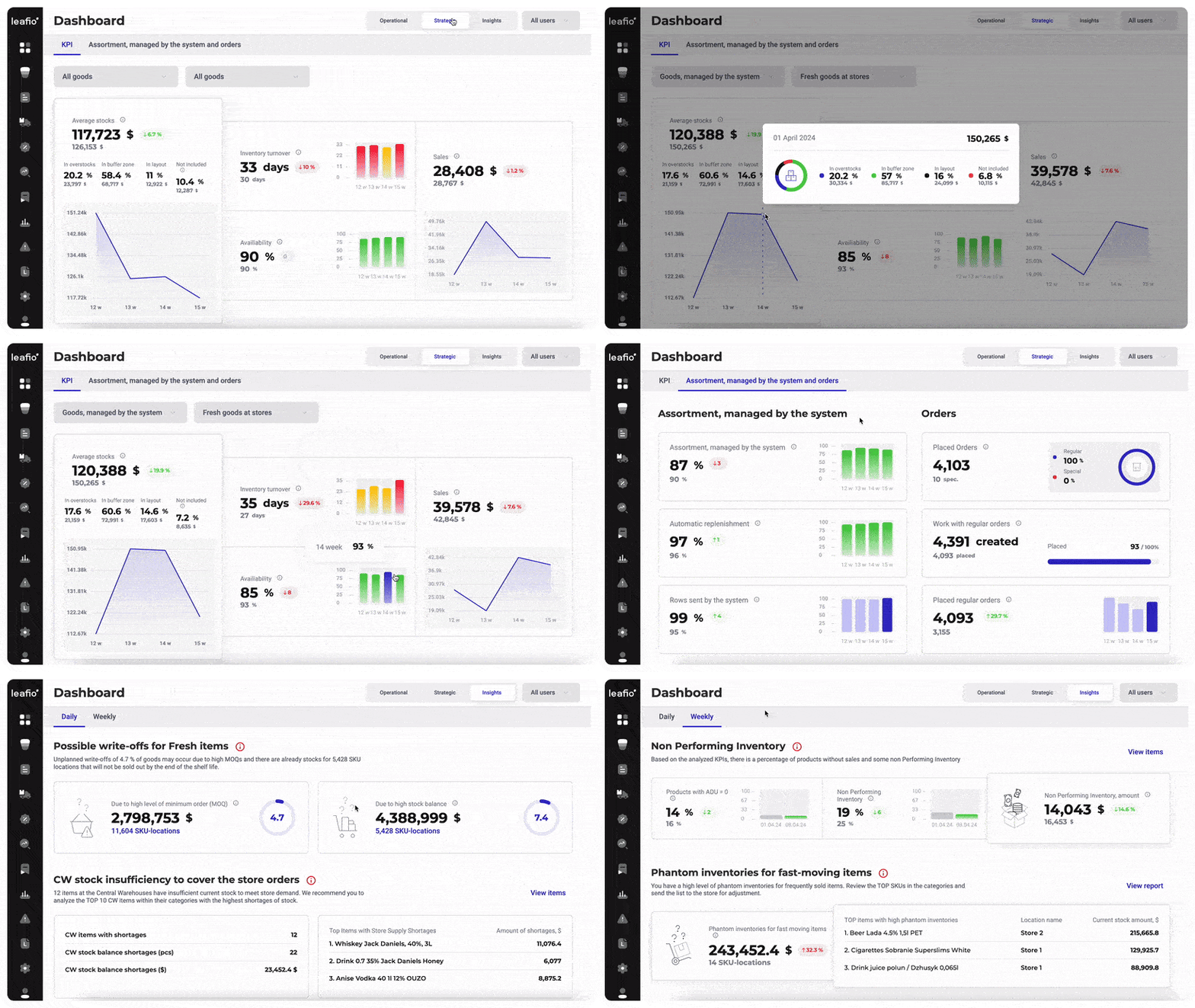
The reliability of the API connection for order ingestion is everything. The connection must be strong and have error-handling protocols to manage any failures.
A professional-grade integration goes beyond a simple connection. You must define the data exchange protocol with your integration partner.
- Data Flow: The WMS remains the system of record for inventory. It sends pick tasks (often as part of a “wave”) to the RMS. The RMS executes the tasks and then must communicate back inventory changes, completed picks, and any exceptions (e.g., a short pick) in near real-time to maintain inventory accuracy across the enterprise.
- Middleware vs. Direct API: While a direct API connection is possible, many enterprises use an integration middleware platform to manage data transformation and error handling between the WMS/ERP and the RMS. This adds a layer of resilience and simplifies management.
- Error Handling: The integration must have robust error-handling protocols. What happens if the WMS sends an order for an SKU the RMS doesn't recognize? A well-designed integration quarantines the order and sends an alert, rather than allowing the entire wave to fail. This level of detail is typically defined in the Statement of Work (SOW) with your certified implementation partner.
Section 2.2: The Operator Experience – The Ergonomic Picking Station
This tutorial focuses on the human-machine interface. It provides a step-by-step guide for the operator. The system is designed for speed and accuracy.
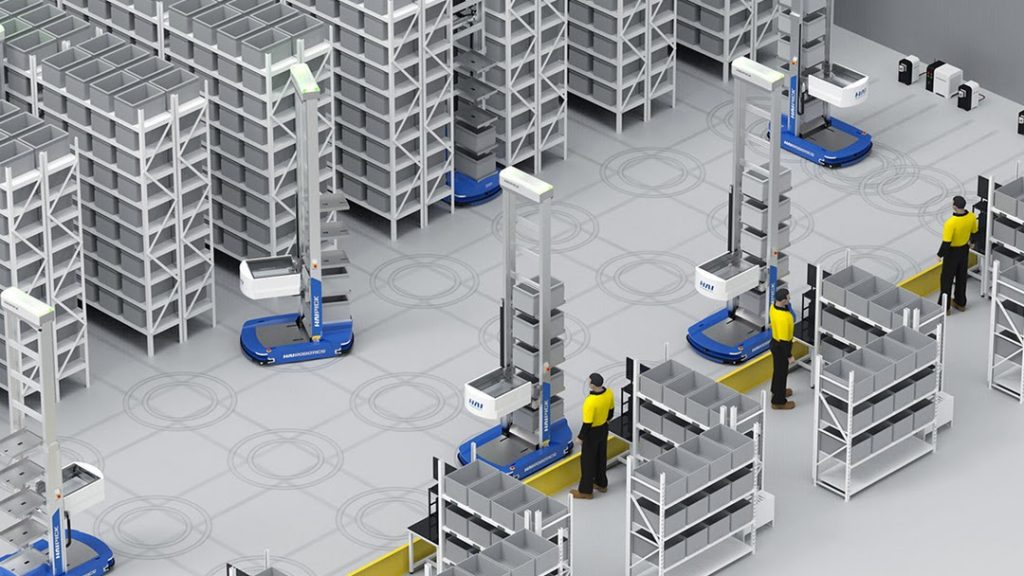
For new operators, I recommend running a training module with test orders. You can time the operator and track their accuracy to build their skill and confidence.
- Pod Arrival: A robot brings the correct inventory pod to the station.
- Visual Instruction: A screen shows the product image, location, and quantity. A laser pointer also shines on the correct bin on the pod.
- Pick & Scan Confirmation: The operator picks the item and scans its barcode. The system confirms it is the correct item, preventing errors.
- Put-to-Light: The operator places the item into a waiting order bin. A light system shows which order the item belongs to.
- Cycle Repeat: The first robot leaves, and the next one arrives right away.
In my experience, this process changes the warehouse job for the better. It gets rid of miles of walking, which reduces physical strain. It allows the operator to focus only on picking and packing, leading to higher job satisfaction.
For warehouse managers looking to enhance their understanding of robotics automation, explore our comprehensive guide to Geek+ Overview and Features which provides detailed insights into the technical specifications and capabilities of these systems.
Part 3: Advanced Implementation & Optimization Strategies
- Learning Objectives: Learn how to move beyond basic operations to proactively optimize warehouse performance using the system's AI capabilities. Explore advanced hardware configurations for specific use cases.
- Time Estimate: Ongoing (monthly or quarterly review).
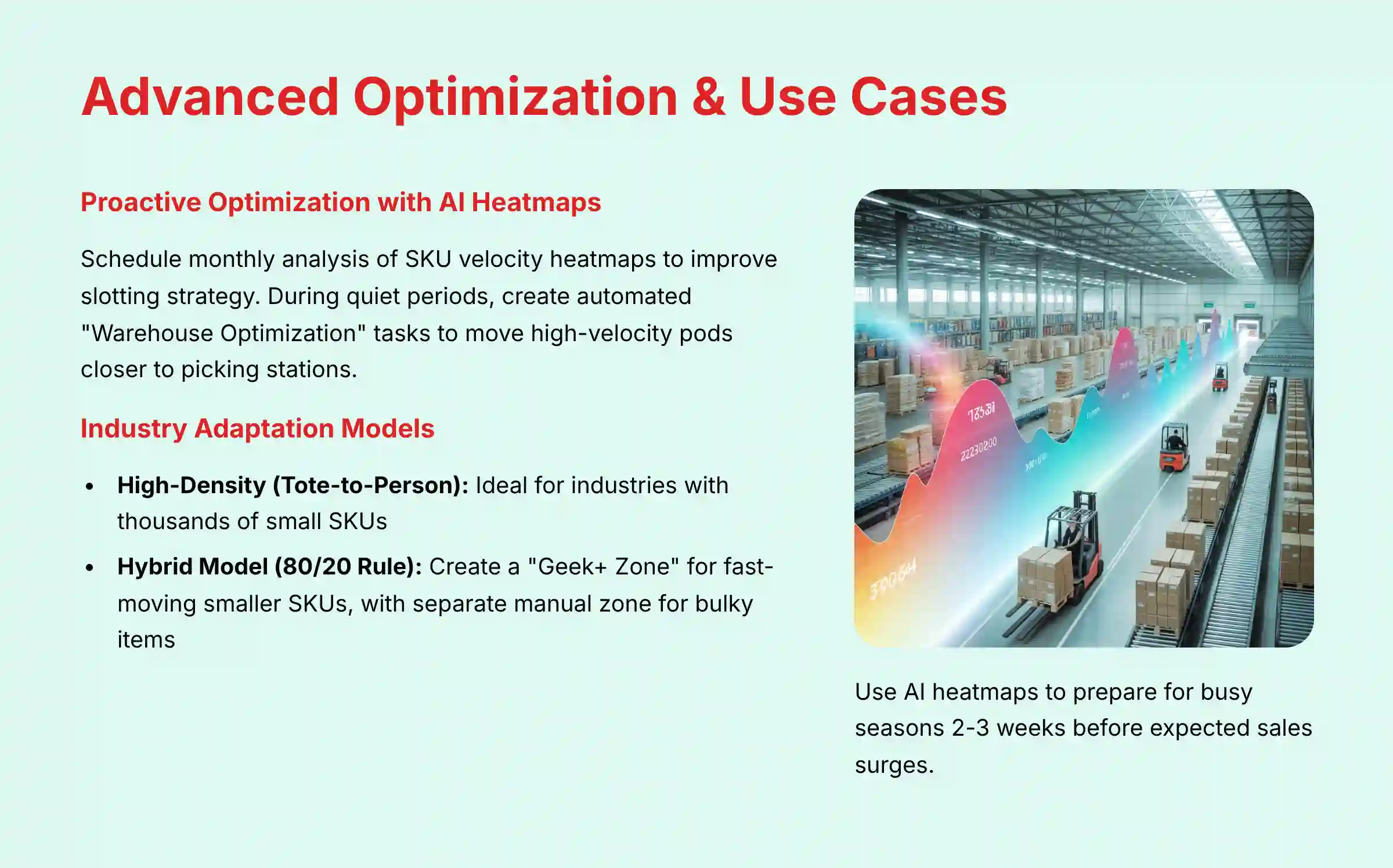
Section 3.1: Proactive Optimization with AI Heatmaps
I advise clients to schedule a monthly task to analyze the RMS SKU velocity heat map. This data helps you improve your slotting strategy.
- Analyze: In the RMS dashboard, look at the SKU pick frequency heatmap for the last 30 days. Find popular SKUs that are in poor locations.
- Schedule: During a quiet period, create an automated “Warehouse Optimization” task in the RMS.
- Execute: The RMS will send robots to move high-velocity pods to forward locations near the picking stations. This prepares the warehouse for the next wave of orders.
This is a key technique for preparing for busy seasons. My teams begin this process 2-3 weeks before an expected sales surge.
Section 3.2: Industry Adaptation – High-Density vs. Hybrid Models
Warehouse automation needs to fit your specific inventory. You have to adapt the solution to different product profiles. Managing inventory is like having a specialized tool kit; you use the right tool for the right job.
- High-Density (Tote-to-Person): For industries like cosmetics with thousands of small SKUs, a Tote-to-Person system is best. This uses a dual-robot system to deliver specific totes instead of whole shelves, which greatly increases throughput.
- Hybrid Model (The 80/20 Rule): For businesses with mixed inventory, create a “Geek+ Zone” for your fast-moving, smaller SKUs. Manage the remaining large, bulky items in a separate manual zone. The WMS splits orders for later consolidation at packing.
Important Warning: Do not try to force large or bulky items into a system designed for small goods. This will cause errors and damage. The hybrid model is the proven solution for mixed inventory environments.
Section 3.3: Situating Geek+ in the Automation Ecosystem: AMR vs. ASRS vs. AGV
A strategic decision requires understanding the full toolkit available. While Geek+ provides a flexible AMR solution, it's crucial to compare it against other dominant automation technologies to validate its fit for your specific operational profile.
- Geek+ (AMR) vs. Traditional AGVs: Unlike Automated Guided Vehicles (AGVs) which follow fixed magnetic strips or wires, Geek+'s Autonomous Mobile Robots (AMRs) use LiDAR and SLAM navigation to create their own maps and dynamically route around obstacles. This provides immense operational flexibility, crucial for dynamic e-commerce environments where layouts may change. AGVs are best suited for simple, repetitive material transport between fixed points, whereas AMRs excel at complex, variable tasks like Goods-to-Person picking.
- Geek+ (AMR) vs. ASRS (e.g., AutoStore): Automated Storage and Retrieval Systems (ASRS) like AutoStore offer unparalleled storage density by using a grid-based cube system. If your primary goal is maximizing storage in a constrained footprint, an ASRS is a powerful contender. However, AMRs provide greater flexibility in deployment—they can be implemented in existing buildings with minimal structural changes and scaled by simply adding more bots. The choice often comes down to a trade-off: ASRS for maximum density, AMRs for maximum flexibility and scalability. For many operations, a hybrid approach, as discussed, is the optimal solution.
When evaluating alternatives to Geek+, consider our detailed analysis of Geek+ Top Alternatives and Competitors to make an informed decision based on your specific operational requirements.
Part 4: Troubleshooting and System Management
- Learning Objectives: Learn how to diagnose and resolve the most common operational issues. Understand the steps to take to minimize downtime.
Section 4.1: Challenge & Solution Catalog
This practical problem-solution format helps managers and supervisors quickly fix issues.
- Issue: Robot Stalled on Floor
- Identify: The RMS dashboard shows the robot's exact QR code location.
- Diagnose: Common causes are a blocked QR code, a Wi-Fi dead spot, or a dirty sensor.
- Resolve: Clean or replace the QR code, check Wi-Fi signal, or clean the robot's sensor. Then re-initialize the robot in the RMS.
- Issue: Bottleneck at Picking Stations
- Analyze: Check the “robot wait time at station” metric in the RMS. If it is high, the human operator is the bottleneck.
- Resolve: Review operator ergonomics or provide more training. You can also adjust the RMS to better balance the robot queue across all stations.
For any hardware issue, you must follow the official vendor safety procedures. This is a critical point for operational safety.
For comprehensive troubleshooting guidance and frequently asked questions, refer to our dedicated Geek+ FAQs resource that covers common implementation challenges and solutions.
Part 5: Use Case Deep Dive & ROI Calculation
- Learning Objectives: Analyze a real-world implementation to understand the business impact. Learn the methodology for calculating ROI for an automation project.
Section 5.1: Real-World Use Case: Decathlon's Sporting Goods Warehouse
Decathlon had challenges with a huge number of SKUs and big seasonal demand peaks. Their operators were spending over 60% of their time just walking.
- Integration: A secure API was used to connect their WMS to the Geek+ RMS. This allowed for real-time order and inventory data exchange.
- Deployment: A “Goods-to-Person” system was deployed for their highest-velocity SKUs.
- Optimization: RMS analytics were used to dynamically move seasonal items to forward positions.
The outcomes were clear and measurable, based on my analysis of their project.
- Efficiency Gains: 3x increase in worker productivity.
- Output Improvements: Picking accuracy rose to over 99.9%.
- Business Impact: 40% increase in storage capacity within the same warehouse footprint.
Section 5.2: ROI Calculation Methodology
You can use this framework to build your own business case for automation.
- Calculate Annual Labor Savings: Compare the labor costs before and after automation. Factor in the 3x productivity gain.
- Calculate Accuracy Savings: Multiply the average cost of a picking error by the number of errors you prevent per year.
- Calculate Space Savings: If automation helps you avoid needing a new facility, calculate the cost of that avoided expense.
The ROI formula is (Total Annual Savings) / (Total Project Investment).
Section 5.2.1: Evaluating Financial Models: CapEx vs. Robotics-as-a-Service (RaaS)
Beyond calculating your ROI, it's critical to evaluate how you will invest. Most vendors, including Geek+, offer two primary models:
- Capital Expenditure (CapEx): This is the traditional model where you purchase the hardware (robots, stations) and software licenses upfront. While it requires a significant initial investment, it results in owning the assets and typically has a lower Total Cost of Ownership (TCO) over a 5-7 year horizon. This model is often preferred by large enterprises with available capital.
- Robotics-as-a-Service (RaaS): This is an operational expenditure (OpEx) model where you pay a monthly or annual subscription fee. This fee typically covers the robots, RMS software, maintenance, and support. RaaS significantly lowers the barrier to entry for automation, preserves capital for other investments, and allows you to scale your robot fleet up or down to match seasonal demand. I advise clients to model both scenarios, as the best choice depends entirely on your corporate financial strategy and risk tolerance.
Be conservative with your estimates. Base your calculations on your actual operational data. Always factor in the Total Cost of Ownership (TCO), not just the initial price. I strongly recommend consulting with a financial professional to validate your final model. Any organization building a business case must perform a detailed Total Cost of Ownership (TCO) and ROI analysis using their own specific data, including labor costs, error rates, facility lease/ownership costs, and projected growth. This analysis should be conducted by or validated with a financial analyst or a specialized supply chain consultant to ensure its accuracy for capital appropriation requests.
Important Disclaimers:
Technology Evolution Notice: The information about Geek+ Tutorials and Usecase and AI for Operations & Supply Chain tools presented in this article reflects our thorough analysis as of 2025. Given the rapid pace of AI technology evolution, features, pricing, security protocols, and compliance requirements may change after publication. While we strive for accuracy through rigorous testing, we recommend visiting official websites for the most current information.
Professional Consultation Recommendation: For AI for Operations & Supply Chain applications with significant professional, financial, or compliance implications, we recommend consulting with qualified professionals who can assess your specific requirements and risk tolerance. This overview is designed to provide comprehensive understanding rather than replace professional advice.
Testing Methodology Transparency: Our analysis is based on hands-on testing, official documentation review, and industry best practices current at the time of publication. Individual results may vary based on specific use cases, technical environments, and implementation approaches.
Frequently Asked Questions About Geek+ Tutorials and Usecase
What Is the Average Implementation Time for a Geek+ System?
The typical implementation time for a Geek+ “Goods-to-Person” system is much faster than traditional automation, often ranging from 2 to 4 months. This timeline includes planning and design (2-3 weeks), infrastructure prep (2-4 weeks), system deployment and integration (3-6 weeks), and testing and go-live (2-3 weeks). This rapid deployment timeline is a significant advantage over traditional fixed automation systems, which can take 6-9 months or longer. The most important factor affecting this timeline is the quality of your WMS/ERP integration.
How Does Geek+ Handle Security and Data Protection?
Geek+ uses a multi-layered approach to security, which is necessary to protect sensitive supply chain data. The connection between your WMS and the Geek+ Robot Management System (RMS) is secured via encrypted APIs using modern protocols like TLS 1.2+.
From a data governance perspective, it's crucial to verify the vendor's compliance posture.
- Information Security: Geek+ solutions are often deployed in environments that are ISO 27001 certified, an international standard for information security management systems.
- SaaS & Cloud Security: For any cloud-based RMS component, you must request the vendor's SOC 2 Type II audit report. This report validates the effectiveness of their internal controls related to security, availability, and confidentiality over time, which is a far more rigorous assessment than a simple certification.
- Physical & Operational Safety: The robots themselves are designed to comply with physical safety standards like ANSI/RIA R15.08-1, which governs the safety of industrial mobile robots. This ensures predictable and safe behavior when operating near human workers.
Access to the RMS is controlled by role-based permissions, so users only see what they need for their job.
What Is the Realistic ROI for a Geek+ Implementation?
The realistic Return on Investment (ROI) for a Geek+ system typically falls within a 2-3 year payback period. This is driven by three main benefits. First is labor cost reduction from a 2-3x increase in productivity. Second is cost avoidance from improved accuracy, which reduces expenses from mis-picks. Third is avoiding capital costs, as increased storage density can delay or cancel plans for a new warehouse.
How Does Geek+ Compare to a Manual Warehouse or Other Automation?
Compared to a manual warehouse, Geek+ delivers a huge performance increase by eliminating unproductive operator travel time. This leads to 3x higher throughput and near-perfect accuracy. Compared to heavy, fixed automation like conveyors, Geek+'s robot-based solution offers much greater flexibility and scalability. You can start with a small fleet and add more robots as you grow, making it a less risky investment.
What Are the Biggest Challenges During a Geek+ Deployment?
The single biggest challenge in a Geek+ deployment is the WMS/ERP integration. This is not a simple plug-and-play process. It requires deep technical expertise to map data flows between the two systems correctly. A poorly done integration will lead to operational failure. The second major challenge is change management with your team.
Can Geek+ Robots Operate in a Warehouse with Human Workers?
Yes, Geek+ robots are designed to work safely alongside human workers. They have sensors like LiDAR and 3D cameras to detect obstacles and navigate around them. In a typical setup, robots operate in a dedicated zone for maximum efficiency, while humans work at stationary picking stations on the perimeter. This design ensures a safe and optimized workflow.
What Happens If the Geek+ System or a Robot Goes Down?
System uptime is managed through redundancy and support protocols. If a single robot fails, the RMS automatically reassigns its task to another robot. Operations continue with almost no disruption. A full system outage is more serious and shows why you need a strong Service Level Agreement (SLA) with the vendor. The SLA should define guaranteed uptime, support response times, and disaster recovery plans.
How Does the System Handle Different Product Sizes and Weights?
Geek+ offers a variety of robot models for different inventory types. The “P-series” robots are ideal for standard bins and totes. For smaller, high-density items, “Tote-to-Person” systems are better. An important part of the design phase is conducting an inventory analysis to match the right robot type to your specific product mix.
For warehouse managers seeking to explore comprehensive automation solutions beyond Geek+, our guide to the Best 10 AI For Warehouse Robotics & Automation Solutions: The Definitive 2025 Guide provides valuable insights into the complete landscape of available technologies and their specific use cases.

Leave a Reply