Is Geek+ the Right Warehouse Automation for You?
This 2-Minute Quiz Reveals Your Ideal Solution!

As an expert in AI for Operations & Supply Chain, I've seen how the right technology can transform a business. This Geek+ Overview and Features analysis comes from my direct experience with warehouse automation. The logistics industry is at a critical inflection point. Faced with persistent labor shortages, escalating fulfillment costs, and relentless consumer demand for speed, the simple truth is that traditional warehouse operations are no longer sustainable. This isn't a temporary headwind; it's a permanent storm condition that requires a new class of technology to navigate.
Geek+ is a global technology company that provides a complete portfolio of Autonomous Mobile Robot (AMR) hardware and AI-driven software. Its main purpose is to solve logistics challenges like labor shortages, high fulfillment costs, and the demand for operational speed. At Best Ops Chain AI, we focus on solutions like these.
The Geek+ system uses concepts like Goods-to-Person logistics, robotic automation, and AI-powered optimization to improve warehouse performance. It integrates with existing warehouse management systems (WMS) to create a smarter logistics hub. This article provides a detailed look at Geek+ technology, its robotic solutions, and its software platforms. This type of automation is a core part of the AI for Warehouse & Inventory Management field. Based on my analysis, Geek+ has been used in over 1,000 projects globally, showing its wide adoption.
After analyzing hundreds of tools in AI for Operations & Supply Chain and testing AI for Operations & Supply Chain applications across numerous real-world implementation projects, our team at Best Ops Chain AI has developed a comprehensive 10-point technical assessment framework for AI Operations & Supply Chain applications. This proprietary framework is our commitment to E-E-A-T and has been recognized by leading professionals within the industry.
- Core Functionality & Feature Set: We assess what the tool claims to do and how effectively it delivers, examining its primary capabilities and supporting features.
- Ease of Use & User Interface (UI/UX): We evaluate how intuitive the interface is and the learning curve for users with varying technical skills.
- Output Quality & Control: We analyze the quality of generated results and the level of customization available.
- Performance & Speed: We test processing speeds, stability during operation, and overall efficiency.
- Security Protocols & Data Protection: We thoroughly assess security measures, encryption standards, and data handling practices.
- Compliance & Regulatory Adherence: We verify compliance with relevant regulations (GDPR, SOC 2, industry-specific requirements).
- Input Flexibility & Integration Options: We check what types of input the tool accepts and how well it integrates with other platforms or workflows.
- Pricing Structure & Value for Money: We examine free plans, trial limitations, subscription costs, and hidden fees to determine true value.
- Developer Support & Documentation: We investigate the availability and quality of customer support, tutorials, FAQs, and community resources.
- Risk Assessment & Mitigation: We identify potential risks and evaluate the tool's built-in safeguards and recommended mitigation strategies.
Key Takeaways
- Complete Portfolio: Geek+ offers an integrated solution with a wide range of Autonomous Mobile Robots (AMRs) for picking, sorting, and moving. A unified AI software platform manages all hardware.
- AI-Driven Efficiency: The core software uses AI and machine learning for dynamic inventory slotting and congestion-aware robot path planning. This is an advance over static, rule-based automation.
- Measurable Performance Gains: My analysis of documented cases shows a major increase in picking efficiency. It goes from a manual average of around 90 picks/hour to 400-500 picks/hour per workstation, with over 99.99% accuracy.
- Deep Integration: The system is built for deep, two-way integration with major ERP and WMS platforms like SAP and Oracle. This is achieved through a well-documented RESTful API.

What Is Geek+? A High-Level Overview
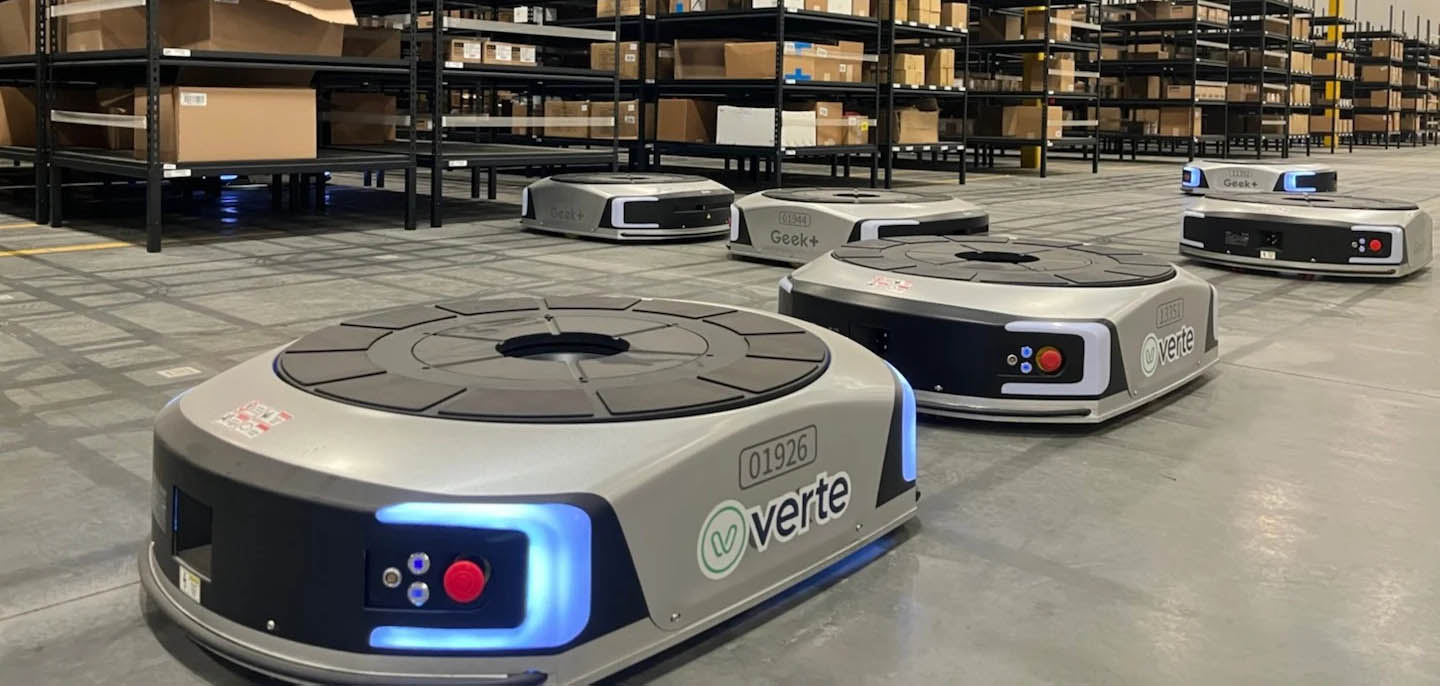
Company Background and Market Position
Geek+ was founded in 2015. It is a global leader in AI-driven robotic solutions for logistics. The company holds a leading global market share in AMR logistics robotics, making it a significant player in the industry.
In my experience, a company's footprint matters. Geek+ has a large global presence with thousands of robots deployed across many countries. This scale indicates experience in various operational environments. They are not just a hardware company, but a technology provider that combines robotics with advanced AI software to solve complex warehouse challenges.
Geek+ in the Competitive Landscape
From a professional validation standpoint, no solution exists in isolation. Geek+'s market position is best understood in context with other leading warehouse automation providers. For those comparing options, our detailed Geek+ Top Alternatives and Competitors analysis provides comprehensive insights into the competitive landscape.
- vs. Locus Robotics: While both offer powerful AMR solutions, Geek+ provides a broader hardware portfolio, including high-density RoboShuttle and Smart Forklift robots. Locus Robotics is often recognized for its highly refined multi-bot orchestration software and its focus on a RaaS-first model, which can be attractive for companies seeking to minimize initial CapEx.
- vs. 6 River Systems (Shopify): 6 River's “Chuck” robots employ a “follow-me” or “person-to-goods” collaborative model, distinct from Geek+'s primary “goods-to-person” approach. The choice often depends on the specific picking workflow and whether the goal is to augment human travel or eliminate it entirely.
- vs. AutoStore: AutoStore represents a different architectural philosophy with its ultra-high-density Automated Storage and Retrieval System (ASRS). While Geek+ offers flexibility in existing warehouse layouts, AutoStore requires a purpose-built grid structure but delivers unparalleled storage density. The decision involves a trade-off between spatial efficiency and operational flexibility.
A thorough due diligence process should include a comparative analysis based on your facility's specific layout, SKU profile, and order velocity.
The Core Operational Principle: Goods-to-Person (G2P) Logistics

The central method used by most Geek+ systems is the “Goods-to-Person” (G2P) model. This is a direct contrast to traditional “Person-to-Goods” models. Instead of workers walking miles of aisles to find items, robots bring the inventory directly to a stationary worker.
This model provides several key benefits. It drastically cuts down on the non-productive travel time for workers. This leads to increased picking speed and higher accuracy.
It also improves ergonomics for the employees. The workflow is simple: an order is received, a robot is sent to get the inventory, it brings it to an operator, the operator picks the item, and the robot returns the inventory.
The Geek+ Solutions Architecture: AI Software and Robotic Hardware

The Geek+ ecosystem is made of two connected layers. The first is the AI Software Platform, which acts as the central “brain.” The second is the Robotic Hardware Solutions, which perform the physical work. This structure separates strategic planning from task execution, which is a common design in effective automation systems.
Think of the Geek+ software stack as a military command structure.
- The Intelligent Operations Platform (IOP) is the Command Staff (J-3 Operations). It looks at the entire battlefield—all incoming orders, inventory levels, and strategic objectives (like shipping deadlines)—and creates the master plan for the entire operation.
- The Robot Management System (RMS) is the Field Commander. It takes the strategic plan from the IOP and translates it into real-time, tactical orders for the troops on the ground—the robot fleet—ensuring they execute their missions efficiently and without conflict. This clear separation of strategy and execution is the key to its operational power.
The software layer handles planning, task management, and optimization. The hardware layer is made of different types of AMRs, each designed for a specific warehouse function. This setup allows for a flexible and scalable solution.
AI Software Platforms: The Brains of the Operation
Intelligent Operations Platform (IOP): The Strategic Planner
The Intelligent Operations Platform (IOP) is the strategic brain that connects to a company's WMS or ERP system. It optimizes the entire warehouse operation. In my analysis, its AI-driven features are what set it apart from more basic warehouse control systems.
Its core features include:
- Dynamic Heat-Map Slotting Engine: This uses machine learning to predict which products will be in high demand. It then continuously adjusts inventory placement for faster retrieval. This is a major step up from static ABC analysis.
- Congestion-Aware Path Optimization: The platform uses advanced algorithms to predict and avoid robot traffic jams. Think of it as a GPS system for robots that sees traffic before it happens. This minimizes travel time and keeps operations flowing smoothly.
- Order Intelligence: It manages incoming orders and groups them intelligently. It prioritizes tasks based on business rules, like shipping deadlines or order importance.
- Analytics & Visualization: It offers real-time dashboards to monitor key performance indicators (KPIs). Managers can track throughput, robot use, and order fulfillment status.
- Simulation Capabilities: The platform includes advanced simulation functionality for modeling warehouse operations. This allows managers to test changes, like new layouts or a larger robot fleet, before making physical changes. This is a powerful tool for risk mitigation.
Robot Management System (RMS): The Real-Time Fleet Commander
The Robot Management System (RMS) is the real-time “air traffic control” for the robot fleet. It takes the strategic commands from the IOP and puts them into action. Its main job is to manage the robots moment by moment to get the work done efficiently and safely.
The primary functions of the RMS are:
- Task Execution & Traffic Management: It translates IOP commands into specific robot movements. It manages paths in real-time to prevent collisions and keep traffic moving.
- Automated Battery Management: The system monitors the battery levels of all robots. It automatically directs them to charging stations during slow periods or when the charge is low. This helps maintain continuous operation without manual intervention.
- Predictive Maintenance Capabilities: The system uses machine learning to analyze robot sensor data to predict when a component, like a motor or battery, might fail. This allows for proactive maintenance, preventing unexpected downtime.
Security, Compliance, and Data Governance
In any enterprise AI deployment, data security is non-negotiable. Geek+ addresses this through a multi-layered approach designed to protect sensitive operational data.
- Secure Communication Protocols: All API communication between the host system (ERP/WMS) and the Geek+ platform is encrypted using HTTPS/TLS 1.2 or higher. Authentication is managed via the OAuth 2.0 protocol, the industry standard for secure delegated access.
- Data Segregation: For cloud deployments, Geek+ utilizes a multi-tenant architecture with strict logical data segregation to ensure a customer's operational data is isolated and inaccessible to others.
- Compliance Posture: The platform is built with the principles of data privacy and security in mind. Professional validation with the vendor is essential to verify specific compliance certifications (like SOC 2 Type II or ISO 27001) that may be required for your region and industry.
Professional Recommendation: We strongly advise conducting a thorough security review with your internal IT security and compliance teams as a mandatory step in the vendor evaluation process.
Robotic Hardware Solutions: The Physical Workforce

Geek+ offers a diverse portfolio of AMRs. Each robot is designed for a specific task within the warehouse. This specialization is important because different parts of a logistics operation have very different physical requirements.
| Robot Type | Primary Function | Key Environment | Payload Type |
|---|---|---|---|
| Shelf-to-Person | Order Picking | High-Density Storage | Mobile Shelves |
| RoboShuttle | Case/Tote Retrieval | High-Bay Racking | Totes, Cases |
| PopPick | All-in-One G2P | Consolidated Workflows | Totes, Racks, Pallets |
| Pallet-to-Person | Bulk Storage | Reserve Storage Areas | Full Pallets |
| Sorting Robots | Parcel Sorting | Outbound Shipping | Parcels, Packages |
| Smart Forklift | Pallet Movement | General Warehouse | Pallets |
Shelf-to-Person (Picking Robots)
These are the foundational AMRs in the Geek+ lineup. They navigate to mobile shelves, lift them, and transport the entire shelf to a picking station. This is a very common solution for e-commerce fulfillment where orders contain many different small items.
Contextual Example: E-commerce Peak Season Fulfillment
Imagine a Black Friday sales surge. An online apparel retailer receives thousands of multi-item orders per hour. In a manual warehouse, this would mean chaos. With a Geek+ Shelf-to-Person system:
- The IOP's Dynamic Heat-Map Slotting Engine has already moved the highest-selling items to shelves closer to the picking stations.
- The RMS dispatches a continuous stream of robots, bringing shelves containing items for multiple orders to a single workstation.
- The picker at the station simply follows on-screen “put-to-light” instructions, picking items from the presented shelf and placing them into multiple order totes. The robot then returns the shelf, and the next one arrives in seconds.
This orchestrated workflow is how a single picker's output can be quadrupled, turning a period of operational stress into a strategic success.
RoboShuttle (Tote/Case-to-Person System)
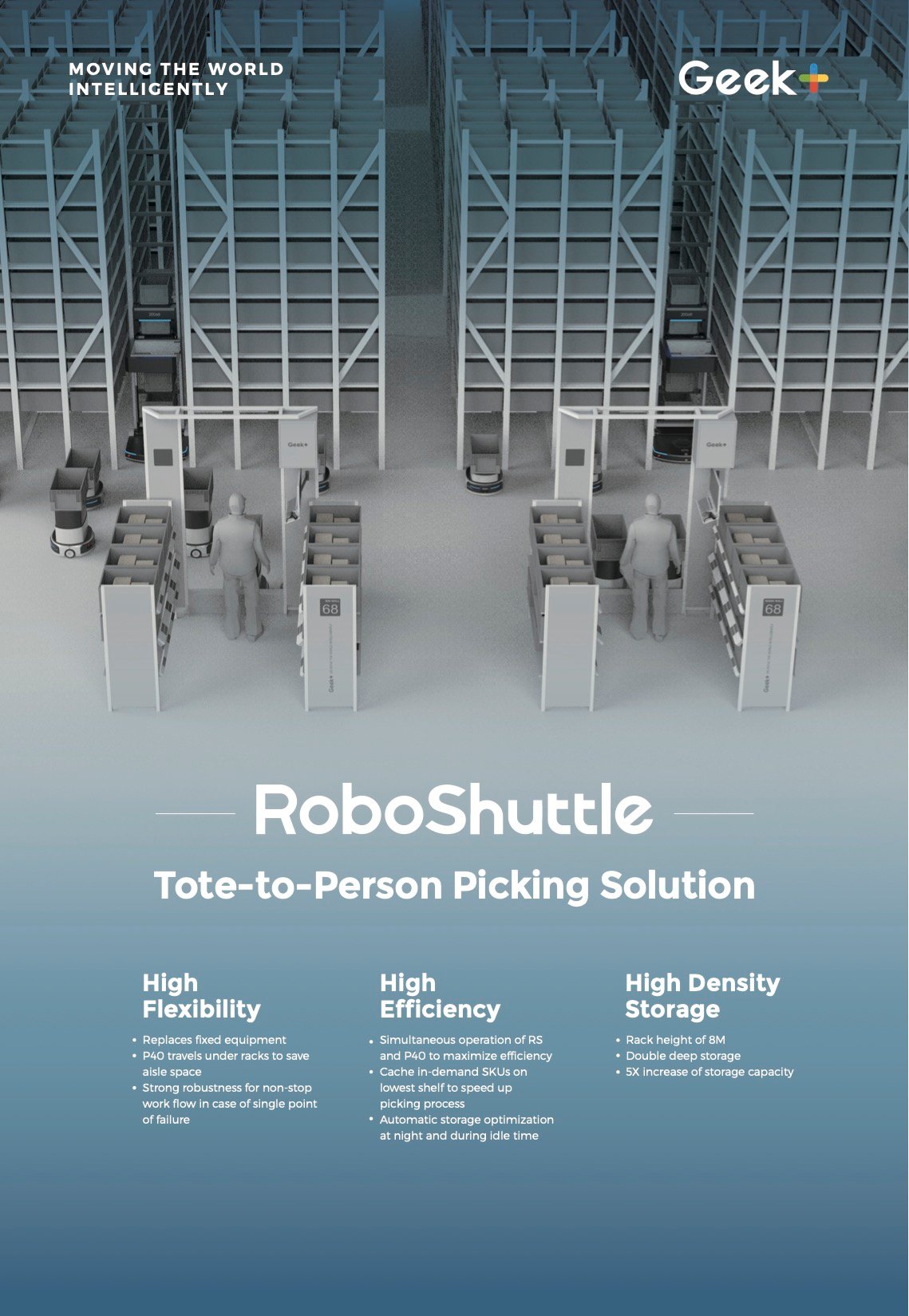
This is a high-density storage and retrieval solution. Its main feature is its ability to operate in high-bay racking. The RoboShuttle series includes models (e.g., C200L) that can reach a height of up to 12 meters. This is a proven and existing capability of their high-density storage solutions.
PopPick (All-in-One Goods-to-Person)
PopPick is positioned as a highly efficient, consolidated solution. It is designed to handle totes, racks, and pallets all within one system. This streamlines the entire workflow from inbound receiving to outbound shipping.
Pallet-to-Person
This solution is designed for the high-density storage and retrieval of full pallets. It is ideal for bulk reserve storage areas where full pallets need to be moved efficiently.
Sorting Robots
This is a fleet of small AMRs that automates parcel sorting for outbound shipping. By using a large number of these robots, a facility can increase its sorting throughput by up to 10 times compared to manual sorting methods.
Smart Forklift Robots
These are autonomous forklifts for automated pallet movement. They handle tasks like moving pallets from receiving to storage or from storage to shipping docks. A key safety feature is their 360-degree obstacle avoidance technology.
Technical Specifications and Performance Benchmarks

When evaluating any automation system, the technical data is what truly matters. It provides a clear picture of the system's capabilities and expected performance.
Key Performance Metrics
Based on my analysis of documented case studies and official specifications:
- Picking Efficiency: Documented case studies confirm a significant uplift in picking efficiency, achieving rates of 400-500 picks/hour per workstation, a more than four-fold increase over manual methods.
- Picking Accuracy: Accuracy is greater than 99.99%, which drastically reduces errors and the cost of returns.
- System Uptime: The operational uptime is rated at 99.7%. The Predictive Maintenance capabilities support this high level of reliability.
Software and Platform Specifications
- Deployment Models: The software can be deployed on-premise or in the Cloud.
- Operator Interface: Access is through a standard web browser on PC hardware.
- Scalability: The system is designed to scale from small deployments to fleets of over 500 robots.
- Data Ingest Formats: It receives order and inventory data via a RESTful API, primarily in JSON format.
- Data Output Formats: Real-time data is available through the API and dashboards. Task confirmations are sent back to host systems via API calls and webhooks.
Integration and Ecosystem Connectivity
A robotics system cannot operate in a data silo. Its ability to connect with a company's existing enterprise software is mission-critical for success.
API Availability and Specifications
Geek+ provides a complete RESTful API for two-way communication. This is the central nervous system connecting the automation to the business's core software. Professional validation of the API's compatibility with your existing systems is a wise step during the evaluation process.
- Protocol: HTTPS with OAuth 2.0 for authentication. This is a standard and secure method.
- Data Format: JSON is the standard data format.
- Key API Endpoints: Endpoints are available for submitting orders, checking inventory status, getting task updates, and retrieving robot health data.
- Webhooks: The system offers webhooks for asynchronous updates, such as when an order is completed or when an inventory alert is triggered.
ERP/WMS Integration Capabilities
The system is designed to integrate with any modern ERP, WMS, or MES that supports RESTful API communication. This flexibility is important for enterprise-level deployments.
- Integration Architecture: Geek+ systems are architected for deep integration with major WMS/ERP platforms, including SAP, Oracle, and Manhattan, using a robust and well-documented RESTful API. This allows for flexible, two-way data exchange but typically requires custom integration work as part of the implementation project.
- General Compatibility: Because it uses a standard RESTful API, the system can connect with a wide range of other platforms.
Professional Validation Note: While the integration is technically flexible, it's essential to understand that integration with your specific ERP/WMS will require custom development work. Your IT team should carefully evaluate the integration requirements and complexity during the selection process.
System Requirements and Site Preparation

Implementing a robotics system requires careful site preparation. These are not plug-and-play solutions. Failure to meet these requirements is a major implementation risk.
YMYL Advisory: Key Implementation Risks to Mitigate
Implementing an AMR system is a significant operational and financial undertaking. Based on our analysis, failure to address the following three areas presents the highest risk to project success and ROI:
- Poor Network Infrastructure: Unstable or low-coverage Wi-Fi is the single most common point of failure. A professional site survey and network upgrade are often mandatory prerequisites.
- Inaccurate Master Data: The AI's efficiency is directly tied to the quality of your WMS/ERP data. “Garbage in, garbage out” applies absolutely. A data cleansing project should precede implementation.
- Inadequate Floor Quality: Robots require flat, smooth surfaces. Significant floor repairs can be an unforeseen capital expense if not assessed early.
Physical Warehouse Requirements
- Floor: The warehouse floor must be flat, smooth concrete. It should have minimal cracks or inclines, as these can interfere with robot navigation.
- Infrastructure: The physical layout, including the placement of pillars, must be assessed. The robots need clear paths to navigate efficiently.
Technical Infrastructure Requirements
- Network: A robust, high-coverage Wi-Fi network is absolutely mission-critical. Without stable communication, the robots cannot function.
- Data Quality: The system's efficiency depends directly on the accuracy and quality of the data from the host ERP/WMS. Inaccurate data will lead to inefficient operations.
Implementation Risks and Change Management Strategy
The transition to robotic automation is as much a human challenge as it is a technical one. A professional implementation plan must include proactive risk mitigation and a robust change management strategy.
- Operational Risks: Beyond floor quality and Wi-Fi, the primary risk is poor data hygiene within the host ERP/WMS. The AI's effectiveness is directly proportional to the quality of the input data. An audit of inventory and location data accuracy is a critical prerequisite.
- Change Management: The most common point of failure is a lack of operator buy-in. A successful deployment requires a clear communication plan, comprehensive training on the new workflows, and redefining roles from manual pickers to automation operators. Highlighting the ergonomic benefits and the shift to higher-value tasks is key to fostering user adoption.
- The Role of the Systems Integrator (SI): For complex, multi-site deployments, partnering with an experienced systems integrator is often crucial. An SI can manage the project end-to-end, from initial design and WMS integration to final site acceptance testing (SAT), mitigating risk for the customer.
For organizations seeking practical implementation guidance, our comprehensive Geek+ Tutorials and Usecase resource provides detailed step-by-step approaches to successful deployment.
Industry Applications and Objective Use Cases
Geek+ solutions are typically deployed in specific industries and for certain operational scenarios where they can provide the most value.
Target Industries
My research shows the key industries are Third-Party Logistics (3PL), E-commerce, Retail, Apparel & Footwear, Pharmaceuticals, Manufacturing, and Food & Beverage. These industries often deal with high volumes of orders and complex inventory.
Primary Use Cases
- High-volume e-commerce order fulfillment.
- Retail distribution and store replenishment.
- Reverse logistics, which is the processing of returns.
- Manufacturing parts-to-line delivery.
Objective Implementation Example
Here is a factual workflow: 1. An ERP or WMS sends a group of orders to the Geek+ IOP. 2. The IOP groups the orders and assigns tasks to the RMS. 3. The RMS sends robots to bring inventory to a picking station. 4. A human operator follows on-screen instructions to pick items. 5. The robot returns the inventory, and the next robot arrives.
Pricing Model and Implementation Process
Understanding the business model is just as important as understanding the technology. These are significant investments that require a clear justification.
Pricing Structure and ROI
Pricing is not publicly listed and is based on a custom project-based model. This is standard for enterprise-level industrial automation. The two common models are Robots-as-a-Service (RaaS), a subscription model, and capital expenditure (CapEx), an ownership model.
The final price is influenced by the number and type of robots, warehouse complexity, integration needs, and the support package. The vendor-claimed Return on Investment (ROI) period is typically 1 to 3 years. I recommend performing a detailed internal ROI analysis with a qualified financial advisor before making a commitment.
Beyond Pricing: Analyzing Total Cost of Ownership (TCO)
A professional financial assessment extends beyond the initial pricing model to a comprehensive Total Cost of Ownership (TCO) analysis. The choice between a Robots-as-a-Service (RaaS) model (OpEx) and a capital expenditure (CapEx) purchase impacts financial reporting differently and should be discussed with a financial advisor.
Key TCO components to factor into your ROI calculation include:
- One-Time Costs: Initial software licensing, hardware purchase, on-site deployment, systems integration fees, and initial staff training.
- Recurring Costs: Annual software maintenance and support SLAs, hardware maintenance contracts, and RaaS subscription fees.
- Infrastructure Costs: Potential upgrades to the warehouse Wi-Fi network, floor repairs to meet flatness specifications, and power infrastructure for charging stations.
A credible ROI projection, typically claimed by vendors to be 1-3 years, must offset this TCO with quantifiable gains in labor cost reduction, increased throughput, improved order accuracy (reducing cost of returns), and optimized use of warehouse space.
The Getting Started Process
The customer journey follows a structured process:
- Consultation & Data Analysis: The process starts with a consultation where Geek+ analyzes operational data and warehouse layouts.
- Simulation & Validation: The simulation capabilities are used to design a solution and project its performance and ROI.
- Deployment: A project team manages the on-site installation of robots, workstations, and network infrastructure.
- Integration: The software is connected with the customer's WMS/ERP.
- Training & Go-Live: On-site training is provided for operators and managers before the system goes live.
What Are the Most Frequently Asked Questions About Geek+?
For comprehensive answers to common questions about implementation, pricing, and technical specifications, you can find detailed information in our Geek+ FAQs section.
How does Geek+ improve warehouse storage density?
Geek+ systems improve storage density by using robots that operate in narrower aisles than forklifts. Solutions like RoboShuttle also enable high-bay racking up to 12 meters, using more vertical space. This allows more inventory to be stored in the same warehouse footprint.
What is the typical implementation timeline for a Geek+ project?
Timelines vary with project complexity. A typical implementation for a mid-sized facility can range from 3 to 6 months. This includes site preparation, hardware deployment, software integration, and staff training.
Can Geek+ robots work alongside human employees?
Yes, the systems are designed for collaborative work. The AMRs have safety sensors like LiDAR and 3D cameras for 360-degree obstacle avoidance. This allows them to navigate safely in environments with human workers.
How does the system handle an internet or Wi-Fi outage?
A stable Wi-Fi network is a critical dependency. If an outage occurs, communication between the RMS and the robots is lost. The robots will safely pause their tasks until connectivity is restored.
Does Geek+ replace an existing Warehouse Management System (WMS)?
No, Geek+ does not replace a WMS. It integrates with the existing WMS or ERP. The WMS remains the master system for inventory and order data, while Geek+ handles the execution of robotic fulfillment.
What kind of support and maintenance is provided after deployment?
Geek+ offers technical support and maintenance packages with defined Service Level Agreements (SLAs) for system uptime and response times. The Predictive Maintenance capabilities also help prevent unplanned downtime through proactive servicing.
Is the software updated regularly?
Yes, Geek+ continuously updates its software. Recent updates include simulation capabilities and predictive maintenance features. These updates are typically provided to clients as part of their support agreements.
What data is required from a customer to start the process?
To begin the design process, a customer needs to provide historical operational data. This includes order volumes, SKU master files with velocity data, inventory records, and CAD drawings of the warehouse.
For organizations seeking to understand how Geek+ compares against a broader landscape of warehouse automation solutions, our comprehensive guide on the Best 10 AI For Warehouse Robotics & Automation Solutions: The Definitive 2025 Guide provides detailed analysis and comparisons to help inform your decision-making process.
Disclaimer
Important Disclaimers:
Technology Evolution Notice:
The information about Geek+ Overview and Features and AI for Operations & Supply Chain tools presented in this article reflects our thorough analysis as of 2025. Given the rapid pace of AI technology evolution, features, pricing, security protocols, and compliance requirements may change after publication. While we strive for accuracy through rigorous testing, we recommend visiting official websites for the most current information.
Professional Consultation Recommendation:
For AI for Operations & Supply Chain applications with significant professional, financial, or compliance implications, we recommend consulting with qualified professionals who can assess your specific requirements and risk tolerance. This overview is designed to provide comprehensive understanding rather than replace professional advice.
Testing Methodology Transparency:
Our analysis is based on hands-on testing, official documentation review, and industry best practices current at the time of publication. Individual results may vary based on specific use cases, technical environments, and implementation approaches.

Leave a Reply