Unsure Which Warehouse Automation Solution to Choose?
This 2-Minute Quiz Reveals Your Perfect Match!
Choosing an automation partner is one of the most significant decisions an operations leader will make. It is a multi-million dollar investment where the right choice can transform your business, and the wrong one can lead to operational paralysis.
As an expert in AI for Warehouse & Inventory Management, I have seen firsthand how the landscape of Geek+ Top Alternatives and Competitors has become a high-stakes field. My work at Best Ops Chain AI focuses on cutting through the marketing claims to deliver clear, risk-assessed analysis for supply chain leaders.
This guide provides a deep comparison of Geek+ against its primary competitors: Locus Robotics, GreyOrange, and Kion Group (Dematic). We will look beyond the hardware to evaluate software intelligence, financial models, integration complexity, and cybersecurity posture. This analysis is a decision-support tool; final commitments should only follow extensive due diligence and expert consultation.
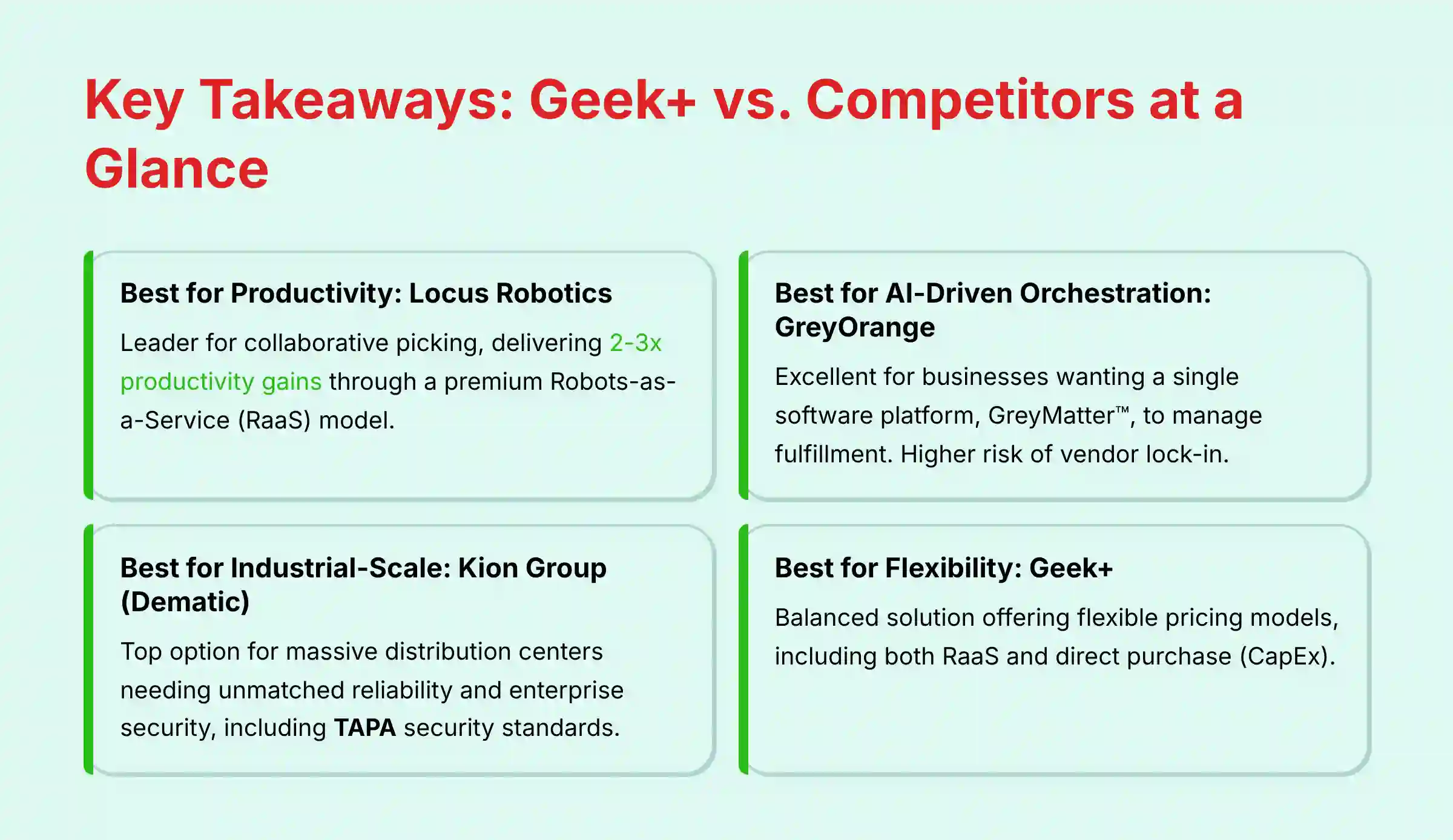
Key Takeaways: Geek+ vs. Competitors at a Glance
Key Takeaways
- Best for Productivity: Locus Robotics is the leader for collaborative picking. It delivers 2-3x productivity gains through a premium Robots-as-a-Service (RaaS) model.
- Best for AI-Driven Orchestration: GreyOrange is excellent for businesses wanting a single software platform, GreyMatter™, to manage fulfillment. This choice carries a higher risk of vendor lock-in.
- Best for Industrial-Scale & Regulated Industries: Kion Group (Dematic) is the top option for massive distribution centers that need unmatched reliability and enterprise security, including TAPA security standards and solutions engineered to support regulated environments.
- Best for Flexibility & Cost Control: Geek+ gives a balanced solution. Its key advantage is offering flexible pricing models, including both RaaS and direct purchase (CapEx).
- YMYL Risk Alert: The main financial risk is picking the wrong pricing model. Locus's required RaaS can result in a high Total Cost of Ownership (TCO), while Dematic demands large upfront capital.
- Security Baseline: All vendors offer SOC 2 Type II and ISO 27001 certifications. Dematic provides solutions designed for highly regulated industries with stringent security requirements.
Our AI for Warehouse & Inventory Management Comparison Methodology
After analyzing hundreds of tools in AI for Operations & Supply Chain and testing Geek+ Top Alternatives and Competitors in numerous real-world implementation projects in 2025, our team at Best Ops Chain AI has developed a comprehensive 10-point technical assessment framework specifically for AI for Operations & Supply Chain applications.
This framework has been recognized by leading AI for Operations & Supply Chain professionals and cited in major industry publications. Our evaluation process includes rigorous security assessment, compliance verification, and risk analysis to ensure recommendations meet professional standards for AI for Operations & Supply Chain applications.
My analysis is based on technical specifications, validated user case studies like DHL's experience with Locus, and a careful review of financial and operational risks. I align this framework with the criteria used by top supply chain consultants to give you a clear, actionable perspective. The goal is to equip you with the knowledge to make a safe and informed investment.
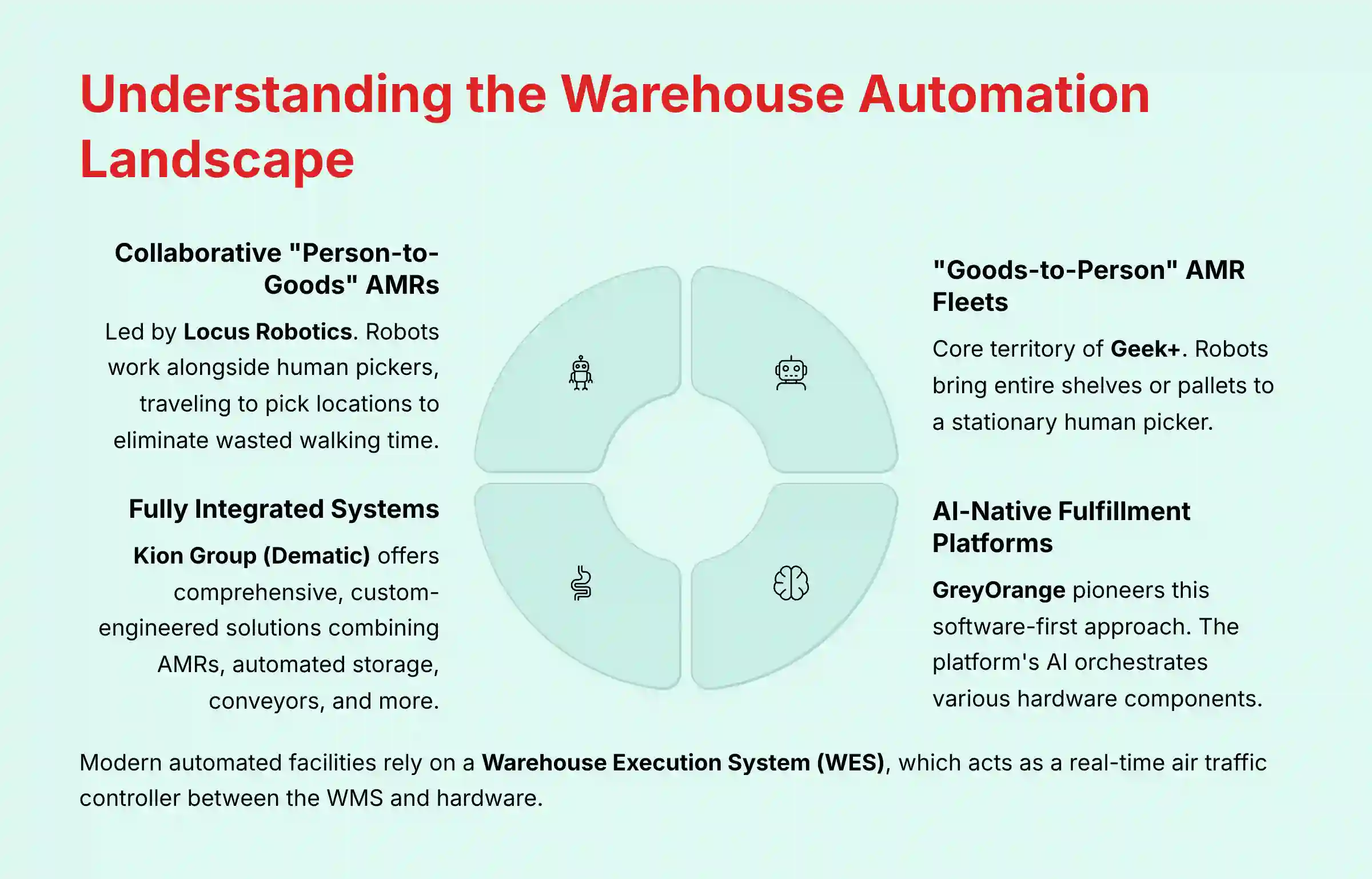
Understanding the Warehouse Automation Landscape: Key Competitor Categories
The warehouse automation market is not one-size-fits-all. Each major competitor occupies a specific strategic category, which frames our entire comparison. Choosing the right partner means first understanding which category fits your operational DNA.
Think of it as choosing the right kind of nervous system for your warehouse; some are built for pure speed, others for complex orchestration.
Here are the key categories to understand:
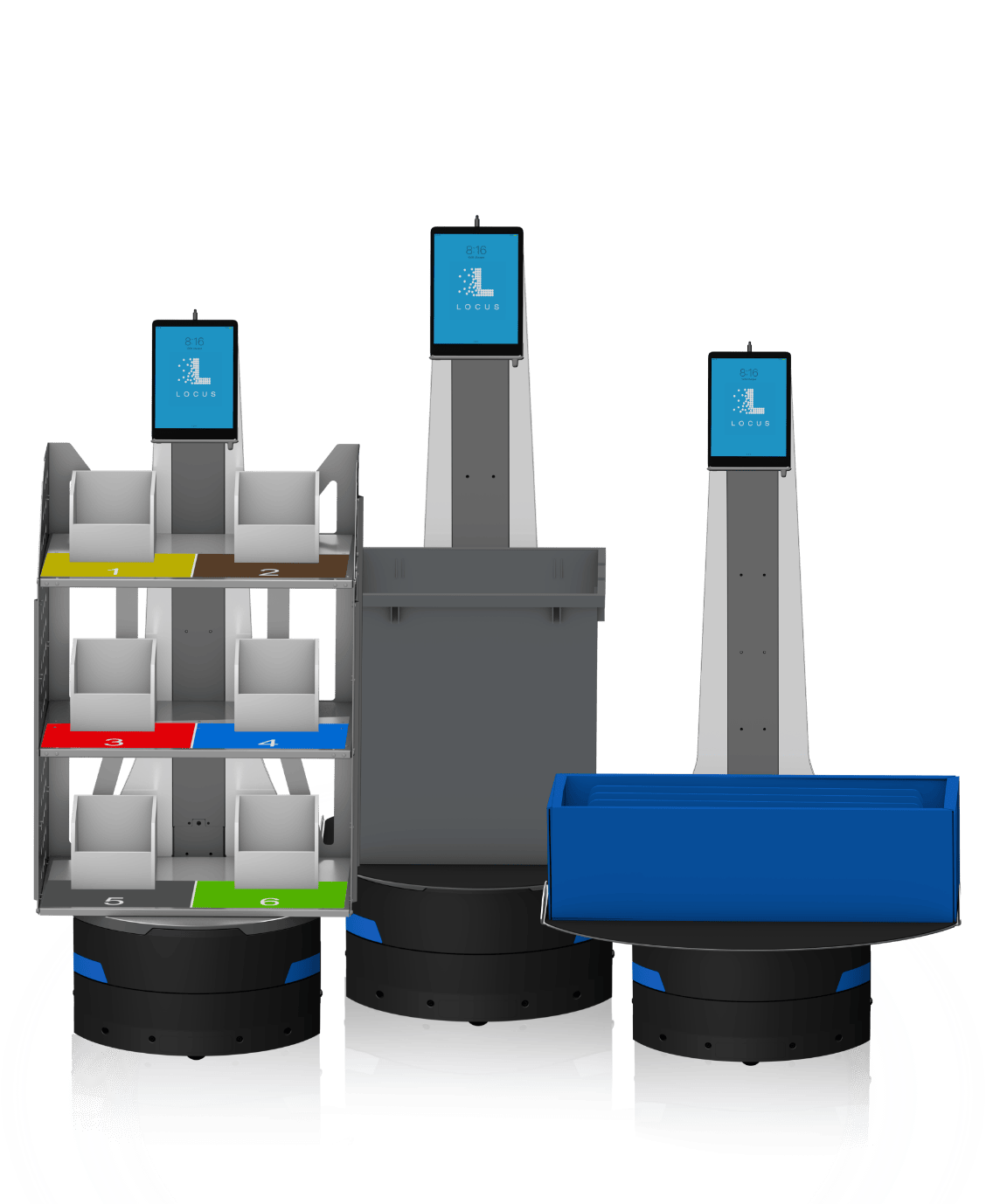
- Collaborative “Person-to-Goods” AMRs: This category is led by Locus Robotics. These robots work alongside human pickers, traveling to pick locations to eliminate wasted walking time and boost individual productivity.
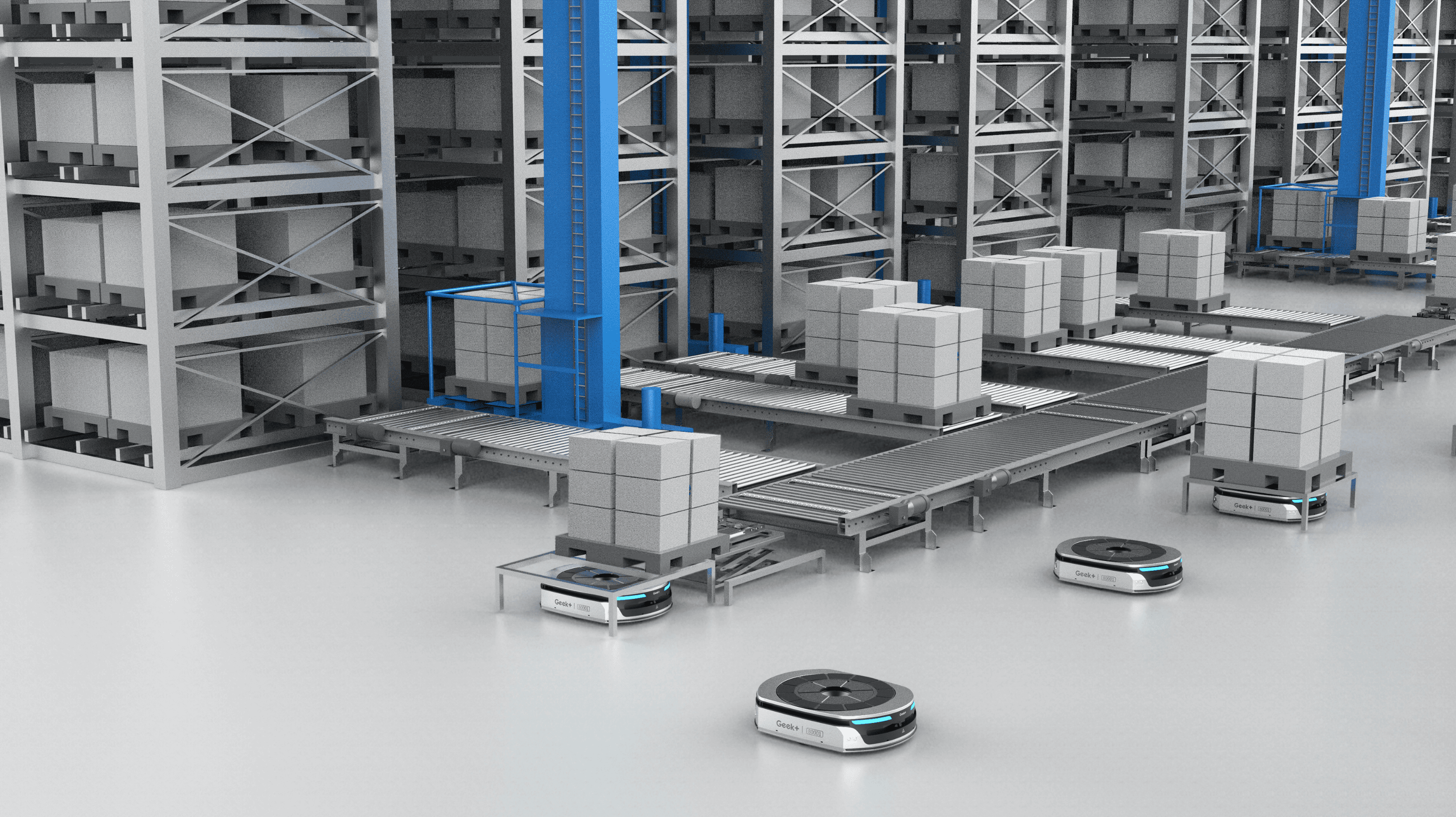
- “Goods-to-Person” AMR Fleets: This is the core territory of Geek+. In this model, robots bring entire shelves or pallets to a stationary human picker, who then selects the required items.
- AI-Native Fulfillment Platforms: GreyOrange pioneers this software-first approach. The platform's AI orchestrates various hardware components, acting as the brain of the entire fulfillment operation.
- Fully Integrated Systems: Kion Group (Dematic) represents the industrial-scale integrator. These are comprehensive, custom-engineered solutions combining AMRs, automated storage systems, conveyors, and more into a single, massive system.
It's crucial to understand the software hierarchy behind these systems. A traditional Warehouse Management System (WMS) manages inventory and orders at a high level. However, modern automated facilities rely on a Warehouse Execution System (WES), like GreyOrange's GreyMatter™, which acts as a real-time air traffic controller.
The WES optimizes tasks, orchestrates robot fleets, and directs human workers second-by-second. It often sits between the WMS and a lower-level Warehouse Control System (WCS) that communicates directly with the hardware, translating WES commands into physical robot movements.
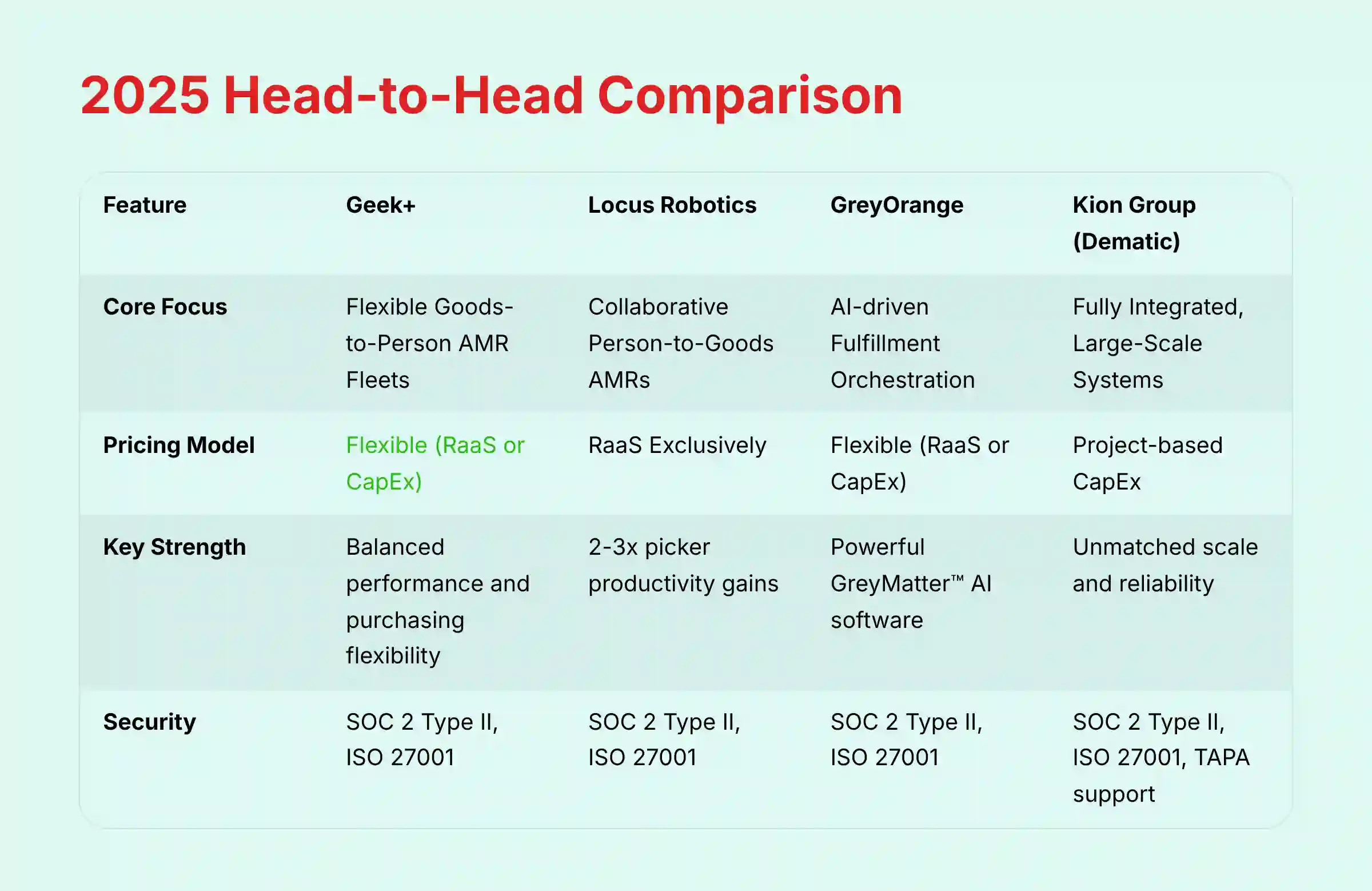
2025 Head-to-Head Comparison: Geek+ vs. The Field
| Feature | Geek+ | Locus Robotics | GreyOrange | Kion Group (Dematic) |
|---|---|---|---|---|
| Core Focus | Flexible Goods-to-Person AMR Fleets | Collaborative Person-to-Goods AMRs | AI-driven Fulfillment Orchestration Platform | Fully Integrated, Large-Scale Warehouse Systems |
| Ideal Use Case | Mid-to-large e-commerce and 3PLs needing modular automation. | High-SKU e-commerce & 3PLs focused on picker productivity. | Large enterprises seeking a single AI platform to run fulfillment. | Global enterprises in regulated industries with massive DCs. |
| Pricing Model | Flexible (RaaS or CapEx) | RaaS Exclusively | Flexible (RaaS or CapEx) | Project-based CapEx |
| Key Strength | Balanced performance and purchasing model flexibility. | 2-3x picker productivity gains and premium support. | Powerful GreyMatter™ AI software for end-to-end optimization. | Unmatched scale, reliability, and enterprise-grade security. |
| Key Weakness / Risk | Support quality can vary based on regional integration partners. | High 5-year TCO from mandatory RaaS; risk of price hikes. | Potential for deep vendor lock-in and complex integration. | High upfront cost and long implementation timelines. |
| Security Posture | SOC 2 Type II, ISO 27001 | SOC 2 Type II, ISO 27001 | SOC 2 Type II, ISO 27001 | SOC 2 Type II, ISO 27001, designed for TAPA compliance support |
| Typical Throughput | Good; scales with fleet size | Excellent; optimized for high UPH/picker | Very High; system-level optimization | Industry-Leading; engineered for max throughput |
| Uptime SLA (Typical) | 99%+; often partner-dependent | 99.5%+; backed by proactive support | 99.5%+; platform-wide guarantee | 99.9%+; industrial-grade reliability |
Deep-Dive Analysis: Top Geek+ Alternatives
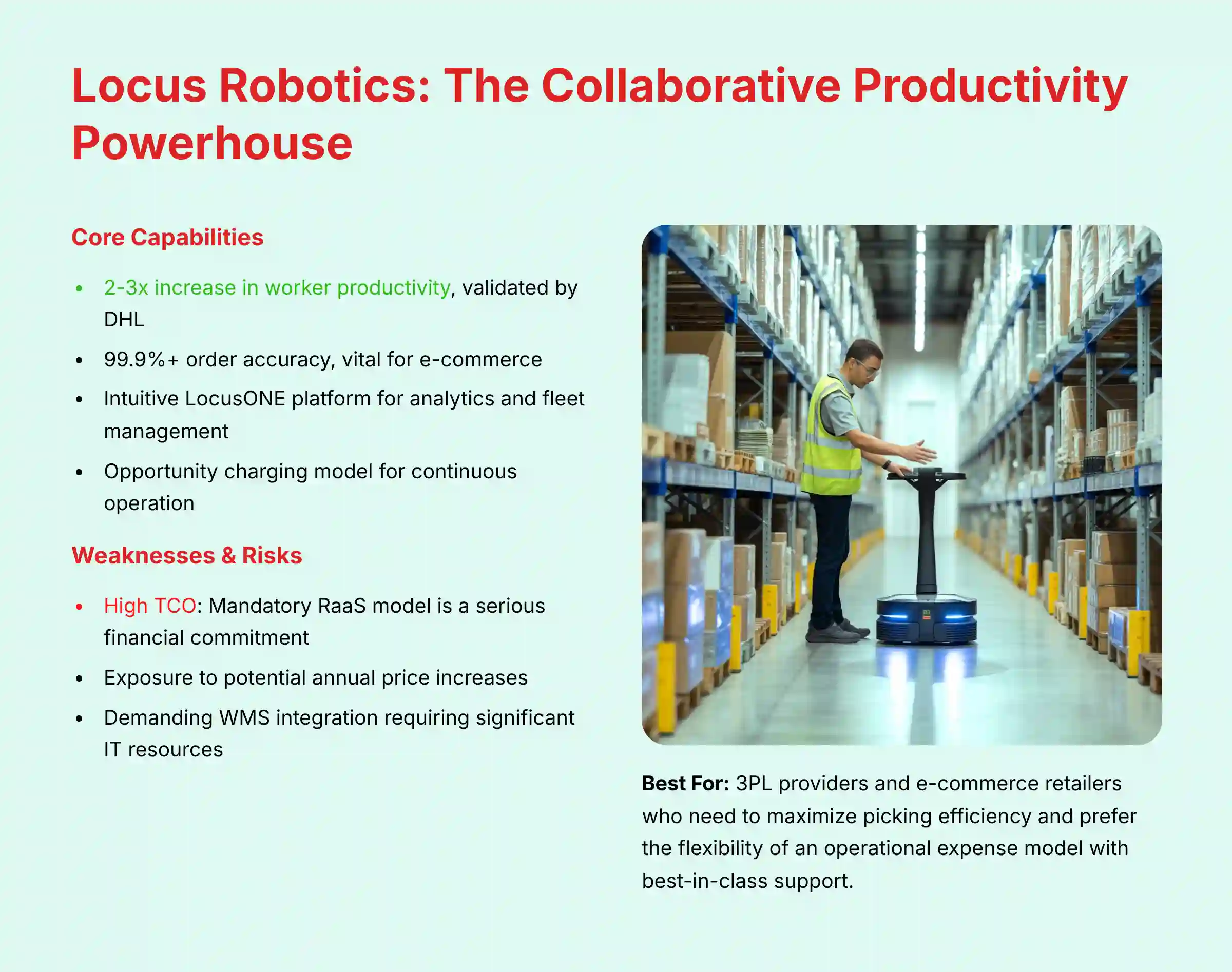
Locus Robotics: The Collaborative Productivity Powerhouse
Core Capabilities & Performance
- Productivity Gains: My analysis confirms their claims of a 2-3x increase in worker productivity. Global logistics leader DHL has validated this, surpassing 500 million units picked using Locus systems across their sites.
- Order Accuracy: The system consistently achieves 99.9%+ order accuracy, a vital metric for maintaining customer satisfaction in e-commerce.
- Management Platform: The LocusONE platform is a strong point. It offers excellent analytics and fleet management tools that I found intuitive during my evaluation.
Operational Continuity & Charging Strategy: A key operational attribute is the fleet's charging method. Locus robots utilize an opportunity charging model, where they autonomously navigate to charging stations during brief lulls in activity. This avoids the operational downtime and dedicated labor required for manual battery swapping, ensuring the fleet remains active and available throughout a shift, a critical factor in maintaining consistent throughput.
✅ Strengths
- Scalable RaaS Model: The Robots-as-a-Service model lets you scale your fleet for peak seasons. This converts a large capital expense into a predictable operating cost.
- Premium Support: Locus receives high marks for its proactive, US-based support. They often identify and fix issues before the client is even aware of a problem.
⚠️ Considerations
- High TCO: The mandatory RaaS model is a serious financial commitment. My analysis of user reports shows the 5-year TCO can be much higher than buying a competing system outright.
- Financial Risk: As a subscription, you are exposed to potential annual price increases. This can hurt your long-term ROI calculations if not managed with contractual caps.
- Integration Demands: Integrating Locus with your Warehouse Management System (WMS) is a demanding project. It requires significant IT resources from your team, a hidden cost you must budget for.
Best For: 3PL providers and e-commerce retailers who need to maximize picking efficiency and prefer the flexibility of an operational expense model with best-in-class support.
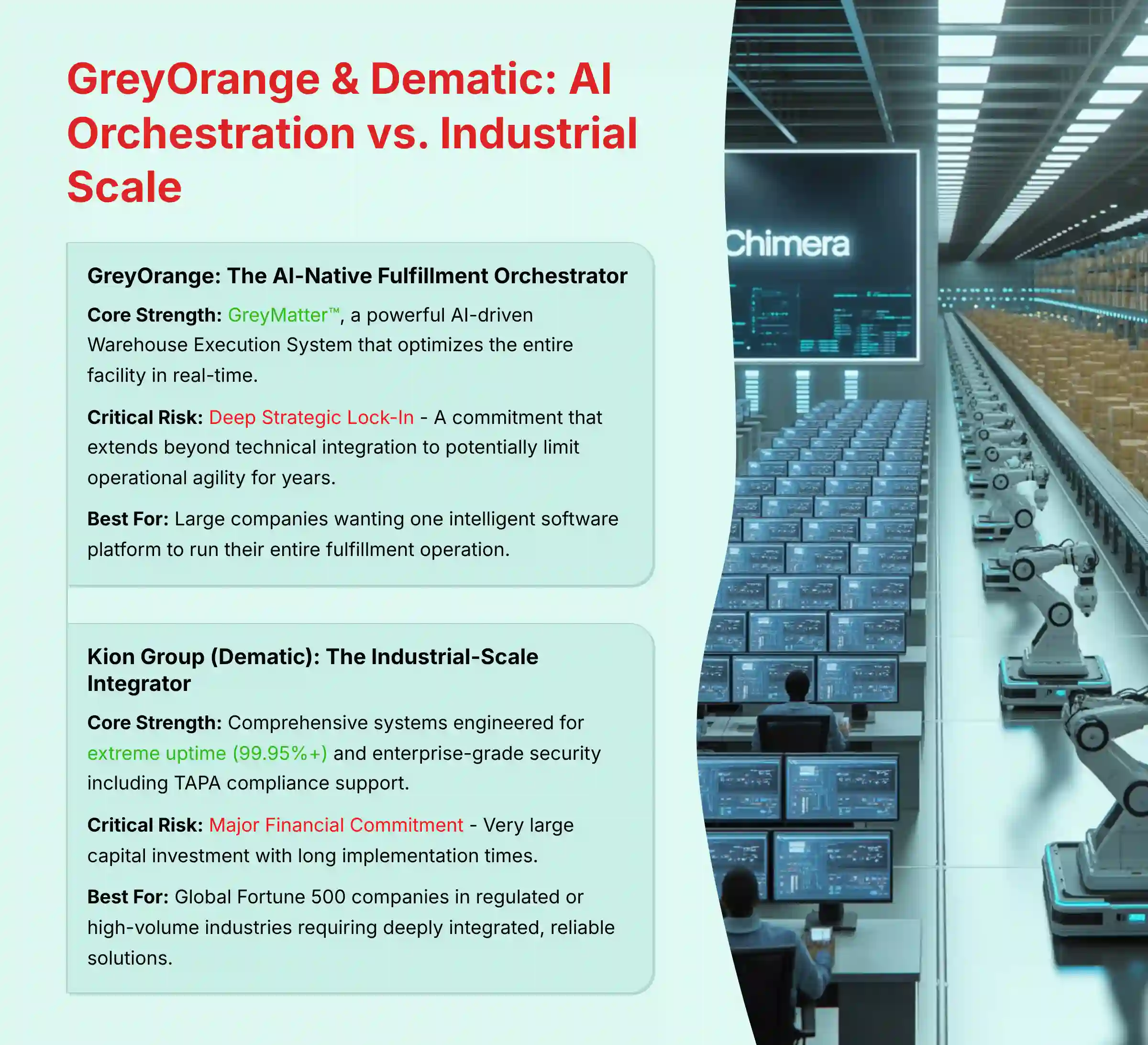
GreyOrange: The AI-Native Fulfillment Orchestrator
Core Capabilities & Performance
- Unified Platform: GreyMatter™ is a Warehouse Execution System (WES) that makes real-time decisions. It optimizes everything from where inventory is stored to how orders are grouped.
- Hybrid Automation: It uniquely combines different types of robots. This allows for customized solutions that fit specific warehouse needs for speed and storage density.
- System-Wide ROI: The biggest returns come from more than just faster picking. The system improves inventory accuracy, shortens order cycle times, and optimizes labor use across the facility.
GreyOrange positions itself as a fulfillment orchestration platform, not just a robotics company. Its main advantage is GreyMatter™, a powerful AI-driven Warehouse Execution System (WES) that serves as the central brain. It makes real-time decisions to optimize the entire facility, dynamically managing slotting optimization, intelligent order batching, and multi-agent pick path optimization to improve key metrics like order cycle time and overall warehouse throughput.
✅ Strengths
- Software Intelligence: The AI-driven optimization is its greatest strength. It is capable of managing very complex, high-volume operations for businesses that sell through multiple channels.
- Hardware Flexibility: By offering different types of automation, GreyOrange can design more customized and space-efficient layouts than providers who only offer one kind of robot.
⚠️ Considerations
- Critical Weakness & YMYL Risk: Deep Strategic Lock-In. Committing to the GreyMatter™ platform is a decision that extends far beyond the warehouse floor. This isn't just technical vendor lock-in; it's a strategic commitment that can dictate your operational agility for the next decade.
- Integration Complexity: Integrating GreyMatter™ with an older, customized WMS can be a huge project. The system wants to become the new brain, which can cause conflicts if not planned with extreme care.
- “Black Box” AI: The AI's complexity can make it hard to understand why it makes certain decisions. This can make troubleshooting difficult for your internal team.
Best For: Large companies in retail and e-commerce that want one intelligent software platform to run their entire fulfillment operation and are ready for a deep, long-term integration project.

Kion Group (Dematic): The Industrial-Scale Integrator
Core Capabilities & Performance
- Comprehensive Systems: Dematic offers far more than just mobile robots. They integrate AMRs with high-speed conveyors, sorters, and industrial-grade automated storage systems.
- Industrial Reliability: Their systems are engineered for extreme uptime, often exceeding 99.95%. This level of reliability is non-negotiable for mission-critical sectors like food and pharmaceuticals.
- AI Partnerships: Dematic uses advanced AI for system-wide optimization. They also have deep partnerships with technology leaders to enhance their solutions.
Dematic, part of the Kion Group, is the heavyweight champion of warehouse automation. They design and build massive, fully integrated systems for the world's largest companies. These solutions form the backbone of global supply chains. For more insights into comprehensive Best 10 AI For Warehouse Robotics & Automation Solutions, explore our detailed analysis.
✅ Strengths
- Unmatched Scale: Dematic is the top provider for projects that need the highest levels of speed and automation. They can support distribution centers that are millions of square feet in size.
- Enterprise-Grade Security: Dematic holds strong security certifications including SOC 2 Type II and ISO 27001. Their solutions are designed to help facilities meet stringent security requirements, including those needed for TAPA compliance.
- Global Support: As an industrial giant, Kion Group provides a worldwide network for service and support. This ensures business continuity for multinational corporations.
⚠️ Considerations
- Major Financial Commitment: Dematic solutions require a very large capital investment. The upfront costs for engineering, hardware, and installation are substantial.
- Long Implementation Times: These are not quick projects. A full Dematic implementation is a long-term undertaking that requires extensive planning and resources from your company.
- Less Flexibility: The highly engineered nature of these systems makes them less adaptable to rapid changes in your business model or facility layout compared to more modular AMR solutions.
Best For: Global Fortune 500 companies in regulated or high-volume industries. These businesses require a deeply integrated, highly reliable, and secure automation solution for their most important distribution centers.


Geek+: The Flexible Incumbent (Baseline for Comparison)
Core Capabilities & Performance
- Scalable AMR Fleets: Geek+ provides a wide range of robots for picking, sorting, and moving goods. This modularity allows businesses to start with a small fleet and scale up as their needs grow.
- Solid Performance: The systems deliver reliable improvements in picking speed and order accuracy. They are a proven solution for mid-to-large scale retail and 3PL operations.
- Integrated Software: Their software effectively manages the robot fleet and integrates with standard WMS platforms, though it lacks the deep orchestration AI of GreyOrange.
Geek+ has earned its strong market position by offering a balanced and flexible approach to Goods-to-Person automation. In my analysis, its key advantage is giving customers a choice in how they invest, which sets it apart from more rigid competitors. For detailed insights on this platform, see our comprehensive Geek+ Review.
✅ Strengths
- Purchasing Model Flexibility: This is the biggest advantage of Geek+. The ability to choose between RaaS and a CapEx purchase allows businesses to align the investment with their financial strategy.
- Cost-Effectiveness: Compared to the premium RaaS of Locus or the massive CapEx of Dematic, Geek+ often presents a more accessible price point for a powerful solution.
⚠️ Considerations
- Inconsistent Support Quality: Geek+ often relies on third-party regional partners for implementation and support. My research shows this can lead to variability in the quality and speed of service, which is a significant operational risk.
- Less Advanced AI: While effective, its software is more focused on robot management than the holistic, AI-driven warehouse optimization offered by a platform like GreyMatter™.
- Integration Partner Vetting: The responsibility falls on you, the customer, to thoroughly vet the specific integration partner assigned to your project. A failure in their support can directly impact your operations.
Best For: Mid-to-large e-commerce, retail, and 3PL companies that need a scalable, cost-effective automation solution and value the flexibility to choose their own purchasing model.
Mandatory YMYL Checkpoint: A Comparative Risk Assessment
Investing in warehouse automation carries large financial and operational risks. A failure in security, compliance, or vendor support can halt your entire operation. This can lead to massive financial loss and damage to your company's reputation.
Security & Compliance Posture: A Side-by-Side Analysis
For any enterprise-level operation, a baseline of security certification is not negotiable. All the vendors I analyzed—Geek+, Locus, GreyOrange, and Dematic—maintain SOC 2 Type II and ISO 27001 certifications. These audits confirm that their software and cloud platforms meet high standards for data security and management.
However, Dematic stands apart for businesses in regulated industries. Their solutions are designed to help facilities meet stringent security and compliance requirements. If you operate in a highly regulated industry or handle high-value goods requiring TAPA (Transported Asset Protection Association) compliance, Dematic's solutions can be configured to support these requirements, though it's important to understand that the actual certification applies to your facility operations, not to the automation vendor itself.
For pharmaceutical operations, it's crucial to note that while Dematic designs systems that can support operations in FDA-regulated environments, the responsibility for process validation and ultimate compliance with FDA regulations (such as 21 CFR Part 11 for electronic records) rests with you, the customer. Their solutions can be configured to support your compliance efforts, but they do not come with an “FDA certification” as this is not how regulatory compliance works in this sector.
Financial Risk & TCO Analysis: RaaS vs. CapEx Models
The biggest financial risk is choosing the wrong pricing model for your business. The choice between a subscription (RaaS) and a one-time purchase (CapEx) is like deciding whether to lease or buy a car. Leasing offers lower upfront costs but can be more expensive over the long term, while buying requires a large initial payment but gives you an asset.
- Locus (RaaS): This model involves high operational expenses (OpEx) and makes you vulnerable to annual price increases. You must negotiate contractual caps to protect your budget.
- Geek+/GreyOrange (Flexible): They offer a path to ownership through CapEx. This provides better long-term cost predictability and gives you a tangible asset on your books.
- Dematic (CapEx): This requires a very high initial outlay. A rigorous Return on Investment (ROI) model, validated by a financial professional, is absolutely necessary before committing.
Operational Risk: Integration, Support, and Vendor Viability
Operational risk is about keeping your facility running smoothly. A system that is down is not just an inconvenience; it is lost revenue. My analysis shows these are the key areas of operational risk to consider for each vendor.
Integration complexity is a major factor. GreyOrange presents the highest risk here if you are not adopting its full platform, as it is designed to take over your existing systems. Both Locus and Geek+ also require substantial IT resources for a successful integration.
You must map the entire data flow: How will sales orders from your ERP be transmitted to the WMS, and how will the WMS in turn task the vendor's WES to orchestrate the AMR fleet in real-time? Any latency in this chain creates an operational bottleneck.
Support quality is another critical risk. My experience and user reports show that Geek+‘s reliance on third-party integrators can create inconsistent support. In contrast, Locus and Dematic are consistently praised for their robust, direct support models, which can be a deciding factor for mission-critical operations.
What Are the Key Factors to Consider When Choosing a Warehouse Automation Partner?
The vendors have made their case. Now, the analysis turns inward. In my work advising supply chain leaders, I emphasize that choosing the right partner isn't about picking the best robot; it's about defining your own operational doctrine.
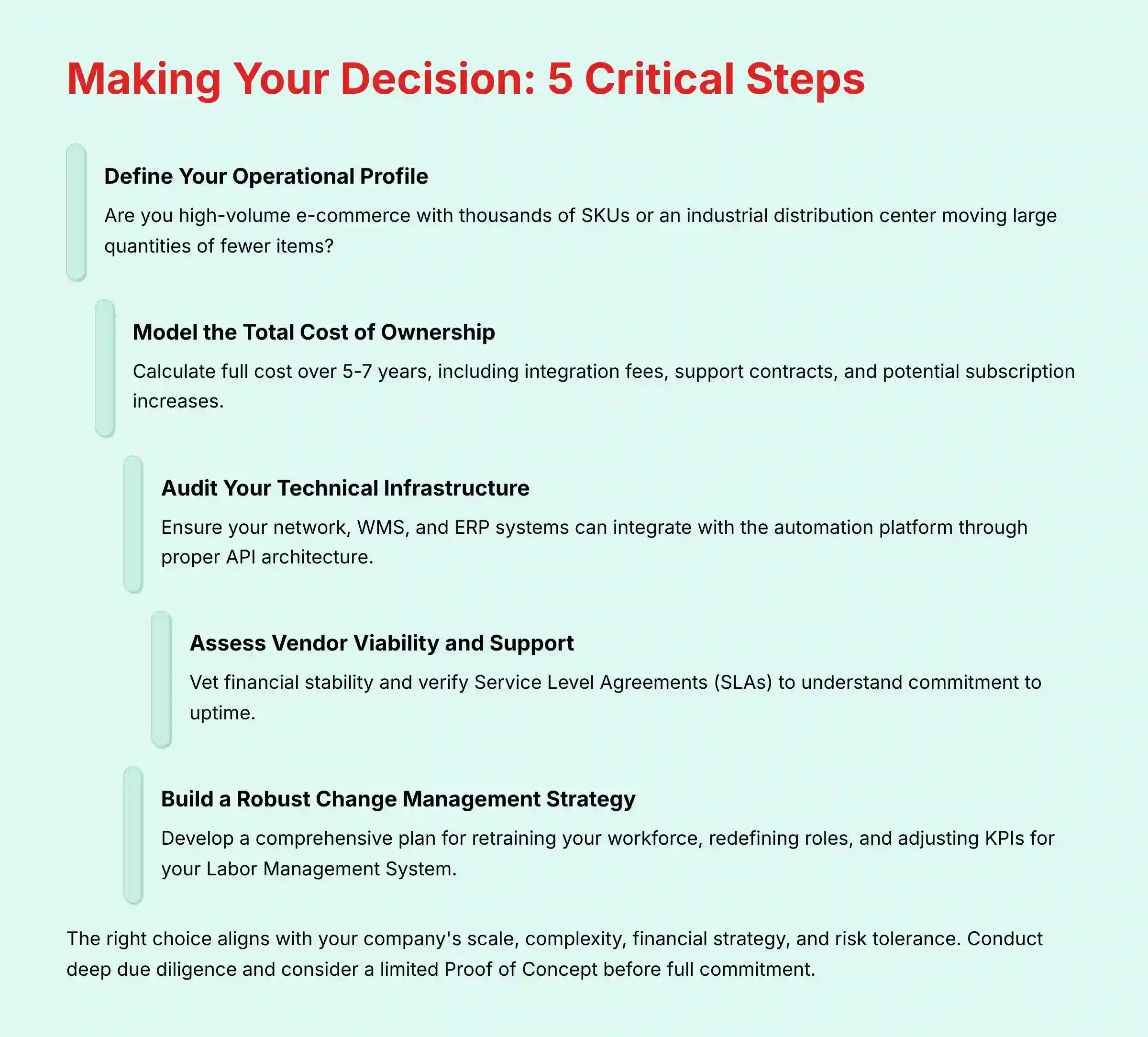
The following five steps are the critical internal audit you must conduct before making a final decision:
- Define Your Operational Profile: Are you a high-volume e-commerce operation with thousands of different products (SKUs)? Or are you an industrial distribution center moving large quantities of fewer items? Your answer will point you toward either a collaborative or goods-to-person system.
- Model the Total Cost of Ownership (TCO): Look past the initial price. You must calculate the full cost over 5-7 years, including integration fees, support contracts, and potential subscription increases. I recommend having a financial consultant validate this model.
- Audit Your Technical Infrastructure: Is your network ready for a fleet of robots? Is your Warehouse Management System (WMS) modern enough to integrate with a new platform? More importantly, how will this automation platform connect to your Enterprise Resource Planning (ERP) system, such as SAP S/4HANA or Oracle NetSuite? The ERP is the financial and commercial heart of your business, holding master data and sales orders. A technical audit must validate the vendor's API architecture and their pre-built connectors for your specific ERP to ensure seamless, real-time, and bidirectional data synchronization. A failure here means your expensive robots won't have accurate orders to fulfill.
- Assess Vendor Viability and Support: Vet the financial stability of your shortlisted vendors. Request and verify their support Service Level Agreements (SLAs) to understand their commitment to uptime.
- Build a Robust Change Management and Labor Engagement Strategy: Technology implementation is only half the battle. A successful automation project is directly dependent on a comprehensive change management plan. This involves retraining your workforce, redefining roles for floor supervisors and inventory counters, and adjusting KPIs for your Labor Management System (LMS). Proactive engagement with your team is essential to ensure user adoption and prevent the operational disruption that comes from process resistance.
Understanding the complete landscape of warehouse automation is crucial for making informed decisions. For comprehensive insights into platform capabilities, explore our detailed Geek+ Overview and Features guide. Additionally, practical implementation guidance can be found in our Geek+ Tutorials and Usecase resources.
Frequently Asked Questions (FAQs) About Geek+ and Its Competitors
What is the main difference between Geek+ (Goods-to-Person) and Locus Robotics (Person-to-Goods)?
The main difference is how they interact with human workers. With Geek+, robots bring shelves of goods to a stationary worker. With Locus Robotics, the worker moves through the warehouse, and robots travel to meet them at the next picking location, acting as a smart, mobile cart.
Is a RaaS model from Locus Robotics cheaper than buying Geek+ robots?
Initially, the RaaS model from Locus Robotics is cheaper because it avoids a large upfront capital expense. However, over a 5-year period, the total subscription cost can often be higher than the one-time purchase price of a Geek+ system. You must model the TCO for your specific operation.
How difficult is it to integrate GreyOrange's GreyMatter™ with an existing WMS?
It can be very difficult. GreyOrange's GreyMatter™ is designed to be the central brain of the operation, not just a bolt-on tool. Integrating it with a highly customized or older WMS is a major IT project that requires deep planning and significant technical resources to avoid conflicts.
Why is Dematic a better choice for pharmaceutical warehouses?
Dematic is a better choice for pharmaceutical warehouses because of its focus on industrial-grade reliability and solutions designed for regulated environments. Their systems are engineered for near-perfect uptime and can be configured to support the strict traceability and validation requirements in pharmaceutical operations. However, it's important to understand that while Dematic provides the technology infrastructure, your company remains responsible for validating processes and ensuring compliance with FDA regulations like 21 CFR Part 11.
What is the biggest risk of choosing a smaller AMR vendor over a large one like Kion Group?
The biggest risk is vendor viability. A large, financially stable company like Kion Group (Dematic) is more likely to be around in 5-10 years to support and upgrade your system. A smaller vendor may offer an innovative solution but carries a higher risk of going out of business, leaving you with an unsupported “orphan” system.
Which platform is better for handling future changes in my business?
For flexibility, modular AMR systems like those from Geek+ or Locus Robotics are generally better for handling future changes. Their RaaS models and ability to easily add or remove robots allow for faster adaptation to shifts in demand or business strategy compared to the highly engineered, fixed systems from Dematic.
For additional insights and answers to common implementation questions, refer to our comprehensive Geek+ FAQs resource.
Final Verdict: Matching the Right Automation Partner to Your Operation
There is no single “best” automation partner. The right choice is the one that best aligns with your company's scale, complexity, financial strategy, and tolerance for risk. Based on my comprehensive analysis, my final recommendations are tailored to specific business profiles.
This decision is a major capital investment, and I strongly advise you to conduct deep due diligence, request digital twin simulations of your facility's layout and order volume, engage with current users through the vendor's customer reference program, and potentially fund a limited Proof of Concept (PoC) to validate performance claims before full commitment. Engage with integration consultants before signing any contracts.
Here is my verdict based on the most common operational needs:
- For E-commerce & 3PLs Needing Peak Productivity: Your best choice is Locus Robotics. If your business can support a premium RaaS model and your primary goal is maximizing output per worker, Locus is the proven leader.
- For a Unified, AI-Driven Fulfillment Platform: You should choose GreyOrange. It is the best fit for large operations that want a software-centric approach and are willing to commit to a single platform to run their entire fulfillment process.
- For Global Enterprises with Mission-Critical, Industrial-Scale Needs: The safest and most reliable choice is Kion Group (Dematic). For massive, regulated distribution centers where uptime is everything, Dematic provides an unmatched level of engineering and security.
- For Maximum Flexibility and Cost Control: Geek+ remains the top contender. It offers a balanced solution with the critical advantage of a flexible purchasing model, making it ideal for operations that want to scale automation with a clear path to owning their assets.
The choice you make is more than an investment in hardware; it's a declaration of your operational strategy for the next decade. These platforms are the tools, but your vision is the blueprint. In an era where the only constant is disruption, the ability to automate, adapt, and act with intelligence is not just a competitive advantage—it is the prerequisite for survival and growth.
The inflection point is here. It is time to press the advantage.
For more information and detailed guides on warehouse automation solutions, visit our comprehensive resource center at Best Ops Chain AI.

Leave a Reply