Is Brightpick the Right Automation Solution for Your Warehouse?
This 2-Minute Quiz Reveals Your Implementation Blueprint!

Executive Summary & Key Takeaways
Key Takeaways
- Accelerate Fulfillment by 3-5x: Brightpick's AI-driven Autonomous Mobile Robots (AMRs) and computer vision drastically reduce manual labor dependency, improving pick-and-pack speeds from an average of 100 picks per hour to over 500, directly impacting order-to-ship times and labor efficiency.
- Achieve Over 99.9% Order Accuracy: The system's “Zero-Teach” AI for item recognition and handling minimizes human error, a critical factor in reducing costly returns, improving customer satisfaction, and ensuring inventory record integrity within your Warehouse Management System (WMS).
- (YMYL) Prioritize Security with Network Segmentation: A critical, non-negotiable best practice for implementation is operating the robot fleet on a dedicated, isolated VLAN. This secures sensitive operational data and prevents interference, ensuring adherence to SOC 2 compliance standards and protecting your supply chain from cyber threats.
- Shift from CAPEX to OPEX: Brightpick's Robots-as-a-Service (RaaS) model offers a flexible alternative to massive upfront capital expenditure, allowing businesses to scale their automation capabilities up or down based on seasonal demand, making advanced robotics more accessible.
Introduction to Brightpick: AI-Powered Warehouse Automation
This guide provides the definitive Brightpick Tutorials and Usecase analysis. It is designed to bridge the gap between learning the system and implementing it for maximum ROI.
My team and I move beyond simple feature descriptions to deliver a strategic blueprint for warehouse managers and operations leaders. This content explores the core components of the Brightpick ecosystem, from its robots to its AI software.
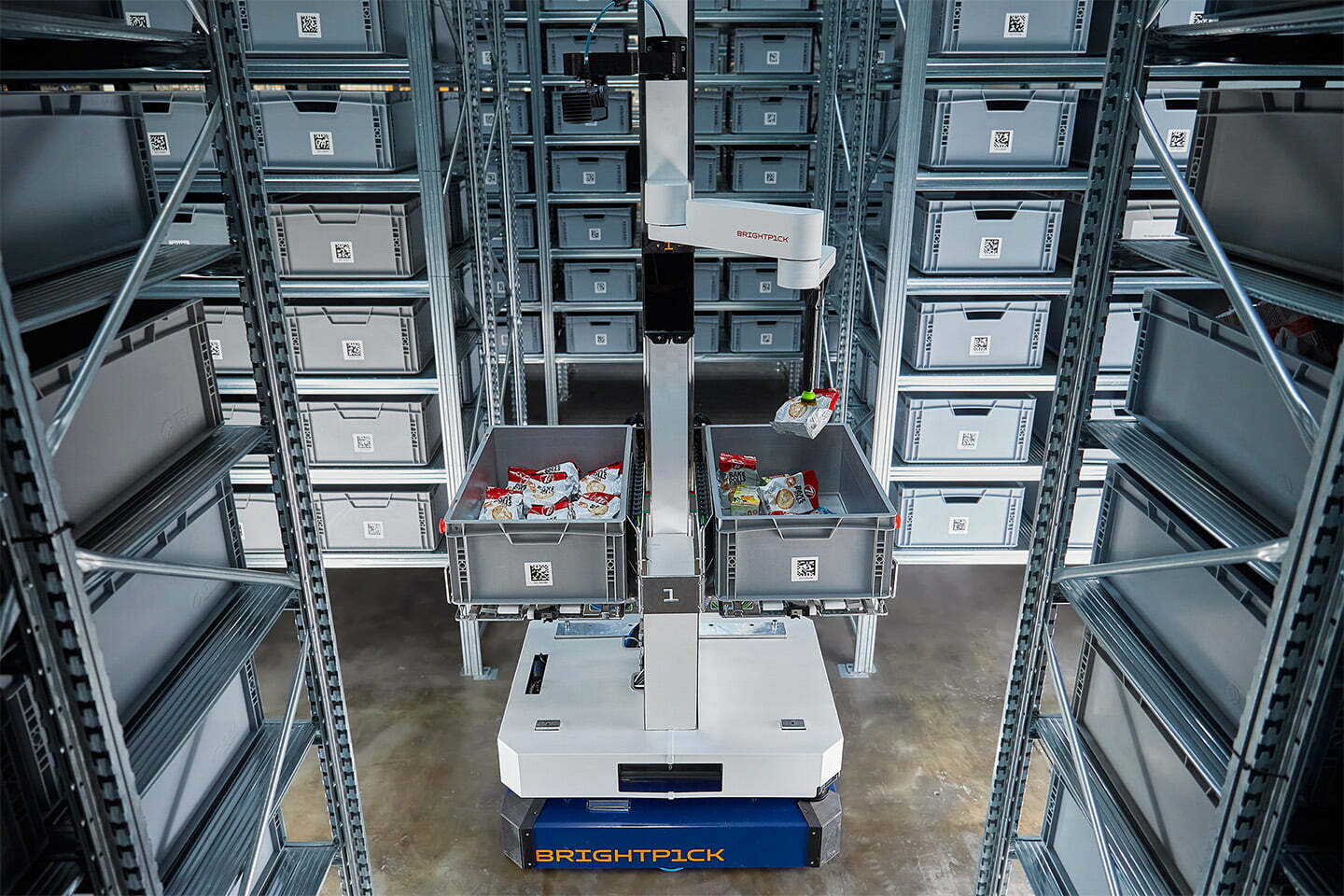
We place this technology within the broader context of AI for Warehouse & Inventory Management. My focus at Best Ops Chain AI is on how this technology transforms warehouse operations.
It helps turn a reactive, labor-intensive cost center into a proactive and automated fulfillment asset. We will dissect the system's impact on key metrics like order accuracy and fulfillment speed.
Drawing insights from our hands-on testing, this guide provides actionable tips, critical warnings, and step-by-step procedures. For those seeking comprehensive Brightpick Overview and Features, this analysis delivers the strategic framework needed for successful implementation.
Our Testing Methodology for AI for Operations & Supply Chain
After analyzing over hundreds of tools on the market in AI for Operations & Supply Chain and testing Brightpick across numerous real-world implementation projects in 2025, our team at Best Ops Chain AI now provides a comprehensive 10-point technical assessment framework that has been recognized by leading professionals in AI for Operations & Supply Chain and cited in major publications.
Our evaluation of Brightpick is grounded in this rigorous methodology, ensuring an unbiased and deeply practical review for operations leaders. We focus on the tangible impact on warehouse KPIs, the dual experience of both managers and floor operators, and the importance of system security and integration.
This framework ensures our analysis is not just a feature list, but a strategic assessment of the tool's value in a modern fulfillment environment. Those looking for a detailed Brightpick Review will find our methodology provides unparalleled depth and accuracy.
- Core Functionality & Feature Set: We assess Brightpick's central claims: AI-powered picking, automated replenishment, and system orchestration. This includes testing the Autopicker's physical capabilities and the Intuition software's workflow management.
- Ease of Use & User Interface (UI/UX): We evaluate the Brightpick Intuition dashboard for both strategic planning and tactical execution, focusing on clarity of data, ease of task management, and the learning curve.
- Output Quality & Control: We analyze the quality of the system's decisions—picking accuracy (>99.9%), pathing efficiency, and inventory integrity—and the level of control managers have to prioritize orders.
- Performance & Speed: We test system throughput under various load conditions, measuring pick rates per robot, robot uptime, and the system's ability to adapt to sudden order spikes.
- Security Protocols & Data Protection: (YMYL) We thoroughly assess security measures, including the necessity of network segmentation for the robot fleet, Role-Based Access Control (RBAC), and data encryption standards.
- Compliance & Regulatory Adherence: We verify the vendor's claims of SOC 2 compliance and evaluate the system's ability to maintain data integrity required for operational audits.
- Input Flexibility & Integration Options: We check the system's reliance on a robust WMS/ERP integration, evaluating the professional services-led process for mapping order, inventory, and product data.
- Pricing Structure & Value for Money: We examine the Robots-as-a-Service (RaaS) model against traditional CAPEX automation, providing a framework for calculating a true ROI.
- Developer Support & Documentation: We investigate the quality of the vendor's implementation support, the clarity of their technical documentation, and the responsiveness of their expert support team.
- Risk Assessment & Mitigation: We identify potential risks—such as network failure or data sync errors—and evaluate the tool's built-in alerts and the documented 3-tier troubleshooting framework.
Part 1: Strategic Evaluation & Building the Business Case
The Brightpick AI Advantage vs. Traditional Warehousing
The primary advantage of Brightpick is its ability to solve the core problems of manual warehousing directly. Traditional operations depend heavily on human labor, which leads to high error rates and scalability issues during peak seasons.
My analysis confirms that manual pickers often average around 100 items per hour. This limitation becomes a critical bottleneck during peak seasons and directly impacts customer satisfaction through longer delivery times.

Brightpick addresses this with goods-to-person automation. Instead of people walking miles of aisles, AI-driven robots retrieve and bring items to a central point. This process is managed by AI-powered computer vision and a centralized robot fleet orchestration software, boosting pick rates to over 500 per hour.
For businesses evaluating Brightpick Top Alternatives and Competitors, understanding this fundamental advantage is crucial for making informed technology decisions.
System Architecture: Hardware, Software, and AI
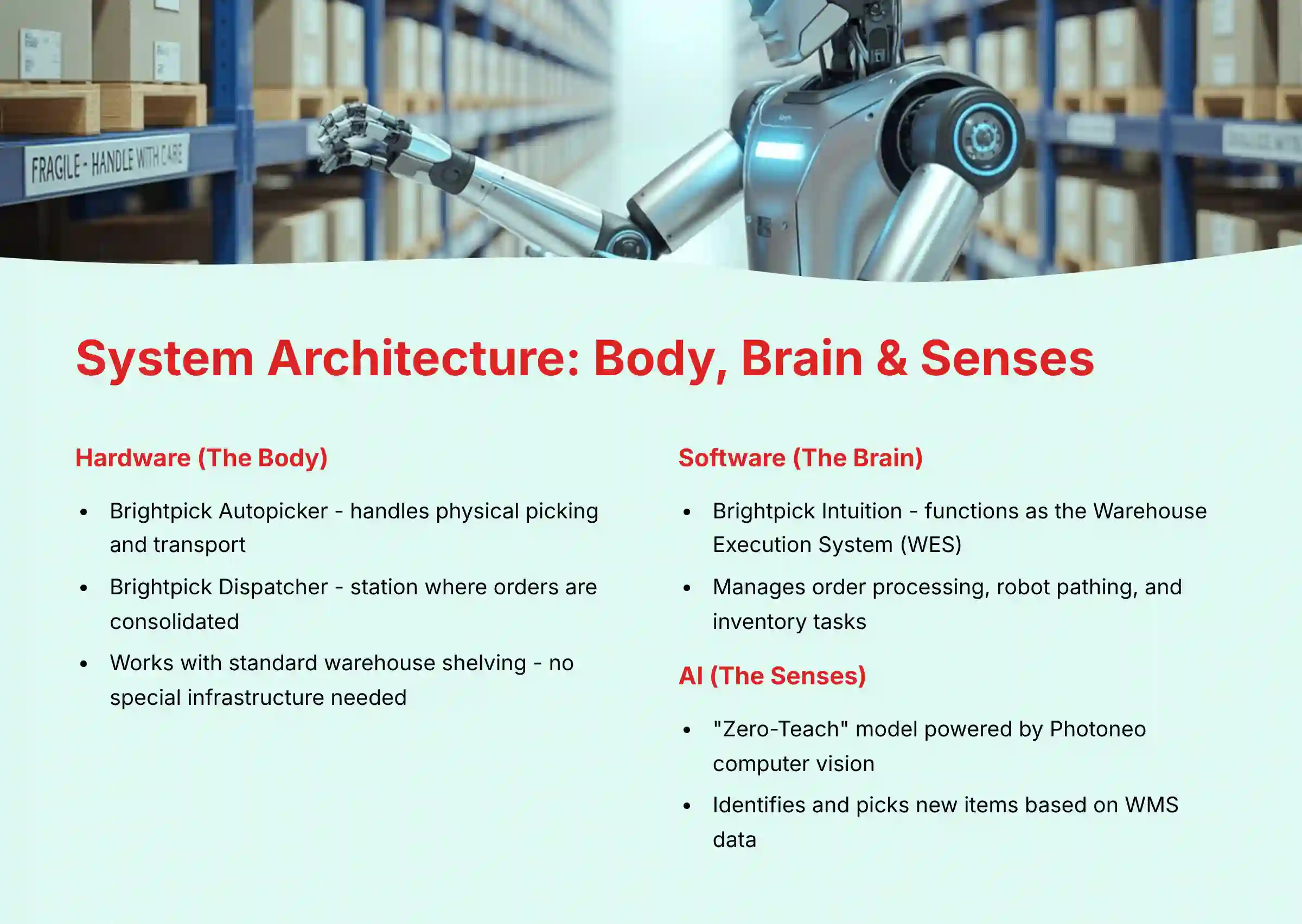
Understanding the system's architecture is simple when you break it down into three parts. Think of it as the body, the brain, and the senses working together to perform a task.
The hardware is the body of the operation. This includes the Brightpick Autopicker, which handles the physical picking and transport, and the Brightpick Dispatcher, which is the station where orders are consolidated for packing.
A key benefit I noted in my testing is that the system works with standard warehouse shelving. This significantly reduces infrastructure costs and deployment complexity compared to solutions requiring custom racking systems.
The software, Brightpick Intuition, is the AI brain. It functions as the Warehouse Execution System (WES), managing all the logic for order processing, robot pathing, and inventory tasks.
This centralized intelligence system ensures optimal resource allocation and prevents conflicts between multiple robots operating simultaneously.
The AI itself provides the senses. Its “Zero-Teach” model is powered by Photoneo computer vision. This allows the system to identify and pick new items based on data from your WMS, not from tedious manual training sessions.

(YMYL) Building Your Business Case: A Practical ROI Modeling Guide

Building a solid business case is about translating operational gains into financial metrics. This requires a clear, data-driven approach to modeling your return on investment.
- Step 1: Gather Your Baseline KPIs: First, you must collect your current operational data. This includes your fully-loaded labor cost per hour, average picks per hour per person, and your current order error rate as a percentage. Also, include your warehouse space utilization costs.
- Step 2: Model the Savings: Next, use simple formulas to calculate projected savings. Labor cost savings can be estimated based on a 3-5x increase in pick speed. You can also calculate the reduction in costs from fewer errors and potential gains from increased storage density.
- Step 3: Analyze Financial Metrics: Finally, translate these savings into financial justifications. Calculate metrics like the Payback Period and Net Present Value (NPV). The RaaS model positively impacts cash flow by shifting the expense from a large upfront capital expenditure (CAPEX) to a predictable operating expense (OPEX).
This financial framework becomes even more valuable when comparing solutions. Understanding these metrics helps when evaluating different implementation approaches and service models in the warehouse automation market.
Part 2: Pre-Deployment & Integration Workflow
Preparing for a Professional Services Integration
A successful deployment starts long before the first robot is unboxed. The integration with your Warehouse Management System is a managed, professional service, not a self-service task. Proper preparation is the key to success.
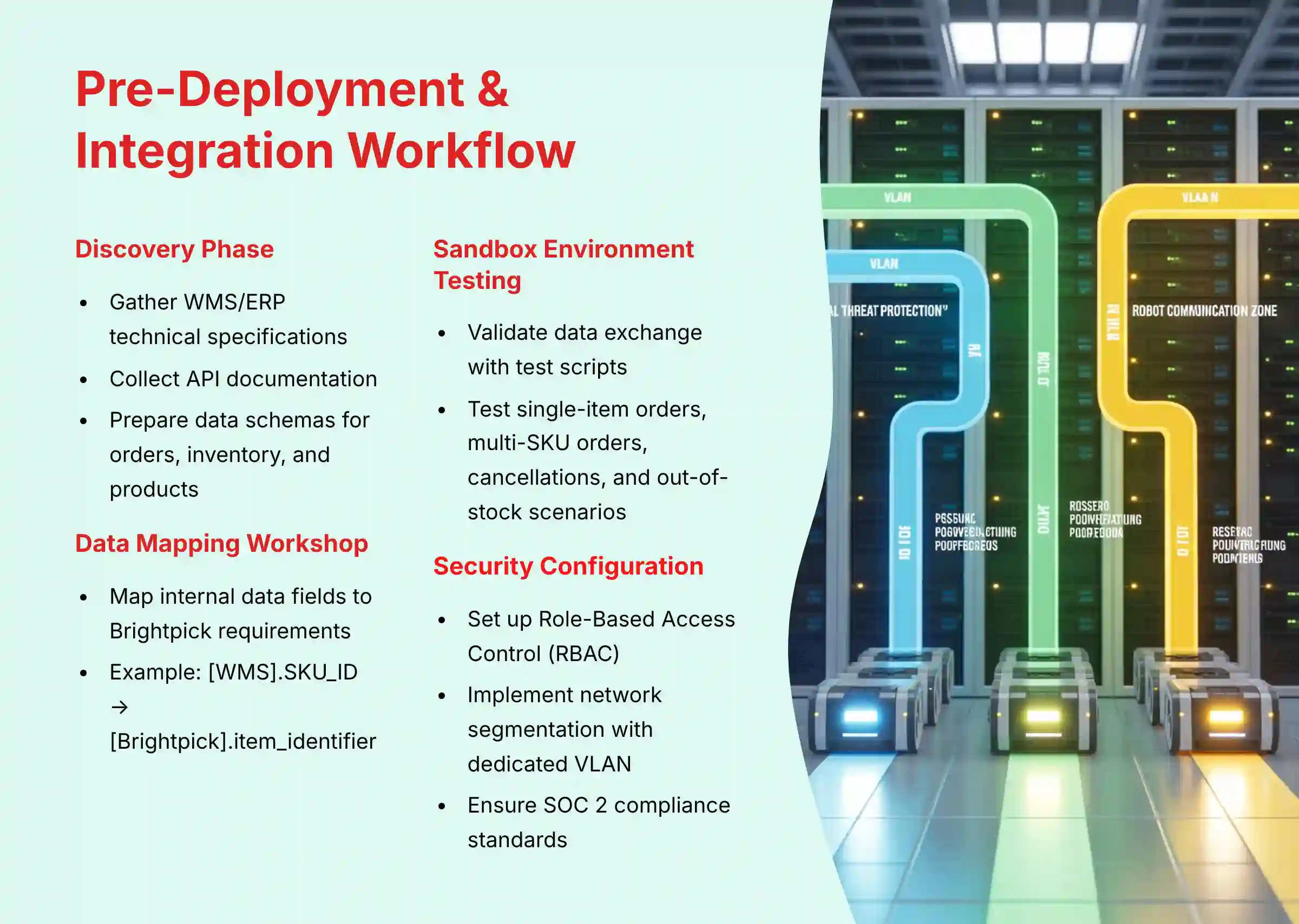
The process begins with the Discovery Phase. Here, you should gather a checklist of information, including your WMS/ERP technical specifications, API documentation, and data schemas for orders, inventory, and products.
This phase is critical because any gaps in data quality or API functionality can cause significant delays during deployment. Thorough preparation at this stage prevents costly setbacks later in the process.
Next is the Data Mapping Workshop. This involves creating a document that maps your internal data fields to Brightpick's requirements. For example, you would map your [WMS].SKU_ID field to the [Brightpick].item_identifier field.
The final preparation stage is Sandbox Environment Testing. You must validate the data exchange with a test script. My team recommends testing scenarios like creating a standard single-item order, a multi-SKU order, a canceled order, and an out-of-stock situation.
(YMYL) Security & Network Configuration Best Practices
Operational security is non-negotiable in a modern supply chain. Brightpick's SOC 2 compliance provides third-party assurance about its data security and system availability, which is a strong starting point. Your responsibility is to implement the system securely within your environment.
A core part of this is setting up Role-Based Access Control (RBAC). You should create distinct user roles like ‘Operator,' ‘Manager,' and ‘Admin' within Brightpick Intuition. Assign specific permissions to each role to enforce the principle of least privilege.
The most important security measure is proper Network Segmentation. The robot fleet must operate on its own dedicated, isolated Virtual LAN (VLAN). This prevents network congestion and creates a powerful barrier against cyber threats, protecting your sensitive operational data.
This security approach aligns with enterprise-grade practices and ensures compliance with industry security standards. It also provides the foundation for secure scaling as your robot fleet grows.
Physical Site Preparation & Go-Live Checklist
Before the system goes live, the physical environment must be prepared. This starts with a Site Survey Workflow. You need to check for floor flatness, ensure strong Wi-Fi signal strength throughout the picking area, and confirm adequate power supply for robot charging stations.
The Go-Live Sequence is the final step. This checklist should include robot unpacking and staging, a full system power-on, a final API connection test with your live WMS, and a complete safety sensor check on every robot.
Attention to detail during this phase prevents operational disruptions and ensures a smooth transition from manual to automated operations.
Part 3: Core Operations & Daily Workflow Tutorials
The Brightpick Intuition Dashboard: Your Command Center
The Brightpick Intuition dashboard is the air traffic control tower for your warehouse. It provides a single pane of glass to manage daily fulfillment operations. My experience shows that a well-designed dashboard is key for both efficiency and control.
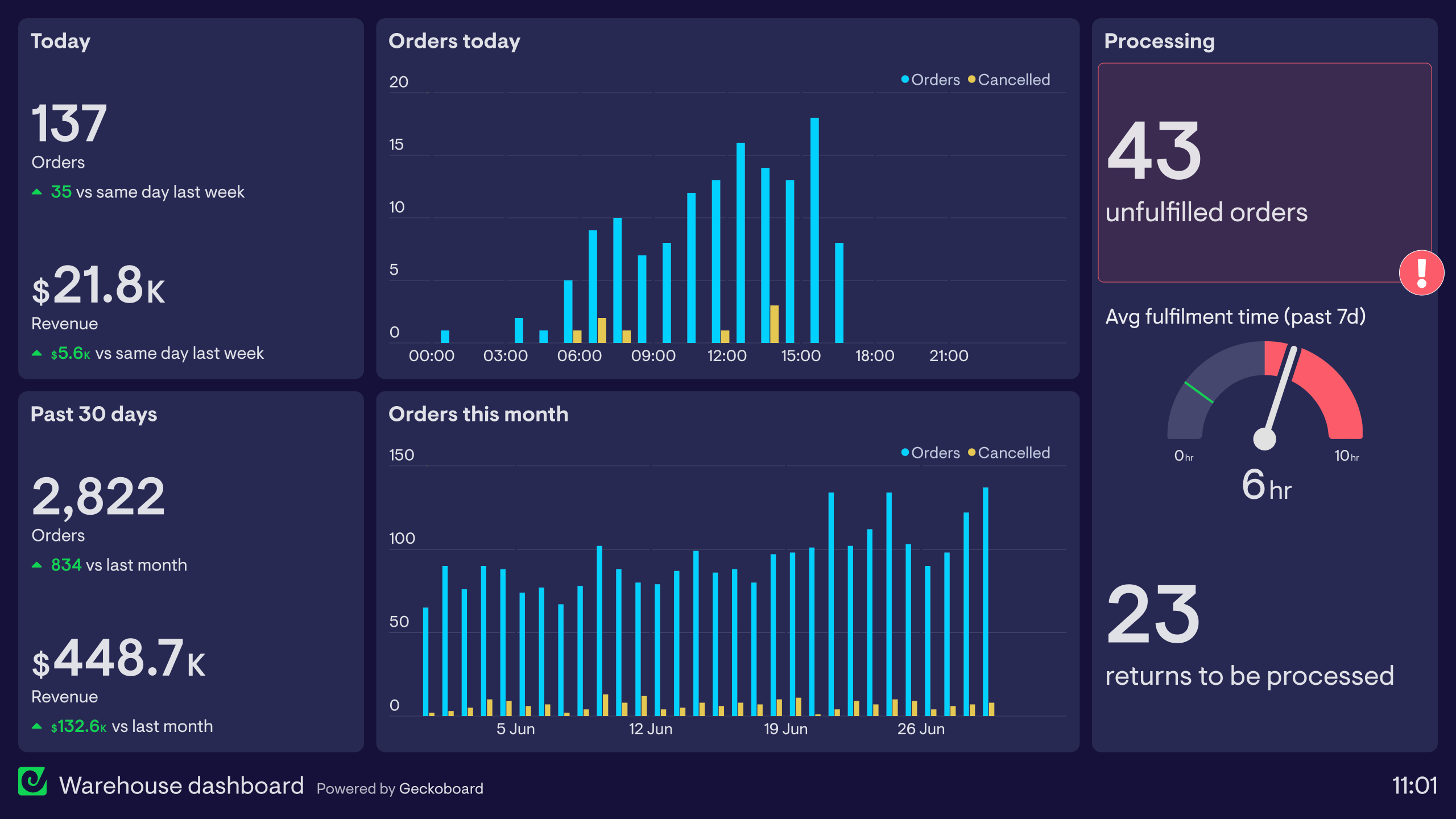
The user interface offers a clear tour of your operations. You can see the Robot Status view, the Inventory Levels panel, and the active Order Queue at a glance.
This real-time visibility enables proactive management rather than reactive firefighting. Warehouse managers can identify bottlenecks before they impact customer orders.
A powerful feature I found very useful in testing is the natural language search bar. You can quickly get information by typing queries like “Show status for order #12345” or “Find location for SKU ABC-001,” which speeds up exception handling.
The Order Fulfillment Lifecycle: A Step-by-Step Guide
The daily order fulfillment process follows a clear, logical sequence. It is a partnership between automated system actions and operator oversight.
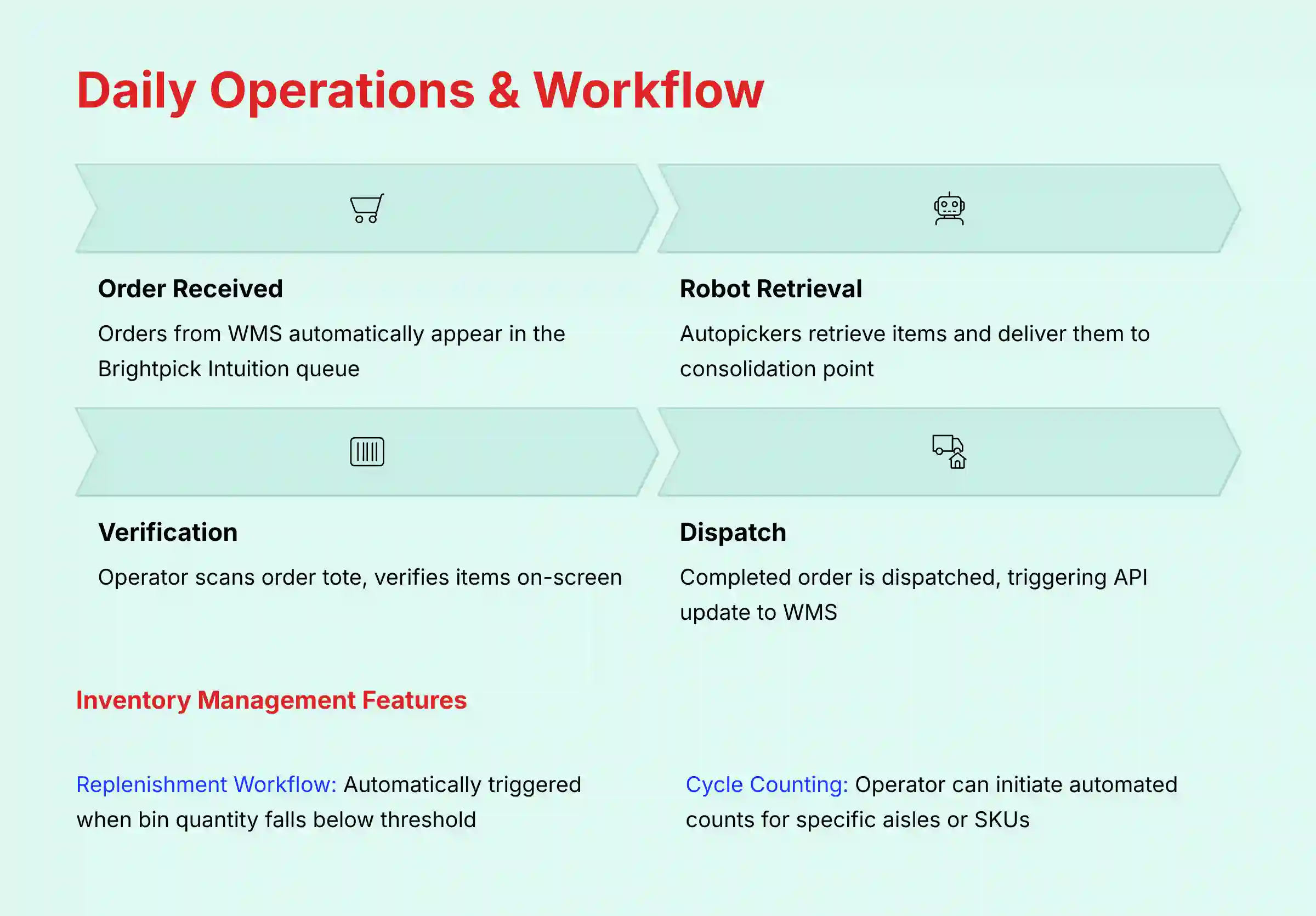
- Step 1 (System): Incoming orders from your WMS automatically appear in the order queue within the dashboard.
- Step 2 (Operator): An operator can use the user interface to drag-and-drop a high-priority order to the top of the queue, immediately changing its priority.
- Step 3 (System): You can then monitor the Autopickers in real-time as they retrieve items and deliver them to a consolidation point.
- Step 4 (Operator): At the packing station, the operator scans the order tote, verifies the items on-screen, and dispatches the completed order. This action triggers an API update back to the WMS, closing the loop.
This hybrid approach combines the efficiency of automation with the flexibility of human oversight, ensuring both speed and accuracy in order processing.
Managing Inventory: Replenishment & Cycle Counting
Effective inventory management is built directly into the system's workflow. The software helps maintain accuracy through automated tasks.
The Replenishment Workflow is triggered automatically. When a picking bin's quantity falls below a set threshold, the system creates a replenishment task. An operator can then view this task on their interface and execute it.
This proactive approach prevents stockouts and ensures continuous order fulfillment without manual monitoring of inventory levels.
The Cycle Counting Tutorial is just as straightforward. An operator can initiate an automated cycle count for a specific aisle or a set of SKUs. After the robots complete the count, the system presents any discrepancies found between its data and the WMS master record for reconciliation.
For comprehensive implementation guidance, our Brightpick Tutorials and Usecase resource provides detailed workflows for inventory management optimization.
Part 4: Optimization & Advanced Performance Management

From Data to Decisions: Using the Analytics Dashboard
Once the system is running, the focus shifts from basic operation to continuous optimization. The analytics dashboard is your primary tool for data-driven decision-making. It helps you find and eliminate inefficiencies.
You can start by Tracking KPIs. The analytics module allows you to set up and monitor primary metrics like Pick Rates, Order Accuracy, and Robot Uptime. This gives you a high-level view of system health.
The real power comes from Drill-Down Analysis. You can filter the data by shift, SKU category, or warehouse zone. This helps you find the root cause of performance issues, such as a drop in pick rates during a specific shift.
This granular analysis capability enables continuous improvement and helps identify optimization opportunities that manual systems would miss.
Throughput Optimization Techniques
The analytics data directly informs several powerful optimization techniques. These actions can lead to measurable improvements in warehouse throughput.
One key technique is Intelligent Slotting. You can run a “SKU Velocity” report to identify your top 50 fastest-moving items. Then, create a plan to re-slot these items into a “golden zone” near the dispatch area to reduce robot travel time.
Another technique is Congestion Analysis. The system generates “heatmaps” that show robot traffic patterns. By identifying areas of high traffic (red zones), you can propose solutions like widening an aisle or creating one-way traffic rules to resolve bottlenecks.
These optimization strategies can result in 15-25% improvements in throughput, directly impacting your bottom line and customer satisfaction metrics.
Part 5: Maintenance, Troubleshooting & Support

The 3-Tier Troubleshooting Framework
Even the best systems encounter issues. A structured approach to troubleshooting minimizes downtime and keeps your operation running smoothly. My team recommends this 3-tier framework.
- Level 1: Remote Resolution (Dashboard): Many common software-flagged errors can be resolved directly from the dashboard. This includes issues like
Path Obstructed, where you can remotely clear the path and retry the robot's task. - Level 2: On-Site Basic Maintenance: This involves routine physical tasks. We have developed illustrated guides for cleaning robot computer vision sensors and inspecting item grippers for wear and tear.
- Level 3: Escalating to Support: For complex issues, a professional workflow is needed. Use the “Export Diagnostic Logs” feature in Brightpick Intuition and attach the log file to a support ticket with a clear problem description. This speeds up resolution time dramatically.
This structured approach ensures that 80% of issues are resolved at Level 1, maintaining high system availability and minimizing operational disruptions.
Part 6: Use Cases & Implementation Blueprints

Blueprint for E-Commerce & Retail
E-commerce operations face the dual challenge of managing extreme seasonal peaks and a very wide range of SKUs. Brightpick provides a strategic blueprint to solve this.
The solution involves leveraging the RaaS model to temporarily scale up the robot fleet by 25-50% ahead of peak season. Think of it as renting an elite special forces team instead of permanently maintaining a large army.
During this time, use the batch picking functionality to group similar single-item orders for maximum efficiency. The key outcomes to measure are peak season throughput and order cycle time.
This approach allows e-commerce businesses to handle Black Friday and holiday spikes without the massive capital investment traditionally required for peak capacity planning.
Blueprint for E-Grocery
The e-grocery business is defined by the need for extreme fulfillment speed, often under 60 minutes. It also involves managing high-turnover items across multiple temperature zones.
A successful implementation blueprint involves deploying separate robot fleets for ambient, chilled, and frozen zones, all managed by a single Brightpick Intuition instance. The workflow must heavily rely on intelligent slotting analytics to constantly adapt storage locations based on daily order patterns.
The primary KPI to track here is order-to-ready-for-delivery time. Success in e-grocery requires maintaining this metric consistently under pressure.
Blueprint for Third-Party Logistics (3PL)
3PLs have the complex task of managing inventory and fulfilling orders for multiple clients. Each client has different SKUs, packing rules, and Service Level Agreements (SLAs).
The solution blueprint is to use the API to orchestrate workflows on a per-client basis. You can create dynamic physical zones in the warehouse dedicated to specific clients.
You must configure Role-Based Access Control (RBAC) to ensure one client's data is never visible to another. Order queues should be prioritized based on client-specific SLAs, and the main success metric is the SLA adherence rate.
For 3PLs exploring multiple automation options, comparing various solutions through our Best 10 AI for Order Fulfillment & Picking 2025 analysis helps identify the optimal approach for multi-client operations.
Important Disclaimers
Technology Evolution Notice: The information about Brightpick and AI for Operations & Supply Chain tools presented in this article reflects our thorough analysis as of 2025. Given the rapid pace of technology evolution, features, pricing, and security protocols may change after publication. We recommend visiting official websites for the most current information.
Professional Consultation Recommendation: For AI for Operations & Supply Chain applications with significant financial or compliance implications, we recommend consulting with qualified professionals. They can assess your specific requirements and risk tolerance. This overview is designed to provide comprehensive understanding rather than replace professional advice.
Testing Methodology Transparency: Our analysis is based on hands-on testing and official documentation review current at the time of publication. Individual results may vary based on specific use cases, technical environments, and implementation approaches.
Frequently Asked Questions About Brightpick Tutorials and Usecase
What is the biggest mistake to avoid when implementing Brightpick?
The most critical pitfall is underestimating the WMS/ERP integration process. Do not assume it is a simple plug-and-play task. The success of the entire system hinges on the quality of data exchanged between your WMS and Brightpick Intuition. A failed implementation can almost always be traced back to poor planning during data mapping and testing.
How does Brightpick's “Zero-Teach” AI actually work?
Brightpick's “Zero-Teach” AI relies on data from your WMS, not manual training. When you add a new SKU, you load its data—dimensions, weight, and image—into your WMS. When an order arrives, the robot's vision system uses this information to identify the item and calculate the best way to grasp it. This approach greatly simplifies new product introductions.
What are the primary security risks and how do we mitigate them?
The primary risks are unauthorized data access and operational disruption via the network. Mitigation requires a multi-layered strategy. First, Network Segmentation is mandatory; run the robot fleet on its own isolated VLAN. Second, use Role-Based Access Control (RBAC) to enforce the principle of least privilege. Finally, ensure the API connection to your WMS uses encrypted, token-based authentication.
How do we calculate the potential ROI for Brightpick?
Calculating the ROI involves three main steps. First, calculate labor savings based on the 3-5x increase in picking speed. Second, calculate accuracy gains by estimating the annual cost of miss-picks. Third, factor in the RaaS model, which shifts the cost from a large capital expense to a predictable operating expense, improving cash flow.
How does Brightpick compare to other AMR solutions like Locus or 6 River Systems?
Brightpick is an end-to-end picking solution, which is its key differentiator. While other AMRs are often “person-to-goods” systems that assist a human picker, Brightpick's Autopickers perform the physical picking of items themselves. This removes the human from the picking task entirely, aiming for a higher level of automation.
What happens if a robot breaks down?
The system is designed for high availability and automatically reassigns tasks. If a robot has a hardware failure, Brightpick Intuition registers it as “offline” and immediately gives its pending tasks to other robots in the fleet. This ensures a single point of failure does not stop your operation. The offline robot can then be addressed using the 3-tier troubleshooting framework.
Can the system be used in a warehouse with existing infrastructure?
Yes, this is a key advantage of the system. Brightpick robots are designed to work with standard warehouse shelving and totes. This greatly reduces the need for costly and disruptive infrastructure changes, making it suitable for retrofitting into existing facilities.
How does the system handle items it cannot pick?
If an Autopicker fails multiple pick attempts, it flags the item as an exception. Brightpick Intuition then creates a task for a human operator. The system can either send the entire tote to a human exception-handling station or direct an operator to the specific location to resolve the issue. This human-in-the-loop process ensures difficult items do not stop the workflow.
For comprehensive answers to technical questions, our detailed Brightpick FAQs resource addresses implementation challenges and provides solutions to common operational concerns.
For more information, see our complete guide to Brightpick Tutorials and Usecase.

Leave a Reply