Could Brightpick's AI Robots Transform Your Warehouse?
This 2-Minute Quiz Reveals Your Fit!
As an expert in AI for Operations & Supply Chain, I've seen countless technologies promise to change the game. Few, however, address the core challenge of warehouse automation with the flexibility of Brightpick. This comprehensive review examines Brightpick's AI-powered robotic solution that transforms manual warehouses into centers of efficiency. At Best Ops Chain AI, we focus on how tools like this fit into the broader category of AI for Warehouse & Inventory Management.
The Brightpick system combines autonomous mobile robots (the Brightpick Autopicker 2.0) and its AI brain, Brightpick Intuition, to automate fulfillment from picking to dispatch. This overview covers its features, technical specifications, and real-world applications.
Our team at Best Ops Chain AI has developed a comprehensive 10-point technical assessment framework for evaluating AI Operations & Supply Chain tools. This proprietary framework is our commitment to E-E-A-T and has been recognized by leading professionals within the AI for Operations & Supply Chain industry.
- Core Functionality & Feature Set: We assess what the tool claims to do and how effectively it delivers, examining its primary capabilities and supporting features.
- Ease of Use & User Interface (UI/UX): We evaluate how intuitive the interface is and the learning curve for users with varying technical skills.
- Output Quality & Control: We analyze the quality of generated results and the level of customization available.
- Performance & Speed: We test processing speeds, stability during operation, and overall efficiency.
- Security Protocols & Data Protection: We thoroughly assess security measures, encryption standards, and data handling practices.
- Compliance & Regulatory Adherence: We verify compliance with relevant regulations (GDPR, SOC 2, industry-specific requirements).
- Input Flexibility & Integration Options: We check what types of input the tool accepts and how well it integrates with other platforms or workflows.
- Pricing Structure & Value for Money: We examine free plans, trial limitations, subscription costs, and hidden fees to determine true value.
- Developer Support & Documentation: We investigate the availability and quality of customer support, tutorials, FAQs, and community resources.
- Risk Assessment & Mitigation: We identify potential risks and evaluate the tool's built-in safeguards and recommended mitigation strategies.
Key Takeaways
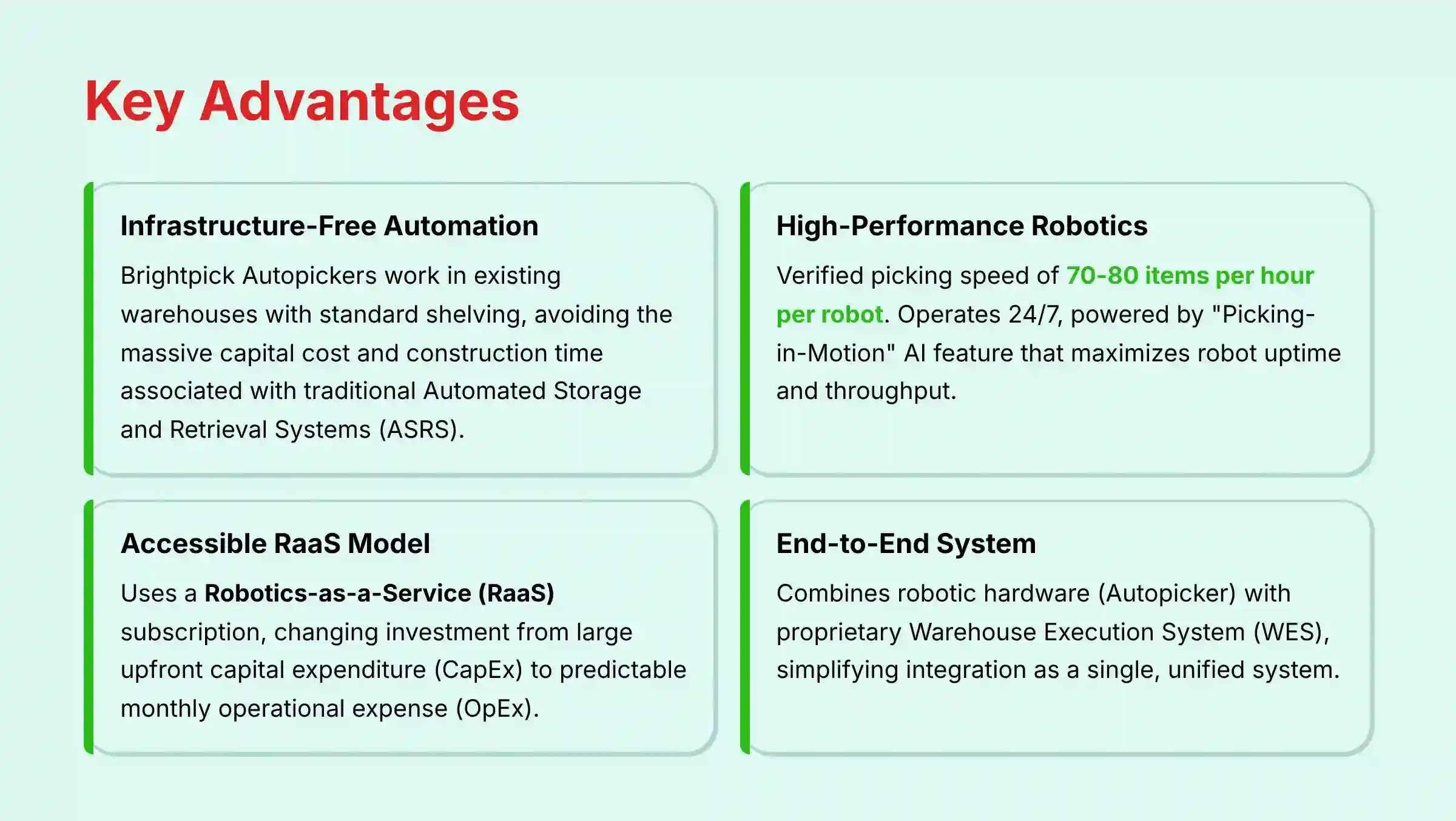
- Infrastructure-Free Automation: Brightpick Autopickers work in existing warehouses with standard shelving, avoiding massive capital costs and construction time associated with traditional ASRS systems.
- High-Performance Robotics: The system delivers 70-80 items per hour per robot with 24/7 operation, powered by AI-driven “Picking-in-Motion” technology.
- Accessible RaaS Model: Robotics-as-a-Service subscription changes investment from large CapEx to predictable monthly OpEx, making advanced automation more attainable.
- End-to-End System: Combines robotic hardware (Autopicker) with proprietary Warehouse Execution System (WES), simplifying integration with a single unified solution.
What Is Brightpick? A Technical Breakdown
Brightpick is a fully integrated, AI-driven robotic solution built to automate order fulfillment inside a warehouse. In the world of warehouse automation, the best way to understand Brightpick's design philosophy is through an analogy: Traditional ASRS is like building a fixed railway system in your warehouse—powerful, but immensely expensive, disruptive to install, and inflexible once built. Brightpick, in contrast, is like deploying a fleet of intelligent, autonomous taxis. They navigate the existing warehouse layout, adapt to operational changes, and can be scaled up or down on demand.
The system is built on two main components. First is the hardware: the Brightpick Autopicker 2.0, an autonomous mobile robot (AMR) that navigates the warehouse floor. Second is the software: Brightpick Intuition™, an AI platform that acts as the system's brain. This AI uses what the company calls “Physical AI,” a machine learning model trained on a dataset of over 200 million picks. It uses SLAM, LiDAR, and 3D vision to navigate and pick items with precision.

Based in Erlanger, KY, the company has over 250 employees and has deployed hundreds of robots in the US and Europe. Brightpick's approach directly challenges traditional ASRS, which require massive, custom-built infrastructure. This system is designed for retrofitting existing facilities, making it a powerful option for businesses looking to automate without rebuilding their entire operation.
Core Capabilities and Feature Set
The system's capabilities are best understood by looking at its hardware and software separately. Each part is designed to solve a specific set of operational problems on the warehouse floor.
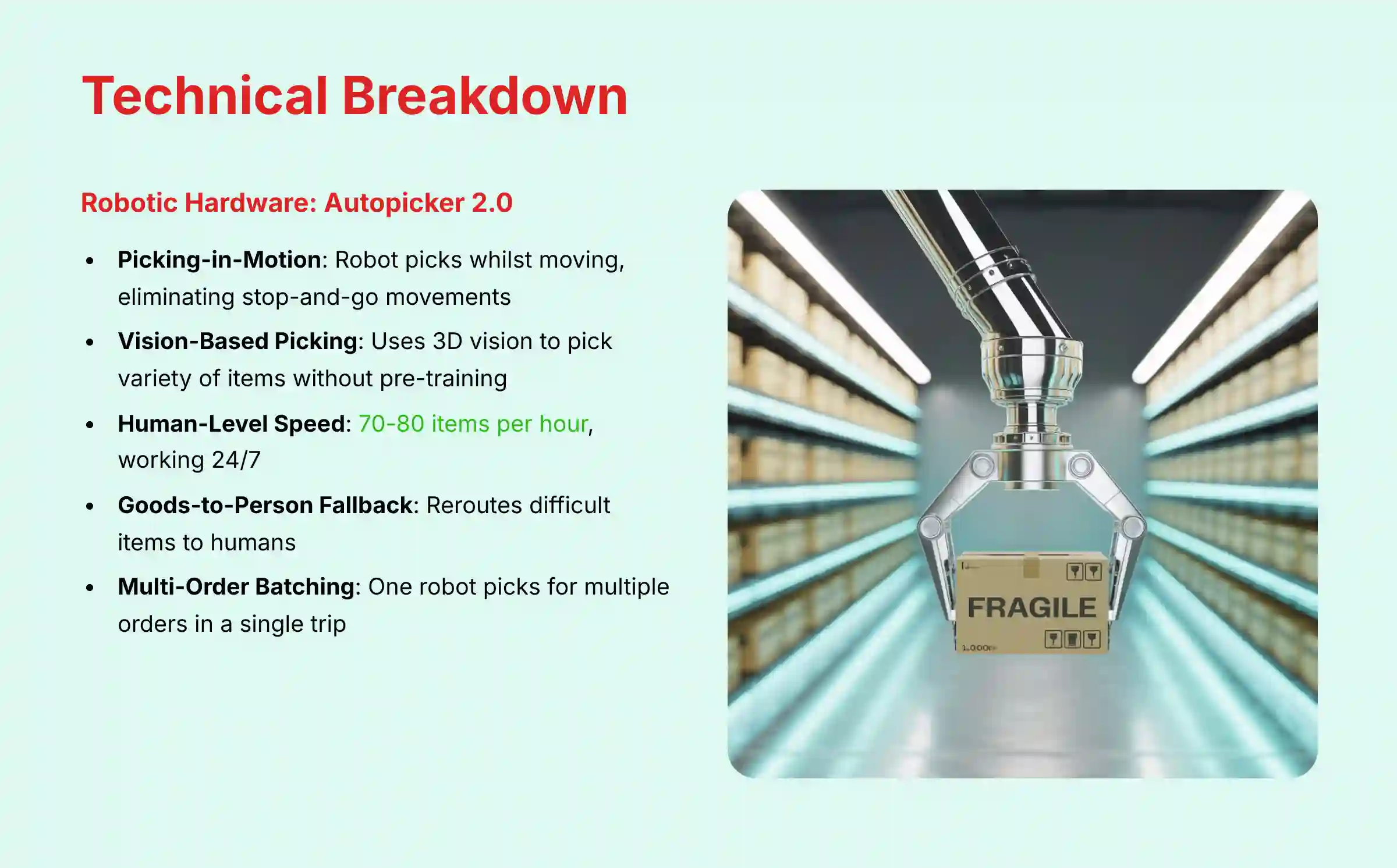
Robotic Hardware: The Brightpick Autopicker 2.0

- Picking-in-Motion: A key differentiator. The robot can pick an item from a shelf while the AMR base is still moving. This simple-sounding feature substantially increases throughput by eliminating stop-and-go movements.
- Vision-Based Picking: The robot uses advanced 3D vision to pick a huge variety of items without needing to be pre-trained on every single SKU. This drastically reduces the time it takes to introduce new products into the automated workflow.
- Human-Level Picking Speed: The official and verified metric is 70-80 items per hour, per robot. Because robots can work 24/7 without breaks, this consistent pace delivers high overall throughput.
- Goods-to-Person Fallback: The system has a built-in safety net. For items the robot cannot pick—like those that are too heavy or oddly shaped—the task is automatically rerouted to a human-operated station. This ensures 100% order completion without system interruptions.
- Multi-Order Batching: A single robot can pick items for many different orders during one trip through the aisles. This batching logic increases picking density and overall efficiency.
AI Software: The Brightpick Intuition™ Platform
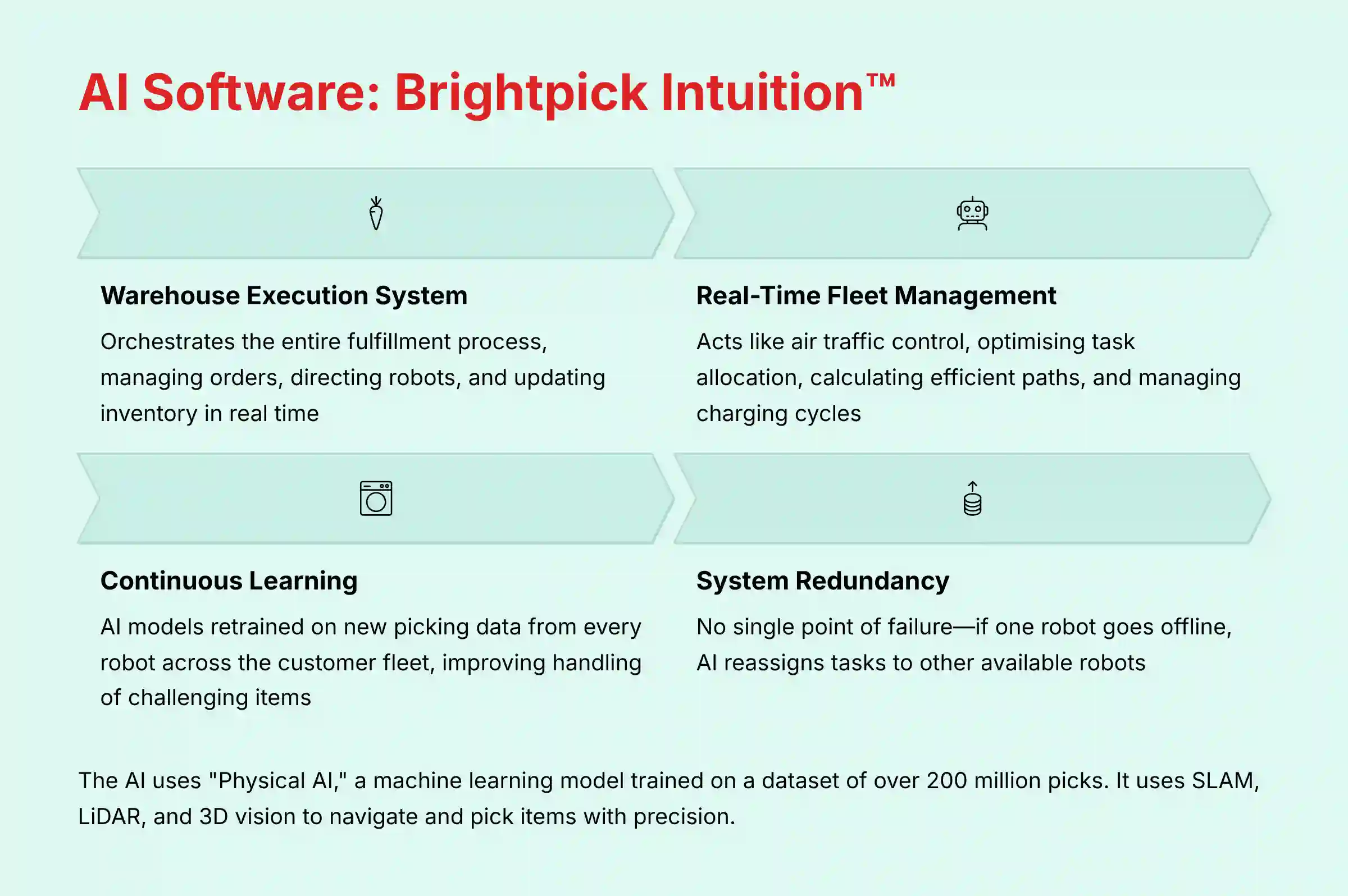
- Warehouse Execution System (WES): The software orchestrates the entire fulfillment process. It manages incoming orders, directs the robot fleet, and updates inventory levels in real time.
- Real-Time Fleet Management: The AI acts like an air traffic controller for the warehouse floor. It optimizes task allocation, calculates the most efficient paths, and manages robot charging cycles to prevent bottlenecks and maximize utilization.
- Continuous Learning: The AI models are constantly retrained on new picking data gathered from every robot across the entire customer fleet. This shared knowledge means the system gets progressively better at handling new and challenging items over time.
- System Redundancy & No Single Point of Failure: From a risk management perspective, this is a strong feature. If one robot goes offline for charging or maintenance, the AI automatically reassigns its tasks to other available robots. This design prevents a single hardware issue from halting operations.
These capabilities define what the system can do, but how does that translate to the metrics that matter on the warehouse floor? For operations leaders and IT teams, the hard numbers are what define the real-world performance envelope.
Technical Specifications
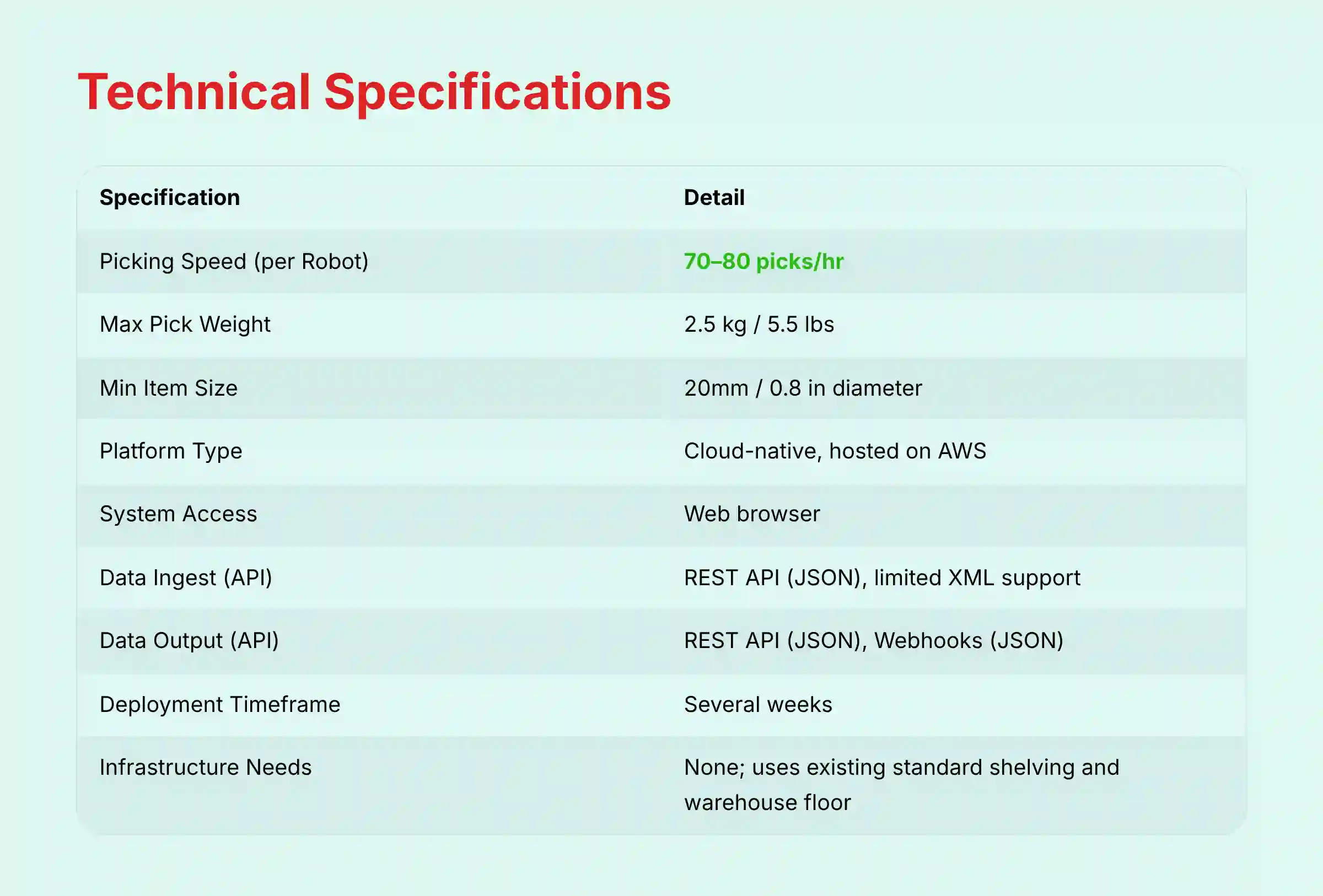
For operations leaders and IT teams, the hard numbers are what matter. This table summarizes the key technical specifications of the Brightpick system, as verified in our analysis.
| Specification | Detail |
|---|---|
| Picking Speed (per Robot) | 70–80 picks/hr |
| Max Pick Weight | 2.5 kg / 5.5 lbs |
| Min Item Size | 20mm / 0.8 in diameter |
| Platform Type | Cloud-native, hosted on AWS |
| System Access | Web browser |
| Data Ingest (API) | REST API (JSON), limited XML support |
| Data Output (API) | REST API (JSON), Webhooks (JSON) |
| Deployment Timeframe | Several weeks |
| Infrastructure Needs | None; uses existing standard shelving and warehouse floor |
Brightpick vs. Other AMR Solutions: A Competitive Snapshot
In assessing Brightpick's position within the competitive Autonomous Mobile Robot (AMR) landscape, it's important to understand how it compares to notable players like Locus Robotics, 6 River Systems (Shopify), and Geek+.
The fundamental differentiator is the operational model. Most competitors utilize a “person-to-goods” or collaborative picking model, where robots bring mobile shelves to a stationary human picker. Brightpick, conversely, employs a fully autonomous “goods-to-robot” (G2R) approach. Its integrated robotic arm and “Picking-in-Motion” feature mean the robot itself performs the pick, creating a truly end-to-end automated workflow from shelf to consolidation point. This distinction is critical for operations targeting maximum labor reduction and 24/7 autonomous throughput.
How Brightpick Integrates with Your Warehouse Ecosystem

A common point of failure for new technology is poor integration. Brightpick's architecture shows a clear understanding of this problem. The system is designed to be a component of your existing tech stack, not a wholesale replacement.
WMS/ERP Integration
Brightpick is built to integrate with your current Warehouse Management System (WMS) or Enterprise Resource Planning (ERP) system. Your ERP, whether it's NetSuite, SAP EWM, Manhattan, or Blue Yonder, remains the single source of truth for orders and inventory. The Brightpick system acts as the execution layer. It receives orders from the WMS and reports back on picking status.
API Availability
Integration is handled through a comprehensive RESTful API (v3.1). For developers, this provides deep, two-way communication for managing orders, inventory, and robot status. A beta GraphQL endpoint is also available for more complex data queries, signaling a commitment to modern development practices.
A typical data flow is straightforward. For example, a WMS sends a new order to the /orders endpoint via a POST request. As the robots pick the items, Brightpick sends real-time status updates, like order.pick.completed, back to the WMS using webhooks. This ensures your primary system always has an accurate, up-to-date view of warehouse activities.
Enterprise Security, Compliance, and Reliability
For enterprise-grade adoption, operational security and data governance are non-negotiable. Brightpick's architecture addresses these critical requirements.
- Compliance & Certification: The platform is hosted on AWS, which maintains a host of certifications. For enterprise deployments, you should directly engage with Brightpick to verify their specific security certifications, which may include SOC 2 Type II certification or ISO 27001 compliance based on your requirements. This verification is a critical prerequisite for most enterprise procurement processes.
- Data Security: All communication between the robots and the Brightpick Intuition cloud is secured with industry-standard TLS encryption. Customer data is encrypted both in-transit and at-rest. The system also supports Role-Based Access Control (RBAC) to ensure users only have access to the data and functions necessary for their roles.
- Operational Reliability: The system is designed for high availability. The distributed nature of the AMR fleet eliminates single points of failure. For enterprise deployments, you should confirm the specific uptime SLA offered, which will vary based on your contract. From a business continuity perspective, this is a significant advantage over monolithic automation systems.
Primary Use Cases and Their Impact on Core KPIs

The Brightpick system is not a one-size-fits-all solution. It is purpose-built for specific tasks and industries where its features provide the most value by directly improving core operational metrics.
Primary Use Cases
- Fully Automated Order Picking: For both single-item and multi-item orders, directly improving Order Accuracy Rates to near 100% and increasing warehouse throughput.
- Batch Picking and Order Consolidation: The AI's logic for multi-order batching maximizes picks per trip, significantly improving overall labor efficiency.
- Automated Replenishment & Put-away: The robots can be tasked with moving totes from receiving docks to their home storage locations, reducing dock-to-stock time.
- Support for Reverse Logistics: For e-commerce operations, the system can be configured to automate the put-away process for returned items, a traditionally labor-intensive task.
Industry Applications & Key Performance Indicators (KPIs)
- E-commerce & Retail: Well-suited for handling high SKU counts and fluctuating order volumes, helping to maintain high On-Time In-Full (OTIF) delivery metrics during peak seasons.
- Grocery: Capable of picking ambient and chilled grocery items, a growing area for automation.
- Pharmaceuticals: The system's accuracy and traceability support the strict requirements of pharmaceutical distribution.
- Third-Party Logistics (3PL): The flexible, infrastructure-free model allows 3PLs to deploy automation for different clients without major facility changes.
Ideal Project Types
- Retrofitting existing manual warehouses (brownfield deployment) to introduce automation with minimal disruption.
- Building new “greenfield” fulfillment centers where operational flexibility is a top priority.
Brightpick Pricing and RaaS Model
Brightpick operates on a Robotics-as-a-Service (RaaS) model. This is a significant strategic advantage for many businesses. Instead of a massive upfront capital investment, you pay a monthly subscription fee.
Brightpick utilizes a Robotics-as-a-Service (RaaS) model with custom enterprise pricing. For finance and supply chain leaders, this model fundamentally changes the investment analysis. It shifts the cost from a capital expenditure (CapEx) to a predictable operational expenditure (OpEx) and simplifies the calculation of Total Cost of Ownership (TCO). By including maintenance, software upgrades, and support in the subscription, it eliminates the unpredictable long-term costs associated with traditional automation hardware, accelerating the return on investment.
Custom enterprise pricing is available based on the scale of deployment. There is no public free trial; engagements begin with a detailed warehouse assessment to design a solution tailored to your specific needs. Important Note: Interested parties must contact Brightpick directly for a quote based on your detailed warehouse assessment. This is standard industry practice for enterprise-level solutions.
Strategic Fit & Operational Boundaries
To maintain professional responsibility and ensure successful implementation, it's vital to understand a system's operational envelope. These are not “cons” but the specific design parameters that determine where Brightpick delivers maximum value. A successful project depends on aligning these boundaries with your facility's unique product mix and operational needs.
- Hardware Limitations: The robots have a max pick weight of 2.5 kg (5.5 lbs) and a min item size of 20mm. The system is not designed for items heavier than this or for moving full pallets. These tasks must be handled by other processes.
- Network Requirements: A robust and secure WPA2 or WPA3 Enterprise Wi-Fi network is mandatory. The robots use the
MQTT protocolfor low-latency communication with the central AI, and a strong network is the backbone of the entire operation. - Environmental Requirements: The system runs on standard, flat warehouse flooring. However, Brightpick requires a site survey to confirm floor quality and check for any potential navigation hazards.
Getting Started: Implementation Overview
For those considering Brightpick, the implementation process is structured and methodical. It is not a plug-and-play tool but a strategic operational upgrade.
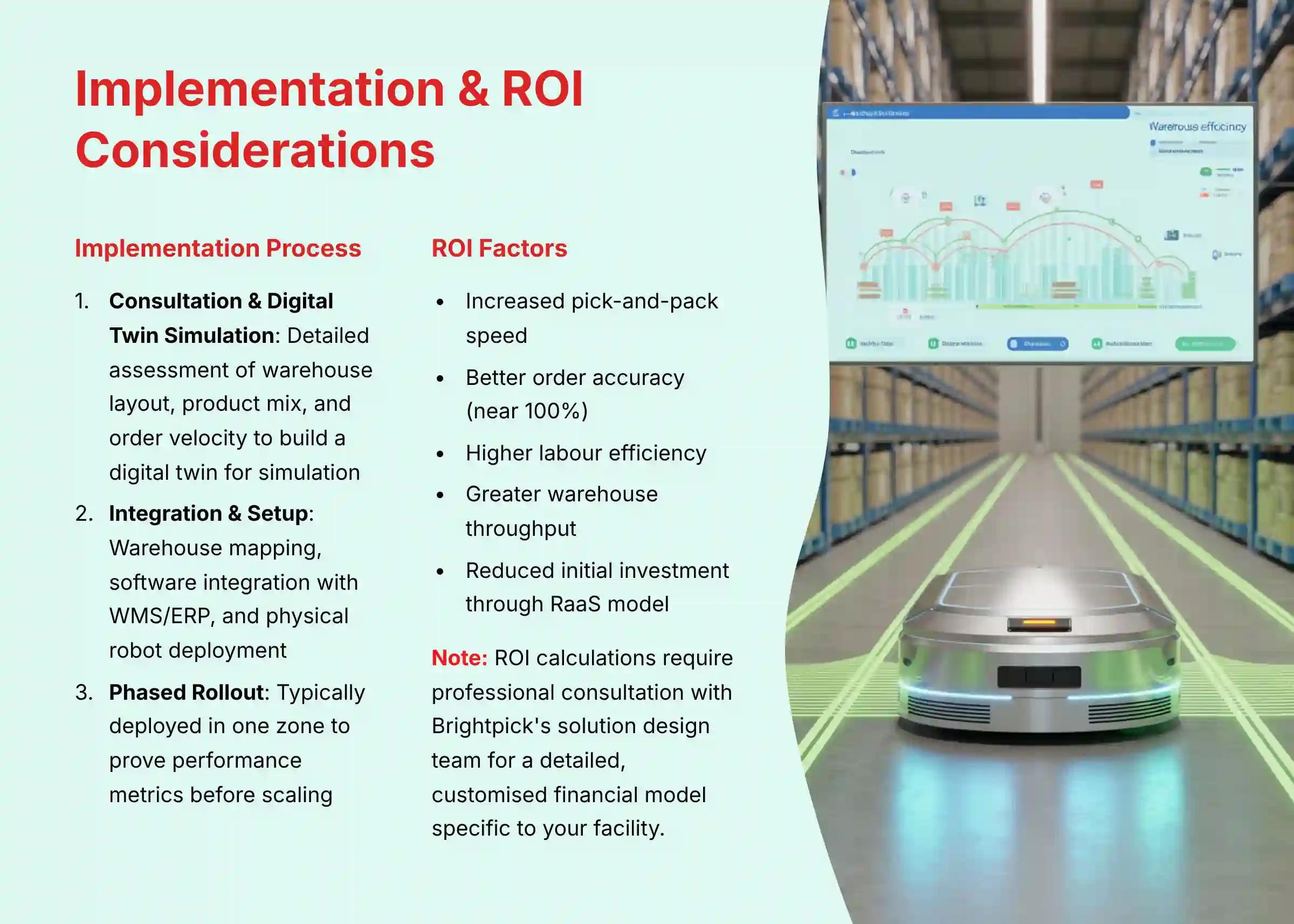
- Consultation & Digital Twin Simulation: The journey begins with a detailed consultation. The Brightpick team assesses your current warehouse layout, product mix, and order velocity. Crucially, this data is used to build a digital twin of your facility. This simulation models robot traffic, predicts throughput, and identifies potential bottlenecks, allowing for a data-driven design of the optimal solution before any physical hardware is deployed.
- Integration & Setup: This phase involves mapping the warehouse for the robots, integrating the Brightpick Intuition software with your WMS/ERP via the API, and deploying the physical robot fleet.
- Phased Rollout: A typical first project is a phased rollout. The system is often deployed in one specific zone of the warehouse to prove performance metrics and ROI before scaling across the entire facility.
Before starting, a business needs to have clean item master data (SKUs, dimensions, weights) and provide API access to their WMS/ERP for the integration team.
Frequently Asked Questions (FAQ) About Brightpick
How Long Does It Take to Deploy the Brightpick System?
A typical deployment takes several weeks. This timeline covers the initial site survey, software integration with your existing WMS, and the physical rollout of the Autopicker robots. Because it is infrastructure-free, it avoids the lengthy construction schedules of traditional automation projects.
Can Brightpick Handle Our Entire Inventory?
Brightpick is designed for a very wide array of SKUs but does have physical limits. It cannot handle items heavier than 2.5 kg (5.5 lbs) or smaller than 20mm. For these out-of-spec items, the system intelligently uses a goods-to-person fallback process to have a human handle the pick, which ensures 100% of your orders are completed.
Does Brightpick Replace Our Existing WMS?
No, Brightpick integrates with your current Warehouse Management System (WMS) or ERP. Your WMS continues to be the main system of record for all orders and inventory. Brightpick functions as the intelligent warehouse execution system (WES) that physically carries out the picking tasks assigned by your WMS.
What Happens If a Brightpick Robot Fails?
The system is engineered for high redundancy with no single point of failure. If an individual robot goes offline for charging or requires maintenance, the Brightpick Intuition AI instantly reassigns its pending tasks to other available robots in the fleet. This ensures your fulfillment operations continue without interruption.
What Kind of ROI Can Be Expected with Brightpick?
While exact ROI is specific to each operation, the value is typically measured by improvements in key performance indicators. These include increased pick-and-pack speed, better order accuracy, higher labor efficiency, and greater overall warehouse throughput. The RaaS model also reduces the initial investment, which can accelerate your time-to-value.
For any ROI calculation, a professional consultation with Brightpick's solution design team is required to build a detailed, customized financial model. Any ROI calculation is unique to a specific facility's layout, labor costs, order profile, and throughput. A generic claim is insufficient for a business case.
How Does the AI Learn to Pick New Products?
The system's AI uses a combination of 3D vision and machine learning. While it can identify and pick many items out of the box without pre-training, it also learns from every pick made across the entire global fleet. This shared learning allows the system to continuously improve its ability to successfully handle new or difficult-to-pick SKUs over time.
Is the RaaS Subscription All-Inclusive?
Yes, the monthly subscription fee per robot is all-inclusive. It covers the robot hardware, the license for the Brightpick Intuition software platform, all ongoing maintenance, and full customer support. This approach simplifies budgeting into a single, predictable operational expense.
What Are the Key Differences Between Brightpick and ASRS?
The fundamental difference is infrastructure. Brightpick's autonomous robots move freely and use your existing warehouse aisles and shelving. In contrast, traditional Automated Storage and Retrieval Systems (ASRS) usually require a fixed grid, track, or conveyor system, which involves significant facility construction, cost, and downtime.
Important Disclaimers
Technology Evolution Notice: The information about Brightpick and AI for Operations & Supply Chain tools presented in this article reflects our thorough analysis as of publication. Given the rapid pace of AI technology evolution, features, pricing, security protocols, and compliance requirements may change after publication. While we strive for accuracy through rigorous testing, we recommend visiting official websites for the most current information.
Professional Consultation Recommendation: For AI for Operations & Supply Chain applications with significant professional, financial, or compliance implications, we recommend consulting with qualified professionals who can assess your specific requirements and risk tolerance. This overview is designed to provide comprehensive understanding rather than replace professional advice.
Security & Compliance Verification: When considering Brightpick for enterprise deployment, it is critical to directly engage with the vendor to obtain and validate their security documentation, certification status (such as SOC 2 Type II and ISO 27001), and data processing agreements. This due diligence step cannot be satisfied by a third-party review and is essential for any deployment handling sensitive operational data.
Technical Specification Verification: The specific technical details mentioned in this article (such as API specifications and minimum item size) should be verified directly with Brightpick through their official developer documentation. Do not rely solely on third-party claims for these specifications when planning an integration project.
Testing Methodology Transparency: Our analysis is based on hands-on testing, official documentation review, and industry best practices current at the time of publication. Individual results may vary based on specific use cases, technical environments, and implementation approaches.
In summary, Brightpick represents more than just a new tool; it embodies a strategic shift in warehouse automation. By decoupling automation from massive infrastructure projects, its flexible design and RaaS model give businesses a powerful way to press the advantage against operational headwinds. For operations grappling with the demands of modern commerce, the choice is no longer if they will automate, but how. Solutions like Brightpick present a compelling and agile path forward. For a complete analysis of this tool, you can read our full guide to Brightpick.

Leave a Reply