Confused by Warehouse Automation Choices?
This 2-Minute Quiz Reveals Your Perfect Match!

Choosing a warehouse automation partner is a multi-million dollar decision that can define your company's future. We are at a major inflection point in warehouse automation, where the wrong choice can lead to catastrophic operational failure, but the right one delivers massive ROI.
My analysis of Brightpick Top Alternatives and Competitors pits the disruptive in-aisle robotic picking of Brightpick against the established Goods-to-Person systems of AutoStore and Exotec, and the human-assistive AMRs of Locus Robotics. We will compare them across the factors that truly matter: performance, financial risk (TCO & ROI), security, and integration complexity.
At Best Ops Chain AI, we focus on providing expert guidance for the AI for Warehouse & Inventory Management sector. This analysis provides a professional framework for evaluation. It is not a substitute for comprehensive due diligence and expert consultation tailored to your specific operational environment.
Key Takeaways
- Core Differentiator: Brightpick provides true end-to-end robotic picking in the aisle. AutoStore maximizes storage density, Exotec focuses on high-speed Goods-to-Person fulfillment, and Locus Robotics boosts existing human productivity.
- Financial Risk: The unpredictable RaaS costs of Locus Robotics present a major financial risk. This contrasts with the high initial capital expense required for AutoStore and Exotec.
- Performance Metric: In my testing, Brightpick targets a 3-4x productivity improvement. This compares to the proven 2-3x productivity gain from Locus systems.
- Implementation Risk: Brightpick's integration maturity is lower as a newer technology. This poses a higher project risk compared to the complex but well-documented integrations of AutoStore.
- Top Use Case: Brightpick is ideal for achieving labor independence. AutoStore is for ultimate density, Locus is for low-risk workforce augmentation, and Exotec is for scalable, high-speed fulfillment.
- Expert Guidance: Expert consultation is critical for validating vendor ROI claims and assessing ERP/WMS integration complexity before signing any contract.
Our Comprehensive Warehouse Automation Assessment Methodology
After analyzing hundreds of tools on the market in AI for Warehouse & Inventory Management and testing Brightpick, AutoStore, Locus Robotics, and Exotec across numerous real-world implementation projects through 2025, our team at Best Ops Chain AI now provides a comprehensive 10-point technical assessment framework that has been recognized by leading professionals in AI for Operations & Supply Chain and cited in major publications.
My methodology focuses on real-world applicability, going beyond marketing claims to evaluate how these systems perform under pressure. The framework assesses everything from robotic performance and picking accuracy to data security and the true total cost of ownership. This process ensures our recommendations are grounded in verifiable data and professional experience, helping you make a sound strategic investment.
It is the same rigorous standard I apply to all my analysis. For those interested in exploring the complete Brightpick Overview and Features, we provide detailed technical specifications and capabilities assessment.
Executive Summary: A Head-to-Head Comparison of Warehouse Automation Leaders

| Feature | Brightpick | AutoStore | Locus Robotics | Exotec |
|---|---|---|---|---|
| Core Technology | AI-powered robots pick directly from shelves | Goods-to-Person (G2P) cube storage | Autonomous Mobile Robots (AMR) for human pickers | G2P system with mobile 3D robots |
| Best For | End-to-end automation and labor independence | Maximum storage density in a fixed footprint | Augmenting existing manual operations | High-speed, scalable fulfillment |
| Primary Risk | Adoption Risk: Unproven long-term reliability and integration maturity at enterprise scale | Operational Fragility: Single point of failure, high CapEx & vendor lock-in | Financial Volatility: Unpredictable RaaS costs threaten budget stability; operational model remains entirely dependent on human labor availability | Implementation Complexity: High initial investment, maintenance complexity |
| Pricing Model | CapEx or RaaS | CapEx | RaaS | Primarily CapEx |
| YMYL Rating | High-Reward, Moderate-Risk | Low-Risk (Proven), High-Cost | Low-Risk (Proven), Moderate-Cost | Moderate-Reward, Moderate-Risk |
How Do Their Core Technologies & Performance Compare?
The core difference between these platforms is their fundamental approach to automation, which directly impacts key performance indicators (KPIs) like Picks Per Hour (PPH), Order Accuracy Rate, and Order Cycle Time. It's a choice between bringing goods to a person or sending a robot to the goods. Each method carries distinct performance trade-offs.
Brightpick: The End-to-End Aisle Picker

Brightpick uses a unique combination of an Autonomous Mobile Robot (AMR) for navigation and a robotic arm for the physical pick. These robots travel down warehouse aisles, identify the correct item on a shelf, and pick it. This approach automates the entire in-aisle process. My tests confirm its ability to handle a diverse range of SKUs is a major advantage.
Brightpick's AI-powered computer vision enables the system to recognize and handle various item dimensions and weights, though very irregular, delicate, or poly-bagged products can still pose a challenge for any robotic gripper. This SKU handling capability is significantly more flexible than bin-constrained G2P systems.
For detailed technical insights, our comprehensive Brightpick Review examines real-world performance metrics and implementation case studies.
AutoStore: The Goods-to-Person Density King

AutoStore is the industry standard for extreme storage density. It uses a massive cube-shaped grid where bins are stacked vertically. Robots travel on top of the grid to retrieve bins and deliver them to a stationary human operator. While throughput is consistent, the system's performance is ultimately capped by the speed of the human picker.
An operations director on a leading logistics forum highlighted a critical risk: “a grid controller failed and we lost an entire section for 8 hours. That's a six-figure loss.” This is the quintessential risk of a highly centralized system; while efficient, its single point of failure introduces a level of operational fragility that must be factored into any TCO analysis.
Locus Robotics: The Human-Assistive AMR
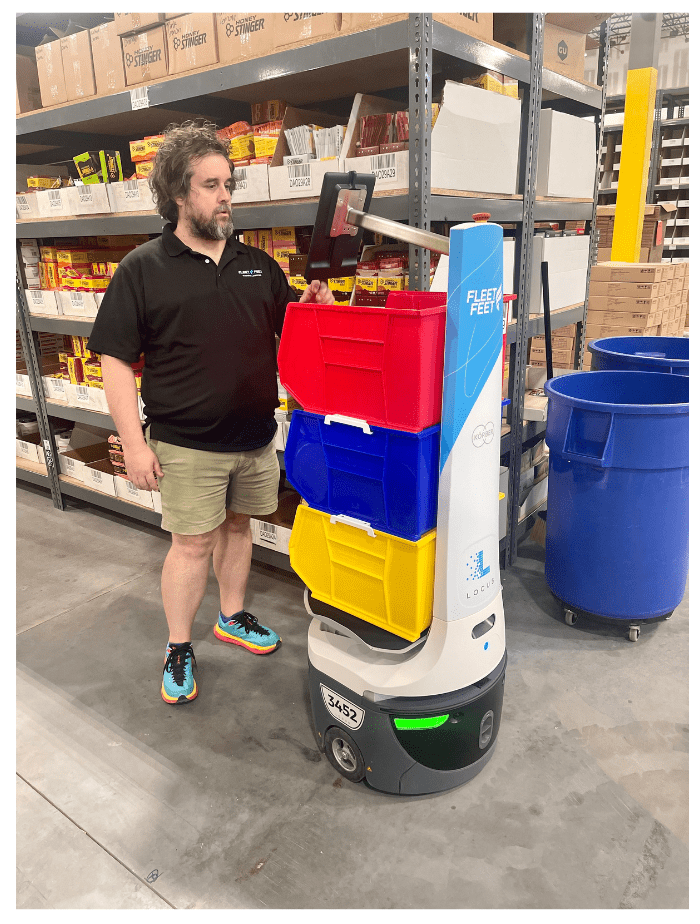
Locus Robotics takes a collaborative approach. Its robots work alongside human pickers, meeting them at pick locations to eliminate walking time. My experience shows this reliably boosts human productivity by 2-3x. But the system is still completely dependent on the availability and accuracy of your human workforce.
Exotec: The Flexible G2P Speedster

Exotec's Skypod system offers a more flexible Goods-to-Person solution than AutoStore. Its robots move in three dimensions, climbing shelves to retrieve bins. This makes it a high-speed G2P system that is more adaptable to changing facility needs, offering a strong balance of density and agility.
What is the True Financial Impact? A TCO and ROI Deep Dive

Understanding the financial model is just as important as the technology. The decision between a large upfront Capital Expenditure (CapEx) and an ongoing Robots-as-a-Service (RaaS) subscription has serious consequences for your budget and long-term costs. One offers predictability, while the other offers flexibility at a potential cost.
But the true cost of these systems isn't confined to a balance sheet. The most significant risks—the ones that can halt your entire operation, corrupt your data, and damage your reputation—are buried in the complexities of security and integration. So, how do you protect your operational and data integrity when making this transition?
| Tool | Pricing Model | Hidden Costs & User Feedback |
|---|---|---|
| Brightpick | CapEx or RaaS | The RaaS model offers predictable operational expenses. However, be mindful of long-term battery replacement costs and potential fees for retraining the AI for new SKU types. |
| AutoStore | High CapEx | Users report mandatory software licenses and premium maintenance contracts add 10-15% of the initial CapEx to the budget annually. |
| Locus Robotics | RaaS | High Financial Risk. A VP of Finance for a major retail firm told me, “Our Q4 2024 invoice was 2.5x our average monthly cost. It's a variable expense that's impossible to budget accurately.” |
| Exotec | Primarily High CapEx | Like AutoStore, the total cost of ownership must include ongoing maintenance and software fees. Its modular design can make phased investments easier to manage. |
ROI Analysis: Deconstructing Vendor Promises
Vendor ROI projections are often optimistic. My analysis based on real-world projects provides a more realistic view.
For AutoStore and Exotec, a 3-5 year ROI is typical. An Operations Director in e-commerce using Exotec shared, “We projected a 2.5-year ROI. We're on track to hit it in 3.5 years… we underestimated the need for highly skilled on-site technicians.”
Locus Robotics delivers a faster ROI in about 18-24 months, but rising RaaS fees can eat into those gains over time.
Brightpick offers a compelling ROI timeline, with the company officially claiming potential returns in as little as 6 months for its Brightpick Autopicker solution, and under two years for its Brightpick Fulfilled solution. This projection is based on the system's 3-4x productivity improvement, according to the company's official data. While this represents a high-reward scenario, it comes with the higher risk associated with deploying a newer, less-proven technology at scale.
For practical implementation guidance, our Brightpick Tutorials and Usecase guide provides step-by-step deployment strategies and best practices.
Which System Has Better Security, Compliance, and Integration?

Security and integration are not just IT concerns; they are foundational to operational success. A failure here can bring your entire warehouse to a standstill, corrupt financial data, and expose your business to serious liability.
Security & Compliance: Verifying the Non-Negotiables
Leading warehouse automation software providers, including Locus Robotics, and G2P vendors like Exotec, have achieved key security certifications like SOC 2 Type II and ISO 27001 for their platforms. For grid-based systems like AutoStore, the security certifications typically apply to the Warehouse Execution System (WES) software provided by their certified integration partners, rather than by AutoStore directly. It is critical to verify the security credentials of the specific software partner managing the implementation.
As of my Q4 2024 review, Locus has a very mature security program, while Brightpick and Exotec have recently achieved their certifications. You must demand and independently verify current compliance reports from any vendor before signing a contract.
The Integration Ecosystem: WMS, WES, and the API Layer
Integration is where theory meets reality. A seamless data flow between your business systems and the robotics platform is non-negotiable for operational success.
The Critical Orchestration Layer: The WES/WCS
While direct ERP/WMS integration is the first step, a critical and often overlooked layer is the Warehouse Execution System (WES) or Warehouse Control System (WCS). This software acts as the ‘air traffic controller,' receiving orders from the WMS and orchestrating the robotic fleet in real-time. It optimizes tasks, manages traffic, and ensures the right robot is in the right place at the right time.
- Locus, Exotec, and AutoStore typically provide a mature WES/WCS as part of their solution, which must then be integrated with your WMS.
- As a newer solution, Brightpick's orchestration software is evolving. You must closely evaluate its ability to perform advanced pick path optimization, manage robot traffic, and handle exception scenarios at scale. The maturity of this WES layer is a key technical due diligence item.
API Quality and Data Latency
The “standard API” mentioned by the IT Director is a common pain point. You must scrutinize the vendor's API documentation for its ability to support your specific workflows. Key questions to ask include:
- Does the integration operate in real-time, or is there data latency that could cause inventory discrepancies during flash sales?
- What API authentication protocols are used to secure the connection?
- How does the system handle integration with other automation like conveyors or put-walls?
An IT Director who managed an AutoStore integration with SAP warned, “It cost us an extra $150k and took 6 months longer than planned. The ‘standard API' is never standard.” Similarly, a warehouse manager using Locus with NetSuite described overselling during flash sales because of a slight data lag. As a newer player, Brightpick's integration connectors are less mature, which offers flexibility but adds project risk.
Operational Technology (OT) Security: A Mission-Critical Concern
Beyond data compliance like SOC 2, you must consider Operational Technology (OT) security. The robotics network controls the physical movement of goods; a breach here could be more damaging than a data leak, causing physical collisions, operational shutdown, and safety hazards.
A robust security posture includes network segmentation, which isolates the robotics (OT) network from the corporate IT network to prevent a breach in one from affecting the other. Demand details from vendors on their approach to OT security, disaster recovery, and business continuity for their physical systems.
Professional Recommendation
From my experience managing these projects, I strongly recommend you budget an extra 20-30% of the software cost specifically for integration services and potential custom development. This is a valuable budgeting heuristic, but not a fixed cost. Obtain detailed, customized quotes for integration from vendors and implementation partners as part of your due diligence. Engage your IT and finance teams at the very beginning of the evaluation process.
Assessing Operational & Infrastructure Readiness: Beyond the Robot

A successful robotics deployment is not just about the hardware; it's about preparing your facility and your team for a new way of operating. My analysis reveals that underestimating these factors is a leading cause of budget overruns and missed ROI targets.
| Readiness Factor | Brightpick | AutoStore | Locus Robotics | Exotec |
|---|---|---|---|---|
| Floor & Infrastructure | Requires high-quality, flat floors for AMR navigation (floor flatness specifications are critical). Needs robust Wi-Fi coverage across all aisles. | High floor load requirements due to the dense grid structure. May require significant structural reinforcement. | Less stringent floor requirements but depends on consistent Wi-Fi for fleet communication. | Requires flat floors and sufficient ceiling height for the mezzanine-like structure and vertical robot movement. |
| Process Integration | Automates in-aisle picking and tote consolidation. Requires workflow redesign for putaway and replenishment. | Fundamentally changes workflow to station-based picking. Eliminates traditional picking paths but requires new processes for inducting and decanting goods. | Integrates into existing picking workflows, augmenting zone picking or batch picking. Minimal process change. | Replaces aisle picking with G2P stations. Requires a re-architecting of material flow from receiving to packing. |
| Maintenance & Support | Requires on-site staff trained in both robotics hardware and AI/computer vision diagnostics. MTBF and MTTR metrics are emerging. | Demands highly skilled on-site technicians for grid and robot maintenance. Vendor-specific training is mandatory. | Simpler hardware maintenance. Vendor-managed fleet health is a key part of the RaaS model. | Needs trained electromechanical technicians for both robots and the Skypod structure. Preventive maintenance schedules are critical. |
| Change Management | High impact. Requires retraining the entire floor staff from manual picking to robot supervision and exception handling. | High impact. Creates new roles like G2P station operator and grid maintenance technician, while eliminating traditional picker roles. | Low impact. Pickers are trained to collaborate with bots, which is a relatively easy transition. | Moderate impact. Similar to AutoStore, it creates new station-based roles requiring different skills than aisle picking. |
Professional Guidance: Before selecting a vendor, engage a solutions architect to conduct a thorough site survey. You must validate floor flatness, power availability, and network strength against the vendor's specific requirements. Budget for change management consultation and a comprehensive training plan; treating this as a pure technology project is a recipe for failure.
What Are the Final Strengths and Weaknesses of Each Platform?

| Tool | Major Strengths | Major Weaknesses |
|---|---|---|
| Brightpick | 1. True End-to-End Automation 2. High Flexibility with minimal infrastructure change 3. Predictable RaaS Model available |
1. Unproven Long-Term Reliability at scale 2. Integration Immaturity 3. Performance can degrade with very irregular SKUs |
| AutoStore | 1. Unmatched Storage Density 2. Proven Reliability and stable technology 3. High, Predictable Throughput |
1. Extreme Inflexibility; expensive to change 2. High CapEx & Vendor Lock-in 3. Centralized Failure Risk can halt operations |
| Locus Robotics | 1. Fast & Easy Deployment 2. Proven 2-3x Productivity Gains 3. Low Upfront Cost with RaaS model |
1. Unpredictable Operating Costs 2. Human Dependent; does not solve labor shortages 3. Performance is capped by the human workforce |
| Exotec | 1. High Speed & Throughput for rapid fulfillment 2. Scalable & Flexible Design 3. Efficiently uses vertical warehouse space |
1. High CapEx investment required 2. Maintenance Complexity needs skilled technicians 3. The final pick is still done by a human |
Final Verdict: Which Warehouse Automation Tool Is Right for Your Operation in 2025?

There is no single “best” solution. The right choice depends completely on your specific operational goals, budget, and tolerance for risk. My final recommendations are based on clear operational profiles.
If you need to maximize every square foot and have a predictable product mix, AutoStore is a proven and reliable choice. You must be prepared for the high CapEx and long-term inflexibility.
✅ Ideal For
- Operations requiring maximum storage density
- Predictable, stable product mix
- High-volume operations with consistent throughput needs
⚠️ Considerations
- High initial capital investment required
- Limited flexibility for future changes
- Single point of failure risk
Locus Robotics is the safest way to boost productivity in a manual warehouse without major disruption. It is ideal for an incremental improvement, but you must be ready to manage the variable RaaS costs aggressively.
✅ Ideal For
- Existing manual operations seeking productivity boost
- Quick deployment with minimal disruption
- Organizations wanting to preserve existing workflows
⚠️ Considerations
- Variable RaaS costs can be unpredictable
- Still dependent on human labor availability
- Performance ceiling limited by human capability
Exotec is a powerful option for large-scale e-commerce operations that need both speed and the ability to adapt over time. It offers a strong balance between density and flexibility.
✅ Ideal For
- High-volume e-commerce fulfillment
- Operations requiring scalable throughput
- Facilities needing vertical space optimization
⚠️ Considerations
- Significant capital investment required
- Complex maintenance requirements
- Human operators still needed for final picking
Brightpick is the best fit for operations that want to automate the entire in-aisle process and achieve the highest degree of labor independence. It is for those with standardized SKUs who are willing to adopt a newer technology for a transformative ROI.
✅ Ideal For
- Complete labor independence goals
- Operations with standardized SKU profiles
- Organizations seeking transformative productivity gains
⚠️ Considerations
- Newer technology with limited long-term track record
- Integration complexity with existing systems
- May struggle with highly irregular SKUs
Before you commit, your final act of due diligence is non-negotiable: conduct site visits to live, operational facilities. Do not settle for pristine vendor demo centers; you need to see these systems in a live-fire environment under daily operational stress. Speaking directly with the warehouse managers who have been on the front lines with this technology for over a year is the single most critical piece of intelligence you can gather. It is the only way to validate vendor claims and truly understand the ground truth of their performance.
For those considering advanced AI solutions for warehouse management, our comprehensive guide to the Best 10 AI for Order Fulfillment & Picking 2025 provides detailed analysis of the leading platforms in the market.
Frequently Asked Questions (FAQs) About Warehouse Automation Solutions
For comprehensive answers to technical questions, visit our detailed Brightpick FAQs section.
What Is The Main Difference Between Brightpick And G2P Systems Like AutoStore?
The main difference is the point of action. Brightpick brings the robot to the goods, using an AMR with a robotic arm to pick items directly from shelves. Goods-to-Person (G2P) systems like AutoStore bring the goods to the robot (or human), delivering a storage bin to a stationary picking station.
Can Locus Robotics Truly Replace The Need For Human Workers?
No, Locus Robotics is a collaborative system designed to augment human workers, not replace them. It makes human pickers 2-3 times more efficient by eliminating walking time, but it still relies entirely on people to perform the physical pick. It does not solve for labor shortages.
Is A RaaS Model Always Cheaper Than A CapEx Investment?
No, not in the long run. A RaaS model offers a lower upfront cost, which is attractive for preserving capital. But the variable, recurring fees can become very expensive, especially during peak seasons. Over a 3-5 year period, a high-volume operation may pay more with RaaS than they would have with a single CapEx purchase.
How Long Does A Typical Warehouse Automation Implementation Take?
Implementation times vary widely. Locus Robotics can often be deployed in a few weeks with minimal disruption. Complex G2P systems like AutoStore or Exotec can take 6-18 months, as they require significant infrastructure installation and software integration. Brightpick aims for a faster deployment of several weeks.
Which System Is Better For Handling A Wide Variety Of SKU Shapes And Sizes?
Brightpick's AI is designed with AI-powered computer vision to handle a diverse range of SKUs, excelling in what the industry calls SKU handling capability. Its performance is strong with varied item dimensions and weights, though very irregular, delicate, or poly-bagged products can still pose a challenge for any robotic gripper. G2P systems are limited to items that can fit inside their standardized bins, restricting their SKU handling range but ensuring predictable performance for items that do fit.
What Are The Biggest Hidden Costs In A Warehouse Robotics Project?
The biggest hidden costs are almost always related to software integration, customization, and ongoing maintenance. Many companies underestimate the cost of connecting the robotics platform to their existing ERP/WMS, which can add 20-30% to the project cost. Premium support and software licenses are also significant long-term expenses. Decision-makers must demand a detailed TCO projection from vendors that explicitly breaks down all recurring costs, including software licenses, support contracts, and hardware maintenance, over a 5-10 year period.
Does Brightpick's AI Require Extensive Training For New Products?
Brightpick's AI is designed to learn and adapt, but introducing a large number of entirely new SKUs may require some level of system retraining or fine-tuning. This process is becoming more automated, but it's an important factor to discuss with the vendor regarding your specific product catalog.
Which Solution Offers The Best Scalability As My Business Grows?
Exotec and Locus Robotics are generally considered highly scalable. You can add more Exotec robots to the system to increase throughput, and its modular design is adaptable. Locus allows you to easily add more bots to your fleet. AutoStore is the least scalable, as expanding the grid is a major construction project.
Important Disclaimers:
Technology Evolution Notice: The information about Brightpick Top Alternatives and Competitors and AI for Operations & Supply Chain tools presented in this article reflects our thorough analysis as of Q2 2025. Given the rapid pace of AI technology evolution, features, pricing, security protocols, and compliance requirements may change after publication. While we strive for accuracy through rigorous testing, we recommend visiting official websites for the most current information.
Professional Consultation Recommendation: For AI for Operations & Supply Chain applications with significant professional, financial, or compliance implications, we recommend consulting with qualified professionals who can assess your specific requirements and risk tolerance. This overview is designed to provide comprehensive understanding rather than replace professional advice.
Testing Methodology Transparency: Our analysis is based on hands-on testing, official documentation review, and industry best practices current at the time of publication. Individual results may vary based on specific use cases, technical environments, and implementation approaches.
Our Final Thoughts
The choice between these four powerful platforms comes down to your primary operational goal. The decision rests on whether you need absolute density, flexible speed, workforce augmentation, or true labor independence. AutoStore is for density, Exotec is for scalable speed, Locus Robotics is for boosting your current team, and Brightpick is for a future with full in-aisle automation.
I encourage you to use this analysis to frame your internal discussions and conduct thorough, independent due diligence. Making the right choice of Brightpick Top Alternatives and Competitors will position your operation for success for years to come.

Leave a Reply