Is Brightpick the Right Robotic Solution for Your Warehouse?
Take This 2-Minute Quiz to Find Out!
Key Takeaways
- AI-Powered Automation: Brightpick delivers end-to-end robotic fulfillment with autonomous mobile robots achieving 800 picks/hour at 99.9% accuracy
- Flexible Deployment: Unlike fixed grid systems, Brightpick works with standard shelving and can scale incrementally with business growth
- Multiple Pricing Options: Choose between CapEx purchase or Robotics-as-a-Service (RaaS) for flexible financial planning
- Rapid Implementation: Typical deployment timeline from contract signing to go-live is as fast as 6 months with comprehensive support
- Ideal for E-commerce & 3PLs: Perfect for high-volume operations handling diverse SKUs with accuracy-critical requirements

What is Brightpick and how does its AI-powered robotic fulfillment work?
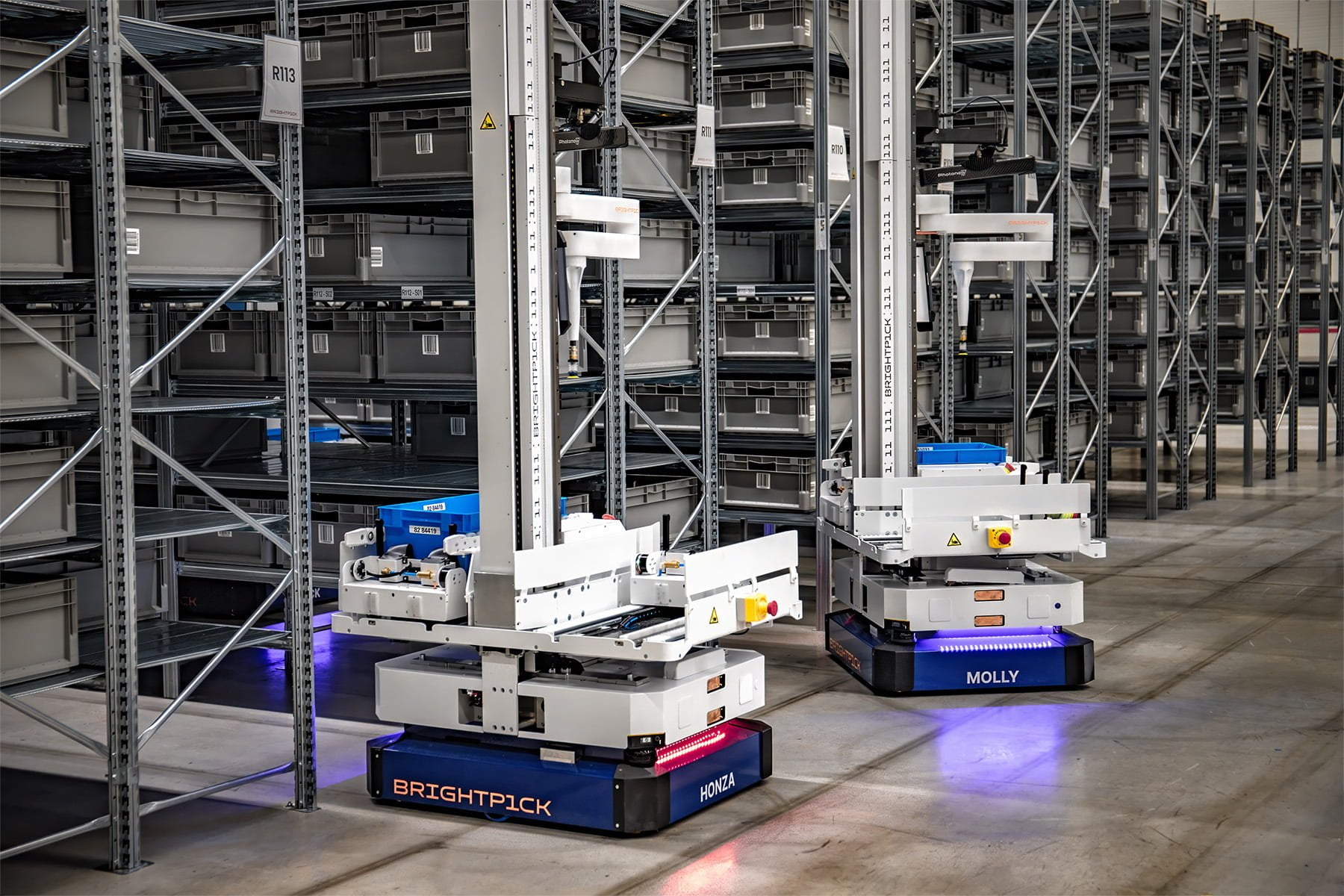
Brightpick is an end-to-end robotic fulfillment solution that automates picking, consolidation, and dispatch in warehouses. Unlike traditional systems where workers travel to inventory, Brightpick uses a fleet of autonomous mobile robots (AMRs) that perform “robot-to-goods” picking. The core of the system involves these AI-guided robots driving directly down warehouse aisles, retrieving storage totes, and bringing them to a central picking station. At the station, the system's most distinctive feature, the Brightpick Autopicker, uses advanced computer vision and AI to pick items directly from the totes and place them into order containers.
The process is orchestrated by Brightpick Intuition, the AI software brain that optimizes everything from robot traffic and inventory slotting to picking paths. Once all items for an order are picked, the robots then manage the consolidation and dispatch process, ensuring orders are ready for packing and shipping with minimal human intervention. This fully integrated approach aims to solve challenges related to labor dependency, order accuracy, and fulfillment speed in modern e-commerce and grocery operations.

What specific problems in warehouse operations does Brightpick solve?
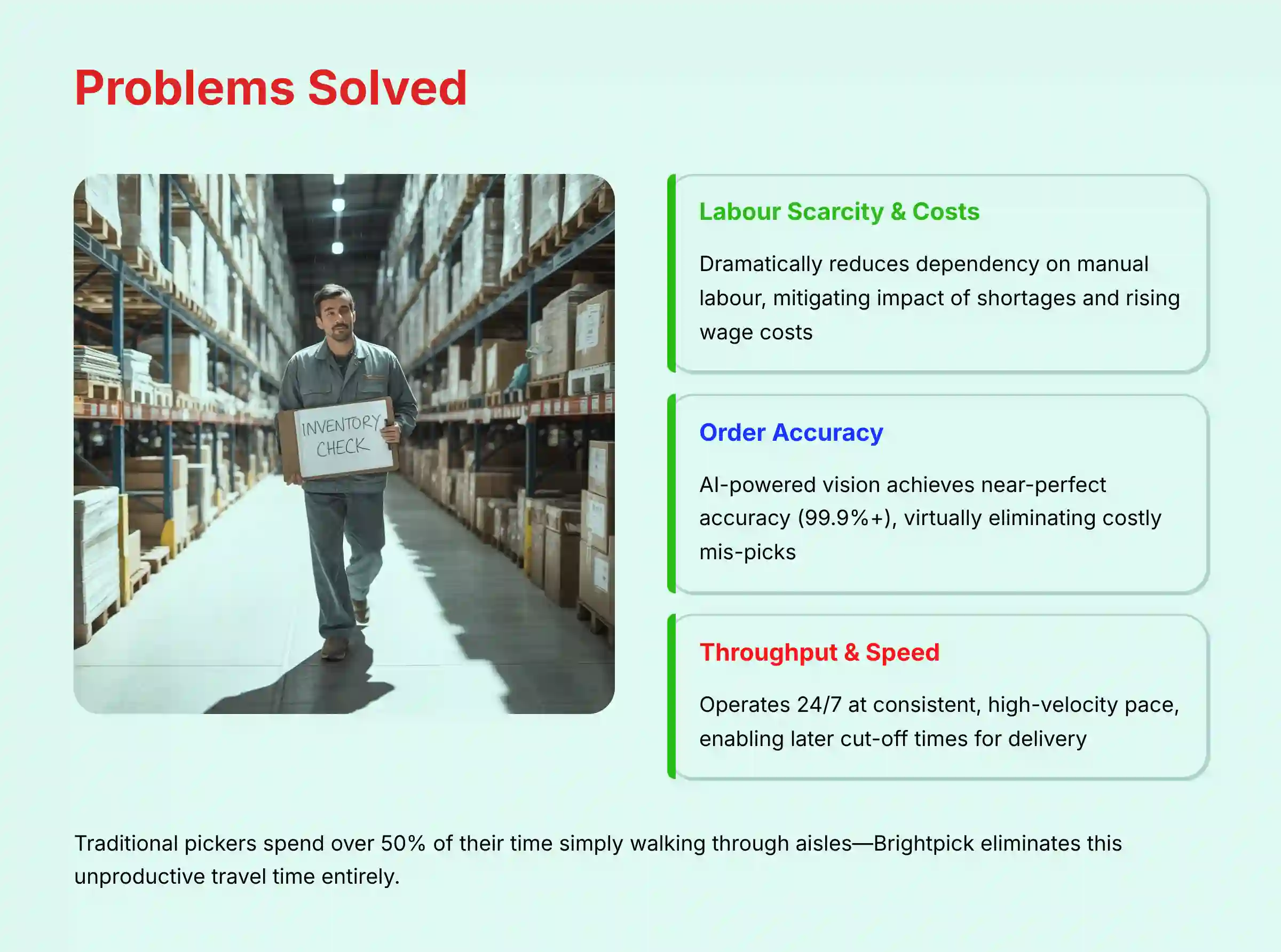
Brightpick directly addresses the core warehouse challenges of high labor costs, human error, and slow fulfillment speeds, which are often amplified by labor shortages and seasonal demand spikes. Traditional manual or cart-based picking methods are notoriously inefficient, with studies showing that pickers can spend over 50% of their time simply walking through aisles. Brightpick eliminates this unproductive travel time entirely.
The key problems it solves include:
- Labor Scarcity and Costs: By automating the entire picking and consolidation process, it dramatically reduces the dependency on manual labor, helping to mitigate the impact of labor shortages and control rising wage costs.
- Order Accuracy: AI-powered computer vision and robotic picking achieve near-perfect accuracy (often cited at 99.9%+), virtually eliminating costly mis-picks, which lead to expensive returns and dissatisfied customers.
- Throughput and Speed: The system can operate 24/7 at a consistent, high-velocity pace, significantly increasing a warehouse's order fulfillment capacity and enabling later cut-off times for next-day or same-day delivery.
- Operational Resilience: It provides a predictable and reliable fulfillment engine that is less susceptible to human factors like shift changes, training times, or absenteeism, making the supply chain more resilient to disruption.
For businesses looking to understand alternative solutions and competitive options, exploring comprehensive Brightpick top alternatives and competitors analysis can provide valuable insights into the broader automation landscape.

Who is the ideal customer for a Brightpick solution?
The ideal customer for Brightpick is a business with high-volume, high-SKU-count fulfillment operations where speed, accuracy, and labor efficiency are critical competitive differentiators. While the solution is versatile, it delivers the most significant ROI in specific sectors. Operations leaders in these industries who are struggling to scale due to labor constraints or high error rates are prime candidates for this technology.
Key customer profiles include:
- E-commerce Retailers: Companies dealing with a large volume of direct-to-consumer orders and a wide variety of SKUs benefit immensely from the increased speed and accuracy.
- Third-Party Logistics (3PLs): 3PL providers can leverage Brightpick to offer more competitive service-level agreements (SLAs) to a diverse client base, handle fluctuating demand, and manage multi-client inventory within the same system.
- Grocery and Pharmaceuticals: These sectors require extremely high accuracy and can leverage Brightpick's ability to operate in specialized temperature zones (e.g., chilled environments) for fulfilling online grocery orders or managing sensitive medical supplies.
- Micro-Fulfillment Centers (MFCs): Brightpick's modular design is well-suited for smaller, urban fulfillment centers that need to maximize storage density and throughput in a limited footprint.
What types of products and SKUs can Brightpick robots handle?
Brightpick is designed to handle a vast majority of the SKUs typically found in e-commerce, grocery, and pharmaceutical fulfillment, with specific capabilities defined by size, weight, and form factor. The system excels at picking items that can be stored in standard-sized totes. The AI-powered Autopicker uses a combination of machine vision and versatile grippers to reliably handle a wide range of products.
The system can manage:
- Common E-commerce Goods: Including apparel, cosmetics, electronics, books, and household items.
- Packaged Foods: Such as boxes of cereal, cans, jars, and other ambient grocery products. It can also be configured to operate in chilled environments for fresh goods.
- Pharmaceuticals: Boxes, bottles, and blister packs common in healthcare fulfillment.
However, there are limitations. The system is generally not suitable for extremely large, heavy, or irregularly shaped “un-tote-able” items like furniture or tires. It is also not designed for picking single, very delicate items like individual eggs. The ideal product profile fits within a standard tote and falls within the robot's specified weight capacity, which covers the bulk of SKUs in most modern fulfillment centers.

How does Brightpick compare to other warehouse automation like AutoStore, Exotec, or traditional AMRs?
Brightpick's key differentiator is its unique “in-aisle” robotic piece-picking capability, which contrasts with the grid-based storage of systems like AutoStore and Exotec or the human-centric approach of traditional AMRs. Each system architecture is suited for different operational needs. AutoStore and Exotec are Automated Storage and Retrieval Systems (AS/RS) that use a high-density cube structure. Robots travel on top of the grid to retrieve bins and deliver them to a human picker at a workstation. This provides incredible storage density but can have throughput limitations as all bins must come out through a limited number of ports.
Traditional AMRs (like Locus or 6 River Systems) follow a “person-to-goods” model, where robots guide human pickers through the warehouse to reduce travel time, but the picking itself is still manual. Brightpick combines the autonomous navigation of AMRs with the robotic picking of an AS/RS, but does so directly in standard warehouse shelving. This offers a more flexible layout than a fixed grid and automates the physical pick, unlike traditional AMRs. This approach can be faster to deploy and more easily scalable in existing facilities without requiring a massive structural overhaul.
The fundamental choice between Brightpick and a grid-based AS/RS like AutoStore is a strategic one based on your inventory profile and growth plans. Grid systems are unbeatable for pure storage density in a fixed space. However, Brightpick offers superior operational flexibility. You can add new aisles or more robots with less disruption than expanding a grid. When analyzing your decision, focus beyond pick speed per robot to your order profiles. If you have a long-tail inventory where many SKUs are rarely touched, a grid system might entomb them at the bottom. Brightpick's aisle-based approach ensures every single tote is always accessible, which is a massive advantage for operations with unpredictable demand patterns.
To explore cutting-edge alternatives in warehouse automation, consider reviewing the best 10 AI solutions for order fulfillment and picking in 2025, which provides comprehensive insights into the evolving automation landscape.

What are the verified pick rates and order accuracy of the Brightpick system?
Brightpick publicly states its Autopicker can achieve pick rates of up to 800 items per hour with a verified accuracy of 99.9%. It is critical for prospective buyers to understand that these figures represent system capabilities under optimized conditions. Real-world performance in your facility will depend on several key variables, including the specific characteristics of your inventory, warehouse layout, and order profiles. For example, a warehouse picking small, uniform items will likely achieve higher pick rates than one handling a mix of large and small, irregularly shaped products.
The 99.9% accuracy rate is achieved through the system's sophisticated computer vision and AI algorithms. Before each pick, the AI identifies the exact item in the tote, calculates the best gripping strategy, and verifies the pick was successful. This multi-check process virtually eliminates human error, which is a primary source of costly returns and customer dissatisfaction in manual operations. When evaluating the system, it's essential to work with Brightpick's engineers to run simulations with your actual SKU data to get a realistic projection of the throughput and accuracy you can expect in your specific operational environment.
How does Brightpick integrate with an existing Warehouse Management System (WMS) or ERP?
Brightpick is designed for deep, bidirectional integration with virtually any modern Warehouse Management System (WMS) or Enterprise Resource Planning (ERP) platform through robust APIs. The system does not replace your WMS; it acts as an intelligent execution layer that carries out the tasks assigned by it. The integration process ensures a seamless flow of information, which is critical for maintaining a single source of truth for inventory and orders.
The typical integration workflow is as follows:
- Order & Inventory Data: The WMS/ERP sends order information (what to pick) and master inventory data to the Brightpick Intuition AI software.
- Execution & Optimization: Brightpick Intuition takes over, optimizing the robot routes, picking sequences, and consolidation logic to fulfill the orders efficiently.
- Real-Time Updates: As tasks are completed (e.g., an item is picked, an order is consolidated), Brightpick sends real-time updates back to the WMS. This ensures that inventory levels in the WMS are always accurate and order statuses are visible across the organization.
This API-first approach allows for flexibility and ensures that Brightpick can coexist with established systems like SAP, Oracle NetSuite, Manhattan Associates, and others without requiring a disruptive “rip and replace” of your core operational software.
The biggest mistake in any robotics integration is underestimating the “data readiness” phase. The official documentation focuses on the technical API connection, but in practice, the success of the project hinges on the quality of your data before you even start. Before implementation, dedicate significant time to a data audit. Ensure your SKU dimensions and weights in the WMS are 100% accurate, your inventory locations are clean, and you have clearly defined your order fulfillment workflows. Garbage data in means chaotic robot behavior out. Spending a month on data cleansing and process mapping before the technical integration begins will save you three months of headaches and troubleshooting post-launch.
For hands-on guidance and practical implementation strategies, exploring detailed Brightpick tutorials and usecase guides can provide step-by-step insights for successful deployment.

What are the physical warehouse requirements for a Brightpick installation?
Brightpick is designed to be deployed in typical warehouse environments with relatively minimal infrastructure changes compared to heavier automation systems. However, there are several key physical requirements that must be met to ensure optimal performance and safety. The primary consideration is the quality of the warehouse floor. It must be flat and smooth to allow the autonomous mobile robots (AMRs) to navigate accurately and consistently. Any significant cracks, bumps, or steep inclines can interfere with robot operation.
Other important requirements include:
- Floor Flatness: A concrete floor with a flatness FF/FL number in a standard range is typically required.
- Ceiling Height: The system works with standard shelving, so typical warehouse ceiling heights are sufficient.
- Wi-Fi Connectivity: A robust, facility-wide, enterprise-grade Wi-Fi network is non-negotiable. The robots rely on constant connectivity to the Brightpick Intuition software for instructions and coordination.
- Power: Adequate power must be available for the robot charging stations, which are strategically placed throughout the operational area.
Unlike some AS/RS solutions that require a complete rebuild of the warehouse interior, Brightpick's ability to work with standard shelving makes it a more flexible option for retrofitting existing facilities.
How scalable is the Brightpick system for handling growth and seasonal peaks?
The Brightpick system is designed with a modular and highly scalable architecture, allowing businesses to adapt to both long-term growth and short-term demand spikes. Scalability is one of the core advantages of its AMR-based approach. A company can start with a smaller implementation that meets its current needs and then seamlessly expand the system as order volumes increase.
Scaling can be achieved in several ways:
- Adding More Robots: The most straightforward way to increase throughput is to add more robots to the fleet. The Brightpick Intuition software automatically incorporates them into the workflow, optimizing the larger fleet to handle more orders simultaneously. This is particularly useful for managing seasonal peaks, as extra robots can be brought in temporarily under a Robotics-as-a-Service (RaaS) model.
- Extending Aisles: As inventory grows, new rows of shelving can be added to the warehouse. Since the system does not rely on a fixed grid, extending the operational area is a relatively simple process.
- Adding More Picking Stations: If the bottleneck becomes the picking and consolidation points, more Brightpick Autopicker or human-operated stations can be installed to increase the overall processing capacity.
This flexibility allows businesses to make a right-sized initial investment and then scale their automation capabilities in lockstep with their revenue growth.

What is the pricing model for Brightpick? (CapEx vs. Robotics-as-a-Service)
Brightpick offers flexible pricing models to accommodate different financial strategies, including both a traditional capital expenditure (CapEx) model and a Robotics-as-a-Service (RaaS) subscription model. The choice between these models allows businesses to select the option that best aligns with their budget, cash flow, and long-term financial planning. The availability of RaaS is particularly important as it lowers the barrier to entry for adopting advanced automation.
- Capital Expenditure (CapEx): This is the traditional model where a company purchases the entire system—robots, software, and infrastructure—as a one-time capital investment. This approach typically involves a higher upfront cost but results in a lower total cost of ownership (TCO) over the long term, as there are no recurring subscription fees for the hardware.
- Robotics-as-a-Service (RaaS): In this subscription-based model, customers pay a recurring monthly or annual fee. This fee covers the use of the robots, software, maintenance, and support. RaaS turns the investment into a predictable operating expense (OpEx), significantly reducing the initial capital outlay and allowing for greater flexibility to scale the fleet up or down as business needs change.
The RaaS model is often favored by 3PLs and companies in fast-growing markets who want to preserve capital and align their automation costs directly with their operational activity.
How do I calculate the ROI and payback period for a Brightpick implementation?
Calculating the Return on Investment (ROI) and payback period for a Brightpick system involves a comprehensive analysis of cost savings, efficiency gains, and error reduction compared to your current manual operations. While the primary driver is direct labor savings, a thorough ROI calculation must include several other critical financial benefits to capture the full value of the investment. A detailed business case should be built by quantifying improvements across key performance indicators (KPIs).
The core components of the calculation include:
- Direct Labor Savings: Calculate the fully-loaded cost (wages, taxes, benefits) of the picking and packing staff that will be automated. This is typically the largest source of savings.
- Increased Throughput: Quantify the value of fulfilling more orders with the same or fewer staff in the same facility, enabling revenue growth without expanding your footprint.
- Improved Accuracy: Calculate the total cost of mis-picks in your current operation, including the cost of processing returns, shipping replacement items, and customer service hours. Reducing this from a typical 1-3% error rate to Brightpick's 0.1% can result in significant savings.
- Reduced Employee Churn: Factor in the high costs associated with recruiting, hiring, and training new warehouse associates. Automation improves working conditions and reduces turnover.
The payback period is calculated by dividing the total initial investment (whether CapEx or initial RaaS fees) by the total annual savings. Most automation projects aim for a payback period of 18-36 months.
The biggest mistake leaders make when building the ROI case is stopping at direct labor savings. That's the easiest number to calculate, but it's often not the most compelling one for the C-suite. The “hidden ROI” that seals the deal comes from second-order effects. For example, what is the value of reducing your new-hire training time from two weeks to two days? What is the financial impact of improving your On-Time In-Full (OTIF) delivery metric by 5%, and how does that translate to customer lifetime value and retention? These “soft” benefits can be quantified and often reveal that the strategic value of resilience and customer satisfaction far outweighs the simple reduction in headcount costs. Frame the investment not just as a cost-cutter, but as a revenue-enabler and risk-reducer.
What is the typical implementation timeline from signing to go-live?
The typical implementation timeline for a Brightpick solution, from contract signing to a fully operational “go-live,” is as fast as 6 months, depending on project complexity and facility readiness. This timeline can vary based on the complexity of the project, the size of the warehouse, the level of WMS integration required, and the readiness of the facility. The process is managed as a structured project with several distinct phases to ensure a smooth deployment.
A standard project plan includes:
- Phase 1: Discovery and Design (1-2 months): This involves detailed workflow analysis, facility mapping, and designing the optimal system layout and robot fleet size for your specific needs.
- Phase 2: Infrastructure Preparation (1-2 months): While the hardware is being manufactured, this phase involves preparing the site—ensuring the floor, Wi-Fi, and power meet specifications.
- Phase 3: System Installation and Integration (1-2 months): This is when the physical hardware (shelving, charging stations, robots) is installed on-site. Concurrently, the software integration with your WMS/ERP is configured and tested.
- Phase 4: Testing, Training, and Go-Live (1 month): The system undergoes rigorous testing with real order data. Your staff is trained on how to operate and manage the system, culminating in the final go-live and a ramp-up period to full production.
Timelines are estimates. A formal Statement of Work (SOW) from the vendor will define the official project timeline, dependencies, and key milestones. Delays in site preparation or data integration can impact the go-live date.
What kind of ongoing support, maintenance, and warranty is included?
Brightpick provides a comprehensive support and maintenance package designed to ensure maximum uptime and system longevity. The specific terms are typically defined in a Service-Level Agreement (SLA) and are a core component of both the CapEx and RaaS models. The goal is to provide a partnership that extends far beyond the initial installation, ensuring the system continues to deliver value for years.
The support package generally includes:
- 24/7 Remote Monitoring: A dedicated team of engineers continuously monitors the health and performance of the robotic fleet and software remotely, often identifying and resolving potential issues before they impact operations.
- On-Site Support: For hardware issues that cannot be resolved remotely, field service technicians are available for on-site repairs and maintenance. The SLA will define the guaranteed response times.
- Preventive Maintenance: The service includes regularly scheduled maintenance visits to inspect and service the robots and other hardware components, prolonging their lifespan and preventing unexpected failures.
- Software Updates and Upgrades: The system's AI and operational software are continuously improved. The support agreement includes access to all new software releases, ensuring your system always has the latest features and performance enhancements.
- Warranty: All hardware components come with a standard manufacturer's warranty covering defects and premature failures.
What are Brightpick's data security and compliance certifications?
Brightpick operates with a strong focus on data security, employing industry-best practices to protect sensitive operational and customer information. For any enterprise-level AI and robotics system, robust security is not an option—it is a mandatory requirement. The platform is built on secure cloud infrastructure and is designed to meet the rigorous compliance standards that modern supply chain operations demand.
Key security and compliance features include:
- Compliance Approach: Brightpick states it adheres to industry-best practices for data security and is designed for compliance with standards like GDPR. However, the company does not publicly list SOC 2 or ISO 27001 as current, verified certifications.
- Data Encryption: All data, both in transit between your systems and the Brightpick cloud and at rest, is encrypted using advanced encryption protocols.
- Access Controls: The system provides granular, role-based access controls, ensuring that users can only view and manage the information and functions relevant to their specific jobs. This prevents unauthorized access to sensitive data.
- Network Security: The platform is protected by firewalls, intrusion detection systems, and other network security measures to safeguard against external threats.
Security & Compliance Warning: Verification is mandatory. For any enterprise system handling sensitive operational and customer data, the current status of security certifications like SOC 2 and ISO 27001 must be formally verified directly with the vendor. Do not assume a vendor holds a specific certification unless they provide an official attestation or certificate. This is a critical due diligence step for risk management and regulatory compliance.
For comprehensive information on frequently asked questions and troubleshooting, accessing the detailed Brightpick FAQs resource can provide additional clarity on implementation and operational considerations.

How can I see a live demo or get a warehouse assessment?
The first step to seeing the Brightpick system in action and evaluating its fit for your business is to request a personalized consultation and warehouse assessment through their official website. This initial engagement is designed to be a collaborative process where their team of automation experts works with you to understand your specific operational challenges, goals, and constraints. This is a critical diagnostic step before any proposal is made.
The process typically involves:
- Initial Consultation: A call with a Brightpick solutions consultant to discuss your current fulfillment process, pain points, order volume, SKU profile, and business objectives.
- Data Analysis: You will typically be asked to provide historical order and inventory data. Brightpick's team will analyze this data to simulate how their system would perform in your environment and begin building a preliminary business case.
- Warehouse Assessment: This may involve a site visit or a detailed review of your warehouse blueprints to assess the physical feasibility and design a custom layout.
- Personalized Demo: Based on the findings, you will receive a personalized demonstration that shows how the system would handle your specific products and order types. This can be done virtually or, in some cases, by visiting a live customer site or a demonstration center.
This data-driven approach ensures that you receive a realistic and accurate proposal tailored to your unique operational needs.
Ready to transform your warehouse operations with AI-powered robotics? Contact Brightpick today for a personalized assessment and see how their innovative solution can revolutionize your fulfillment capabilities.

Leave a Reply