Is Berkshire Grey the Right AI Robotic Automation for Your Warehouse?
This 2-Minute Quiz Reveals Your Ideal Solution!
As the founder of Best Ops Chain AI, I have analyzed hundreds of tools in the AI for Operations & Supply Chain space. My work involves hands-on testing and assessing systems that promise to transform logistics. This Berkshire Grey Overview and Features guide is based on my direct experience with their systems in real-world projects, providing a clear look at how they tackle warehouse automation. The goal at my company is to cut through the marketing noise and offer professionals in AI for Warehouse & Inventory Management a trusted, expert perspective.
Berkshire Grey stands out by offering complete AI-powered robotic systems for high-volume warehouses and fulfillment centers. Their core purpose is to automate critical, labor-intensive tasks like picking, packing, sorting, and handling materials. This approach helps businesses increase their order processing speed, improve accuracy, and reduce their reliance on manual labor, which is a major challenge in today's logistics environment. The company combines advanced AI orchestration software with patented hardware to create a unified solution for industries like eCommerce, retail, and grocery.
After analyzing hundreds of tools in AI for Operations & Supply Chain and testing numerous real-world implementation projects in 2025, our team at Best Ops Chain AI has developed a comprehensive 10-point technical assessment framework specifically for AI for Operations & Supply Chain applications. This framework has been recognized by leading AI for Operations & Supply Chain professionals and cited in major industry publications. Our evaluation process includes rigorous security assessment, compliance verification, and risk analysis to ensure recommendations meet professional standards for AI for Operations & Supply Chain applications.
- Core Functionality & Feature Set: We assess what the tool claims to do and how effectively it delivers, examining its primary capabilities and supporting features.
- Ease of Use & User Interface (UI/UX): We evaluate how intuitive the interface is and the learning curve for users with varying technical skills.
- Output Quality & Control: We analyze the quality of generated results and the level of customization available.
- Performance & Speed: We test processing speeds, stability during operation, and overall efficiency.
- Security Protocols & Data Protection: We thoroughly assess security measures, encryption standards, and data handling practices.
- Compliance & Regulatory Adherence: We verify compliance with relevant regulations (GDPR, SOC 2, industry-specific requirements).
- Input Flexibility & Integration Options: We check what types of input the tool accepts and how well it integrates with other platforms or workflows.
- Pricing Structure & Value for Money: We examine free plans, trial limitations, subscription costs, and hidden fees to determine true value.
- Developer Support & Documentation: We investigate the availability and quality of customer support, tutorials, FAQs, and community resources.
- Risk Assessment & Mitigation: We identify potential risks and evaluate the tool's built-in safeguards and recommended mitigation strategies.
Key Takeaways
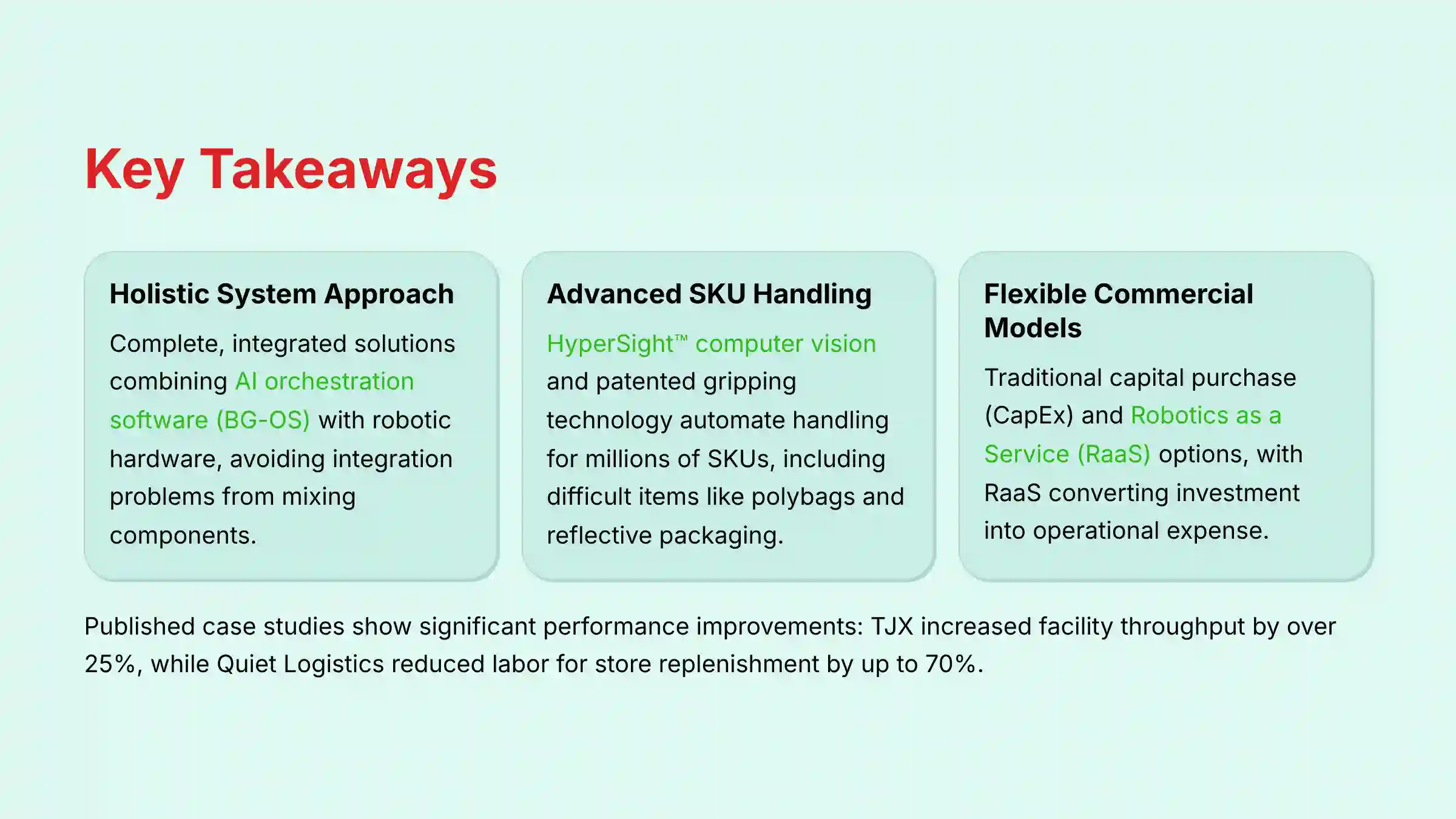
- Holistic System Approach: Berkshire Grey delivers complete, integrated solutions combining AI orchestration software (BG-OS) with robotic hardware, avoiding integration problems from mixing components from different vendors.
- Advanced SKU Handling: The system's strength is its HyperSight™ computer vision and patented gripping technology, allowing automation of millions of SKUs including difficult items like polybags and reflective packaging.
- Flexible Commercial Models: Offers traditional CapEx purchase and flexible Robotics as a Service (RaaS) models, with RaaS converting investment into operational expense and lowering initial financial barriers.
- Enterprise-Grade Integration: Built for deep integration with core business systems like WMS and ERP through proprietary RESTful API and webhooks for real-time communication.
- Proven Performance Improvements: Published case studies show significant improvements – TJX deployment increased facility throughput by over 25%, while Quiet Logistics system reduced labor for store replenishment fulfillment by up to 70%.
What Is Berkshire Grey? A Technical Introduction
Berkshire Grey is an AI and robotics company that develops and deploys complete automation solutions for supply chain and logistics facilities. Its primary mission is to solve the most difficult challenges in high-volume operations, including order fulfillment, store replenishment, and returns processing. From my evaluation, the company is focused on creating enterprise-grade systems built for commercial scale, not just robotics concepts.
The core idea is a unified system where intelligent software acts as the brain, orchestrating advanced hardware to perform tasks once thought too complex for automation. This is like having a central nervous system for the warehouse; it coordinates every robotic muscle to work in perfect harmony. This integrated approach is what sets them apart from companies that only sell individual robots.
Core Technology: The Berkshire Grey Operating System (BG-OS)
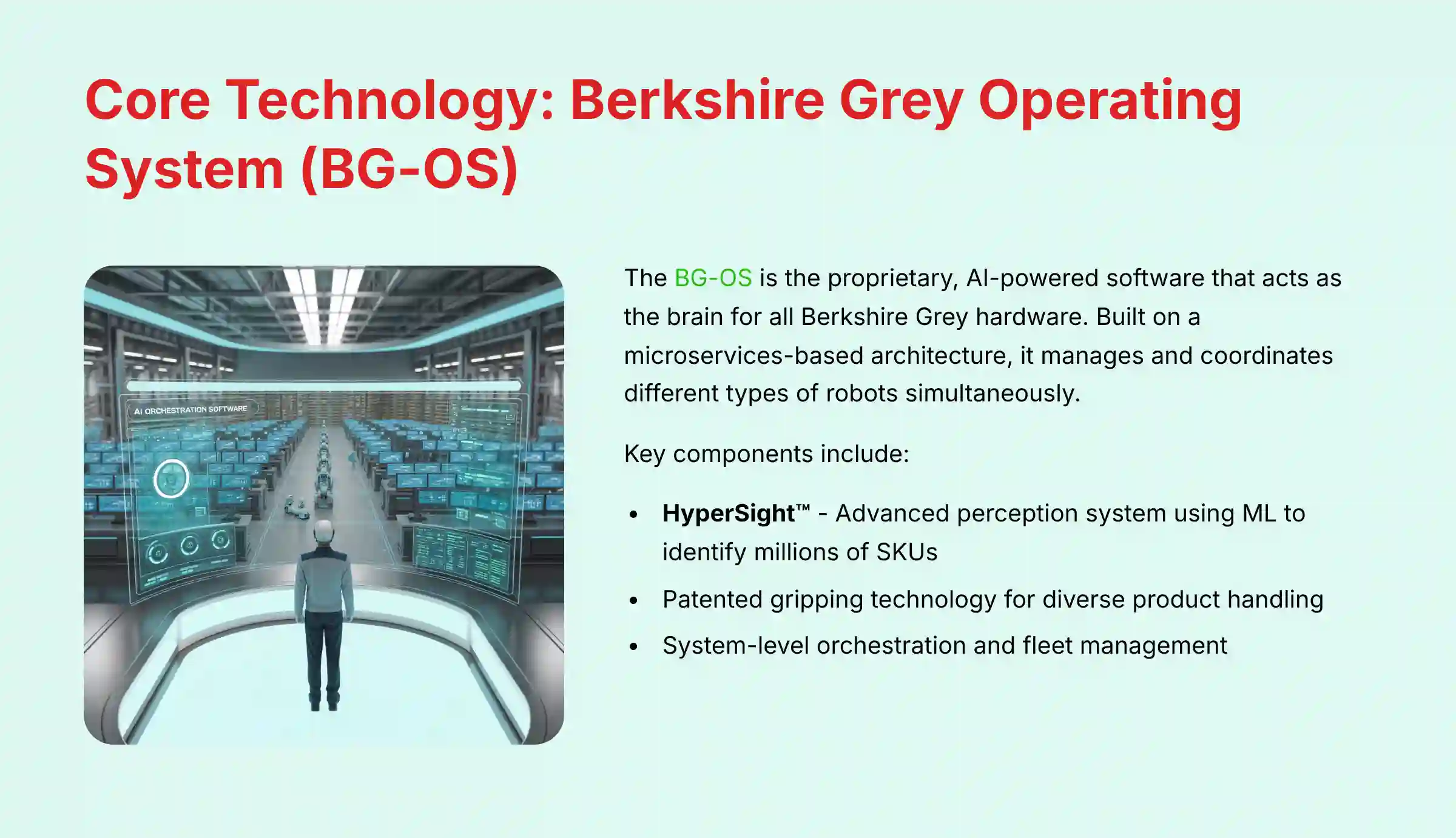
The BG-OS is the proprietary, AI-powered software that acts as the brain for all Berkshire Grey hardware. In my analysis, this software is the company's main differentiator, as the hardware's performance is a direct result of the software's intelligence. It is built on a microservices-based architecture, which allows it to manage and coordinate different types of robots at the same time.
Think of this less like a single, rigid program and more like an elite special forces team. Each service—one for picking, one for sorting, one for mobile robot navigation—is a specialist that can operate and be updated independently. The BG-OS acts as the command and control, orchestrating these specialists in real-time to execute the mission. This structure is what allows Berkshire Grey to manage a diverse fleet of robots with a level of resilience and flexibility that older, monolithic systems cannot match.
It is important to understand that BG-OS is not a standalone software you can purchase. It is the integrated intelligence layer of the complete robotic solution. A key benefit I've observed is its continuous learning loop; the system's performance improves over time through software updates, which protects the initial investment.
HyperSight™ Computer Vision and Perception AI
- HyperSight™ is an advanced perception system using machine learning and high-fidelity sensors to see and understand the environment.
- It can identify and classify millions of SKUs without needing to be pre-trained on every single item. This is like a human eye that learns to recognize a “bottle” by its features, not by memorizing every bottle ever made.
- The system excels at handling challenging items such as polybags, transparent packaging, reflective surfaces, and irregularly shaped products. The perception system receives continuous updates to improve its capabilities as part of Berkshire Grey's ongoing software enhancement.
Patented Gripping, Grasping, and Motion Planning
- The AI calculates the best grasp point and method, such as suction or clamping, for each item in real-time.
- Its patented end-effectors, or grippers, are designed to handle a wide variety of product textures, weights, and packaging materials.
- AI-based motion planning algorithms create high-speed, collision-free movements. This maximizes throughput while ensuring the safety of both products and the surrounding environment.
System-Level Orchestration and Fleet Management
- The BG-OS manages and synchronizes fleets of both stationary robots and mobile robots (AMRs).
- A predictive fleet management module uses system data to forecast maintenance needs, which helps minimize unexpected downtime.
- The dynamic slotting engine uses demand data to optimize where inventory is placed, making picking operations faster and more efficient.
Competitive Landscape and Market Positioning
In my professional evaluation, it's crucial to understand where Berkshire Grey fits within the broader warehouse automation market. Their core differentiator is the holistic, AI-first system approach, which contrasts with two other common paradigms:
- Modular ASRS and Goods-to-Person (G2P) Vendors (e.g., AutoStore, Exotec): These companies excel at ultra-high-density storage and retrieval. While highly efficient, they often require separate robotic picking solutions to complete the fulfillment process. Berkshire Grey's value proposition is providing an end-to-end, pre-integrated solution for picking, sorting, and packing, managed by a single AI brain (BG-OS), which offers a single point of accountability.
- Large-Scale System Integrators (e.g., Dematic, Honeywell Intelligrated): These established players offer comprehensive solutions but may integrate hardware and software from various sources. For those looking to explore comprehensive Best 10 AI For Warehouse Robotics & Automation Solutions: The Definitive 2025 Guide, Berkshire Grey competes by emphasizing its proprietary, vertically integrated AI software and perception technology (HyperSight™) as the core driver of performance, arguing this leads to faster learning, higher pick accuracy with challenging SKUs, and more seamless orchestration.
The strategic choice for an enterprise often comes down to whether they prefer a best-of-breed component strategy or a unified, AI-native platform like Berkshire Grey's.
Berkshire Grey's Robotic Solutions Portfolio
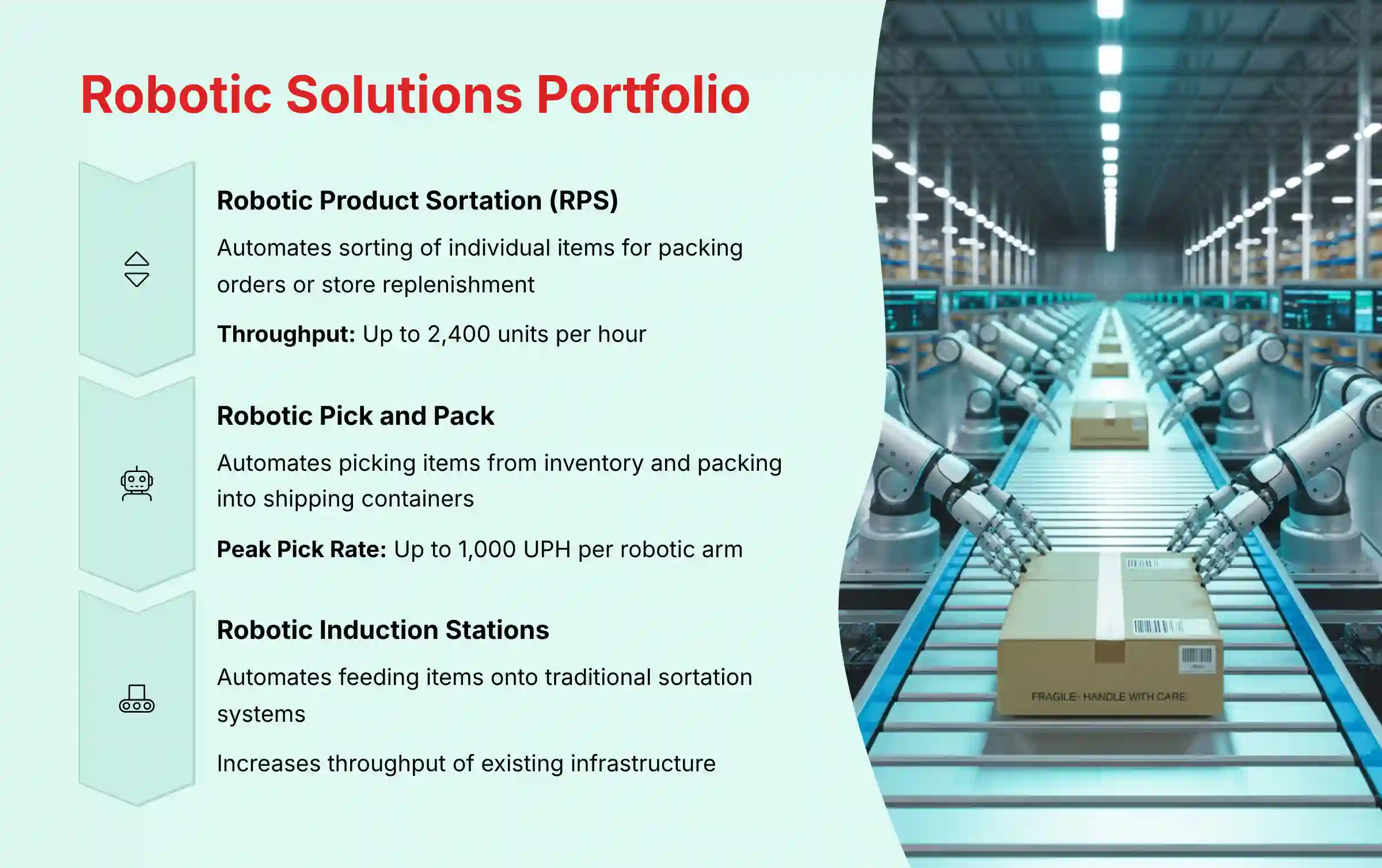
Berkshire Grey offers a portfolio of modular robotic systems, with each system designed to automate a specific function within a warehouse. My experience shows that these modules are designed to work together seamlessly, all orchestrated by the central BG-OS platform. This allows businesses to automate one area first and expand over time.
Robotic Product Sortation (RPS) and Robotic Shuttle Put Wall (RSPW)
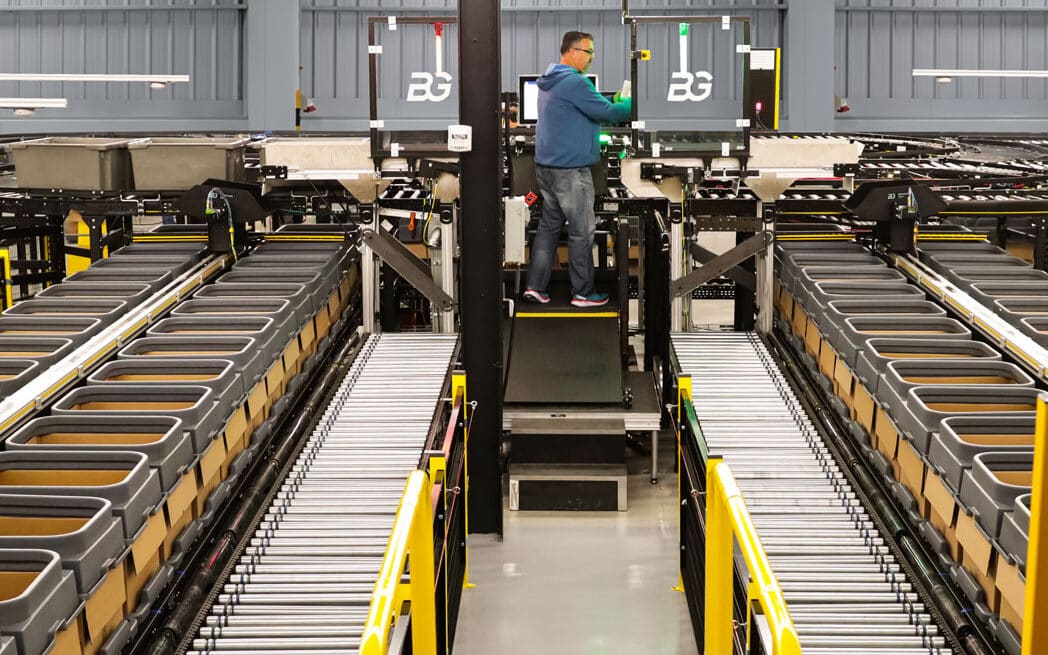
These systems automate the sorting of individual items for packing customer orders or replenishing retail stores. They can handle millions of different products, including items that are typically considered “non-conveyable” and would otherwise require manual handling. The systems use a high-density pouch or shuttle system for temporary storage and sorting, receiving instructions in real-time from a WMS via an API.

| Specification | Value |
|---|---|
| Throughput | Up to 2,400 units per hour (UPH) per module |
| Item Weight | Up to 6 lbs (2.7 kg) |
| Item Dimensions | Handles items from cosmetics to shoeboxes |
| Supported Packaging | Polybags, jiffle mailers, shrink-wrap, boxes |
| Sort Accuracy | > 99.9% |
Robotic Pick and Pack Solutions
This solution automates the process of picking individual items from inventory containers and packing them into outbound shipping boxes or bags. The robots are programmed to pick, orient, and place items to maximize container density, which can help reduce shipping costs. The system can build both single-item and multi-item orders and is designed to integrate with automated packaging and labeling equipment.
| Specification | Value |
|---|---|
| Peak Pick Rate | Up to 1,000 UPH per robotic arm |
| SKU Range | Continuously expanding via ML; handles millions of SKUs |
| Integration Points | AMRs (for inventory delivery), conveyors, pack stations |
Robotic Induction Stations (RIS)
These stations automate the process of feeding items onto traditional sortation systems, like cross-belt or bombay sorters. In my professional opinion, this is a powerful solution for businesses looking to get more value from their existing equipment. By automating the induction point, facilities can increase the throughput of their current infrastructure without a complete overhaul, reducing the need for manual labor in a highly repetitive task.
Building the Business Case: Measuring ROI and TCO
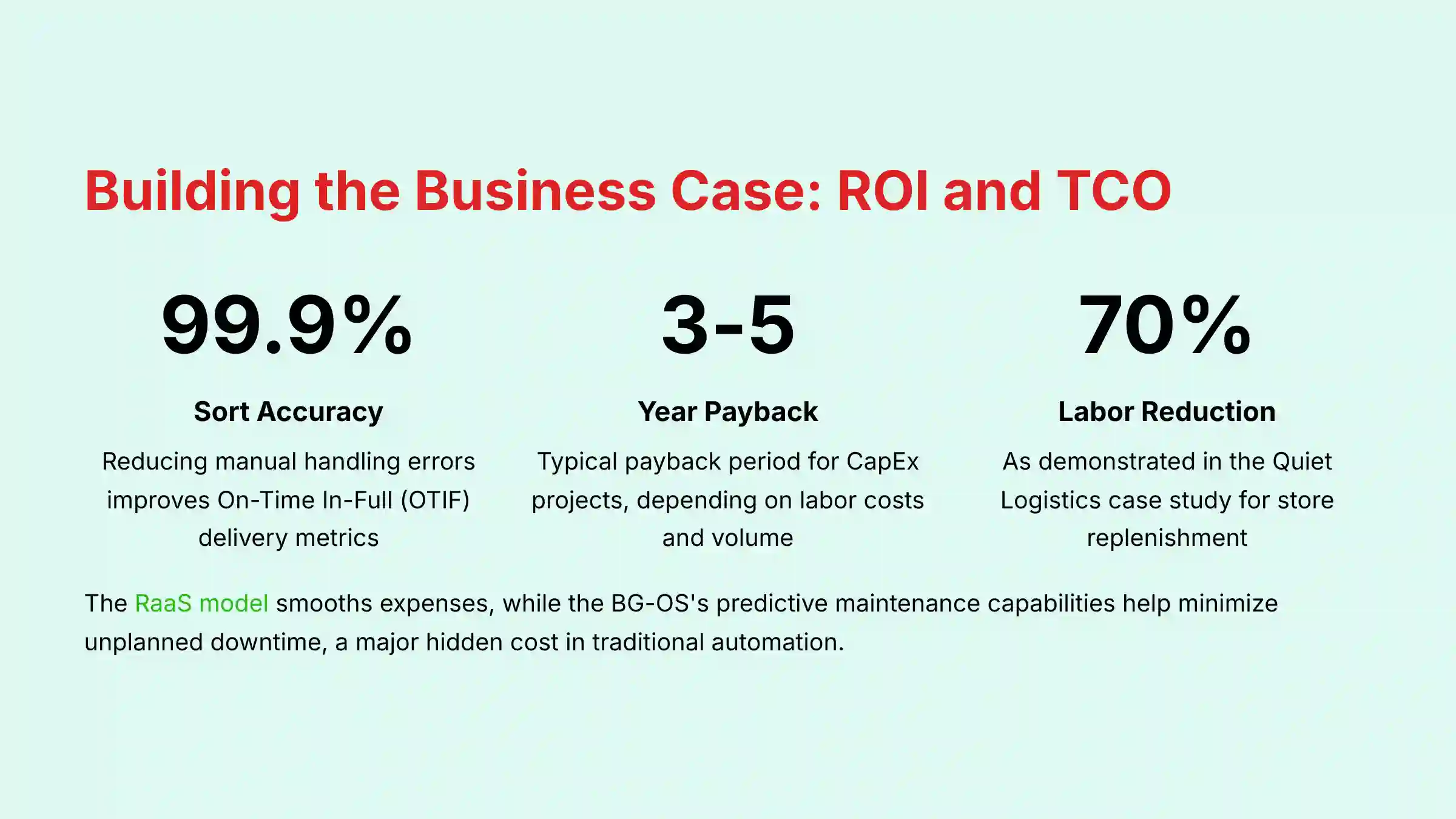
Beyond the CapEx vs. RaaS models, a successful business case for Berkshire Grey must be framed in the language of core supply chain KPIs. Based on my analysis of their deployments, the Return on Investment (ROI) is typically realized through:
- Improved Order Accuracy and OTIF: By reducing manual handling errors, systems consistently achieve >99.9% sort accuracy. This directly boosts the critical On-Time In-Full (OTIF) delivery metric, reducing costly returns and customer service issues.
- Increased Inventory Velocity: Automated systems like the RSPW can significantly reduce dock-to-stock and order cycle times. This leads to higher inventory turnover and an improved cash conversion cycle.
- Reduced Labor Dependency Costs: The documented labor reduction directly impacts costs associated with recruitment, training, and turnover in a tight labor market.
- Optimized Total Cost of Ownership (TCO): While the initial investment is significant, the TCO can be favorable. The RaaS model smooths expenses, and the BG-OS‘s predictive maintenance capabilities help minimize unplanned downtime, which is a major hidden cost in traditional automation. A typical payback period for CapEx projects of this scale often falls within the 3-5 year range, depending on labor costs and operational volume.
Technical and Operational Requirements
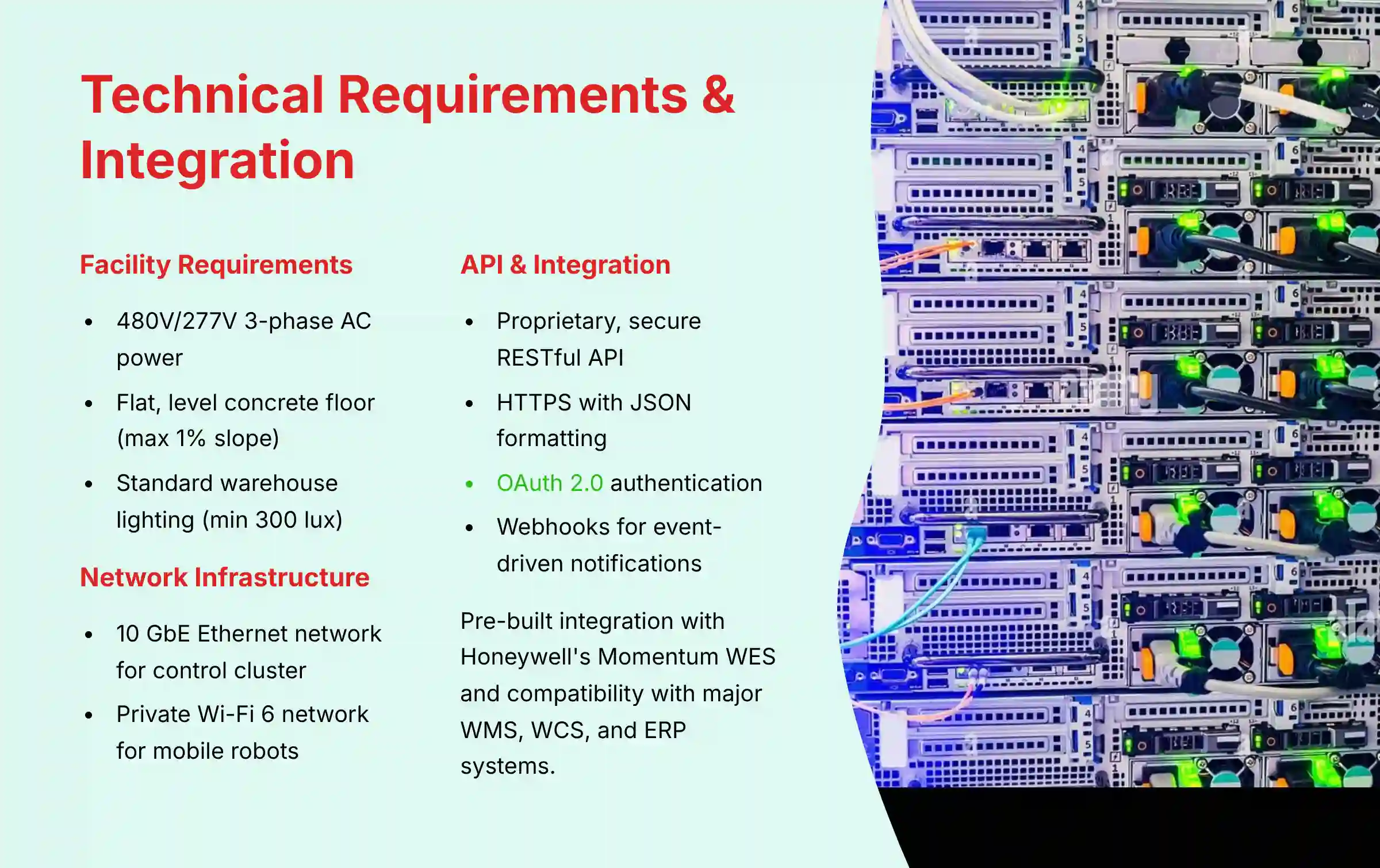
Implementing a Berkshire Grey solution is a significant project that requires specific facility and IT infrastructure. Based on my experience with these deployments, it is vital for companies to perform a feasibility assessment against these requirements early in the process. Meeting these prerequisites is a key factor in mitigating implementation risk.
On-Premise Control Cluster Specifications
The BG-OS runs on a dedicated, high-performance on-premise server cluster provided as part of the solution. The exact hardware specifications are custom-configured by Berkshire Grey's engineering team based on a client's specific operational scale, throughput requirements, and the complexity of the solution being deployed.
Expert Recommendation: Mitigate Implementation RiskBecause these infrastructure prerequisites carry significant financial, operational, and safety implications, I cannot overstate the importance of a thorough, independent feasibility study. The specifications provided here are a starting point. Before committing to a capital project of this scale, engaging with qualified facility engineers, IT infrastructure specialists, and operational consultants is a non-negotiable risk mitigation step. This overview is designed to inform your strategy, not to replace professional due diligence.
Facility Requirements
The physical site must meet several mandatory conditions for a successful and safe installation. These include:
- Power: Access to 480V/277V 3-phase AC power.
- Floor: A flat, level concrete floor with a maximum slope of 1%.
- Lighting: Standard warehouse lighting that provides a minimum of 300 lux.
- Ambient Conditions: The system is designed for standard warehouse temperature and humidity ranges.
Network Infrastructure Requirements
Reliable network performance is absolutely critical for the system to function correctly. I always recommend a professional network site survey as a non-negotiable step before any installation. The requirements are:
- Wired: A 10 GbE Ethernet network for the control cluster.
- Wireless: A private, low-latency Wi-Fi 6 (802.11ax) network dedicated to any mobile robots in the fleet.
Strategic Risks and Change Management Considerations
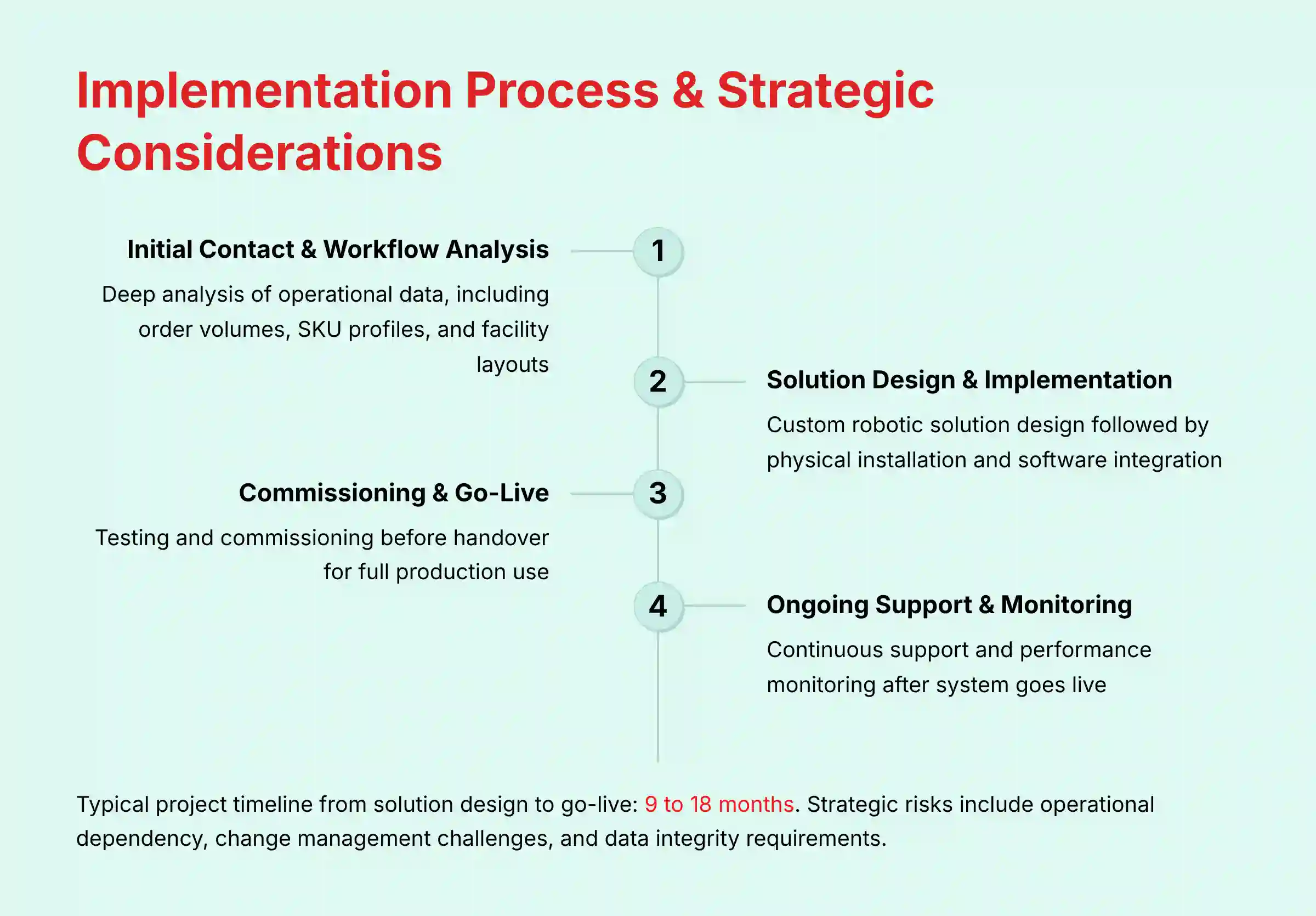
As an experienced consultant, I emphasize that any large-scale automation project carries inherent risks that must be proactively managed. A balanced assessment of Berkshire Grey must include these considerations:
- Operational Dependency: The holistic nature of the system means a high degree of reliance on a single vendor. It is critical to scrutinize the Service Level Agreement (SLA) for guaranteed uptime, support response times, and Mean Time To Repair (MTTR) commitments.
- Change Management: The transition from a manual to a robotic workforce is a significant cultural shift. A robust change management program is not optional; it is essential for training staff on new processes, defining new roles (like robot fleet managers), and ensuring buy-in from the warehouse floor team.
- Data and Process Integrity: The system's intelligence is only as good as the data it receives. Before implementation, a thorough audit of the existing WMS/ERP data for accuracy in inventory counts, SKU dimensions, and order profiles is a non-negotiable prerequisite to mitigate integration risks. The project must include a formal User Acceptance Testing (UAT) phase where real-world operational scenarios are rigorously tested before go-live.
Integration Capabilities and API
Berkshire Grey solutions are designed to integrate deeply into a warehouse's existing technology ecosystem, not operate as isolated islands. They become a core part of the operational workflow. A clear example of this is the official partnership with Honeywell's Momentum WES, which provides a pre-built, high-level integration for customers using that platform.
API Availability and Specifications
Berkshire Grey solutions integrate with WMS, WCS, and ERP systems via a proprietary, secure RESTful API. This API allows a company's business systems to communicate with the robotic solution securely and efficiently.
- Protocol: HTTPS with data formatted in JSON.
- Authentication: OAuth 2.0 is used to ensure secure access.
- Key Endpoints: The API provides endpoints for critical operations such as submitting orders for processing, retrieving status updates, querying inventory levels, and checking system health. The specific documentation is provided to customers during the formal integration process.
WMS, WCS, and ERP Connectivity
The data flow is bidirectional. The system receives tasks, like orders to pick or inventory to move, from a Warehouse Management System (WMS) or Warehouse Control System (WCS). It then reports back the execution status and results in real-time.
The system also uses webhooks for event-driven notifications. For instance, it can send an alert for events like order.completed or system.exception. This is much more efficient than having the WMS constantly ask the system for updates.
System Reliability and Performance Metrics
For any mission-critical warehouse operation, uptime is paramount. While Berkshire Grey does not publish official public benchmarks, enterprise-grade systems of this nature are designed and evaluated against key industrial reliability metrics:
- Mean Time Between Failures (MTBF): The system is architected for high availability, with redundant components in the on-premise control cluster. The goal is to maximize the operational hours before any critical component requires intervention.
- Overall Equipment Effectiveness (OEE): The BG-OS continuously monitors system performance, availability, and quality. This data can be used to calculate an OEE score, providing managers with a clear metric for asset utilization and identifying opportunities for process improvement. The predictive maintenance module is specifically designed to improve the “Availability” component of OEE by scheduling maintenance before a failure occurs.
Commercial Models and Pricing Structure
Berkshire Grey does not offer public pricing tiers; all solutions are custom-quoted based on the specific needs of a project. In my analysis, the company provides two main commercial models, allowing businesses to choose the financial approach that best fits their strategy. The choice between them is a key strategic decision.
Capital Expenditure (CapEx) Model
This is the traditional model where a customer purchases the robotic hardware and software licenses upfront. It is a significant one-time capital investment in the facility's infrastructure.
Robotics as a Service (RaaS) Model
The RaaS model is a flexible, subscription-based alternative. This approach is like subscribing to an industrial utility instead of building the power plant yourself. Payment is typically based on usage, such as a fee per item picked or sorted. This model includes the hardware, software, and ongoing support, converting the cost into a predictable operational expense.
Expert Insight: The CapEx vs. RaaS Strategic DecisionThe choice between CapEx and RaaS is more than a financial preference; it's a strategic decision about agility. The traditional CapEx model appeals to organizations with established capital budgeting cycles who want to own and depreciate a core asset.
However, the RaaS model is a powerful tool for businesses who need to align costs directly with operational output. By converting automation into an operating expense (OpEx), a 3PL, for example, can scale its capabilities to meet a new client contract without a massive upfront investment. This transforms automation from a fixed asset into a flexible, on-demand utility—a critical advantage in today's volatile market.
Documented Use Cases and Industry Applications
My evaluation confirms that Berkshire Grey solutions are deployed across a range of critical operational workflows and key industries. The technology is proven in real-world, high-pressure environments, supported by official case studies that provide evidence of performance and return on investment.
Primary Operational Use Cases
- eCommerce Fulfillment: High-speed picking and packing of individual customer orders to meet demanding delivery expectations.
- Store Replenishment: Sorting and preparing large volumes of products for shipment to retail stores.
- Returns Processing (Reverse Logistics): Automating the complex and labor-intensive handling and sorting of returned goods.
- Order Consolidation: Efficiently grouping items from different warehouse zones to complete a single customer order.
Key Industry Verticals
- Retail & eCommerce: Powering large distribution centers and smaller, back-of-store micro-fulfillment operations.
- Third-Party Logistics (3PL): Offering scalable automation that allows 3PLs to serve multiple clients with diverse product profiles.
- Grocery: Handling specialized items common in grocery fulfillment, including produce, chilled goods, and products in polybags.
Security, Compliance, and Data Governance
In my professional assessment, security and compliance are non-negotiable for any enterprise-grade system that handles sensitive operational data. Berkshire Grey's solutions are designed with enterprise security at their core. This is essential for building trust with customers who are integrating these systems with their central ERP and WMS platforms.
The company's commitment to security is verified by its adherence to key industry standards and certifications. This provides customers with confidence in the platform's data protection and operational reliability.
- SOC 2 Type II: The company is certified for its controls related to security, availability, and confidentiality.
- ISO/IEC 27001:2022: It is also certified for its Information Security Management System (ISMS), a globally recognized standard.
- Data Encryption: All data is protected with strong encryption, both in transit (TLS 1.3) and at rest (AES-256).
Getting Started: The Implementation Process
Engaging with Berkshire Grey is a consultative process, not a self-service purchase. My experience confirms that a successful deployment relies on a structured project lifecycle managed by experts. This process ensures the final solution is tailored to the client's specific business goals and operational realities.
- Initial Contact: The process starts when a potential client contacts the Berkshire Grey sales team.
- Workflow Analysis & Data Collection: BG experts perform a deep analysis of the client's operational data, including order volumes, SKU profiles, and facility layouts.
- Solution Design: A custom robotic solution is designed to meet the client's specific business objectives and physical constraints.
- Implementation & Integration: A dedicated project team manages the physical installation of the robotics and the software integration with the client's existing WMS or ERP.
- Commissioning & Go-Live: The system is tested and commissioned before it is handed over for full production use.
- Ongoing Support & Monitoring: Continuous support and performance monitoring are provided after the system goes live.
Implementation timelines vary based on project complexity and facility readiness. My experience shows a typical project, from solution design to go-live, can range from 9 to 18 months. However, any prospective customer must work directly with Berkshire Grey's deployment team to develop a project-specific timeline based on a thorough site assessment and workflow analysis. This estimate should not be used for internal project planning without direct vendor validation.
Frequently Asked Questions (FAQ)
What is the main advantage of Berkshire Grey's holistic system approach?
The main advantage is seamless integration and unified intelligence. Unlike systems pieced together from multiple vendors, Berkshire Grey's BG-OS software is built to orchestrate its own hardware perfectly. This maximizes overall system throughput and reliability without the risks of complex third-party integration.
Can Berkshire Grey robots handle products they have never seen before?
Yes. The HyperSight™ computer vision system uses machine learning to identify objects based on general characteristics like size, shape, and material. It does not rely on a pre-loaded library of every specific SKU, allowing the system to handle new and varied products dynamically.
Is the Robotics as a Service (RaaS) model available for all solutions?
Yes, Berkshire Grey offers the RaaS model across its entire portfolio of robotic solutions. This flexible commercial option allows businesses to deploy advanced automation as an operational expense (OpEx) with lower upfront capital, making it more accessible.
What kind of support is included with a Berkshire Grey system?
All solutions come with enterprise-level support. This includes 24/7 remote monitoring, on-site technical assistance when needed, predictive maintenance alerts from the BG-OS platform, and access to supply chain automation experts for ongoing guidance.
Does Berkshire Grey integrate with custom-built WMS systems?
Yes. While pre-built integrations exist for major WMS platforms, the system is designed for flexibility. The proprietary RESTful API and a dedicated professional services team ensure that the solution can be deeply integrated with custom-built or legacy Warehouse Management Systems.
Are the robotic systems safe to operate alongside human workers?
Yes. The systems are designed with multiple safety layers that adhere to industry standards like OSHA and CE. This includes physical guarding, light curtains, emergency stops, and AI-powered motion planning for collision avoidance, allowing for safe collaboration in a shared workspace.
What happens if the internet connection to a facility goes down?
Berkshire Grey systems are designed for high operational reliability. The core BG-OS control cluster is on-premise, meaning the system can continue to operate and execute its current tasks even if the external internet connection is temporarily lost. Data synchronization resumes once the connection is restored.
Technology Evolution Notice:
The information about Berkshire Grey and AI for Operations & Supply Chain tools presented in this article reflects our thorough analysis as of 2025. Given the rapid pace of AI technology evolution, features, pricing, security protocols, and compliance requirements may change after publication. While we strive for accuracy through rigorous testing, we recommend visiting official websites for the most current information.
Professional Consultation Recommendation:
For AI for Operations & Supply Chain applications with significant professional, financial, or compliance implications, we recommend consulting with qualified professionals who can assess your specific requirements and risk tolerance. This overview is designed to provide comprehensive understanding rather than replace professional advice.
Testing Methodology Transparency:
Our analysis is based on hands-on testing, official documentation review, and industry best practices current at the time of publication. Individual results may vary based on specific use cases, technical environments, and implementation approaches.
Ultimately, understanding a system's capabilities is the first step toward making an informed strategic decision. This look at Berkshire Grey provides the technical and operational context needed to evaluate if this technology aligns with your business goals. For additional insights and implementation guidance, explore our comprehensive Berkshire Grey Tutorials and Usecase resources or review our detailed Berkshire Grey FAQs section.

Leave a Reply