Is Berkshire Grey the Right AI Robotics Solution for Your Warehouse?
This 2-Minute Quiz Reveals Your Automation Match!
Key Takeaways
- SoftBank Subsidiary: Berkshire Grey operates as a privately held subsidiary of SoftBank Group Corp following their 2023 acquisition, providing AI-powered robotics solutions for warehouse automation.
- Intelligent Automation: Unlike traditional fixed automation, Berkshire Grey's systems use advanced computer vision and AI to adapt to different product types, including challenging items like polybags and apparel.
- Comprehensive Solution Portfolio: Offers four main robotic systems – Pick & Pack, Sortation, Mobile Robots (AMRs), and Shuttle Systems – all integrated through their unified AI platform.
- Flexible Commercial Models: Provides both traditional CapEx purchasing and Robotics-as-a-Service (RaaS) subscription models with performance-based pricing options for different business needs.
- Strong ROI Potential: Customers typically see 2-3 year payback periods with benefits including labor cost reduction, improved accuracy up to 99.9%, and increased throughput during peak seasons.
What is Berkshire Grey and what specific problems does it solve?
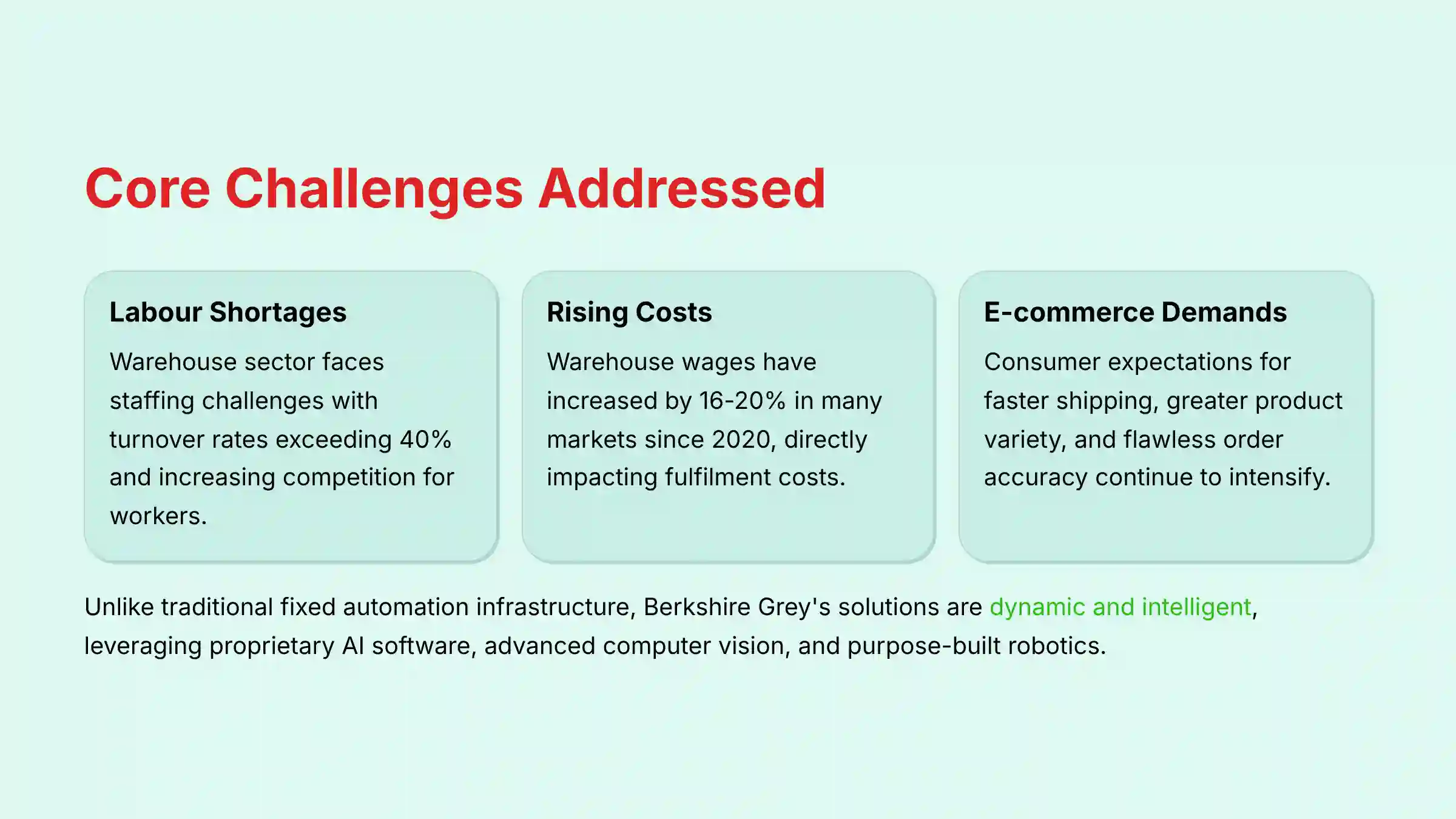
Berkshire Grey is an AI-powered robotics and automation company that develops intelligent fulfillment solutions for warehouses, distribution centers, and retail stores. Operating as a privately held subsidiary of SoftBank Group Corp. following an acquisition completed in July 2023, Berkshire Grey tackles the most pressing challenges in modern supply chain operations.
The company addresses three critical pain points in today's logistics landscape:
- Persistent labor shortages: The warehouse sector consistently faces staffing challenges with high turnover rates (often exceeding 40%) and increasing competition for workers.
- Rising labor costs: Warehouse wages have increased by 16-20% in many markets since 2020, directly impacting fulfillment costs.
- Accelerating e-commerce demands: Consumer expectations for faster shipping, greater product variety, and flawless order accuracy continue to intensify.
Unlike traditional fixed automation infrastructure (conveyor belts, static sorters), Berkshire Grey's solutions are dynamic and intelligent. They leverage a sophisticated combination of proprietary AI software, advanced computer vision systems, and purpose-built robotics to perform complex tasks that previously required human dexterity and decision-making.
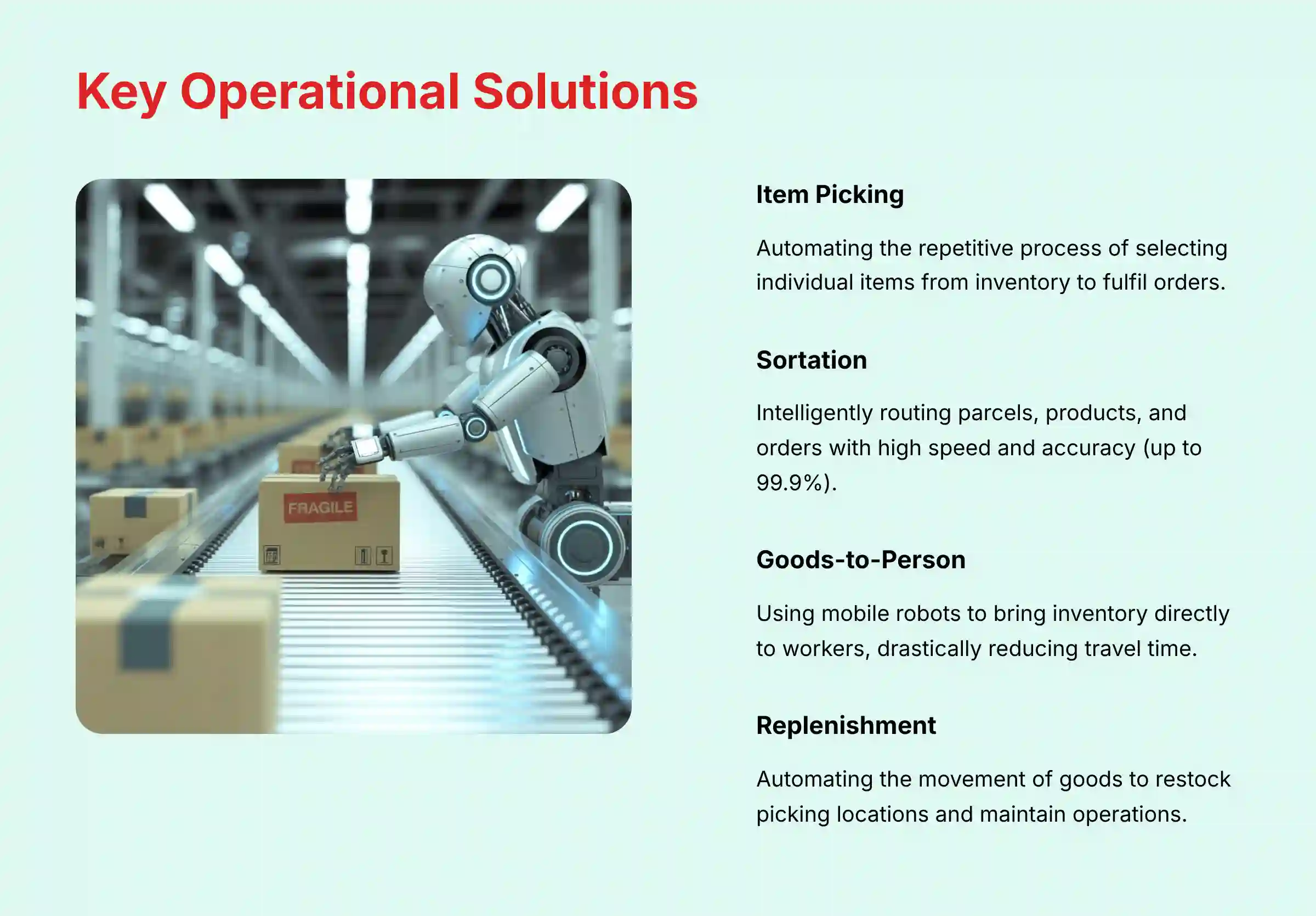
The core operational challenges Berkshire Grey's systems address include:
- Item Picking: Automating the repetitive and labor-intensive process of selecting individual items from inventory to fulfill orders.
- Sortation: Intelligently routing parcels, products, and orders to their correct destinations with high speed and accuracy, handling everything from polybags to boxes.
- Goods-to-Person: Using mobile robots to bring inventory directly to stationary workers, drastically reducing travel time and improving efficiency.
- Replenishment: Automating the movement of goods to restock picking locations and maintain continuous fulfillment operations.
By addressing these critical bottlenecks, Berkshire Grey helps companies increase throughput, improve order accuracy to up to 99.9%, and reduce dependency on a volatile labor market, transforming traditional cost centers into strategic competitive advantages. For companies seeking deeper insight into robotic warehouse solutions, our comprehensive analysis of the best 10 AI warehouse robotics solutions provides valuable comparative insights.
How does Berkshire Grey's AI-powered robotics differ from traditional warehouse automation?
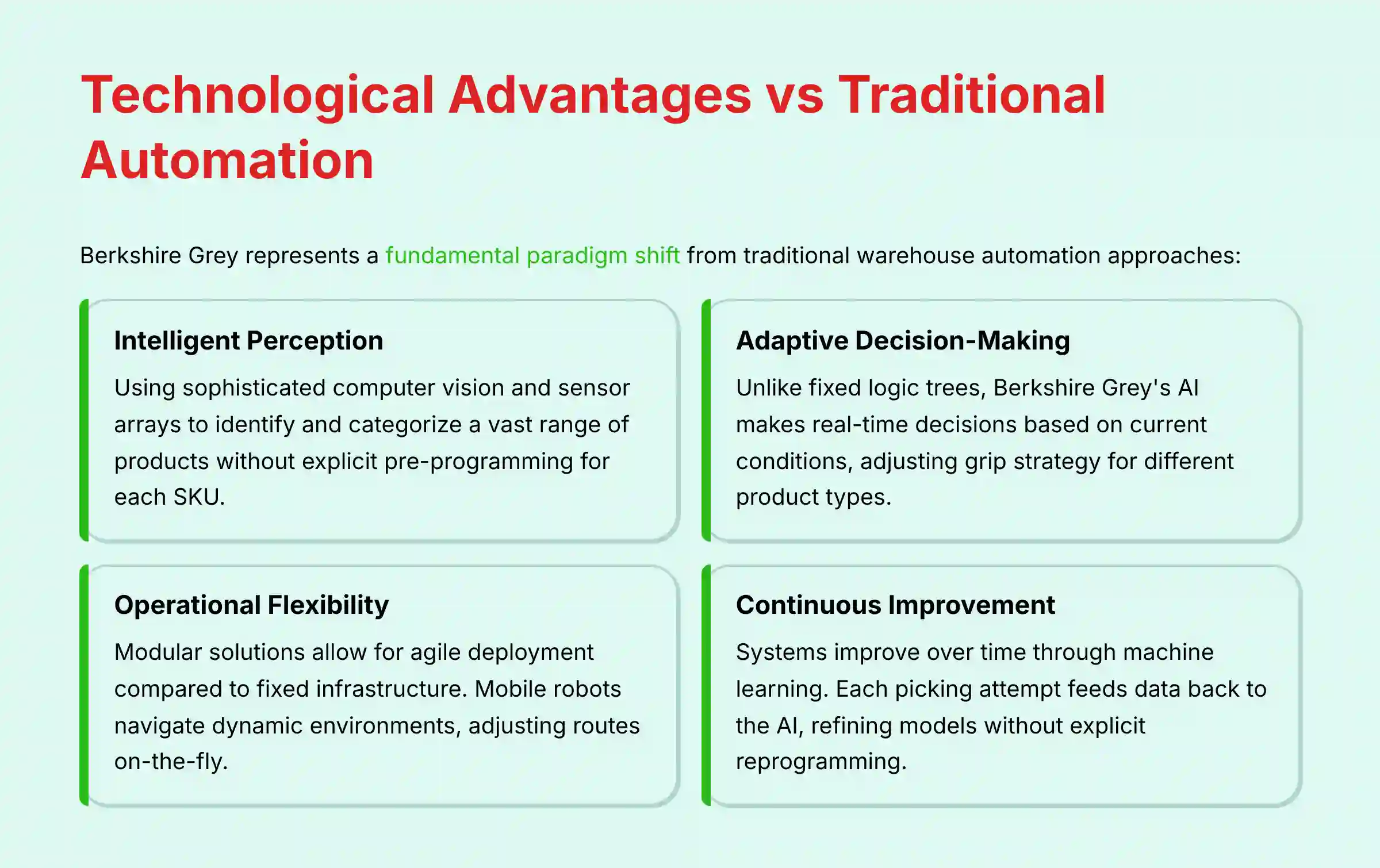
Berkshire Grey's AI-powered robotics represents a fundamental paradigm shift from traditional warehouse automation approaches. The key distinction is adaptability and intelligence versus rigidity and pre-programmed logic.
Traditional automation systems—such as fixed conveyor networks, legacy sorters, and basic AS/RS (Automated Storage and Retrieval Systems)—excel at performing specific, repetitive tasks in controlled environments with minimal variability. While efficient for standardized workflows, these systems are inherently inflexible.
Modifying processes, accommodating new package types, or reconfiguring warehouse layouts typically requires significant mechanical re-engineering, extended downtime, and substantial capital reinvestment.
Berkshire Grey's AI-powered approach revolutionizes this model through four key technological advantages:
- Intelligent Perception: Using sophisticated computer vision and sensor arrays, Berkshire Grey's systems can identify, categorize, and analyze a vast range of products—including challenging items like polybags, irregular packages, and apparel—without explicit pre-programming for each SKU. The AI “learns” to recognize and handle new items through continuous machine learning.
- Adaptive Decision-Making: Unlike traditional systems that follow fixed logic trees, Berkshire Grey's AI makes real-time decisions based on current conditions. For example, robotic pickers can dynamically adjust their approach and grip strategy when encountering different product types or densities, much like a human would.
- Operational Flexibility: The modular nature of Berkshire Grey's solutions allows for more agile deployment compared to traditional fixed infrastructure. Their mobile robots can navigate dynamic environments, adjusting routes on-the-fly to avoid congestion or obstacles—capabilities far beyond basic AGVs (Automated Guided Vehicles) that require predefined paths.
- Continuous Improvement: Perhaps most importantly, Berkshire Grey's systems improve over time through machine learning. Each picking attempt, successful or not, feeds data back to the AI, refining its models and improving performance without explicit reprogramming.
This intelligence-first approach enables Berkshire Grey to handle the extreme variability inherent in modern e-commerce and omnichannel fulfillment—where SKU counts often exceed 100,000 items and product characteristics vary widely—creating adaptable automation that can evolve alongside changing business requirements. To understand how Berkshire Grey compares with other robotics providers, you can explore our detailed analysis of Berkshire Grey alternatives and competitors.
What are the main types of robotic systems Berkshire Grey offers?
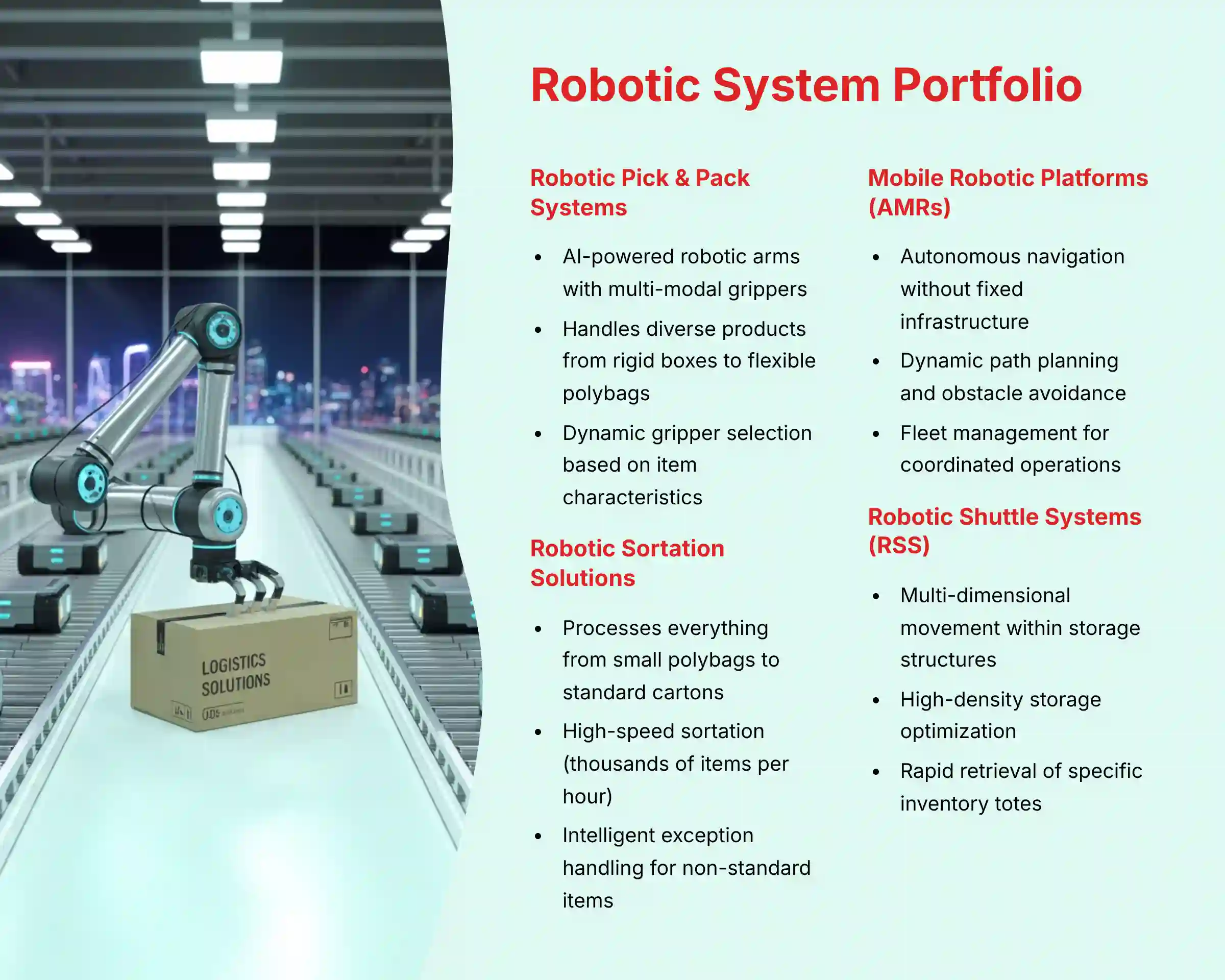
Berkshire Grey offers a comprehensive portfolio of intelligent robotic systems built on their unified AI software platform. Each system can operate independently or as part of an integrated automation ecosystem. The four principal system categories include:
1. Robotic Pick & Pack Systems
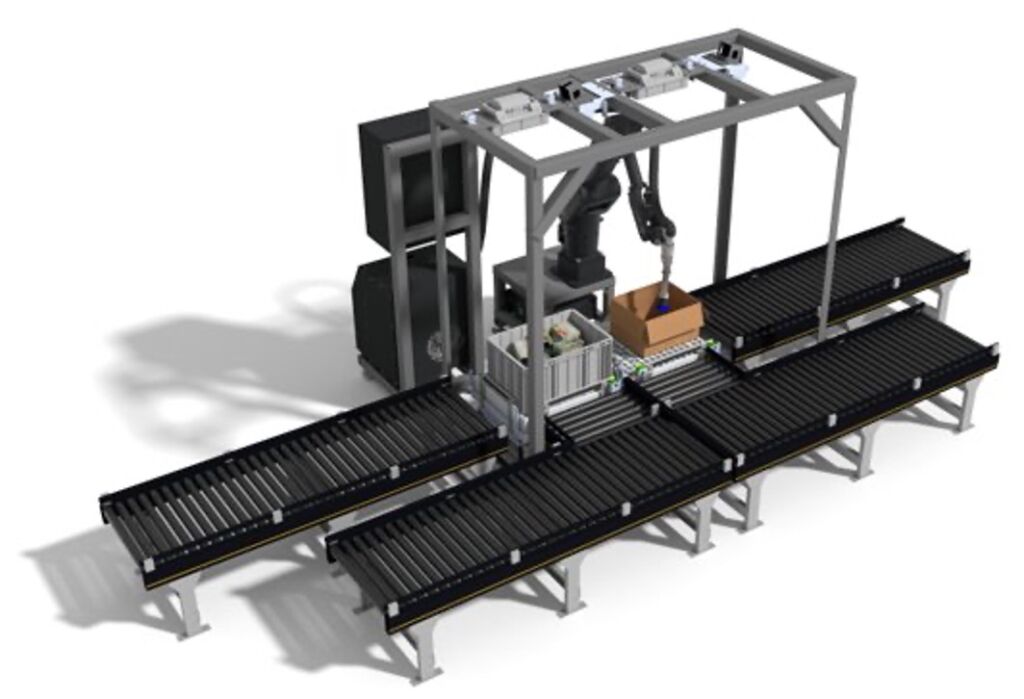
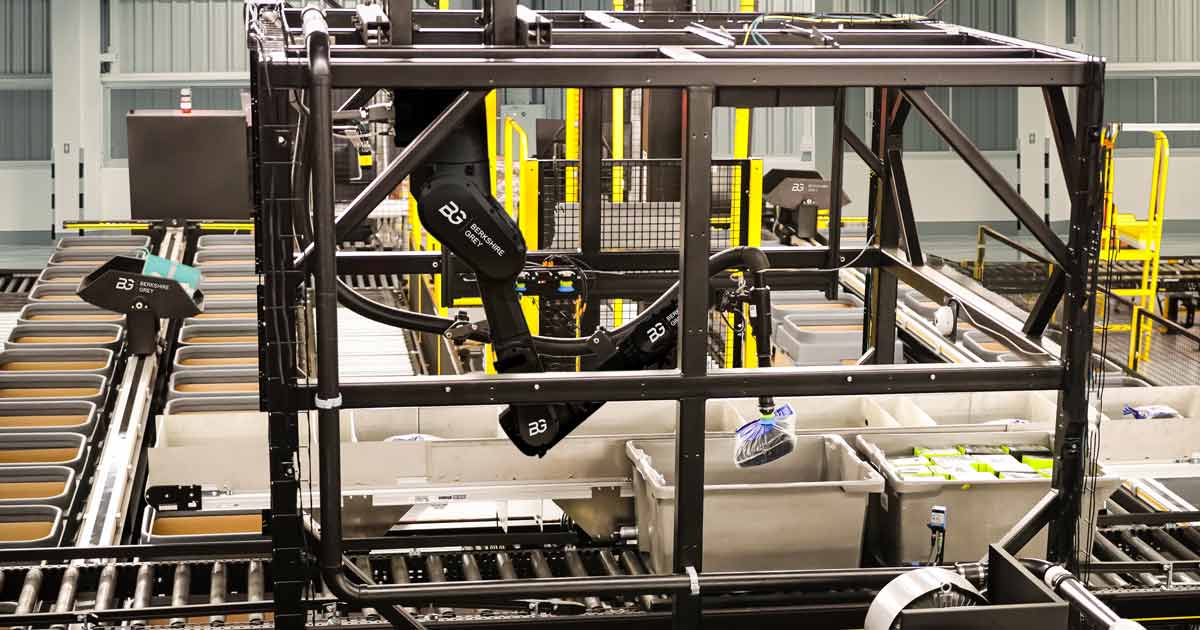
These systems leverage AI-powered robotic arms equipped with multi-modal grippers and advanced vision systems to automate the most challenging manual task in fulfillment: item picking. The robots can identify and extract individual products from storage totes, bins, or shelves—even when items are jumbled together or partially obscured.
Key capabilities include:
- Handling diverse product types from rigid boxes to flexible polybags
- Dynamic gripper selection based on item characteristics
- Precision placement of picked items into order containers
- Integration with existing conveyor systems or mobile robots
2. Robotic Sortation Solutions
Berkshire Grey's sortation systems are designed to handle the diverse package mix found in modern e-commerce operations. Unlike traditional sorters limited by package dimensions and rigidity, these AI-powered systems can process everything from small polybags to standard cartons with minimal manual intervention.
Key capabilities include:
- Automatic induction and orientation of packages
- High-speed sortation (thousands of items per hour)
- Handling difficult-to-automate items like polybags and jiffy mailers
- Intelligent exception handling for non-standard items
3. Mobile Robotic Platforms (AMRs)
Berkshire Grey's Autonomous Mobile Robots provide flexible movement of goods throughout the facility, serving both goods-to-person and robot-to-robot functions. These intelligent vehicles navigate facilities autonomously, dynamically planning paths and avoiding obstacles.
Key capabilities include:
- Autonomous navigation without fixed infrastructure
- Dynamic path planning and obstacle avoidance
- Seamless integration with picking and sortation systems
- Fleet management software for coordinated operations
4. Robotic Shuttle Systems (RSS)
For dense storage and high-throughput retrieval, Berkshire Grey offers automated storage and retrieval systems that use robotic shuttles. These systems optimize storage density while providing rapid access to inventory when needed.
Key capabilities include:
- Multi-dimensional movement (vertical and horizontal) within storage structures
- High-density storage optimization
- Rapid retrieval of specific inventory totes
- Integration with robotic picking stations
All these systems are underpinned by Berkshire Grey's proprietary AI software platform that orchestrates operations, optimizes workflows, and enables continuous performance improvement through machine learning—creating a comprehensive ecosystem for warehouse automation. For detailed implementation guidance and use cases, refer to our comprehensive Berkshire Grey tutorials and use cases.
Berkshire Grey vs. Symbotic: What are the key differences?
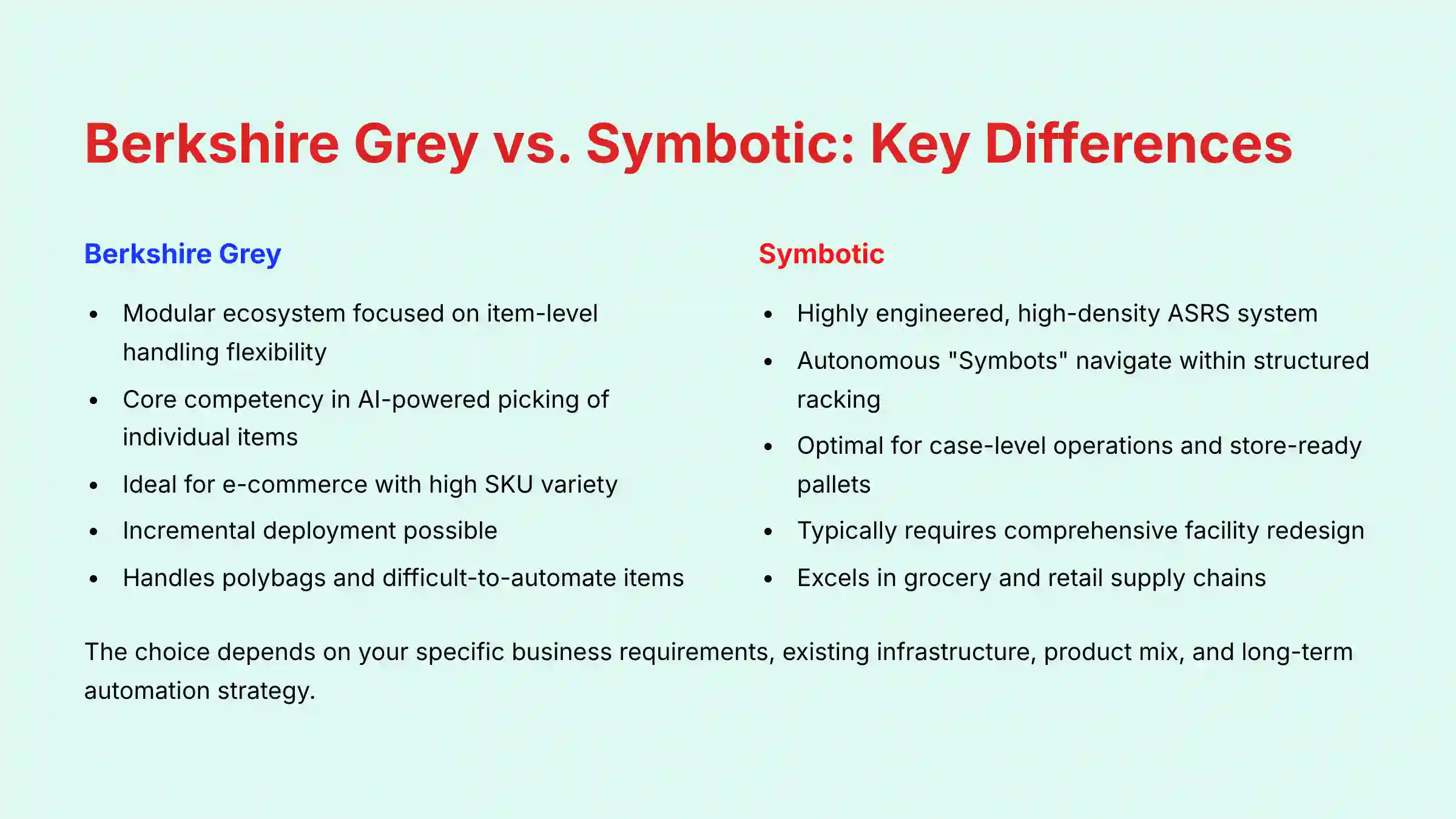
While both Berkshire Grey (a SoftBank subsidiary) and Symbotic represent cutting-edge approaches to warehouse automation, they address fundamentally different operational challenges and employ distinct architectural philosophies. Understanding these differences is crucial for making appropriate investment decisions in supply chain technology.
System Architecture & Core Focus
Symbotic's solution centers on a highly engineered, high-density Automated Storage and Retrieval System (ASRS). Their innovation lies in their autonomous “Symbots” that navigate at high speeds within a tightly structured steel racking system.
These robots can store and retrieve cases with remarkable efficiency, operating in extremely narrow aisles to maximize cubic storage density. Symbotic excels at optimizing case-level operations within their proprietary storage infrastructure, with particular strength in building store-ready pallets.
Berkshire Grey, by contrast, offers a more modular ecosystem of robotics focused on item-level handling flexibility. Their core competency lies in AI-powered picking of individual items, robotic sortation of mixed parcels (including difficult-to-handle polybags), and mobile robotics that can operate more adaptably within existing warehouse layouts.
While they also provide storage solutions, their primary value proposition is automating discrete fulfillment tasks with intelligent robots that can be deployed either as integrated systems or standalone solutions.
Ideal Application Scenarios
Symbotic is optimally suited for:
- Large-scale distribution centers handling primarily full cases
- Grocery and retail supply chains focused on store replenishment
- Operations requiring extremely high-density storage and case-level throughput
- Facilities being built new or completely retrofitted for automation
Berkshire Grey is better aligned with:
- E-commerce fulfillment centers processing individual customer orders
- Operations handling high SKU variety and product type diversity
- Facilities requiring flexible automation that can be incrementally deployed
- 3PLs and retailers needing to automate piece-picking and parcel sortation
Implementation Approach
Symbotic typically requires a more comprehensive facility redesign, with their solution essentially forming the centerpiece of warehouse operations. Their implementation generally involves a larger upfront commitment both financially and in terms of physical infrastructure changes.
Berkshire Grey's modular approach allows for more incremental automation, where companies can start with automating specific processes (like picking or sorting) before expanding to other areas. This can be advantageous for operations seeking to validate ROI before committing to full-scale automation.
The choice between these platforms ultimately depends on your specific business requirements, existing infrastructure, product mix, and long-term automation strategy. Organizations primarily dealing with case-level distribution to retail stores may find Symbotic's approach more aligned with their needs, while those focused on e-commerce fulfillment with high SKU counts might benefit more from Berkshire Grey's flexibility in handling individual items.
How does Berkshire Grey integrate with existing WMS or ERP systems?
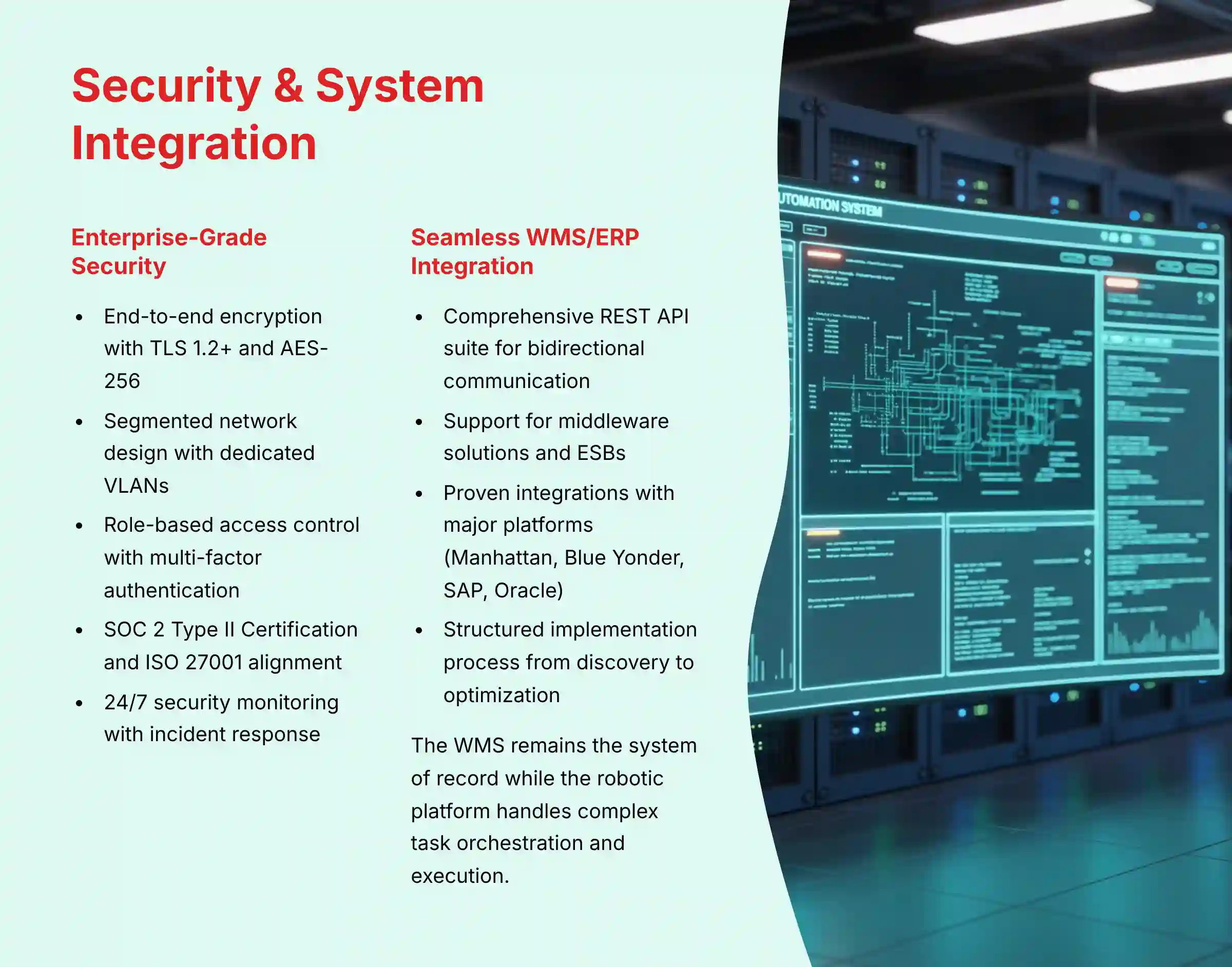
Seamless integration with core business systems—particularly Warehouse Management Systems (WMS) and Enterprise Resource Planning (ERP) platforms—is critical for successful automation implementation. Berkshire Grey has architected its software platform specifically to enable frictionless connectivity with these essential enterprise systems.
The integration architecture centers around Berkshire Grey's AI software layer, which serves as the central orchestration platform for the robotic fleet. This platform interfaces with client systems through several well-established methods:
1. API-Based Integration
The primary integration method utilizes Berkshire Grey's comprehensive REST API suite. This well-documented API ecosystem enables bidirectional communication between the robotic systems and the client's WMS/ERP. The API handles:
Inbound Data Flow:
- Order information (items to be picked/sorted)
- Inventory data (available stock and locations)
- Product master data (dimensions, weights, images, handling requirements)
- Warehouse layout information
Outbound Data Flow:
- Real-time task completion confirmations
- Inventory movement and consumption updates
- Exception handling notifications
- Performance metrics and KPIs
2. Middleware Solutions
For more complex enterprise environments, especially those with legacy systems, Berkshire Grey supports integration through industry-standard middleware platforms and enterprise service buses (ESBs) that can translate between different data formats and protocols.
3. Integration with Major Platforms
The system is designed to be platform-agnostic, with proven integrations with major WMS/ERP providers including:
- Manhattan Associates
- Blue Yonder (formerly JDA)
- SAP EWM and S/4HANA
- Oracle WMS Cloud
- HighJump
- Korber (formerly HighJump)
- Custom/proprietary systems
Implementation Process
The integration process typically follows these phases:
- Discovery: Assessment of existing systems, data structures, and integration requirements
- Architecture Design: Development of integration blueprint specific to the client environment
- Development: Configuration of APIs and data mapping
- Testing: Rigorous validation in test environments before live deployment
- Deployment: Phased go-live approach to minimize operational disruption
- Monitoring & Optimization: Continuous refinement of the integration
Critical Success Factors
For optimal integration results, organizations should:
- Conduct thorough data quality audits before implementation, particularly of product master data
- Ensure item dimension and weight data is accurate, as these are critical for robotic picking
- Establish clear data governance protocols for ongoing maintenance
- Involve IT stakeholders early in the project planning process
Berkshire Grey's integration approach emphasizes maintaining the WMS as the system of record while the robotic platform handles the complex task orchestration and execution, creating a seamless workflow that combines the strengths of both systems. For more detailed information about Berkshire Grey's features and capabilities, explore our comprehensive overview of Berkshire Grey's features.
Can Berkshire Grey robots handle specific product mixes like polybags and apparel?
Yes, Berkshire Grey's AI-powered robotics systems are specifically engineered to handle the diverse and challenging product mix found in modern e-commerce and omnichannel operations. Their ability to process difficult-to-automate items represents a core technological differentiation from conventional automation solutions.
Advanced Vision and AI Technology
The foundation of Berkshire Grey's item-handling capability is their proprietary computer vision and AI system. Each robotic station incorporates multiple high-resolution cameras and structured light sensors that create detailed 3D models of items in real-time. The AI processes these images to:
- Identify individual items even when jumbled together or partially obscured
- Determine optimal grasp points based on item geometry and material properties
- Recognize item boundaries and separate touching or overlapping products
- Adapt to variations in packaging, including reflective surfaces and transparent materials
Multi-Modal Gripping Technology
Berkshire Grey employs a sophisticated array of gripping technologies that can be dynamically selected based on item characteristics:
- Vacuum-Based Grippers: For handling flat items, polybags, and smooth-surfaced products
- Finger Grippers: For securely grasping more structured items with defined edges
- Hybrid Grippers: Combining multiple technologies for maximum versatility
- Custom End Effectors: For specialized product categories with unique handling requirements
This multi-modal approach enables the handling of diverse product categories including:
- Apparel in Polybags: One of the most challenging item types for traditional automation due to their flexible, non-rigid nature and variable surface friction
- Soft Goods: Including clothing, textiles, and fabric items with inconsistent shapes
- Electronics: Both boxed and unboxed devices requiring careful handling
- Health and Beauty Products: Often small, irregularly shaped items with varied packaging
- General Merchandise: A vast range of consumer goods with different dimensions and characteristics
Continuous Learning and Improvement
What truly sets Berkshire Grey's systems apart is their capacity for continuous learning. The AI models are constantly refined through:
- Data collected from millions of picking attempts across diverse customer environments
- Feedback loops that capture successful and unsuccessful handling attempts
- Transfer learning from across Berkshire Grey's customer base (while maintaining data privacy)
- Periodic software updates that enhance recognition and handling capabilities
Pre-Implementation Assessment
Before deployment, Berkshire Grey conducts a comprehensive analysis of a client's specific product catalog. This process typically includes:
- Detailed SKU analysis covering dimensions, weights, and material properties
- Physical testing of representative product samples
- Simulation of picking scenarios with the actual product mix
- Configuration recommendations to optimize performance for the specific inventory profile
This methodical approach ensures the system is properly configured to handle the unique characteristics of each customer's product range, maximizing throughput and minimizing exceptions from day one of operation. For answers to common questions about Berkshire Grey's capabilities, visit our detailed Berkshire Grey FAQs section.
What is Berkshire Grey's pricing model? Do they offer Robotics-as-a-Service (RaaS)?
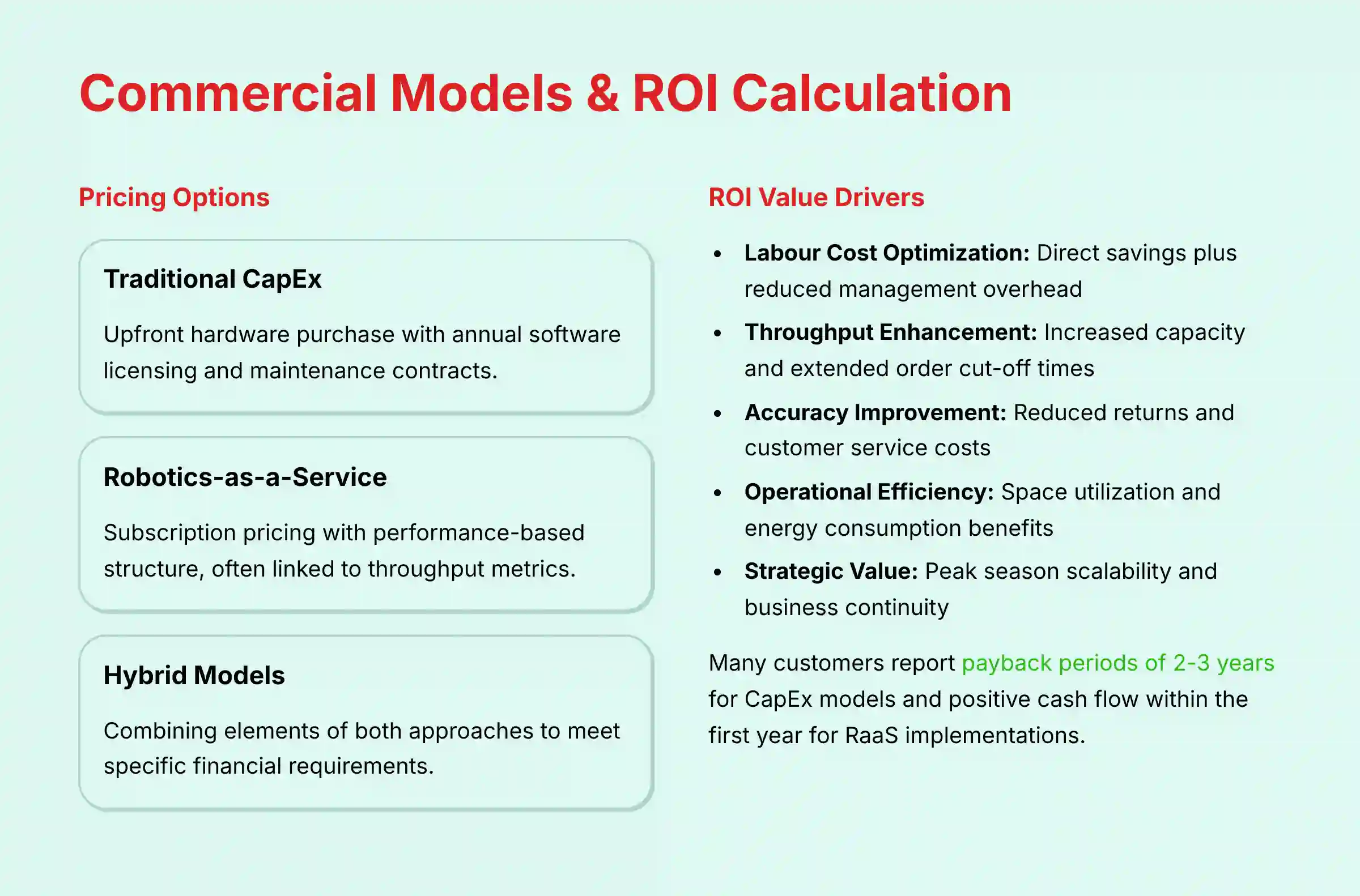
Berkshire Grey offers flexible commercial models designed to align with diverse financial strategies and operational requirements. Following their acquisition by SoftBank in 2023, they've maintained and expanded these options to accommodate various business needs and investment preferences.
Traditional Capital Expenditure (CapEx) Model
For organizations preferring asset ownership and balance sheet capitalization, Berkshire Grey offers a traditional purchase model:
- Upfront Hardware Purchase: Companies acquire the robotic systems outright as capital assets
- Software Licensing: Typically structured as an annual license for the AI and orchestration platform
- Maintenance & Support: Annual service contracts covering preventive maintenance, parts, and technical support
- Implementation Services: One-time professional services fee for installation, integration, and commissioning
This approach appeals particularly to:
- Organizations with available capital budgets for automation initiatives
- Companies preferring to own and depreciate physical assets over time
- Businesses with established automation strategies seeking to standardize on owned infrastructure
Robotics-as-a-Service (RaaS) Model
Recognizing the growing preference for operational expenditure models, Berkshire Grey offers a comprehensive RaaS subscription:
- Subscription Pricing: A predictable recurring fee (typically monthly or quarterly) covering both hardware and software
- Performance-Based Structure: Often linked to throughput metrics (e.g., cost per pick, cost per sorted item)
- Comprehensive Coverage: Includes all maintenance, software updates, monitoring, and technical support
- Scalability Options: Ability to flex capacity up or down based on seasonal needs
The RaaS model delivers several strategic advantages:
- Reduced Initial Investment: Eliminates large upfront capital requirements, accelerating time-to-value
- Aligned Incentives: Berkshire Grey remains financially motivated to maintain peak system performance
- Technology Obsolescence Protection: Hardware refreshes can be incorporated into longer-term agreements
- Balance Sheet Benefits: Qualifies as operational expense rather than capitalized investment
Hybrid Models
For some deployments, Berkshire Grey offers hybrid approaches that combine elements of both models:
- Partial upfront payment with reduced ongoing subscription fees
- Performance-based pricing layered on top of base subscription rates
- Capital purchase of hardware with software and services as subscription
Implementation and Integration Costs
Regardless of the primary commercial model, implementations typically include:
- Project management and engineering services
- Integration development with existing systems
- Site preparation consulting
- Training and knowledge transfer
Following their SoftBank acquisition, Berkshire Grey has maintained competitive pricing while potentially gaining additional financial flexibility for creative commercial structures. Prospective customers should engage directly with Berkshire Grey's commercial team to develop a customized pricing proposal based on their specific operational requirements, throughput needs, and financial objectives.
When evaluating these options, it's advisable to consider both immediate budgetary constraints and long-term total cost of ownership calculations to determine the most advantageous approach for your specific business case.
How do I calculate the potential ROI for implementing Berkshire Grey's system?
Calculating the Return on Investment (ROI) for a Berkshire Grey implementation requires a comprehensive analysis that extends beyond basic labor cost reduction. A robust business case should incorporate multiple value drivers across operational efficiency, strategic capabilities, and risk mitigation.
Core Financial Value Drivers
1. Labor Cost Optimization
- Direct Labor Savings: Calculate the fully-loaded cost (wages, benefits, taxes) of positions being automated
- Indirect Labor Benefits: Reduced management overhead, training costs, and HR administration
- Labor Market Risk Mitigation: Quantify the value of reduced dependency on scarce warehouse labor
- Calculation Example: 20 FTEs × $55,000 annual fully-loaded cost = $1.1M potential annual savings
2. Throughput and Revenue Enhancement
- Increased Processing Capacity: Quantify additional orders that can be processed during peak periods
- Extended Order Cut-off Times: Calculate the sales impact of later order acceptance deadlines
- Reduced Shipping SLA Violations: Measure the financial impact of meeting delivery promises consistently
- Calculation Example: 15% increase in peak capacity × $50M peak revenue = $7.5M additional revenue opportunity
3. Accuracy Improvement and Error Reduction
- Reduced Returns Processing: Calculate the full cost of returns handling (labor, shipping, restocking)
- Customer Service Savings: Fewer error-related customer service interactions
- Customer Retention Value: Improved retention from higher order accuracy
- Calculation Example: Reduction from 99.0% to 99.8% accuracy × 1M annual orders × $45 cost per error = $360,000 annual savings
4. Operational Efficiency Gains
- Space Utilization Improvements: Calculate the value of reduced footprint requirements
- Energy Consumption Reduction: Robotics often require less lighting and climate control
- Inventory Carrying Cost Reduction: Through improved inventory accuracy and turnover
- Calculation Example: 30% footprint reduction × 50,000 sq ft × $15 annual cost per sq ft = $225,000 annual savings
5. Strategic and Risk Mitigation Value
- Peak Season Scalability: Quantify the cost avoidance of seasonal hiring and training
- Business Continuity: Value of operational resilience during labor market disruptions
- Competitive Positioning: Strategic value of improved customer experience and faster fulfillment
ROI Calculation Framework
A comprehensive ROI analysis should include:
1. Initial Investment:
- System purchase or first-year RaaS costs
- Implementation, integration, and project management
- Facilities modifications and infrastructure updates
2. Annual Operating Costs:
- RaaS fees or maintenance/support contracts
- Power consumption and facility costs
- Internal support resources
3. Annual Benefits: (Sum of all value drivers above)
4. Net Annual Benefit: Annual Benefits – Annual Operating Costs
5. Simple Payback Period: Initial Investment ÷ Net Annual Benefit
6. 5-Year ROI: (5-Year Net Benefits – Initial Investment) ÷ Initial Investment × 100%
Real-World Considerations
When building your ROI model, consider these practical tips:
- Create separate calculations for normal operations versus peak season
- Factor in ramp-up periods where the system is learning and optimizing
- Consider the strategic value of redeploying staff to higher-value activities
- Include sensitivity analysis for varying labor costs and order volumes
Many Berkshire Grey customers report payback periods of 2-3 years for CapEx models and positive cash flow within the first year for RaaS implementations, though actual results vary based on specific operational profiles and implementation scope.
For maximum credibility, involve finance team members early in the ROI development process and validate assumptions with current operational data whenever possible. For a comprehensive evaluation of Berkshire Grey, check out our detailed Berkshire Grey review covering AI robotics capabilities.
What security protocols and data protection measures does Berkshire Grey implement?
As a SoftBank subsidiary handling mission-critical fulfillment operations, Berkshire Grey maintains enterprise-grade security protocols and data protection measures that meet the stringent requirements of major retailers, e-commerce companies, and logistics providers. Their comprehensive security architecture addresses both physical operational security and information security across all system components.
Data Security and Protection
1. End-to-End Encryption
- All data transmission between the Berkshire Grey platform and client systems (WMS/ERP) is secured using TLS 1.2+ with industry-standard cipher suites
- Data at rest is protected with AES-256 encryption for databases and file storage
- API communications utilize OAuth 2.0 and token-based authentication with automatic rotation
2. Network Security Architecture
- Implementation of defense-in-depth strategy with multiple security layers
- Segmented network design isolating robotic control systems from general IT infrastructure
- Dedicated VLANs for operational technology with strict access control
- Secure VPN tunnels for remote monitoring and support
- Advanced firewall protection with intrusion detection/prevention systems (IDS/IPS)
3. Access Control and Authentication
- Role-based access control (RBAC) with principle of least privilege
- Multi-factor authentication (MFA) for all administrative access
- Biometric authentication options for physical system access
- Comprehensive audit logging of all system interactions
- Regular access reviews and privilege attestation
Compliance and Certifications
Berkshire Grey maintains rigorous compliance with industry standards including:
- SOC 2 Type II Certification: Independent validation of controls over security, availability, processing integrity, confidentiality, and privacy
- ISO 27001 Alignment: Adherence to international information security management standards
- NIST Cybersecurity Framework: Implementation of security controls based on NIST guidelines
- GDPR and CCPA Compliance: For implementations handling personal data
Physical and Operational Security
1. Robotic System Safety
- Comprehensive safety systems including light curtains, pressure mats, and emergency stops
- Regular safety assessments and certifications
- Compliance with ANSI/RIA R15.06 and ISO 10218 robotics safety standards
- Automatic fault detection and safe shutdown procedures
2. Supply Chain Security
- Secure hardware supply chain with component verification
- Firmware signature verification and secure boot processes
- Regular vulnerability scanning and penetration testing
- Continuous security monitoring for anomalous behavior
Security Operations and Incident Response
1. 24/7 Security Monitoring
- Security Operations Center (SOC) providing continuous monitoring
- Automated threat detection and alerting
- Regular vulnerability assessments
2. Incident Response and Business Continuity
- Formal incident response plan with defined roles and procedures
- Regular tabletop exercises and simulations
- Comprehensive business continuity and disaster recovery planning
- Backup and recovery systems with regular testing
3. Security Updates and Patch Management
- Structured vulnerability management process
- Regular security patches and updates
- Pre-deployment testing in isolated environments
As part of pre-implementation due diligence, Berkshire Grey typically provides detailed security documentation and can accommodate customer-specific security assessments, including on-site audits and penetration testing by third-party security firms. Their security posture is regularly reviewed and updated to address emerging threats and changing compliance requirements, providing customers with confidence that their operational data and physical assets are protected to the highest industry standards.
Ready to explore warehouse automation solutions? Berkshire Grey's AI-powered robotics platform offers a comprehensive approach to modern fulfillment challenges, from handling complex product mixes to providing flexible commercial models that align with your business objectives.

Leave a Reply