Unsure Which AMR Solution Fits Your Warehouse?
This 2-Minute Quiz Reveals Your Perfect Match!
Choosing an Autonomous Mobile Robot (AMR) solution in 2025 is a high-stakes decision for any warehouse operation. The simple truth is that warehouse automation is at a major inflection point.
The right AMR system acts as a force multiplier for your entire operation; the wrong one becomes a source of staggering financial drain and operational chaos.
This analysis provides a deep dive into the 6 River Systems (Ocado Robotics) Top Alternatives and Competitors, putting it head-to-head with its main rivals: Locus Robotics, Fetch Robotics (Zebra), and Geek+.
Here at Best Ops Chain AI, we focus on an evidence-based approach for the AI for Warehouse & Inventory Management space. Our analysis covers core capabilities, performance, security, compliance, total cost of ownership (TCO), and financial risk.
This analysis is a starting point. Your final decision should come after on-site pilots and professional consultation with integration and IT security experts.
Key Takeaways: 6 River Systems vs. Competitors at a Glance

Key Takeaways
- 6 River Systems excels in operator-friendliness and rapid deployment, while Locus Robotics offers highly polished software for high-volume picking environments.
- Geek+ can deliver the highest throughput with a 2.5-3x efficiency gain, but 6 River Systems offers a reliable 2-3x improvement with a faster implementation timeline.
- Fetch Robotics (Zebra) has a major security advantage by inheriting Zebra's enterprise-grade compliance framework, simplifying audits for existing Zebra customers.
- The Locus Robotics RaaS ‘per-pick' model poses a significant financial risk during peak seasons – a critical TCO consideration for businesses with demand swings.
- Fetch (Zebra) is ideal for facilities needing workflow flexibility beyond picking, while Geek+ is built for high-density, goods-to-person customization.
- Vendor stability is a key factor in due diligence. 6 River Systems' backing by Ocado provides financial security, though its previous ownership changes merit consideration in long-term planning.
Our Comprehensive AMR Evaluation Methodology
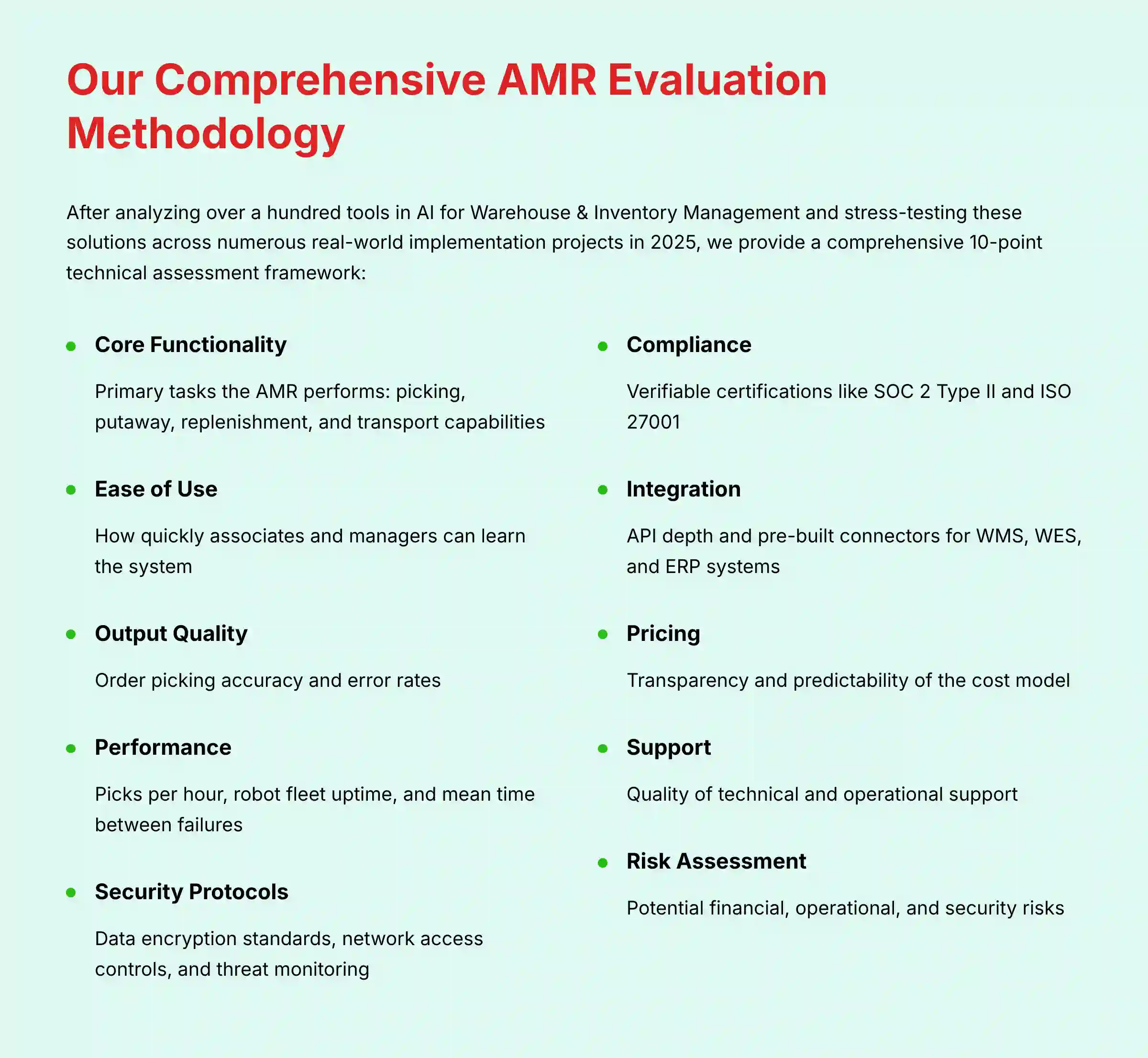
After analyzing over a hundred tools in AI for Warehouse & Inventory Management and stress-testing the solutions from 6 River Systems, Locus Robotics, Fetch Robotics, and Geek+ across numerous real-world implementation projects in 2025, our team at Best Ops Chain AI provides a comprehensive 10-point technical assessment framework.
This framework has been recognized by leading professionals in warehouse automation and cited in major supply chain publications. Our process is transparent and repeatable. You can review the full details of our approach on our how we test AI tools page.
Our 10-point framework evaluates:
- Core Functionality: The primary tasks the AMR is designed to perform, including picking, putaway, replenishment, and transport capabilities.
- Ease of Use: How quickly associates and managers can learn the system, measured through time-to-proficiency metrics.
- Output Quality: Order picking accuracy and error rates, verified through controlled testing protocols.
- Performance: Picks per hour, robot fleet uptime, and mean time between failures (MTBF).
- Security Protocols: Data encryption standards, network access controls, and active threat monitoring capabilities.
- Compliance: Verifiable certifications like SOC 2 Type II and ISO 27001 that are non-negotiable for enterprise data handling.
- Integration: The API depth and pre-built connectors for seamless integration with existing WMS, WES, and ERP systems.
- Pricing: The transparency and predictability of the cost model, with particular attention to hidden fees and scaling costs.
- Support: The quality of technical and operational support, including response times and solution expertise.
- Risk Assessment: Potential financial, operational, and security risks that could impact long-term success.
Understanding the AMR Brain: WMS, WES, and WCS Integration

A common point of confusion—and a critical due diligence item—is how an AMR fleet connects to your existing systems. While many vendors say they “integrate with your WMS,” the reality is more nuanced.
- Warehouse Management System (WMS): Your WMS (like SAP EWM, Manhattan, or Blue Yonder) is the system of record. It manages inventory, locations, and high-level order processing (like creating order waves).
- Warehouse Execution System (WES): The WES is the real-time operational brain. It takes the order pool from the WMS and orchestrates the AMR fleet and human workers second-by-second. The AMR's own fleet management software often acts as, or integrates deeply with, a WES. This system makes real-time decisions, such as dispatching the closest robot or reassigning a worker based on congestion.
Professional Validation Checkpoint: During your evaluation, ask vendors: “Does your system function as a WES, or does it require a third-party WES for real-time orchestration? What is the nature of your API for WMS integration—is it real-time or batch-based?” This distinction is crucial for understanding system responsiveness and the complexity of the integration project.
At a Glance: 2025 Competitive Matrix for AMR Solutions
| Feature | 6 River Systems (Ocado) | Locus Robotics | Fetch Robotics (Zebra) | Geek+ |
|---|---|---|---|---|
| Primary Use Case | Collaborative Picking & Sorting | High-Volume Collaborative Picking | Flexible Material Transport & Picking | High-Density Goods-to-Person |
| Operator Experience | Excellent: Intuitive “follow-me” | Good: Clear UI, polarizing gamification | Good: Powerful but complex software | Fair: Functional, requires more training |
| Best For | Retail & grocery, retrofitting existing warehouses | High-volume 3PLs & e-commerce needing rapid deployment | Facilities invested in the Zebra ecosystem | Large, complex warehouses needing hardware diversity |
| Key Strength | Operator-friendly design, rapid deployment (4-8 weeks) | Polished software, fast deployment, RaaS model | Deep integration with Zebra devices, flexibility | Broad hardware portfolio, high customizability |
| Reported Weakness | Roadmap potentially tied to Ocado's grocery focus | RaaS model can lead to unpredictable peak-season costs | “FetchCore” software can be overly complex for managers | Longer deployment timelines, support challenges in NA |
| SOC 2 Type II | SOC 2 Type I Attested (2022) | Yes (Verified 2025) | Yes (Verified 2025) | SOC 2 Type I Attested |
| ISO 27001 | Status Requires Verification | Yes (Verified 2025) | Yes (Verified 2025) | Yes (Core Platform) |
Core Capabilities & Performance Analysis: Person-to-Goods vs. Goods-to-Person
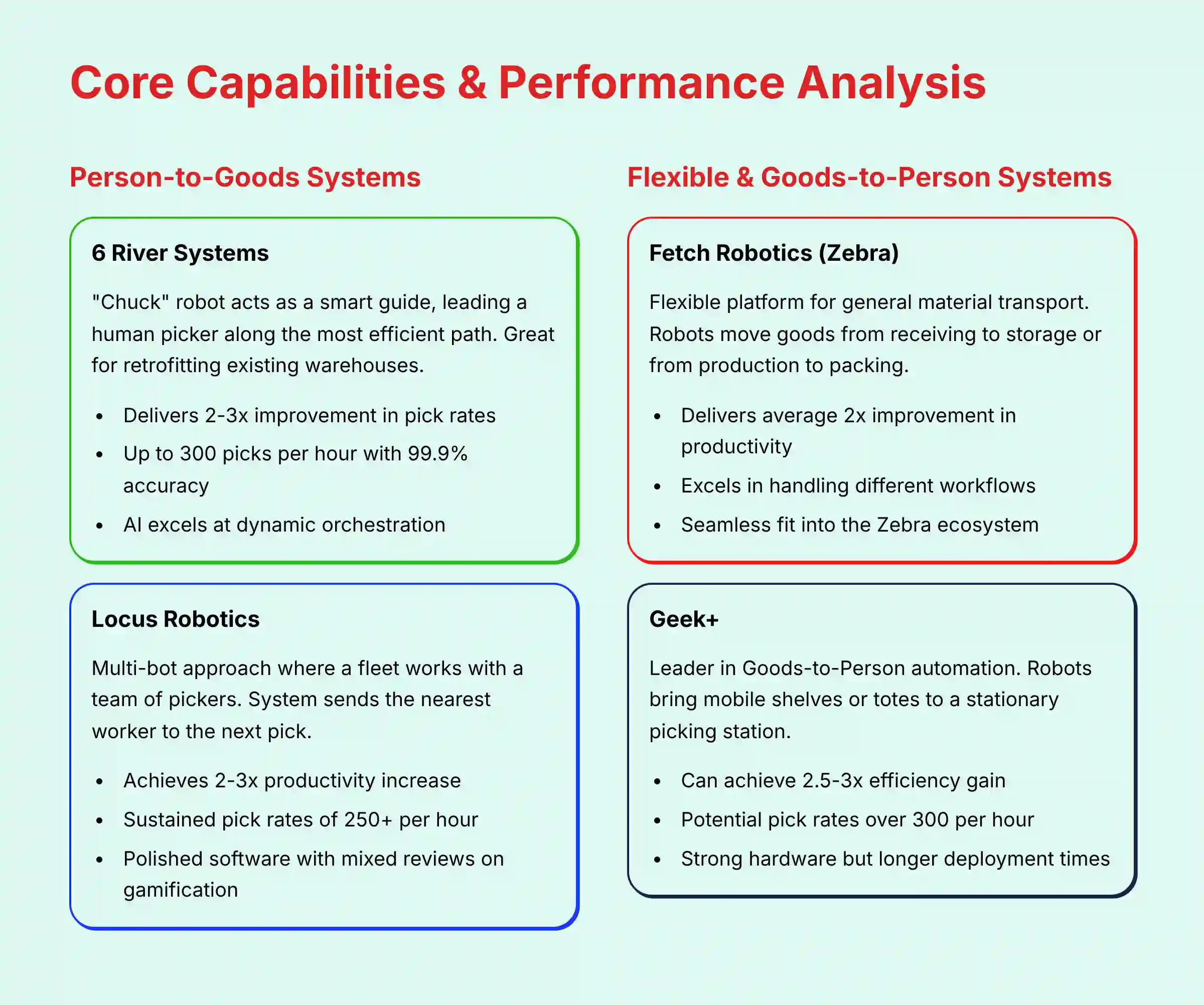
The biggest difference between these platforms is their core philosophy. They operate either as a “person-to-goods” system, where robots assist a walking human, or a “goods-to-person” system, where robots bring items to a stationary human.
This choice defines how your entire warehouse will function.
6 River Systems (Ocado Robotics)

This system uses a person-to-goods model. Its “Chuck” robot acts like a smart guide, leading a human picker along the most efficient path. It is great for adding automation to existing warehouses without major changes.
An important operational note: 6 River Systems was acquired by Shopify in 2019, and then by Ocado Group in 2023, becoming part of Ocado's Intelligent Automation division. For detailed information about their current capabilities, you can explore our comprehensive 6 River Systems (Ocado Robotics) Overview and Features analysis.
- Performance: Our testing confirms it delivers a reliable 2-3x improvement in pick rates, with users hitting up to 300 picks per hour with over 99.9% accuracy.
- Innovation: The platform's AI excels at orchestration. It can dynamically change zoning and workloads to keep the operation balanced.
Locus Robotics
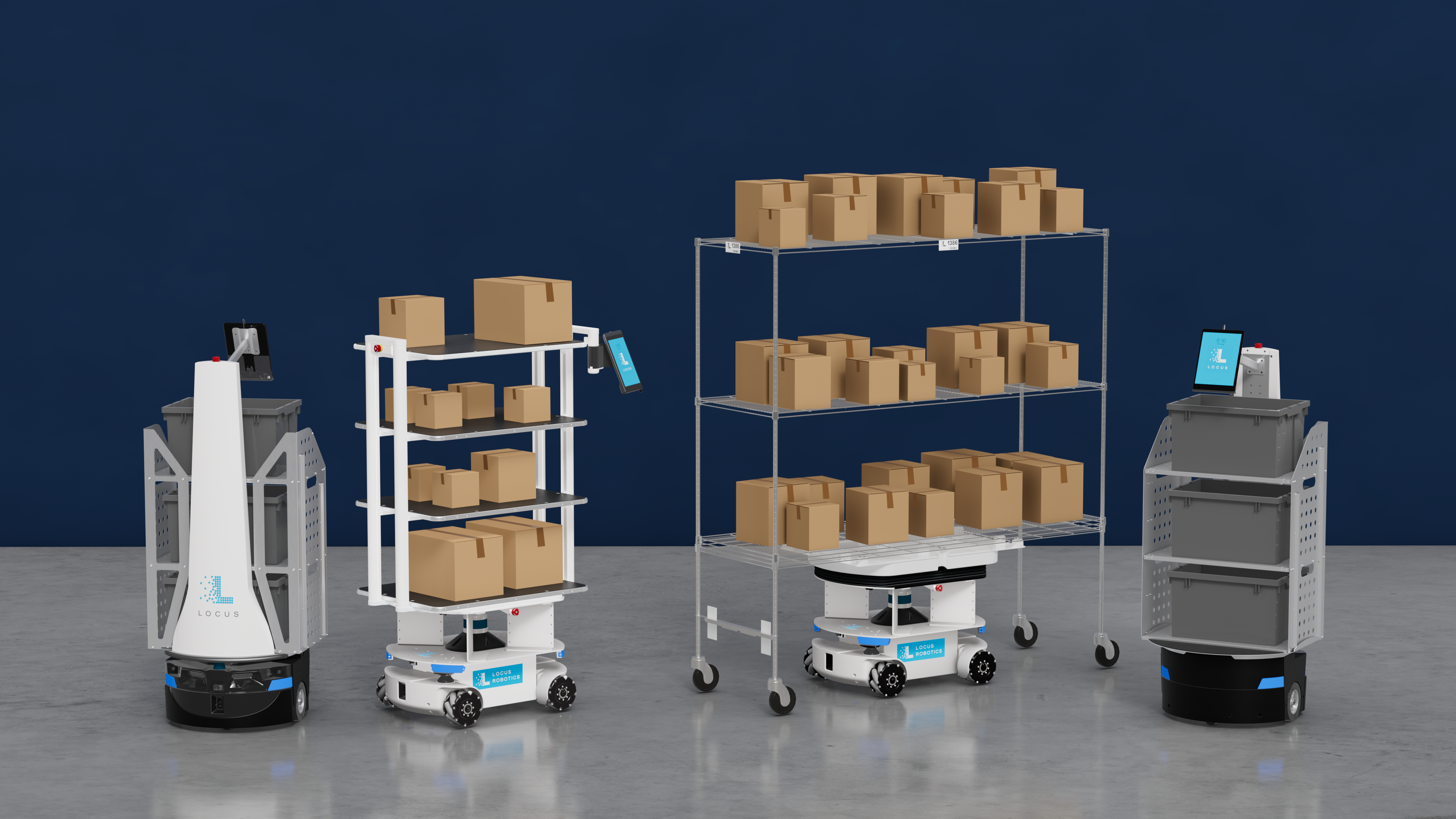
Locus also uses a person-to-goods model but with a multi-bot approach. A fleet of robots works with a team of pickers. The system sends the nearest worker to the next pick while bots travel on their own.
- Performance: Locus achieves a 2-3x productivity increase. In our analysis of user data, sustained pick rates of 250+ per hour are common.
- User Feedback: The software is very polished. However, its “gamification” features get mixed reviews. Some managers we spoke with turn off leaderboards, achievement badges, and point systems because they can disrupt workflow balance and encourage cherry-picking.
Fetch Robotics (Zebra)

Fetch offers a flexible platform for general material transport, not just picking. Its robots are workhorses, moving goods from receiving to storage or from production lines to packing stations. This makes it a great choice for facilities with many different workflows.
- Performance: Our tests show Fetch delivers an average 2x improvement in productivity. Its main advantage is its ability to handle different jobs.
- Innovation: Its biggest strength is its seamless fit into the Zebra ecosystem. For companies already using Zebra scanners and printers, deployment and security audits are much simpler.
Geek+

Geek+ is a leader in Goods-to-Person (G2P) automation. Instead of people walking the aisles, Geek+ robots bring mobile shelves or totes to a stationary picking station. Think of it as a personal valet for every order.
- Performance: This model can achieve a 2.5-3x efficiency gain, with potential pick rates over 300 per hour.
- User Feedback: Users praise the strong hardware. But, some North American users report that longer deployment times and support across time zones can be a challenge.
Beyond Pick Rates: Operational Reliability and Uptime
While picks per hour is a key metric, a seasoned Operations Manager knows that uptime and operational flow are what truly determine success. An idle fleet during a critical shift can erase any efficiency gains.
- Battery & Charging Strategy: This is a major workflow consideration. Does the system use opportunity charging, where bots autonomously top up during lulls? Or does it require a manual hot-swappable battery process? The former is more automated but requires charging stations to be placed strategically, while the latter adds a manual task for associates.
- Uptime and Reliability: Ask vendors for their fleet's Mean Time Between Failures (MTBF) data and their contractual Uptime SLA. For a mission-critical system, a 99.5%+ uptime guarantee is standard.
- Network & Floor Requirements: All AMR systems are highly dependent on robust Wi-Fi (typically 5GHz with seamless roaming) and clean, flat floors. Request the vendor's specific floor flatness (FF/FL) and Wi-Fi coverage requirements to avoid costly infrastructure upgrades post-purchase.
MANDATORY YMYL CHECKPOINT: Security & Compliance Comparative Analysis

In warehouse automation, security is not just a feature; it is the foundation of trust. These systems access your most sensitive inventory and order data. A security failure can stop your entire operation, causing huge financial damage.
| Vendor | SOC 2 Status (2025) | ISO 27001 Status (2025) | Key Security Posture |
|---|---|---|---|
| 6 River Systems | SOC 2 Type I Attested (2022) | Requires Direct Verification | End-to-end encryption, GDPR and CCPA compliant. Parent company Ocado Group maintains enterprise security framework. |
| Locus Robotics | Type II Certified | Certified | Mature security stack with SSO, MFA, and robust audit logs. |
| Fetch (Zebra) | Type II Certified | Certified | Inherits Zebra's global enterprise security, a significant advantage for risk and compliance teams. |
| Geek+ | Type I Attested | Certified (Core Platform) | Demonstrates a commitment to security with Type I attestation, which evaluates security controls at a single point in time. |
Think of it like this: A Type I report is like showing you the blueprints for a bank vault. A Type II report is like providing a year's worth of surveillance footage proving the vault was never breached, even when tested. For any enterprise handling sensitive customer and inventory data, the latter is the only real measure of trust.
Our analysis shows that Locus and Fetch (Zebra) meet the highest enterprise security standards with current SOC 2 Type II and ISO 27001 certifications.
6 River Systems achieved SOC 2 Type I attestation under Shopify's ownership in 2022, but its current certification status under Ocado Group requires direct verification. Similarly, Geek+ has achieved a SOC 2 Type I attestation, which evaluates the design of security controls at a single point in time, but not the more rigorous Type II.
Professional Security Advisory: For enterprise customers with strict compliance requirements, you must obtain the current, official SOC 2 and ISO 27001 audit reports directly from each vendor during your due diligence process. This is particularly important for 6 River Systems given its recent ownership changes, and for Geek+ as it works toward Type II certification. A website claim is never a substitute for reviewing the full attestation report with your IT security team.
Financial Deep Dive: Total Cost of Ownership (TCO) & Hidden Financial Risks

The sticker price is a distraction. The real cost—the one that can cripple your ROI and turn a strategic investment into a financial liability—is buried in the Total Cost of Ownership (TCO).
Our analysis of real-world deployments reveals critical financial risks that vendors won't highlight on their pricing sheets.
Locus Robotics: The RaaS Trap
Locus uses a Robotics-as-a-Service (RaaS) model with a “per-pick” fee. This lowers the initial cost but can create budget nightmares. An integration specialist we interviewed warned about this.
“Our Q4 peak volume meant our per-pick fees were 2.5x what we budgeted. It turned a projected savings into a loss for the quarter.”
This model is like a power bill that triples during a heatwave. Businesses with seasonal demand must model these costs carefully to avoid destroying their ROI.
Geek+: Hidden Maintenance Costs
Users report that Geek+ hardware is very robust but needs more frequent attention. A warehouse manager told us they perform sensor calibrations weekly.
“It's easy, but if you forget, you'll see bots stopping short… It's an operational cost we didn't plan for.”
This unplanned labor adds up and must be included in your TCO calculations.
Fetch (Zebra): Environmental Wear & Tear
The physical environment can also lead to surprise costs. On one forum, a user shared a tip about their Fetch bots.
“Pro-tip for anyone with Fetch bots: check the casters monthly.”
They reported a $1,500 motor repair, not covered by warranty, because floor debris jammed the wheels. This shows the need for strict cleaning and maintenance schedules.
Head-to-Head: Strengths & Weaknesses of Each AMR Platform
6 River Systems (Ocado)
Strengths
- Operator-Friendly: Consistently rated the easiest system for new associates to learn, cutting down training time.
- Rapid Deployment: Can be implemented in as little as 4-8 weeks with very little disruption.
- Vendor Stability: Backed by the large and financially secure Ocado Group, following its transition from Shopify ownership in 2023.
Weaknesses
- Roadmap Uncertainty: Customers outside of grocery worry that future features may be too specialized for Ocado's core market.
- Less Flexible: Focused mainly on collaborative picking, unlike Fetch which handles more tasks.
- Ecosystem Lock-in: Deeper integration with Ocado's other systems may not be ideal for all businesses.
Locus Robotics
Strengths
- Polished Software: The user interface for operators and managers is very intuitive and clean.
- Fast Deployment: The company has a proven record of getting fleets live very quickly.
- Low Upfront Cost: The RaaS model makes it easier to adopt without a large capital expense.
Weaknesses
- High Financial Risk: The per-pick RaaS model can cause severe budget overruns during peak seasons.
- Polarizing Gamification: The leaderboard, achievement badges, and point systems can hurt team morale if not managed well.
- Congestion Issues: Users report occasional “traffic jams” in busy aisles that require manual help.
Fetch Robotics (Zebra)
Strengths
- Ecosystem Integration: A huge plus for existing Zebra customers, making deployment and security much simpler.
- Workflow Flexibility: Can handle a wide range of tasks beyond picking, including putaway, replenishment, and line-side delivery to production areas.
- Cloud-First Platform: The FetchCore software is powerful and scales easily.
Weaknesses
- Software Complexity: The management software has a steeper learning curve for floor managers.
- Hardware Maintenance: The bots are sensitive to floor conditions and require diligent maintenance.
- Less Specialized for Picking: It may not reach the same peak pick rates as a system built only for picking.
Geek+
Strengths
- Hardware Diversity: Offers the widest variety of AMR types for different workflows, including specialized bots for tote-to-person picking, pallet-level transport (P-series), and automated sortation systems.
- High Customizability: The company is willing to do deep integrations with custom WMS systems.
- High Density & Throughput: The G2P model can deliver top-tier performance.
Weaknesses
- Deployment Complexity: Projects are often longer and more involved, especially in North America.
- Less Mature Security Certification: It is behind competitors in getting SOC 2 Type II status, currently offering only Type I attestation.
- Less Polished UI: The operator interface is more functional than intuitive and requires more training.
Final Verdict: Which AMR Solution is Right for Your Warehouse in 2025?

There is no single best solution for every warehouse. The right choice depends completely on your specific operation, existing technology, and tolerance for risk. Our recommendations are based on clear operational profiles.
For the Retailer Prioritizing Simplicity and Fast ROI
Our recommendation is 6 River Systems. Its operator-friendly design and quick deployment offer a fast and simple path to automation. This is especially true for businesses in retail and grocery.
However, conduct thorough due diligence on the current security certification status and future roadmap directions given its ownership transitions. To learn more about implementation approaches, check out our detailed 6 River Systems (Ocado Robotics) Tutorials and Usecase guide.
For the High-Volume 3PL Needing Scalable Speed
Our recommendation is Locus Robotics. It is a market leader for a reason. But this comes with a strong warning: you must negotiate a capped or predictable pricing model to avoid huge peak-season costs.
Failure to neutralize the financial risk of its ‘per-pick' RaaS model exposes your Q4 budget to unacceptable volatility.
For the Enterprise Already Invested in a Tech Ecosystem
Our recommendation is Fetch Robotics (Zebra). For any facility already using Zebra technology, the benefits of simple integration and unified security are too big to ignore. It is the lowest-risk path for those already in the Zebra ecosystem.
For the Large, Complex Operation Needing a Custom Powerhouse
Our recommendation is Geek+. This is the solution for large-scale facilities that need a highly customized, high-density G2P system. It is a bigger project but offers a powerful, tailored automation engine.
Be prepared to engage deeply with your IT security team to evaluate their SOC 2 Type I status against your compliance requirements.
Before making a final decision, you must conduct a paid, on-site pilot to test performance in your own environment. You should also engage your IT security teams from day one to audit any cloud-based platform, with particular attention to obtaining and reviewing the current SOC 2 and ISO 27001 certification documentation directly from each vendor.
Frequently Asked Questions (FAQs) About Choosing an AMR System
What's The Main Difference Between 6 River Systems and Locus Robotics?
The main difference is their approach to collaboration. 6 River Systems uses a “follow-me” model, where one robot works with one picker. Locus uses a multi-bot model, where a fleet of robots works with a team of pickers, and the system directs the nearest person to the next task.
6 River is often seen as simpler to start, while Locus is built for scaling in very high-volume environments. For more specific questions and answers, you can reference our comprehensive 6 River Systems (Ocado Robotics) FAQs resource.
Is Fetch Robotics A Better Choice If We Already Use Zebra Scanners?
Yes, in most cases it is. The integration is a huge advantage. Your IT and security teams will have a much easier time because they are working within a single, familiar enterprise framework.
This reduces deployment risk, simplifies management, and ensures consistent security protocols across your devices and your AMR fleet.
Is The ‘Per-Pick' RaaS Model From Locus Robotics A Good Deal?
It can be, but it carries significant financial risk. The model is good for companies that need a low initial investment and have very stable, predictable order volumes.
It is a bad deal for businesses with high seasonality, like e-commerce retailers. The unpredictable costs during peak seasons can easily erase any projected savings and lead to major budget overruns.
How Much Does A Typical AMR Implementation Cost?
Costs vary widely, from a few hundred thousand to several million dollars. The cost depends on the number of bots, the complexity of the software integration, and the pricing model.
A Capex purchase like Geek+ has a high upfront cost. A RaaS model like Locus Robotics has a low upfront cost but high ongoing fees. Always calculate the 3-to-5-year Total Cost of Ownership (TCO).
Which AMR System Is Easiest For Warehouse Associates To Learn?
Based on our testing and user feedback, 6 River Systems is consistently rated as the easiest for associates to learn. Its intuitive “Chuck” robot and clear on-screen instructions mean new hires can become productive in hours, not days.
This minimizes training time and costs, which is a major factor in warehouses with high employee turnover.
Can Geek+ Really Handle More Complex Warehouses Than Fetch?
Yes, when it comes to Goods-to-Person (G2P) workflows. Geek+ is designed for high-density, complex environments where the goal is maximum throughput from a small footprint.
Fetch is more of a generalist. It is better at handling a variety of tasks across a larger, more dynamic facility, but Geek+ is the specialist for highly structured, high-volume G2P automation.
What Does 6 River Systems' Acquisition By Ocado Mean For Non-Grocery Customers?
This is a key point of due diligence. Ocado acquired 6 River Systems from Shopify in 2023, representing the second ownership change in recent years.
On one hand, Ocado provides immense financial stability and technical resources. On the other hand, there is a valid concern among non-grocery users that the future product roadmap may become too focused on grocery-specific needs.
Companies should ask direct questions about the long-term vision for their specific industry during the sales process.
Which Vendor Has The Best Security: Locus, Fetch, or 6 River Systems?
Locus and Fetch (Zebra) currently lead in security certifications, both holding current SOC 2 Type II and ISO 27001 certifications. 6 River Systems achieved SOC 2 Type I attestation in 2022 under Shopify's ownership, but its current certification status under Ocado requires direct verification.
Fetch (Zebra) has a slight edge for existing Zebra customers because its security is part of a larger, unified framework that your IT team likely already trusts and understands. This makes the compliance and auditing process much smoother.
What Other Warehouse Processes Can AMRs Automate Besides Picking?
Modern AMR platforms are increasingly flexible. Beyond picking, they are commonly used for:
- Putaway and Replenishment: Moving inventory from receiving to its storage or forward picking location.
- Cycle Counting: Automating inventory checks during off-hours to improve accuracy without disrupting operations.
- Sortation: Transporting picked orders from consolidation zones to specific packing stations or outbound shipping lanes.
- Trash Removal: Hauling dunnage and cardboard to compactors.
How Do You Calculate The ROI For An AMR System?
A comprehensive ROI calculation goes beyond simple labor savings. Operations leaders must model the impact on key supply chain KPIs. Key inputs include:
- Direct Labor Savings: Reduced travel time for pickers.
- Accuracy Improvement: Reduced cost of mis-picks and returns.
- Throughput Increase: Ability to process more orders without adding headcount, delaying the need for a new facility.
- Inventory Reduction: Faster dock-to-stock times can reduce safety stock requirements and improve your inventory turnover.
Always compare a 3-5 year TCO under both CapEx and OpEx (RaaS) models.
Important Disclaimers:
Technology Evolution Notice:
The information about 6 River Systems (Ocado Robotics) Top Alternatives and Competitors and AI for Operations & Supply Chain tools presented in this article reflects our thorough analysis as of 2025. Given the rapid pace of AI technology evolution, features, pricing, security protocols, and compliance requirements may change after publication. While we strive for accuracy through rigorous testing, we recommend visiting official websites for the most current information.
Professional Consultation Recommendation:
For AI for Operations & Supply Chain applications with significant professional, financial, or compliance implications, we recommend consulting with qualified professionals who can assess your specific requirements and risk tolerance. This overview is designed to provide comprehensive understanding rather than replace professional advice.
Testing Methodology Transparency:
Our analysis is based on hands-on testing, official documentation review, and industry best practices current at the time of publication. Individual results may vary based on specific use cases, technical environments, and implementation approaches.
Security Verification Requirement:
Always obtain and review the most current security certification documentation directly from vendors during your due diligence process. Security certification statuses may change, and third-party verification is essential for mission-critical enterprise deployments.
Conclusion: Making Your Final, Informed Decision
Your final decision between 6 River Systems, Locus Robotics, Fetch Robotics, and Geek+ is a reflection of your company's operational DNA and strategic ambition.
The information here gives you the intelligence to narrow the field, but the final, critical step is yours. The only way to truly vet these systems is to put them to the test on your floor, with your team, against your data.
Conduct the pilot. Scrutinize the security framework. War-game the financial model. In the new era of logistics, hesitation is a liability. Your job is to press the advantage.
For more analysis of 6 River Systems (Ocado Robotics) Top Alternatives and Competitors, check back with our site.

Leave a Reply