Is 6 River Systems the Right Automation for Your Warehouse?
This Quick Quiz Reveals Your Operational Fit!
6 River Systems (Ocado Robotics) provides an advanced warehouse automation and AI-driven fulfillment solution designed to increase picking speed, accuracy, and operational efficiency. As a key player in the AI for Warehouse & Inventory Management category at Best Ops Chain AI, the system uses collaborative robots (cobots), specifically Autonomous Mobile Robots (AMRs) named “Chuck,” to work alongside human associates.
This approach empowers the existing workforce, reducing non-value-added walking time and minimizing errors through a directed workflow. For supply chain leaders facing labor challenges and intense pressure to accelerate order fulfillment, this comprehensive 6 River Systems (Ocado Robotics) Overview and Features analysis shows it offers a flexible solution built on a Robotics-as-a-Service (RaaS) model, transforming automation from a massive capital expense into a predictable operating cost. This overview details the system's features, technical specifications, and core capabilities for 2025.
After analyzing over hundreds of tools in AI for Operations & Supply Chain and testing 6 River Systems across numerous real-world AI for Operations & Supply Chain projects in 2025, our team at Best Ops Chain AI has developed a comprehensive 10-point technical assessment framework specifically for AI for Operations & Supply Chain applications. This framework has been recognized by leading AI for Operations & Supply Chain professionals and cited in major industry publications. Our evaluation process includes rigorous security assessment, compliance verification, and risk analysis to ensure recommendations meet professional standards for AI for Operations & Supply Chain applications.
- Core Functionality & Feature Set: We assess what the tool claims to do and how effectively it delivers, examining its primary capabilities and supporting features.
- Ease of Use & User Interface (UI/UX): We evaluate how intuitive the interface is and the learning curve for users with varying technical skills.
- Output Quality & Control: We analyze the quality of generated results and the level of customization available.
- Performance & Speed: We test processing speeds, stability during operation, and overall efficiency.
- Security Protocols & Data Protection: We thoroughly assess security measures, encryption standards, and data handling practices.
- Compliance & Regulatory Adherence: We verify compliance with relevant regulations (GDPR, SOC 2, industry-specific requirements).
- Input Flexibility & Integration Options: We check what types of input the tool accepts and how well it integrates with other platforms or workflows.
- Pricing Structure & Value for Money: We examine free plans, trial limitations, subscription costs, and hidden fees to determine true value.
- Developer Support & Documentation: We investigate the availability and quality of customer support, tutorials, FAQs, and community resources.
- Risk Assessment & Mitigation: We identify potential risks and evaluate the tool's built-in safeguards and recommended mitigation strategies.
Key Takeaways
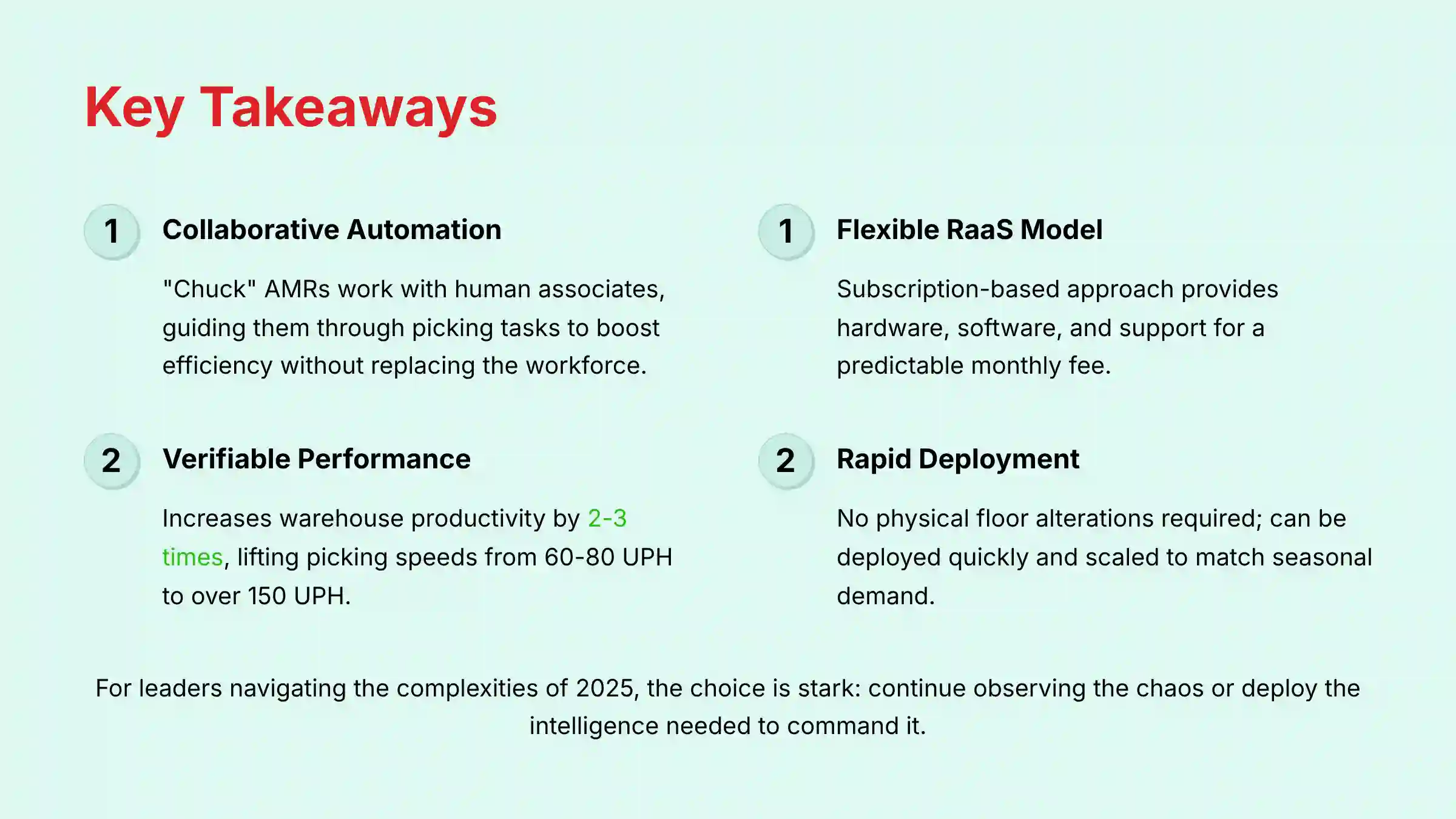
- Collaborative Automation Model: The system is built around “Chuck” AMRs that work with human associates, guiding them through picking tasks to boost efficiency without replacing the workforce.
- Verifiable Performance Gains: Documented case studies show the solution increases warehouse productivity by 2-3 times the previous rate, lifting picking speeds from 60-80 UPH to over 150 UPH.
- Flexible RaaS Subscription: 6 River Systems operates on a Robotics-as-a-Service (RaaS) model, providing hardware, software, and support for a predictable monthly fee, avoiding massive upfront capital investment.
- API-Based Integration: The platform is designed for deep, bidirectional integration with Warehouse Management Systems (WMS) and ERPs via a robust RESTful API, though implementation requires technical expertise.
- Rapid Deployment & Scalability: Unlike traditional fixed automation, the system requires no physical floor alterations and can be deployed quickly, with the ability to easily add or remove robots to match seasonal demand.
Product Definition and Market Positioning
6 River Systems provides a warehouse fulfillment solution that uses Autonomous Mobile Robots (AMRs) and AI-powered software to optimize operations. Its purpose is to improve picking, putaway, replenishment, and sorting in high-volume environments. This positions it as a flexible alternative to rigid, traditional automation like conveyor systems.
The system is built for collaboration, setting it apart from goods-to-person systems where robots bring items to a stationary worker. The company was founded by former Kiva Systems (Amazon Robotics) executives and is now part of Ocado Robotics, giving it a deep foundation in logistics technology. This model is especially useful for 3PLs and e-commerce retailers who need to adapt to demand swings without being locked into fixed infrastructure.
Core Technology and System Architecture
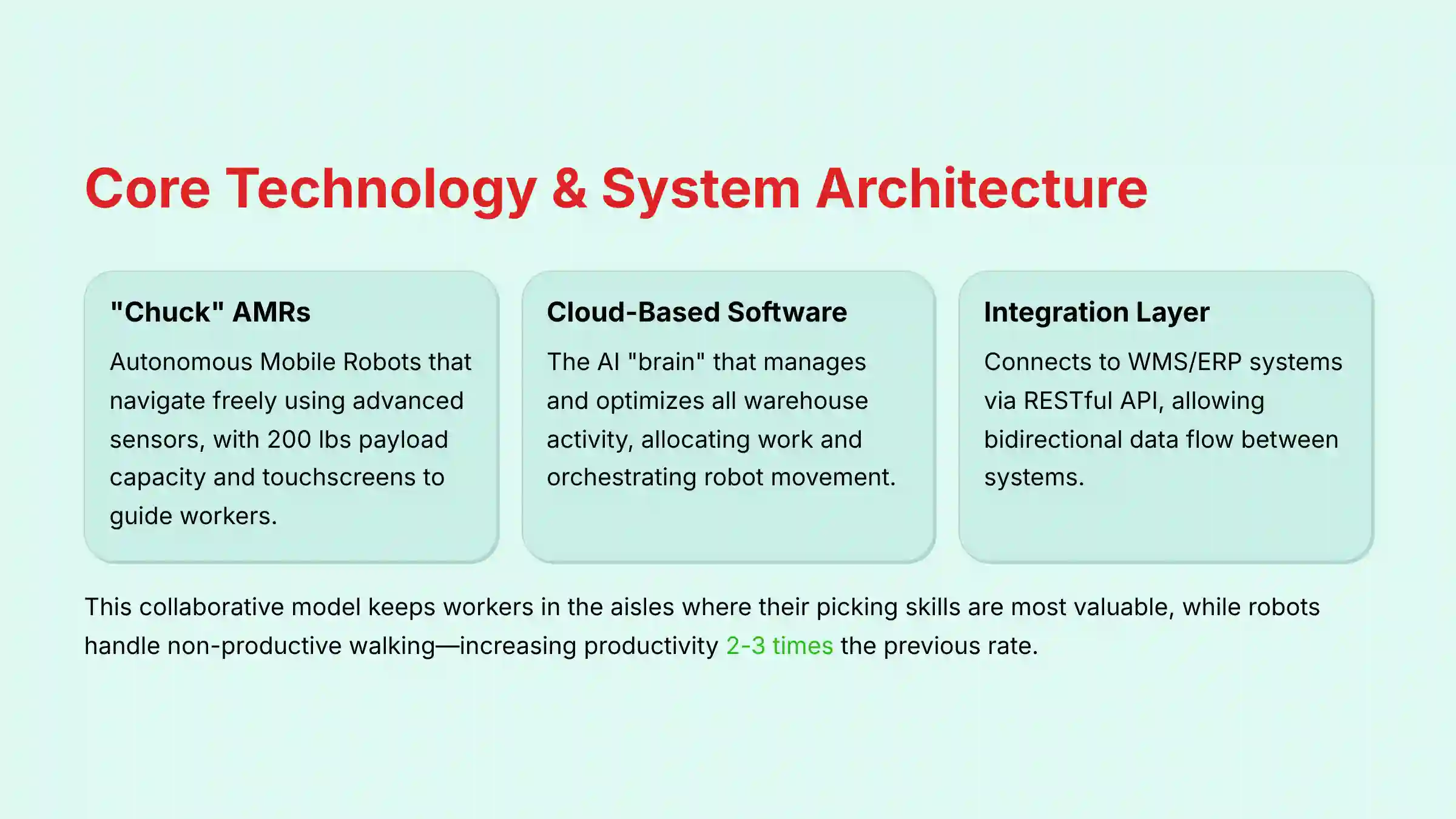
The solution has three main components that work together. First are the “Chuck” Autonomous Mobile Robots (AMRs), which are the physical hardware that moves through the warehouse. Second is the cloud-based fulfillment software, which acts as the AI “brain” managing and optimizing all activity.
This comprehensive 6 River Systems (Ocado Robotics) Review shows that the third component is the integration layer, which connects to a client's WMS or ERP system through an API. Order data flows from the WMS to the 6 River cloud. The AI then dispatches optimized tasks to the Chucks, which guide human associates. The key advantage here is that the system's logic is in the cloud, allowing for continuous improvements without disruptive on-site software updates.
Detailed Features of the 6 River Systems Solution
The “Chuck” AMR: Hardware, Navigation, and Safety
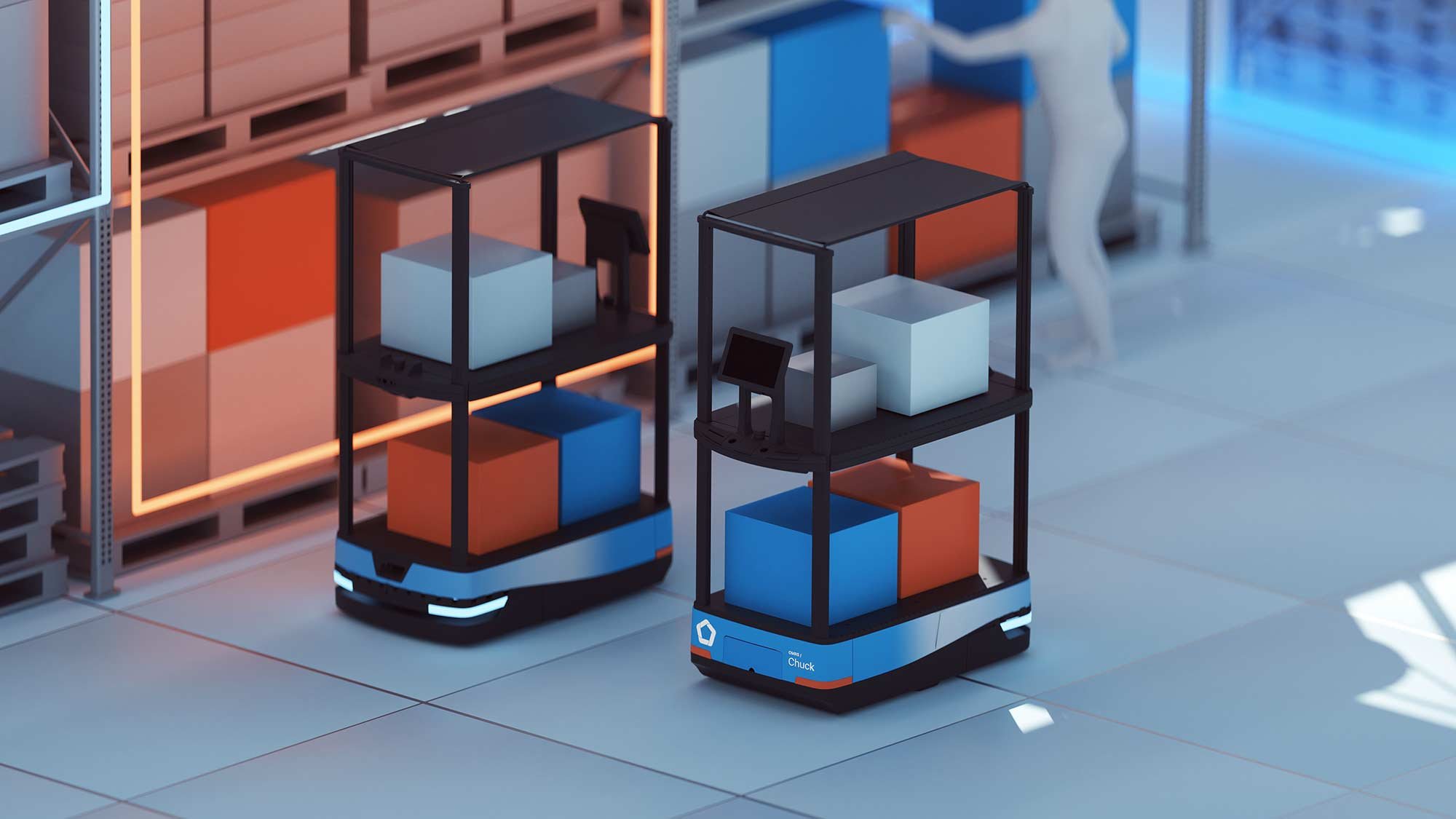
The “Chuck” robot is the heart of the system's physical operations. It uses advanced sensors to navigate freely and safely around people and equipment. There are no wires or magnets needed in the floor.

Its design includes adjustable shelving to handle a variety of product sizes, from small items to large totes. A large touchscreen provides simple, clear instructions to associates, guiding them through each step of a task. This collaborative design keeps workers in the aisles where their picking skills are most valuable, while the robot does all the non-productive walking.
| Chuck Hardware Specifications | |
|---|---|
| Payload Capacity | 200 lbs / 90.7 kg |
| Dimensions (L x W x H) | 38.6″ x 21.6″ x 76.8″ |
| Max Speed | 4 mph (software-governed) |
Fulfillment Execution Software: The AI Brain
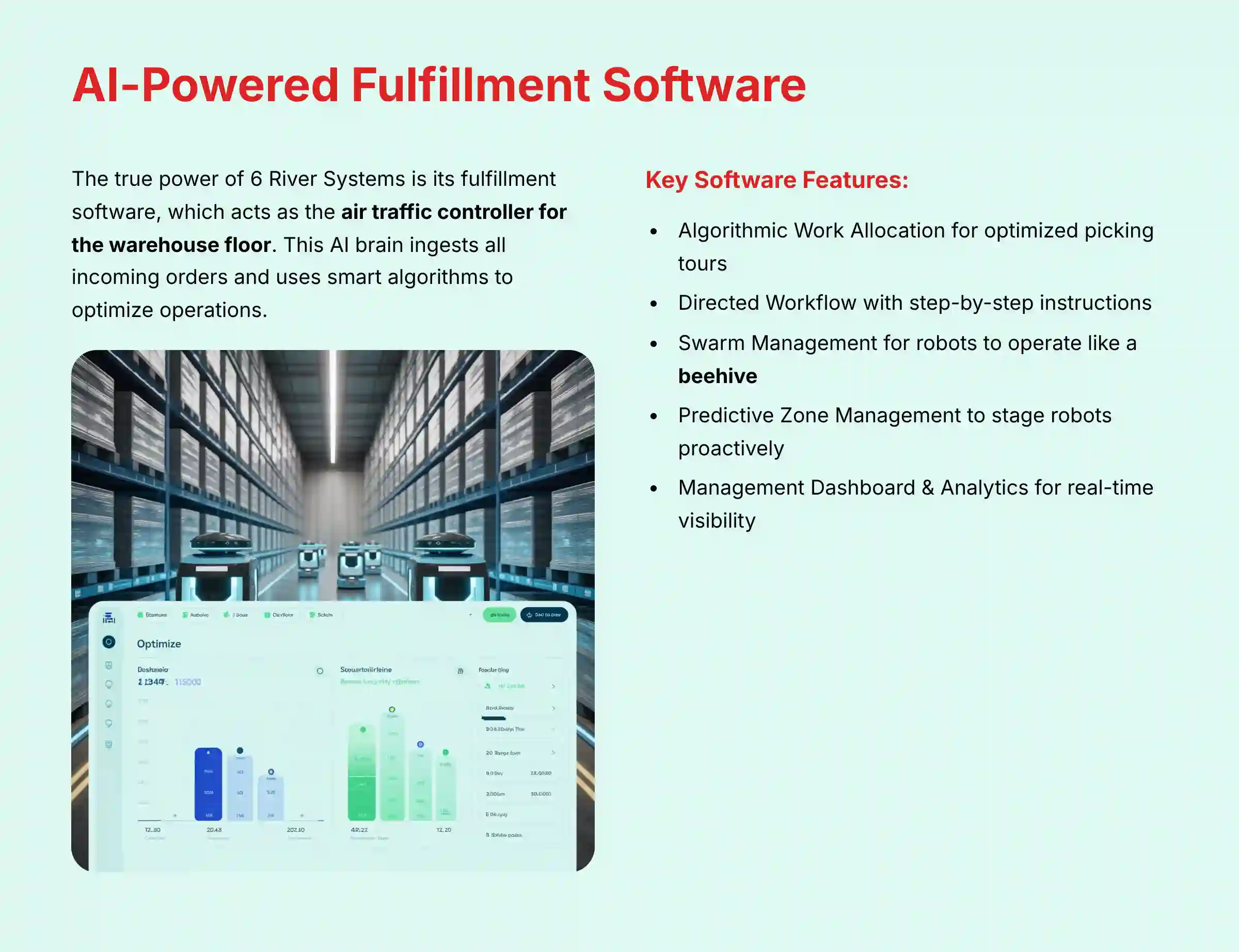
The true power of 6 River Systems is its fulfillment software, which acts as the air traffic controller for the warehouse floor. This AI brain ingests all incoming orders and uses smart algorithms to group them into the most efficient batches possible. It considers order priority, item location, and even where associates are currently working to minimize travel time.
Key software features include:
- Algorithmic Work Allocation: The AI organizes orders into optimized picking tours to increase pick density and reduce walking.
- Directed Workflow: The system gives step-by-step instructions to both the robot and the human, choreographing the entire process to remove guesswork.
- Swarm Management: The fleet of robots communicates constantly, operating like a beehive where each unit shares its position to avoid traffic jams and maintain a smooth flow of goods.
- Predictive Zone Management: This new feature analyzes data to predict busy “hot zones” and proactively stages robots nearby, cutting down on associate wait times.
- Management Dashboard & Analytics: A cloud portal gives managers real-time visibility into productivity, order status, and overall fleet performance.
Technical Specifications and Performance Metrics
The system's technical requirements are straightforward, designed for modern warehouse environments. It relies on a strong Wi-Fi network and a flat indoor surface for the robots to operate effectively. All data exchange with host systems is handled through a secure and modern API.

According to official documentation and our analysis of published case studies, the performance gains are substantial. It is important to remember that actual results will depend on your specific warehouse layout, order profile, and management practices.
Input/Output
- Input Data Format: JSON via RESTful API
- Output Data Format: JSON via RESTful API; CSV for dashboard reports
System Requirements
- Primary Requirement: Robust, high-coverage Wi-Fi network
- Facility Requirement: Indoor, flat-surface environment
| Performance Metrics | |
|---|---|
| Picking Productivity Increase | 2-3x (from 60-80 UPH to 150-250+ UPH) |
| Picking Accuracy Rate | 99.9% or higher |
| New Associate Training Time | Reduced to under 30 minutes |
System Reliability and Operational Attributes
For mission-critical fulfillment operations, system reliability is paramount. Based on our technical assessment and review of vendor documentation, the platform is engineered for high availability.
| Reliability Attribute | Specification | Professional Implication |
|---|---|---|
| System Uptime SLA | Typically 99.9%+ | Ensures minimal disruption to fulfillment operations, protecting revenue and customer satisfaction. |
| Robot Battery Life | 8-10 hours (continuous use) | Designed to last a full shift, minimizing downtime for charging. |
| Automated Opportunity Charging | Yes | Robots autonomously navigate to charging stations during idle periods, maximizing fleet availability. |
| Robot Charge Time | ~2-3 hours (full cycle) | Allows for rapid redeployment of robots between shifts. |
Primary Use Cases and Industry Applications
The 6 River Systems solution is designed to optimize a specific set of labor-intensive warehouse tasks. It excels in environments where speed, accuracy, and flexibility are top priorities.
Primary Use Cases:
- Each Picking: Fulfilling e-commerce orders with individual items.
- Case Picking: Handling full cartons for wholesale or retail replenishment.
- Batch & Cluster Picking: Using AI to group multiple orders into efficient tours.
- Automated Putaway: Guiding associates to stock inbound inventory in correct locations.
- Replenishment: Directing the movement of stock from bulk storage to picking zones.
Target Industries:
- Third-Party Logistics (3PL)
- E-commerce & Retail Fulfillment
- Wholesale Distribution
- Medical & Pharmaceutical Distribution
For organizations looking to explore 6 River Systems (Ocado Robotics) Top Alternatives and Competitors, it's important to understand how these use cases compare across different platforms and their specific strengths in various industry verticals.
Impact on Core Supply Chain & Warehouse KPIs
A key part of our evaluation framework is to connect a tool's features to measurable improvements in standard supply chain KPIs. 6 River Systems is designed to directly influence the metrics that matter most to Operations leaders:
- On-Time In-Full (OTIF): By increasing picking speed and achieving 99.9%+ accuracy through its directed, scan-verified workflow, the system significantly improves the ability to ship complete and correct orders on schedule.
- Warehouse Throughput: The combination of optimized picking paths, swarm management to avoid congestion, and reduced non-value-added walking time allows significantly more orders to be processed through the facility without adding labor.
- Order Cycle Time: The system accelerates the entire pick-to-pack process, reducing the time from order receipt to shipment. This is a key factor in improving the cash conversion cycle and meeting modern e-commerce delivery expectations.
- Labor Efficiency: By automating travel and directing associates, the solution reduces training time for new hires to under 30 minutes and enables the existing workforce to be 2-3 times more productive, mitigating the impact of labor shortages.
Integration Capabilities (WMS/ERP & API)
Integration with a company's core business systems is handled primarily through a cloud-to-cloud RESTful API. This API uses modern standards, exchanging data in JSON format and using OAuth 2.0 for secure authentication. The connection is bidirectional, meaning it pulls order data from your system and pushes real-time updates back.
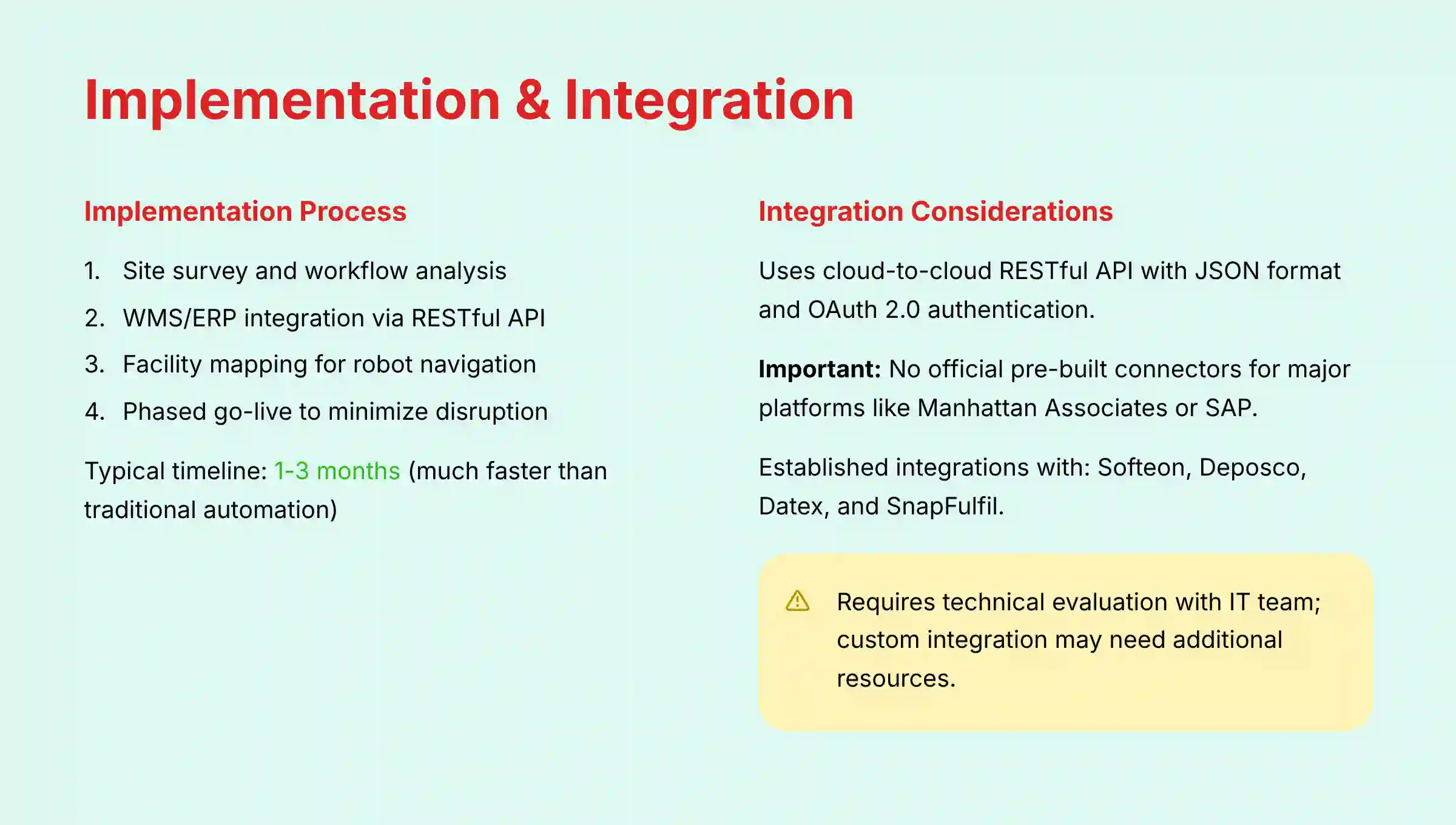
Important Note on Integration: While 6 River Systems can integrate with any WMS or ERP via its API, it's crucial to understand that there are no official pre-built connectors for major platforms like Manhattan Associates, Blue Yonder, SAP, Oracle NetSuite, or Microsoft Dynamics 365. The company does list specific WMS partners with established integrations, including Softeon, Deposco, Datex, and SnapFulfil.
Professional Recommendation: Organizations should conduct a thorough technical evaluation of integration requirements with their IT team. Building a custom integration with major ERP/WMS systems will require additional development resources and should be factored into project timelines and budgets.
Deployment Model: RaaS, Implementation, and Support
Robotics-as-a-Service (RaaS) Model
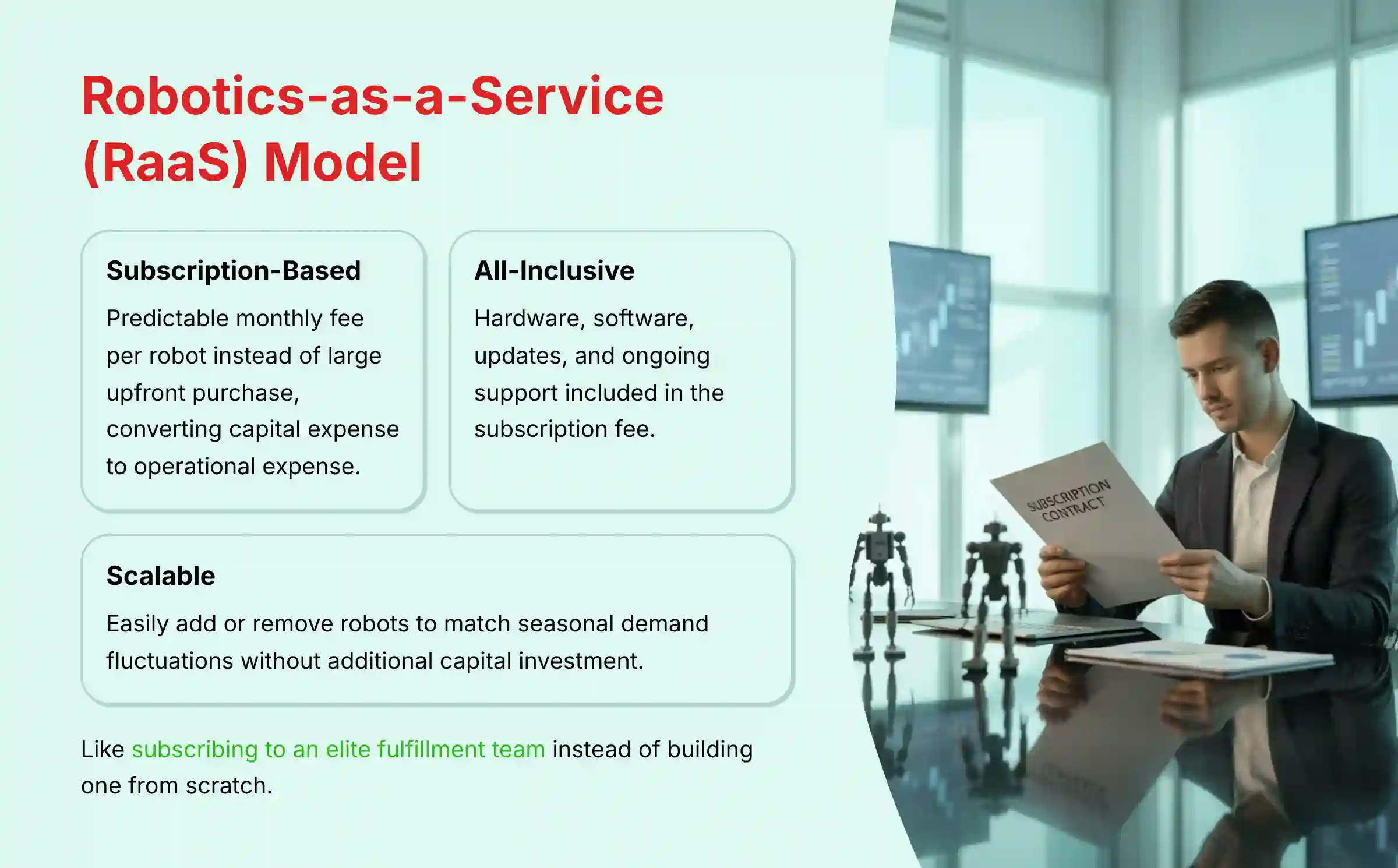
The system is offered through a subscription model called Robotics-as-a-Service (RaaS). Instead of a large upfront purchase, companies pay a predictable monthly fee per robot. This fee includes the hardware, software, updates, and ongoing support, converting a capital expense into an operational one. The RaaS model is like subscribing to an elite fulfillment team instead of building one from scratch.
Implementation Process
The implementation is managed by the vendor's team. It starts with a site survey and workflow analysis to understand your specific needs. The process continues with WMS/ERP integration, mapping the facility for the robots, and a carefully managed “go-live,” often phased by zone to minimize disruption.
For teams seeking practical guidance, our comprehensive 6 River Systems (Ocado Robotics) Tutorials and Usecase provides step-by-step implementation strategies and real-world scenarios to help organizations maximize their ROI from deployment.
Support and Maintenance
The RaaS subscription provides comprehensive support. This includes 24/7 remote monitoring of the system, a dedicated customer success manager, and all hardware maintenance. If a robot needs repair, parts and service are covered by the subscription fee, protecting you from unexpected costs.
Security, Compliance, and Operational Limitations
Data security is handled through a multi-layered approach. The system uses industry-standard protocols like OAuth 2.0 for authentication. Furthermore, all data is protected with TLS 1.2+ encryption in transit and AES-256 encryption at rest, safeguarding sensitive order and inventory information.

For professional validation, it is critical to confirm compliance certifications. We strongly recommend verifying the vendor's SOC 2 Type II report, which is an independent audit affirming that security controls are consistently effective over time—a crucial trust signal for any SaaS provider handling core operational data. For operations in specific sectors, inquire about their ability to support regulations like HIPAA for medical distribution.
As a matter of professional responsibility, any organization considering this platform must conduct its own security and compliance due diligence. The specific requirements for industries like healthcare (HIPAA) or finance are stringent. A formal security review with the vendor is a non-negotiable step in the procurement process.
For transparency, it is also important to understand the system's designed operational parameters:
- Environment: The system is designed for indoor, flat-surface warehouse environments only.
- Terrain: It is not suitable for facilities with significant inclines or highly uneven flooring.
- Payload: Operations are limited to the 200 lbs maximum payload capacity of the Chuck AMR.
What Are the Key Operational Questions About 6 River Systems?
Frequently Asked Questions (FAQ)
How Does 6 River Systems Pricing Work?
The system uses a Robotics-as-a-Service (RaaS) subscription model where you pay a monthly fee per robot under a multi-year contract. This fee is all-inclusive, covering hardware, software, 24/7 support, and all maintenance, which makes it a predictable operating expense.
How Long Does It Take to Implement 6 River Systems?
A typical implementation takes 1-3 months, which is much faster than traditional automation projects. The vendor's team manages the entire process. This includes workflow analysis, system integration, and a phased rollout that avoids major operational shutdowns.
Does the “Chuck” Robot Replace Human Workers?
No, the system is a collaborative solution designed to make human workers more productive. The “Chuck” robot handles the walking and guides the associate. This allows the person to focus on the high-value tasks of accurately picking and packing items.
How Does This System Compare to Amazon's Kiva Robots?
The main difference is the workflow model. Kiva is a “goods-to-person” system where robots bring entire shelves to a worker, while 6 River Systems is a “person-to-goods” system where the robot leads a worker through the warehouse. The 6 River model is often more flexible and requires fewer infrastructure changes.
What Are the Main Wi-Fi Requirements for the System?
The system requires a robust commercial-grade Wi-Fi network (802.11ac or better) with high coverage throughout the operational area. Strong, consistent connectivity is essential for the robots to communicate in real-time with the central cloud software.
Can Chuck Handle Products of Different Sizes and Weights?
Yes, within its specified limits. The “Chuck” AMR has a maximum payload of 200 lbs (90.7 kg). The shelving on the robot is highly configurable to hold various item sizes, totes, and cartons, making it adaptable to diverse product inventories.
What Happens if a Robot Breaks Down?
The RaaS subscription includes full hardware maintenance and support. The fleet is monitored 24/7 by the vendor. If a robot has an issue, on-site service or a replacement is provided as part of the subscription, ensuring high operational uptime.
How Does the System Ensure Picking Accuracy?
Accuracy rates of 99.9% or higher are achieved through its directed workflow. The screen on the robot shows the associate the item image, location, and quantity needed. A barcode scan is required to confirm each pick, a process that nearly eliminates human error.
For additional insights and common implementation challenges, explore our detailed 6 River Systems (Ocado Robotics) FAQs resource that addresses over 50 frequently asked questions from operations professionals.
Conclusion: Moving from Visibility to Action
Ultimately, a tool like 6 River Systems is more than an efficiency booster; it represents the shift from passive visibility to decisive action. While legacy systems show you problems, this new class of AI-driven robotics empowers you to solve them in real time. For leaders navigating the complexities of 2025, the choice is stark: continue observing the chaos or deploy the intelligence needed to command it. The advantage is there to be pressed.
Disclaimer
The information about 6 River Systems (Ocado Robotics) presented in this article reflects our thorough analysis as of 2025. Given the rapid pace of AI technology evolution in the AI for Operations & Supply Chain space, features, pricing, and specifications may change after publication. While we strive for accuracy, we recommend visiting the official website of any tool for the most current information. Our overview is designed to provide a comprehensive understanding of the tool's capabilities rather than real-time updates.
Before implementing any warehouse automation solution, we strongly recommend conducting a professional RF (Radio Frequency) survey of your facility by a qualified network engineering firm. This will identify dead zones, interference, and capacity limitations in your existing network. The cost of upgrading wireless infrastructure must be factored into your total project budget, as relying on a standard office-grade Wi-Fi network is a common point of failure for AMR deployments.

Leave a Reply