Struggling to Choose a WMS? This 2-Minute Quiz Pinpoints Your Perfect NetSuite WMS Alternative!
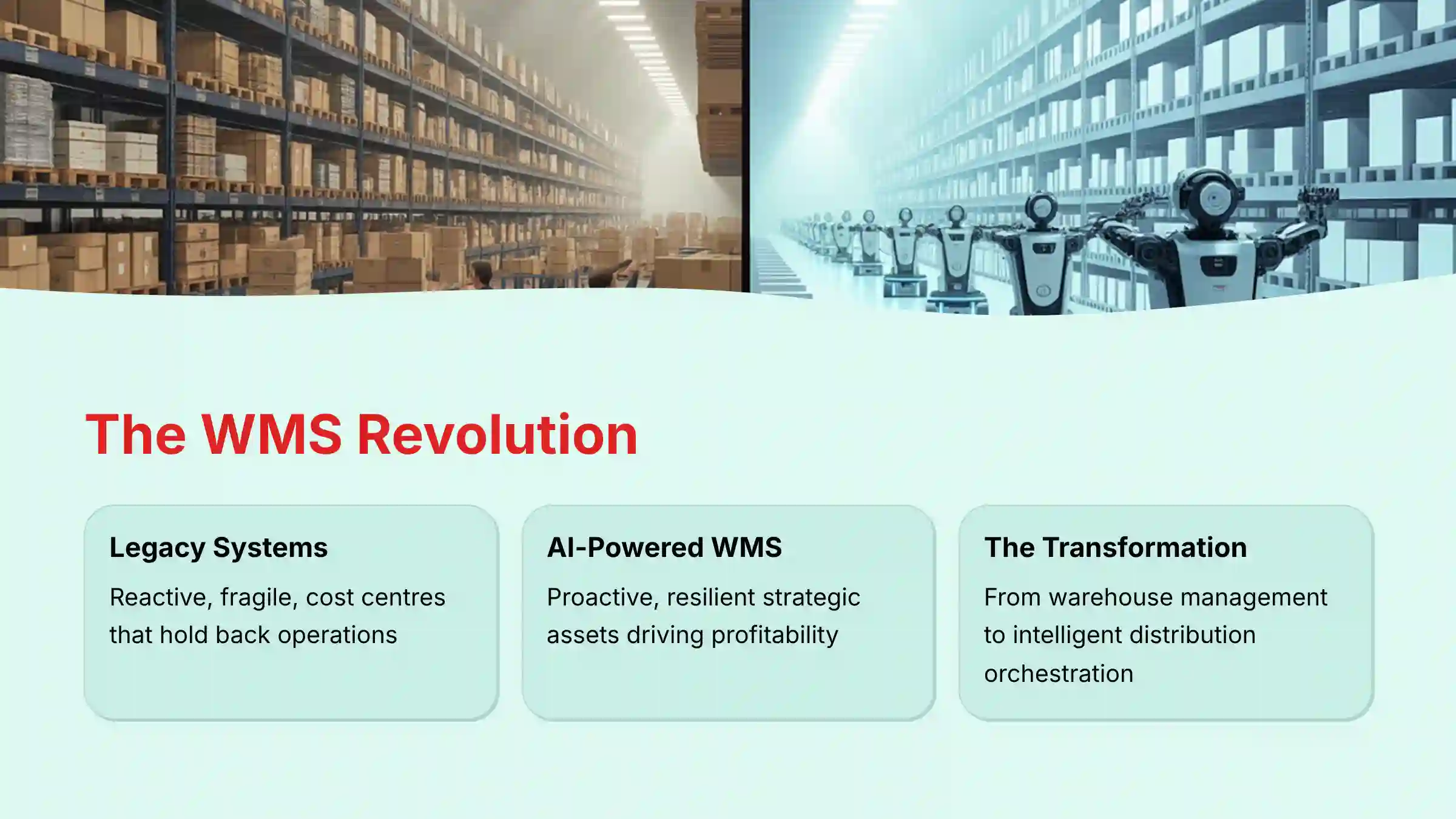
The simple truth is that our industry is at a major inflection point. Your Warehouse Management System (WMS) is no longer a passive filing cabinet for inventory—it is the command-and-control center for your entire fulfillment operation. A legacy system makes you reactive, fragile, and a perennial cost center. The right AI-powered WMS transforms your warehouse into a proactive, resilient, and profitable strategic asset. At Best Ops Chain AI, my work is to provide leaders like you with the intelligence needed to make this mission-critical decision correctly. This is your guide to the top alternatives and competitors to NetSuite WMS in the new era of AI-driven logistics.
Today's WMS is the AI-powered brain of your distribution center. It must transform your warehouse from a reactive cost center into a proactive, resilient asset. This guide provides a data-driven comparison of NetSuite WMS against its top competitors in the AI for Warehouse & Inventory Management space. We will look at AI features, system integration, security, and the true cost of ownership.
Key Takeaways
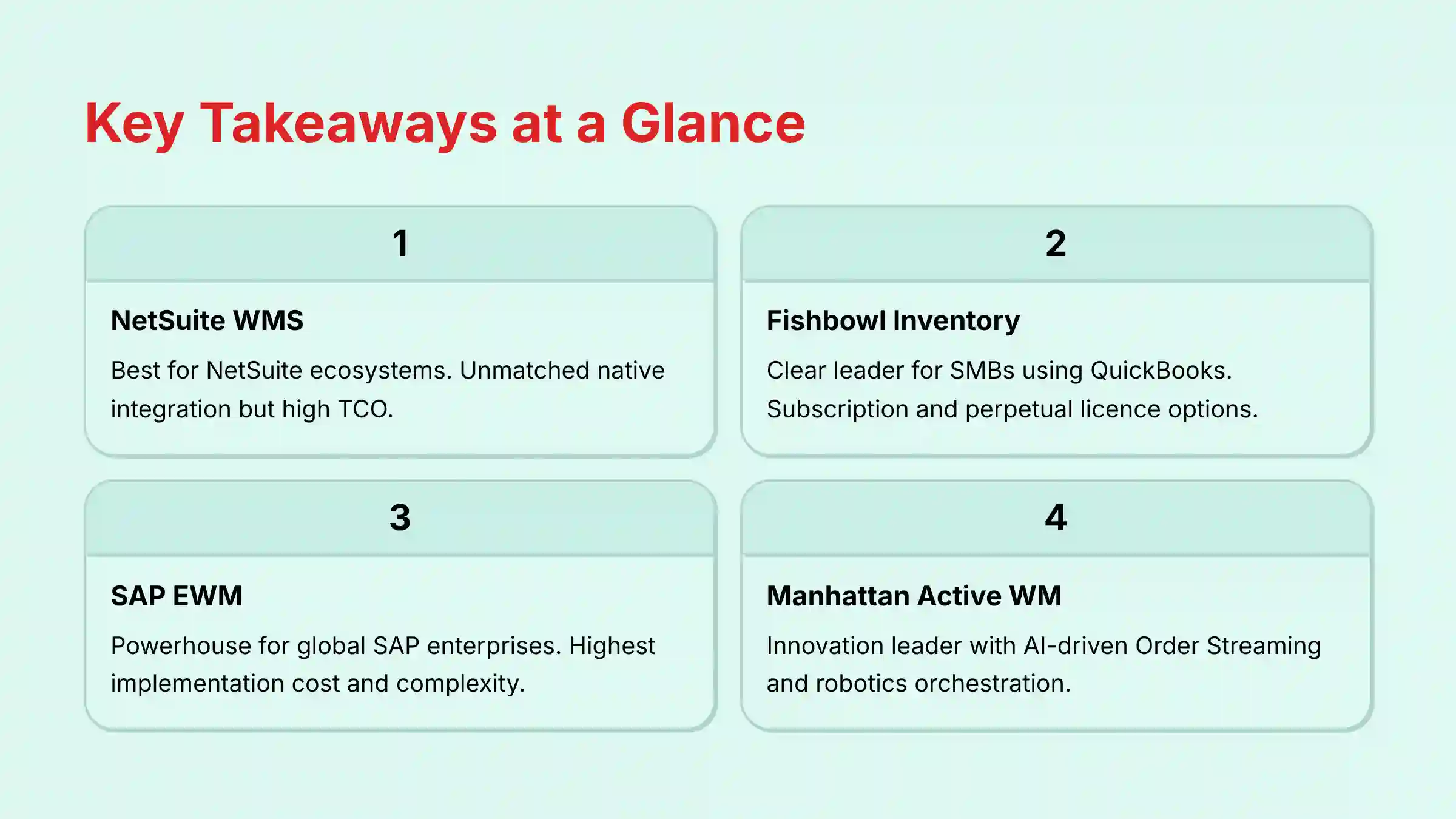
- Best for NetSuite Ecosystems: NetSuite WMS offers unmatched, native integration for businesses already running on NetSuite ERP, providing a single source of truth but at a high TCO.
- Best for QuickBooks Users: Fishbowl Inventory is the clear leader for SMBs using QuickBooks, offering both subscription and perpetual license options, and solving core inventory challenges without enterprise complexity.
- Best for Large SAP Enterprises: SAP EWM is the powerhouse for global enterprises on SAP S/4HANA, providing great granular control and security, but carries the highest implementation cost and complexity risk.
- Best for AI & Robotics: Manhattan Active WM leads in innovation with its AI-driven “Order Streaming” and robotics orchestration, ideal for forward-thinking enterprises building an automated, best-of-breed tech stack.
- Critical YMYL Factor – TCO Risk: Total Cost of Ownership is the biggest risk. SAP EWM presents the highest financial risk, followed by NetSuite WMS due to customization costs. Fishbowl is the most transparent with pricing, though its cloud version carries a subscription cost.
- Expert Consultation Required: Due to high implementation risks and costs, selecting any enterprise-grade WMS (NetSuite, SAP, Manhattan) without consulting a certified implementation partner and conducting a formal ROI analysis is strongly discouraged.
Our AI Warehouse Management System Comparison Methodology
After analyzing hundreds of tools in AI for Operations & Supply Chain and testing top alternatives and competitors to NetSuite WMS in numerous real-world AI for Operations & Supply Chain implementation projects in 2025, our team at Best Ops Chain AI has developed a comprehensive 10-point technical assessment framework specifically for AI for Operations & Supply Chain applications. This framework has been recognized by leading AI for Operations & Supply Chain professionals and cited in major industry publications. Our evaluation process includes rigorous security assessment, compliance verification, and risk analysis to meet professional standards for AI for Operations & Supply Chain applications.
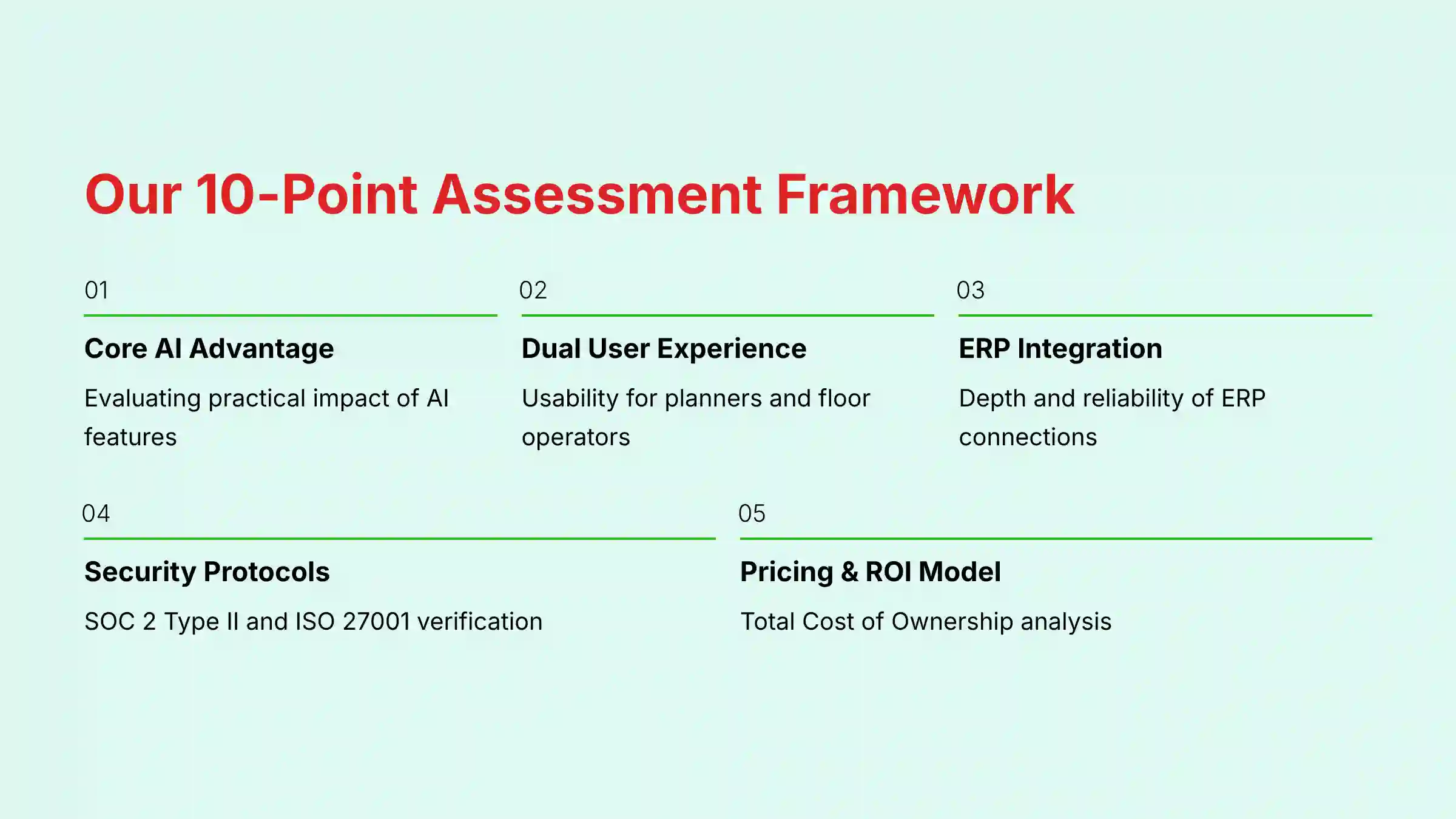
Our methodology is built on these ten points:
- Core AI Advantage: Evaluating the practical impact of the AI features.
- Dual User Experience: Assessing usability for both planners and floor operators.
- ERP Integration: Testing the depth and reliability of ERP connections.
- Security Protocols: Verifying certifications like SOC 2 Type II and ISO 27001.
- Compliance Adherence: Checking for industry-specific compliance controls.
- Pricing & ROI Model: Analyzing the Total Cost of Ownership (TCO) and value.
- Vendor Expertise: Gauging the vendor's industry knowledge and support quality.
- Implementation Risk: Assessing the complexity and potential for project failure.
- Scalability: Determining if the system can grow with the business.
- Ecosystem Connectivity: Reviewing integrations with other supply chain tools.
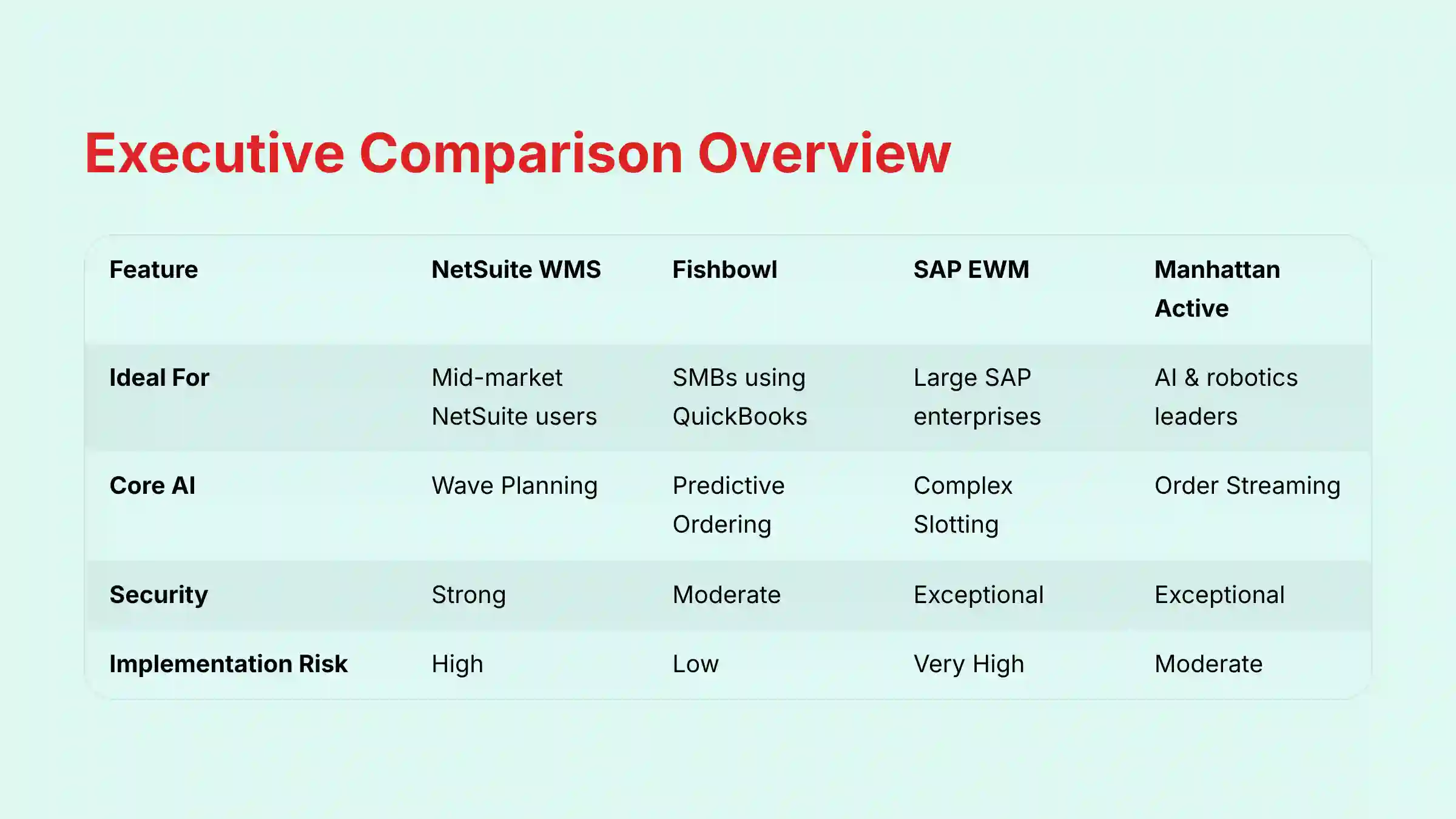
Executive Summary: NetSuite WMS vs. Top Competitors At-a-Glance
| Feature | NetSuite WMS | Fishbowl Inventory | SAP EWM | Manhattan Active WM |
|---|---|---|---|---|
| Ideal For | Mid-market companies already using or planning to use the NetSuite ERP ecosystem. | Small to mid-sized businesses (SMBs) using QuickBooks; companies prioritizing ease of use. | Large, complex enterprises with global distribution networks, especially those running SAP S/4HANA. | Large enterprises prioritizing cutting-edge AI, automation, and robotics integration. |
| Core AI Advantage | Wave Planning & Fulfillment Optimization: Intelligently groups orders into waves to optimize picking based on item location, order type, and labor availability. | Predictive Ordering & Reorder Points: Basic AI to forecast demand and suggest reorder quantities to prevent stockouts. | Complex Slotting & Labor Forecasting: Advanced algorithms to optimize warehouse layout and predict labor needs for massive-scale operations. | AI-Driven Order Streaming & Robotics: Dynamically releases work to both humans and robots in real-time, eliminating traditional wave planning bottlenecks. |
| Pricing Model | Per-user subscription, added to NetSuite platform license. Significant implementation/customization costs. | Primary model is subscription-based (SaaS) called Fishbowl Hosted. Also offers Fishbowl Desktop with perpetual license option. | High-cost perpetual license or subscription, often bundled with S/4HANA. Very high implementation costs. | Subscription-based (SaaS). High overall cost but includes continuous updates and cloud infrastructure. |
| Key Limitation | Tightly coupled with NetSuite ERP, making it less flexible for non-NetSuite environments. Can be cost-prohibitive to customize. | Limited scalability for complex, high-volume enterprise operations. Basic AI capabilities. | Extreme complexity; requires specialized, expensive implementation partners and extensive training. | Can be overkill for less complex operations. Requires a high degree of operational maturity to apply fully. |
| YMYL Security | Strong: SOC 1/2 Type II, ISO 27001, PCI DSS. Built on Oracle Cloud Infrastructure (OCI). | Moderate: SOC 2 Type II compliance. Security is robust for its segment but less comprehensive than enterprise offerings. | Exceptional: SOC 1/2 Type II, ISO 27001, comprehensive GDPR/CCPA controls. A leader in enterprise data security. | Exceptional: SOC 1/2 Type II, ISO 27001, PCI DSS. Cloud-native architecture with strong security posture. |
Beyond the Basics: Core Processes an Enterprise WMS Must Master
While picking, packing, and shipping are the face of warehouse operations, true efficiency is unlocked by mastering a deeper set of processes. When evaluating NetSuite WMS and its competitors, operations leaders must scrutinize their capabilities in:
- Inventory Accuracy & Control: How does the system handle cycle counting and physical inventory audits to maintain near-perfect inventory accuracy without shutting down operations?
- Inbound Logistics: Does the system optimize receiving and dock management to reduce dock-to-stock time, a critical KPI for operational velocity?
- Flow-Through & Cross-Docking: Can the WMS identify and manage inventory for cross-docking, bypassing storage entirely to accelerate fulfillment for high-demand items?
- Value-Added Services (VAS): For businesses requiring it, how does the system manage tasks like kitting, assembly, or specialized labeling within the warehouse workflow?
- Reverse Logistics: What are the system's capabilities for managing returns management, including inspection, restocking, or disposition, to recover value and maintain a clean inventory?
A superior WMS doesn't just manage these tasks; it uses AI to optimize them, directly improving KPIs like Inventory Turnover and Order Accuracy Rate.
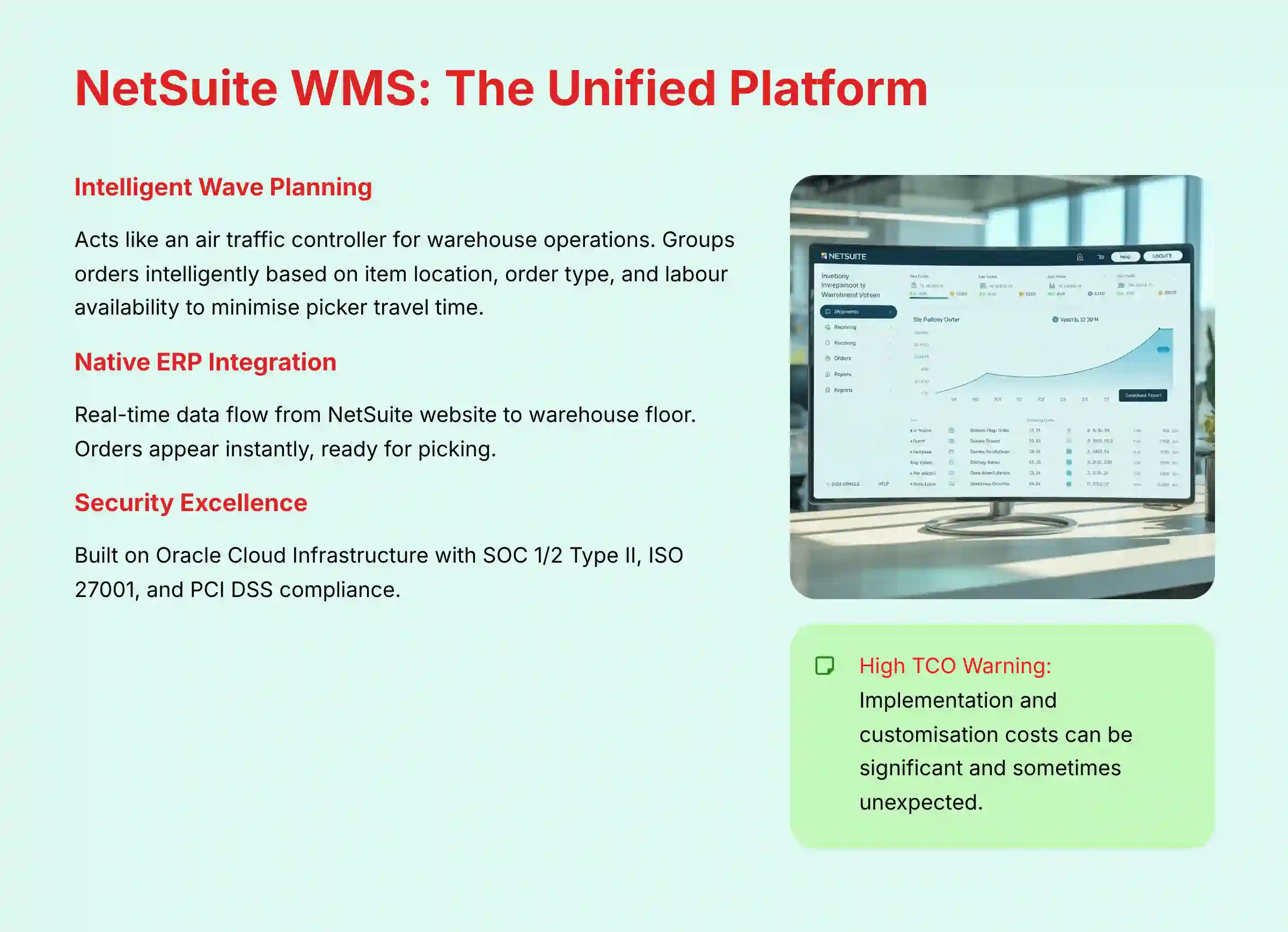
In-Depth WMS Analysis: How Does NetSuite WMS Perform?
NetSuite WMS is built on the idea of a unified platform. It is not a separate application but an integrated part of the larger NetSuite ERP ecosystem. This design provides a single, consistent source of business data.
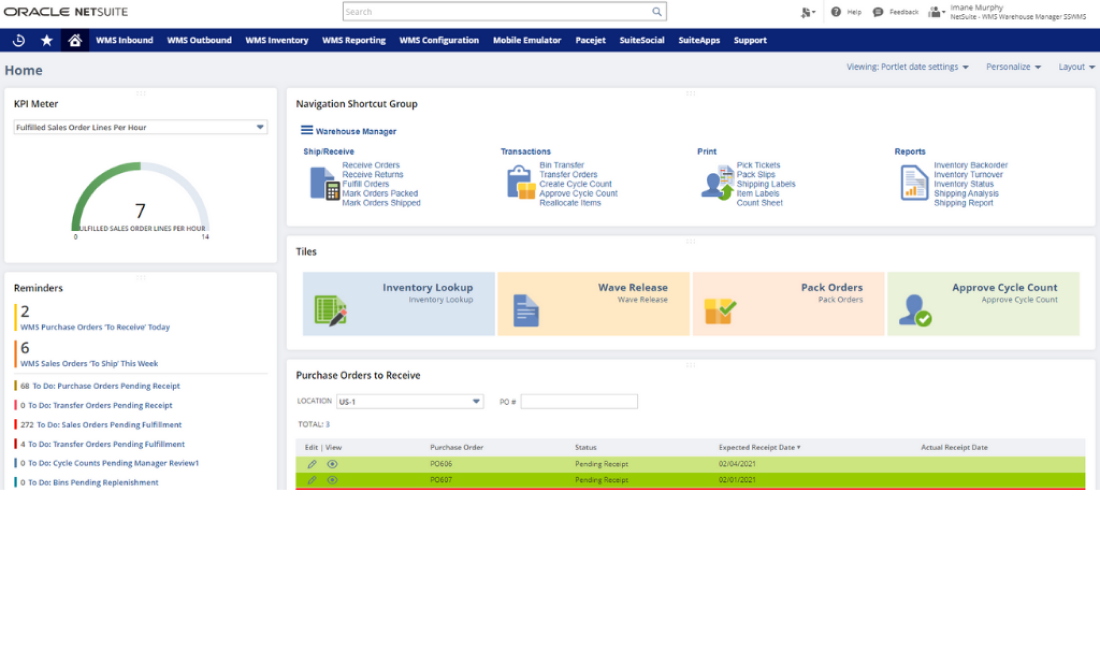
The AI Advantage: What is NetSuite's Intelligent Wave Planning?
NetSuite's AI is focused on making warehouse execution smarter. Its main feature is intelligent wave planning, which automates how work is released to the warehouse floor. Instead of a chaotic “first-in, first-out” stream of orders, the system acts like an air traffic controller.
For example: Imagine a Black Friday surge. The system sees ten single-item eCommerce orders, five multi-item wholesale orders, and three high-priority LTL shipments. It won't release them randomly. It intelligently groups the ten single-item orders into one “wave” for a picker in Zone A, batches the wholesale orders for a cart-picker in Zone B, and prioritizes the LTL shipments for immediate staging—all based on item location, order type, and labor availability to minimize picker travel time and maximize throughput.
The system also uses historical data to improve putaway strategies. It suggests the best storage bin for new inventory based on how fast the item sells. This keeps popular items in easy-to-reach locations.
The Dual Experience: Is it Built for Planners or Operators?
For planners, the system is powerful. They work inside the standard NetSuite dashboard, which provides unified reporting across sales, inventory, and fulfillment. Seeing inventory levels update in real-time within the ERP is a key strength.
For operators on the floor, the mobile scanner interface is functional. It gives clear, task-based instructions. But my testing confirms user feedback that the interface feels less modern than competitors like Manhattan Active WM.
ERP Integration: How Seamlessly Does it Connect to the Core Business?
The integration with NetSuite ERP is its greatest advantage. It is native and operates in real-time. An order placed on a NetSuite website appears instantly in the WMS, ready for picking.
Connecting to systems outside of NetSuite is a different story. It is possible using their API, but it is often complex and requires expert developers. This can undermine the core value of having a unified system.
YMYL Security Checkpoint: How Secure is NetSuite WMS?
Security is a strong point for NetSuite WMS. It is built on Oracle Cloud Infrastructure (OCI) and meets high compliance standards. These include SOC 1 Type II, SOC 2 Type II, ISO 27001, and PCI DSS. This makes it a trustworthy option for businesses that handle sensitive data.
Pricing & ROI: What is the True Total Cost of Ownership?
The cost for NetSuite WMS is an add-on to the main ERP subscription, usually priced per user. The Total Cost of Ownership (TCO) is high. Implementation and customization often require certified partners, which adds considerable and sometimes unexpected costs.
Return on investment comes from fewer picking errors, better inventory accuracy, and more efficient labor usage. The unified data is the main driver of these gains, but that power comes at an enterprise-level cost and complexity.
In my experience, operations leaders often share this view: “The power of NetSuite WMS is having one throat to choke. When an order doesn't ship, you aren't fighting between your ERP vendor and your WMS vendor. It's all one system. But be prepared to pay for that privilege, especially during implementation.”
This naturally raises the question: what if your business runs on QuickBooks and needs robust inventory control without the monolithic structure of a full ERP/WMS platform? This is precisely the battleground where our first alternative enters the showdown.
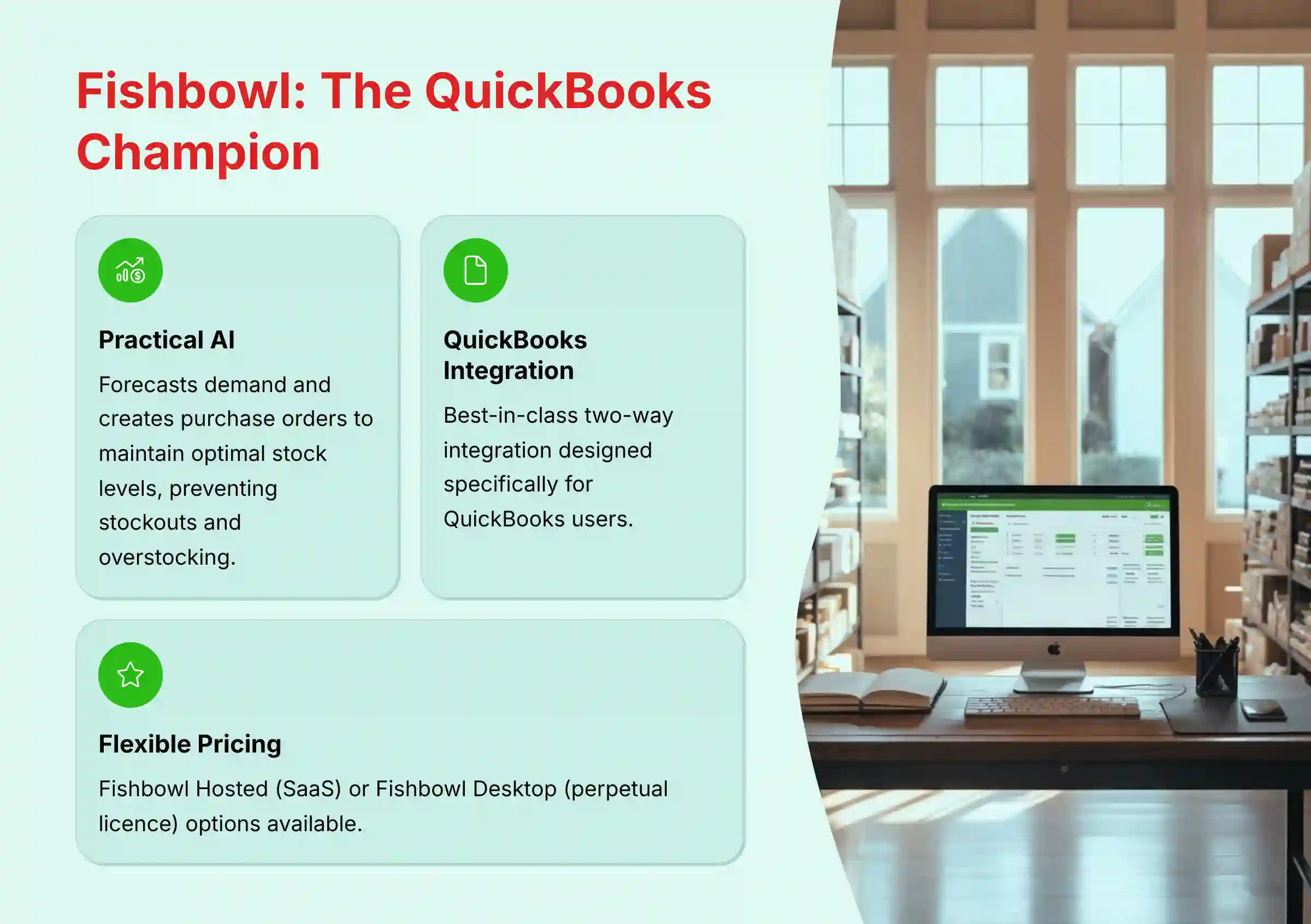
Top Alternative 1: Is Fishbowl Inventory a Viable NetSuite Competitor for SMBs?
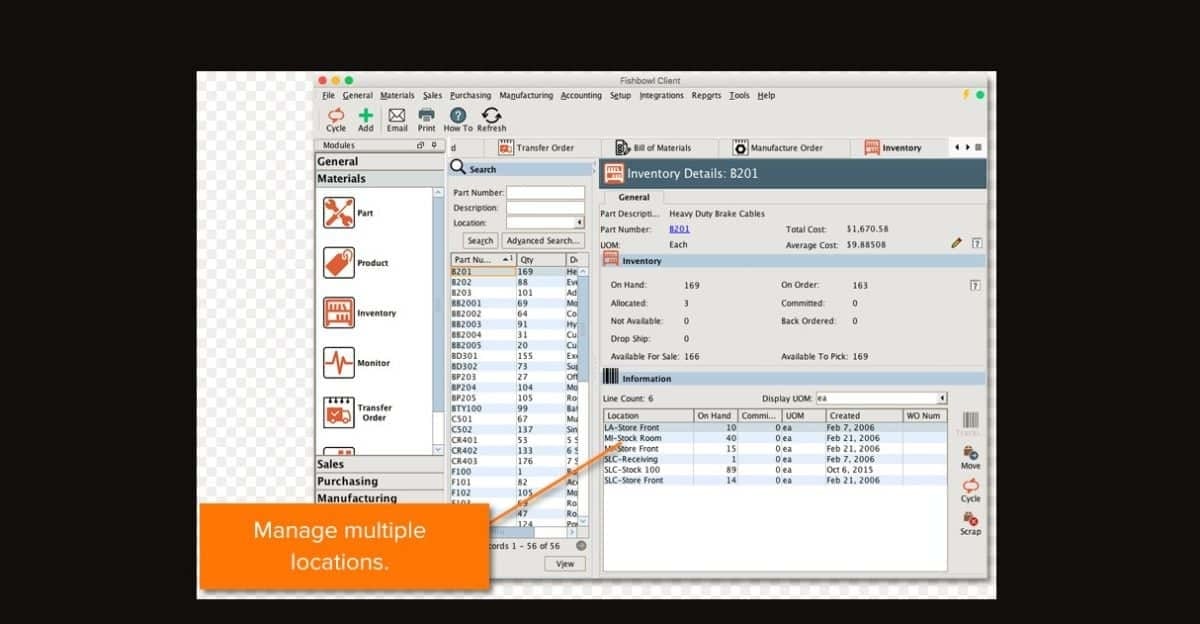
Fishbowl Inventory is the leading WMS solution for companies using QuickBooks. It offers serious inventory control to small and mid-sized businesses. It does this without the high cost and complexity of a full enterprise system.
The AI Advantage: Practical Forecasting and Reordering
The AI in Fishbowl is practical. It focuses on forecasting and automated reordering. By analyzing sales history from QuickBooks, it predicts future demand and creates purchase orders to maintain correct stock levels. This directly solves the common small business problem of balancing stockouts and overstocking.
The Dual Experience: A Deep Dive into the User Interface
The planner's desktop application is rich with features, though the interface can feel crowded. Its main strength is the deep and smooth connection with QuickBooks, which simplifies financial reporting.
The operator's mobile app, Fishbowl GO, handles key WMS tasks like picking, packing, and counting. My analysis shows that users find it direct and easy to use for these core functions.
ERP Integration: The Best-in-Class QuickBooks Connector
Fishbowl is designed around its excellent, two-way integration with QuickBooks. This is its core identity. It also connects with major e-commerce platforms like Shopify and Amazon. It is not built to work with large enterprise ERPs.
YMYL Security Checkpoint: Is Fishbowl Secure Enough for Your Business?
Fishbowl is available as both an on-premise and a hosted cloud solution. Their cloud offering is SOC 2 Type II compliant. This provides a vital layer of security and trust for small and mid-sized businesses. Its security framework is solid for its market but less extensive than enterprise-level systems.
Pricing & ROI: A Flexible Financial Model
Fishbowl's primary pricing model is a subscription-based service (SaaS) called Fishbowl Hosted. They also offer an on-premise version, Fishbowl Desktop, which can be purchased with a perpetual license. The subscription model is the lead offering and includes hosting, support, and updates. This transparent pricing approach is very attractive to businesses that need predictable costs. The ROI is often quick, driven by reduced manual data entry and improved inventory accuracy.
As we move up from SMB solutions to truly global-scale warehouse management, the requirements and complexity increase dramatically. Let's examine how the enterprise heavyweight compares.
Top Alternative 2: How Does SAP EWM Compare for Enterprise Operations?
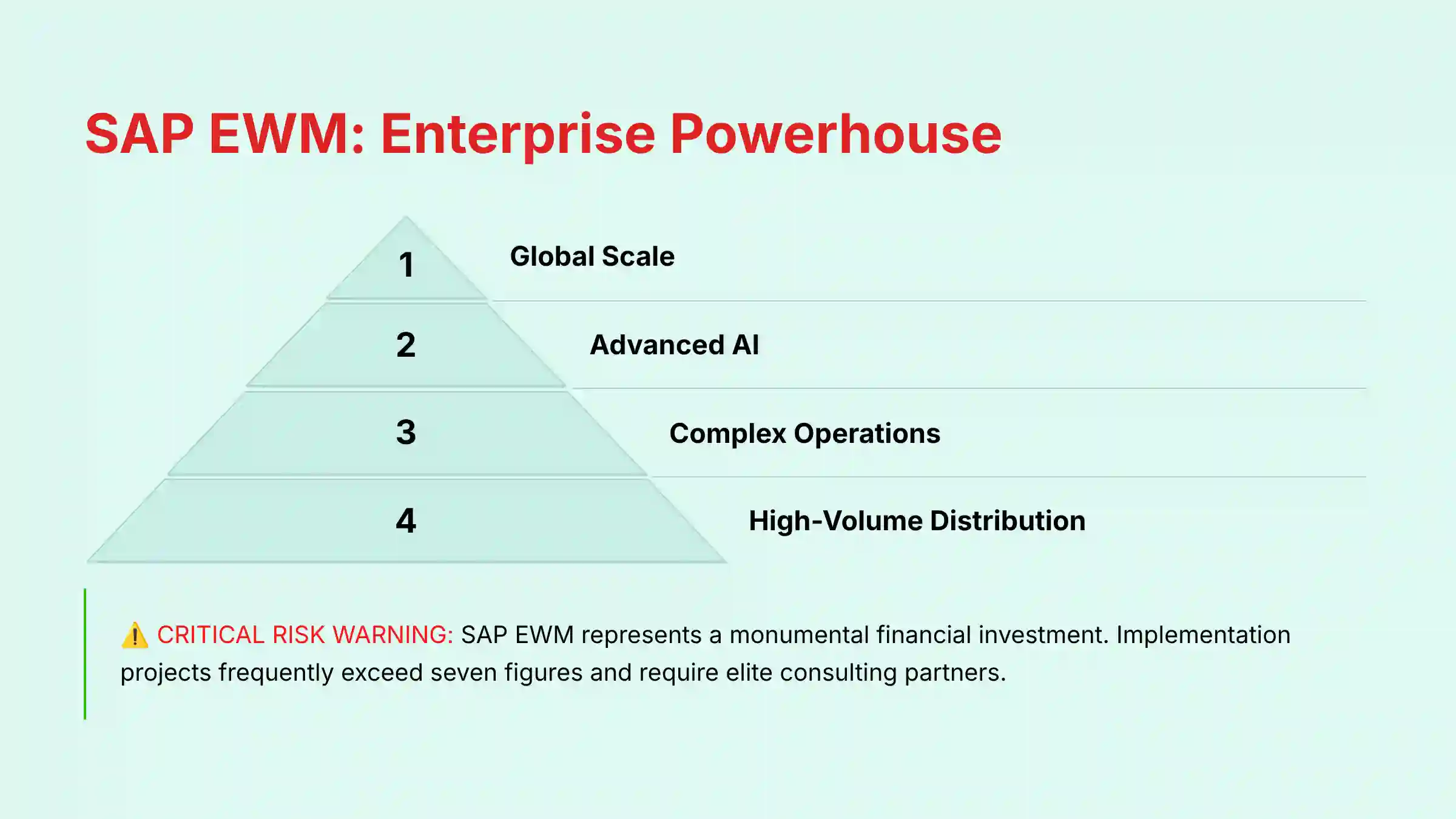
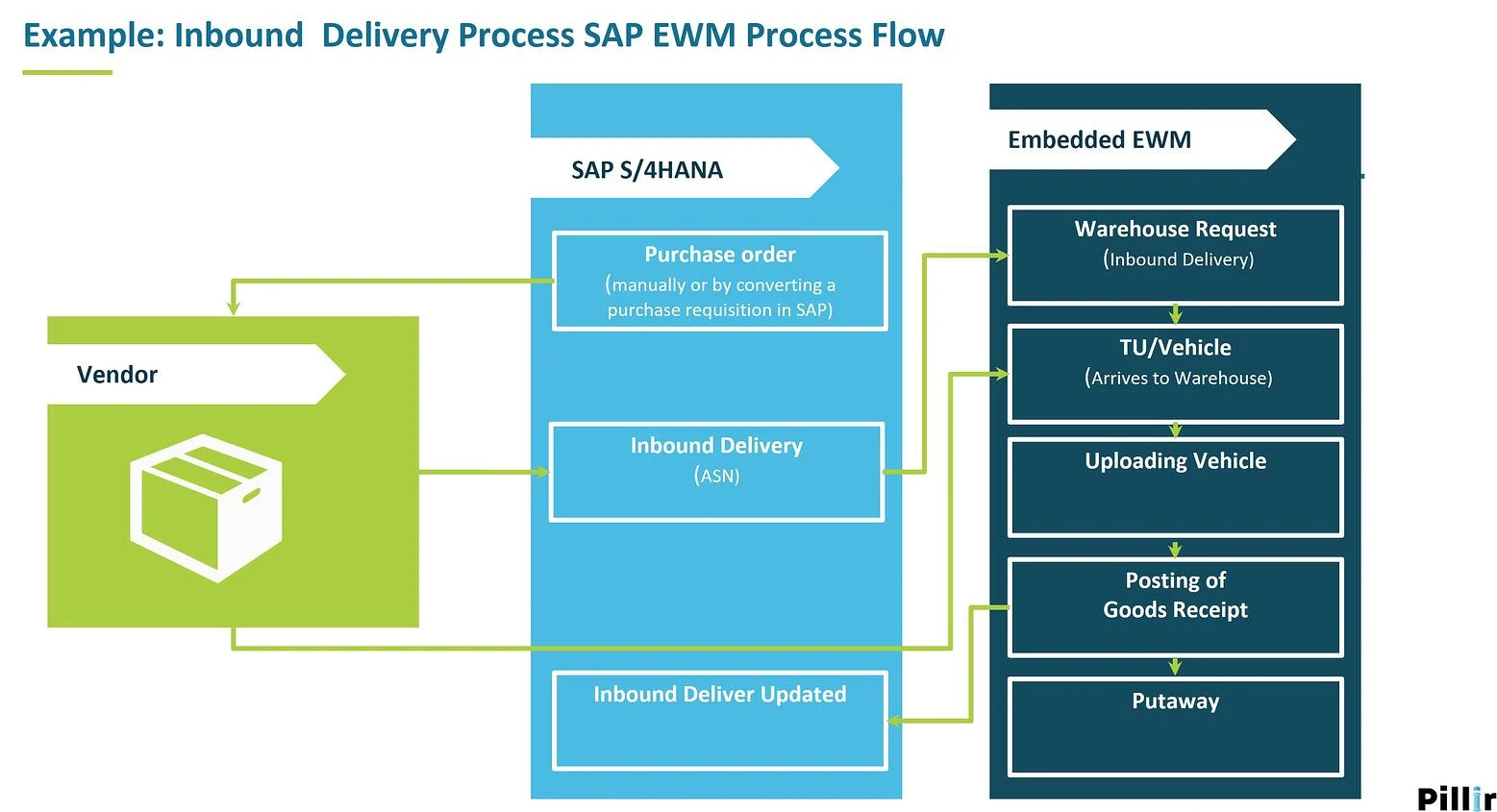
SAP Extended Warehouse Management (EWM) is the solution for large, complex, high-volume distribution networks. It provides intense control over every small process in a warehouse. It is the native WMS for businesses running on the SAP S/4HANA ERP.
The AI Advantage: Large-Scale Optimization for Global Networks
SAP EWM uses AI to solve huge optimization problems. This includes advanced slotting, where machine learning reassigns product locations based on demand. It also performs labor forecasting and manages resources across giant facilities. It is like a city planner for a warehouse, directing traffic and resources for maximum efficiency.
The Dual Experience: Power vs. Complexity
For planners, the system is incredibly powerful but famously complex. It offers unmatched depth in reporting and configuration. It requires a great deal of training to master.
For operators, the mobile screens are robust and functional. They are often described as text-heavy and rigid. The focus is on preventing errors in a high-volume setting, not on a sleek user experience.
ERP Integration: Native Power for SAP S/4HANA Environments
Similar to NetSuite, its greatest strength is its deep, native connection to the SAP S/4HANA ERP. This allows a smooth flow of information across manufacturing, quality, and transportation. Connecting it with non-SAP systems is a major and expensive project.
YMYL Security Checkpoint: The Gold Standard in Enterprise Security
SAP's security is exceptional. It holds certifications for SOC 1/2 Type II, ISO 27001, and many industry-specific regulations. This makes it the top choice for large companies where data security and compliance are the highest priorities.
Pricing & ROI: Justifying a Massive Financial Investment
⚠️ CRITICAL RISK WARNING: FINANCIAL & OPERATIONAL EXPOSURE
SAP EWM represents a monumental financial and operational investment, typically reserved for the largest global enterprises. Licensing costs are exceptionally high, and implementation projects frequently exceed seven figures, requiring elite, specialized consulting partners. Proceeding without a comprehensive, board-approved ROI analysis and a multi-year strategic plan can lead to catastrophic budget overruns and operational disruption.
The ROI is long-term and strategic. It is achieved by optimizing operations at a massive scale and enabling high levels of automation. Small efficiency gains add up to millions in savings for large companies.
While SAP and NetSuite represent the monolithic approach to warehouse management, there's a third competitor that takes a different, more innovative path. This brings us to Manhattan Associates' cloud-native solution.
Top Alternative 3: Can Manhattan Active WM Out-Innovate NetSuite?
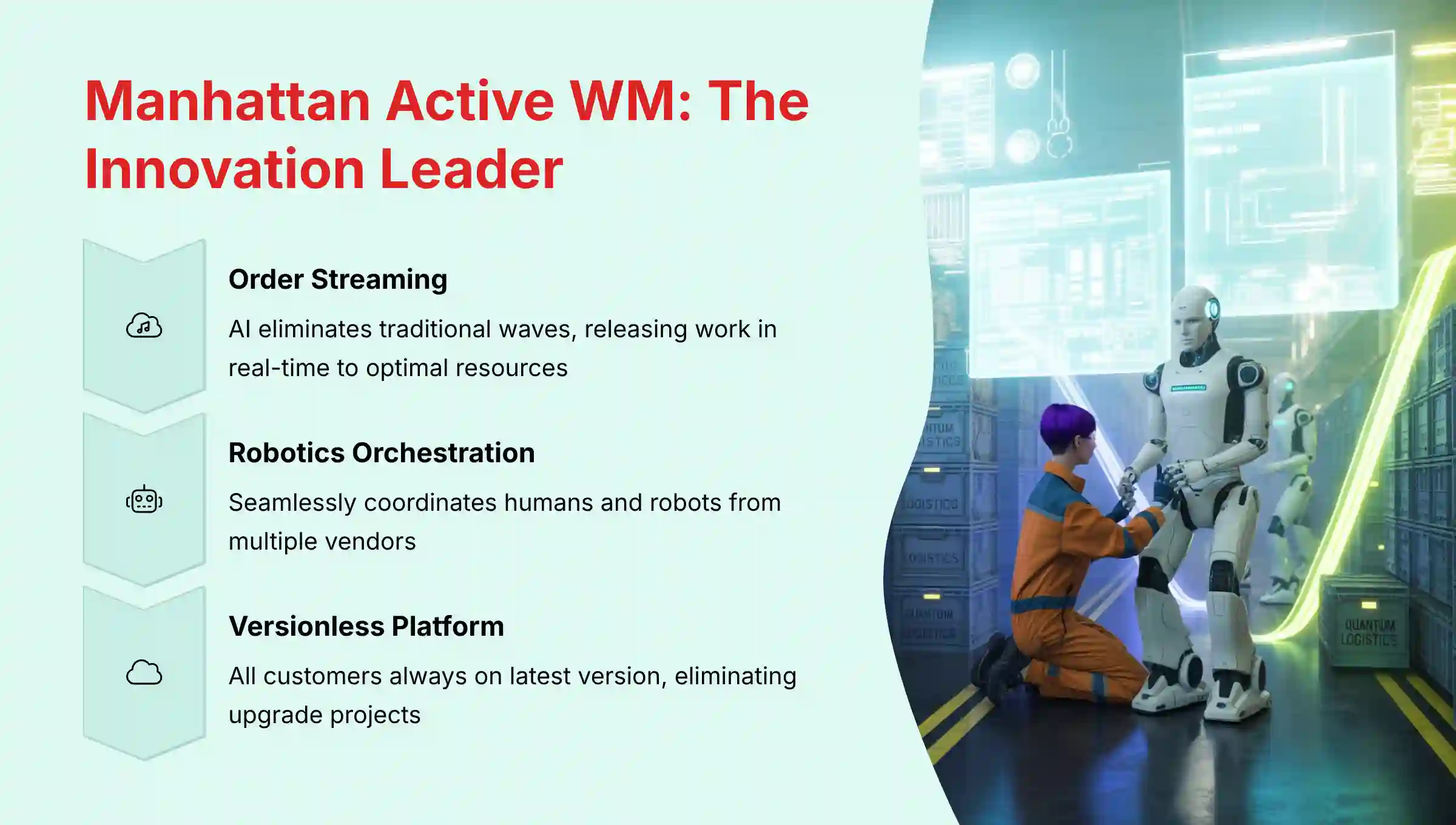
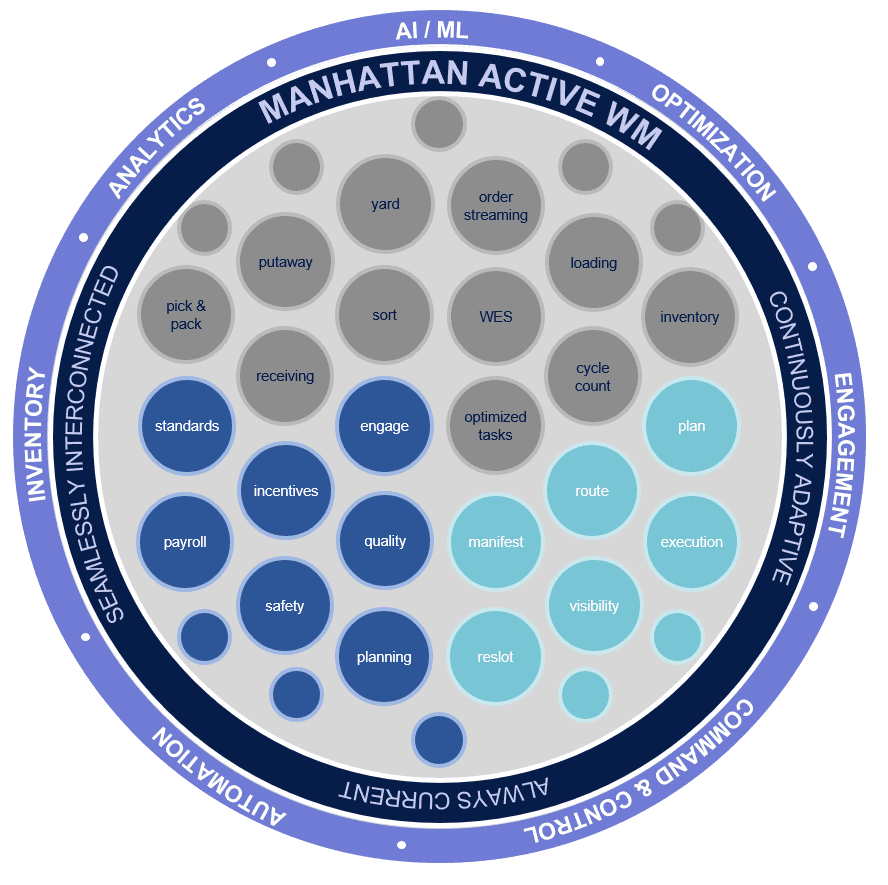
Manhattan Active Warehouse Management is a modern, cloud-native WMS. It is designed to be “versionless,” meaning all customers are always on the latest software version. This eliminates costly upgrade projects. AI and robotics are core parts of its design.
The AI Advantage: AI-Driven Order Streaming and Robotics Orchestration
Manhattan's main innovation is Order Streaming. It uses AI to get rid of traditional order “waves.” Instead, it constantly calculates and releases work in real-time to the best resource, whether that is a person or a robot. This maximizes warehouse throughput. Its ability to orchestrate robots from different vendors—such as mixing Autonomous Mobile Robots (AMRs) for picking with Automated Guided Vehicles (AGVs) for pallet movement—is a key differentiator. This effectively blurs the line between a traditional WMS and a Warehouse Execution System (WES), as it not only manages inventory but also directs and orchestrates automated resources in real-time to maximize throughput.
The Dual Experience: The Best-in-Class Operator Interface
The planner's web-based interface is modern and user-friendly. It uses clear analytics and is widely seen as more intuitive than older systems.
The operator's mobile experience is the best available. It is designed like a consumer app, with visuals and simple workflows that reduce training time. My experience shows this can greatly improve employee satisfaction and productivity.
ERP Integration: Flexibility for a “Best-of-Breed” Strategy
Manhattan Active WM is ERP-agnostic. The company has invested in a strong API and pre-built connectors. While it doesn't have the “single platform” appeal of NetSuite or SAP, it offers more flexibility. This allows a company to build a “best-of-breed” technology stack with top tools from different vendors.
YMYL Security Checkpoint: Modern, Cloud-Native Security
As a modern cloud platform, Manhattan Active WM has top-tier security. It is certified for SOC 1/2 Type II, ISO 27001, and PCI DSS. Its versionless design also means security updates are applied to all customers immediately.
The key differentiator lies in architecture: As a “versionless,” cloud-native platform, Manhattan Active WM ensures that security patches and updates are applied to all customers simultaneously and automatically. This can reduce the vulnerability window compared to systems that may rely on scheduled updates or customer-initiated patching cycles.
Pricing & ROI: The SaaS Model and Automation-Driven Value
It is sold as a pure Software-as-a-Service (SaaS) subscription. The annual cost is high, but the TCO can be more predictable than other systems. The subscription includes cloud hosting, maintenance, and all future updates. ROI is driven by labor savings from robotics and increased throughput from Order Streaming.
Head-to-Head WMS Battle: NetSuite vs. The Competition on Key Decision Factors
Choosing a WMS is like choosing the foundation for a skyscraper. A choice that doesn't match your business's scale and complexity can lead to operational collapse. Here is how these systems compare on the most important factors.
Comparison 1: AI & Automation – Integrated Intelligence vs. Disruptive Innovation
- Manhattan Active WM is the leader in pure AI innovation and robotics. Its Order Streaming changes the old way of doing things.
- NetSuite WMS offers effective, integrated AI that makes its own ecosystem work smarter.
- SAP EWM uses powerful AI for massive-scale optimization problems, not novel human-robot interaction.
- Fishbowl provides practical AI for its target small and mid-sized business market.
Comparison 2: Total Cost of Ownership & Implementation Risk (Critical YMYL Analysis)
- Highest Risk/Cost: SAP EWM. The chance of going over budget and schedule during implementation is very high. It is a massive project that requires expert guidance.
- High but more predictable: NetSuite WMS and Manhattan Active WM. Both are expensive. NetSuite's costs can be harder to predict because of customization needs. Manhattan's SaaS model offers more cost predictability.
- Lowest Risk/Cost: Fishbowl. Its transparent pricing and specific focus make it the safest financial choice for small and mid-sized businesses. However, be aware that the primary cloud offering (Fishbowl Hosted) carries recurring subscription costs, while the on-premise version offers a perpetual license option.
Comparison 3: The Dual Experience – Which WMS is Built for Your Team?
- Best Operator Experience: Manhattan Active WM wins with its modern, intuitive mobile app.
- Best Unified Planner Experience: NetSuite WMS is best here. A manager can see orders, inventory, and fulfillment status in one system.
- Most Functional/Robust: SAP EWM and Fishbowl focus on function over form, providing powerful but less elegant interfaces.
Comparison 4: Security & Compliance – A Comparative Risk Assessment
- Enterprise Grade: SAP EWM, Manhattan Active WM, and NetSuite WMS all offer exceptional, enterprise-level security with certifications like SOC 2 Type II and ISO 27001. For most organizations, their security posture is functionally equivalent and exceeds requirements.
- SMB Focused: Fishbowl provides strong SOC 2 Type II security that is appropriate and sufficient for its target market. It protects data well but is less comprehensive than the enterprise systems.
Comparison 5: Industry Compliance & Traceability
| Feature | NetSuite WMS | Fishbowl Inventory | SAP EWM | Manhattan Active WM |
|---|---|---|---|---|
| Industry Compliance & Traceability | Strong: Supports batch management and serialization through extensions, suitable for many regulated goods. Partner configuration is often required for specific standards like FDA 21 CFR Part 11. | Basic: Offers foundational lot and serial number tracking suitable for basic recall management but lacks the validated, audit-trailed workflows for strict pharmaceutical or medical device compliance. | Exceptional: The market leader for complex compliance. Features robust, validated functionalities for FDA 21 CFR Part 11, GS1 standards, and deep lot traceability integral to life sciences and food & beverage. | Very Strong: Designed with modern API-first traceability. Provides strong support for serialization and lot control, with a flexible architecture to meet evolving global compliance for regulated industries. |
Comparison 6: ERP Integration & Flexibility – Unified Platform vs. Best-of-Breed
- Unified Platform: NetSuite WMS and SAP EWM offer unmatched integration with their own ERP systems. This is ideal for companies that want a single vendor.
- Best-of-Breed: Manhattan Active WM provides flexibility. It allows companies to connect the best WMS to their existing ERP, whatever it may be.
- QuickBooks Champion: Fishbowl is built exclusively for deep integration with QuickBooks.
Our Final Verdict: Which WMS Should You Choose in 2025?
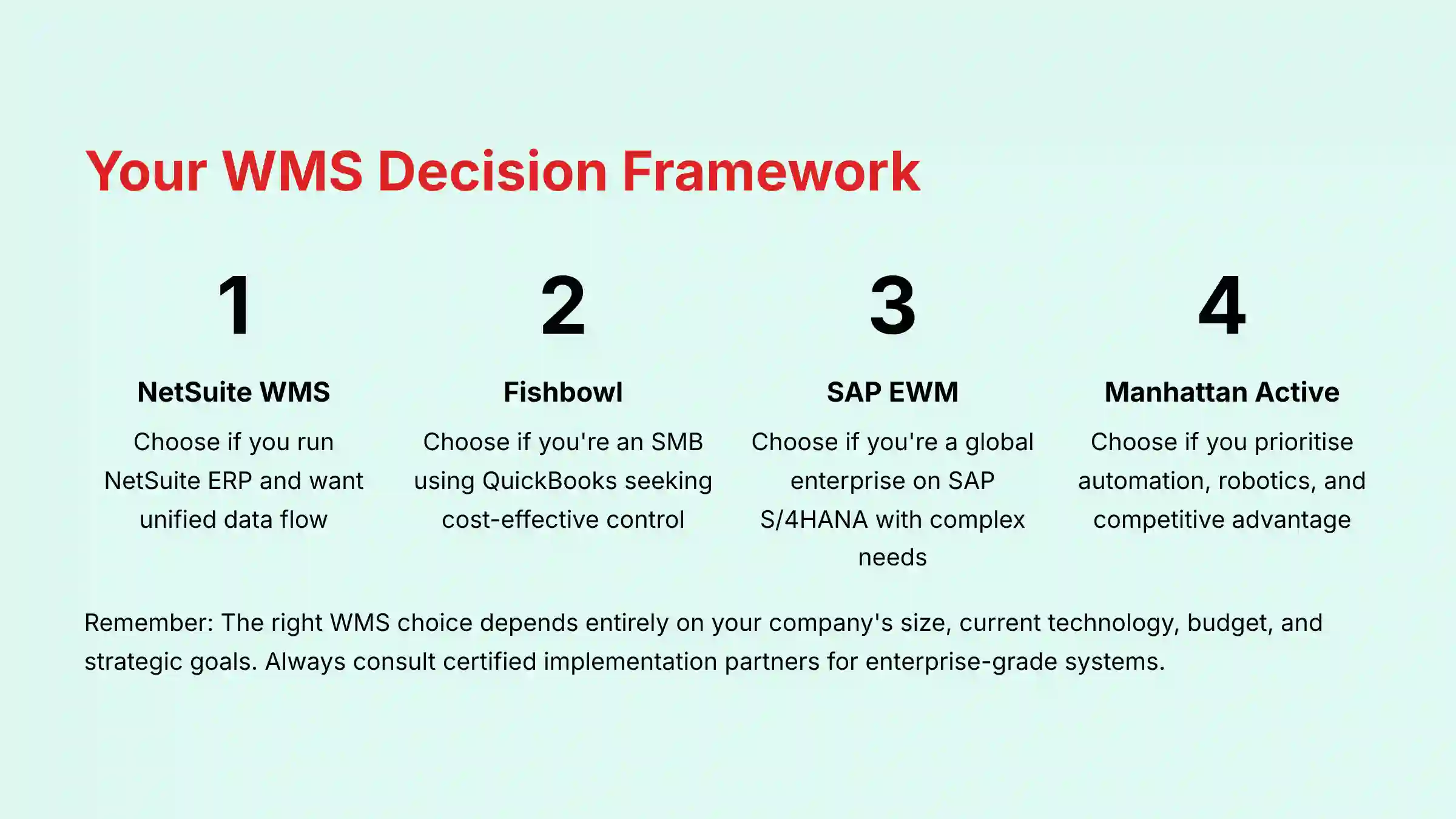
There is no single “best” WMS. The right choice depends entirely on your company's size, current technology, budget, and goals.
Recommendation 1: Choose NetSuite WMS if…
Your business runs on NetSuite ERP. Your main goal is a smooth, unified data flow from your website to your warehouse. You prefer a single vendor and have the budget for a full platform implementation.
Recommendation 2: Choose Fishbowl Inventory if…
You are a small or mid-sized business that uses QuickBooks. Your priority is getting control of your inventory with a cost-effective solution that is easy to implement. You do not need complex, enterprise-level features yet. For those preferring operational expenditure, Fishbowl Hosted (subscription model) is ideal, while those preferring capital expenditure might opt for Fishbowl Desktop with its perpetual license option.
Recommendation 3: Choose SAP EWM if…
You are a large, global company running SAP S/4HANA. You have very complex, high-volume distribution needs and require intense control. You have the large financial and human resources needed for a successful implementation.
Recommendation 4: Choose Manhattan Active WM if…
You are a large company aiming to get a competitive advantage through automation and robotics. You value operational flexibility, a great user experience for your team, and want a cloud platform that evolves continuously.
What Other Factors Should Influence Your WMS Decision?
Beyond the features discussed, other points matter. Consider the quality of vendor support, the strength of the implementation partner network, and the long-term technology roadmap of the provider. Always ask for customer references in your specific industry.
Frequently Asked Questions About NetSuite WMS Alternatives
What is the biggest difference between NetSuite WMS and SAP EWM?
The biggest difference is their target market and philosophy. NetSuite WMS is for mid-market companies seeking a unified business platform. SAP EWM is for massive global enterprises that need extreme control and run on SAP's core ERP.
Is Fishbowl a serious alternative to NetSuite WMS for a growing business?
Yes, but only if that business uses QuickBooks. Fishbowl is a perfect “next step” for companies outgrowing spreadsheets. But it is not a direct competitor to NetSuite WMS for a business that needs a full, integrated ERP and WMS platform.
How does Manhattan Active WM's “Order Streaming” compare to NetSuite's “Wave Planning”?
Wave Planning (NetSuite) is an intelligent way to batch orders for efficient picking. Order Streaming (Manhattan) is a more advanced, real-time method that constantly sends work to both people and robots, eliminating the start-and-stop nature of waves. It is generally faster and more flexible.
Which WMS has the lowest total cost of ownership (TCO)?
Based on my analysis, Fishbowl Inventory has the lowest and most transparent TCO. Its pricing model makes it very predictable for small businesses, particularly if opting for the perpetual license of Fishbowl Desktop. Enterprise systems like SAP EWM and NetSuite WMS have the highest TCO.
Can NetSuite WMS integrate with robotics as well as Manhattan Active WM?
No. While NetSuite WMS can integrate with robotics through partners, Manhattan Active WM is purpose-built with a Warehouse Execution System (WES) component at its core, designed for native orchestration of heterogeneous automation fleets (AMRs, AGVs, etc.). Its ability to manage robots as a fluid resource pool is a fundamental architectural advantage for highly automated facilities.
In terms of security, is there a major difference between SAP EWM and NetSuite WMS?
No. Both SAP EWM and NetSuite WMS offer exceptional, top-tier security with extensive certifications. For most businesses, both systems exceed standard security requirements. The choice between them should be based on other factors.
Which system is easier to implement and requires less training for warehouse staff?
Fishbowl Inventory is the easiest to implement. For warehouse staff, Manhattan Active WM generally requires less training due to its modern, app-like mobile interface. SAP EWM is by far the most complex to implement and use.
Do I need a certified partner to implement these WMS solutions?
Yes, for the enterprise systems, this is non-negotiable. Implementing NetSuite WMS, SAP EWM, or Manhattan Active WM without a certified partner is extremely risky. These are complex projects where the partner is responsible for process re-engineering, data migration, system configuration, and ensuring the User Acceptance Testing (UAT) process is successful. The success of a WMS project is often determined more by the quality of the implementation partner than any single software feature. Fishbowl, with its narrower focus, can sometimes be implemented by a skilled internal team, but partner support is still recommended for a smoother rollout.
Important Disclaimers:
Technology Evolution Notice: The information about NetSuite WMS Top Alternatives and Competitors and AI for Operations & Supply Chain tools presented in this article reflects our thorough analysis as of 2025. Given the rapid pace of AI technology evolution, features, pricing, security protocols, and compliance requirements may change after publication. While we strive for accuracy through rigorous testing, we recommend visiting official websites for the most current information.
Professional Consultation Recommendation: For AI for Operations & Supply Chain applications with significant professional, financial, or compliance implications, we recommend consulting with qualified professionals who can assess your specific requirements and risk tolerance. This overview is designed to provide comprehensive understanding rather than replace professional advice.
Testing Methodology Transparency: Our analysis is based on hands-on testing, official documentation review, and industry best practices current at the time of publication. Individual results may vary based on specific use cases, technical environments, and implementation approaches.
Conclusion: Making a Safe and Strategic WMS Investment
Choosing the right WMS is one of the most important technology decisions an operations leader will make. The goal is to find a system that not only solves today's problems but also supports your future growth. A unified platform like NetSuite WMS is powerful for companies within its ecosystem.
However, specialized solutions like Fishbowl, SAP EWM, and Manhattan Active WM offer compelling advantages for different business types. By focusing on your specific needs for AI, user experience, integration, security, and cost, you can make a safe and strategic investment. This will position your warehouse as a key driver of your company's success. For more on NetSuite WMS Top Alternatives and Competitors, my team and I continue to track the latest developments.

Leave a Reply