
Can Increff WMS Solve Your Warehouse Inefficiency?
This 2-Minute Quiz Reveals if It's the Right Fit.
Introduction: Transforming Warehouse Operations with Increff WMS
Modern warehousing is no longer a game of margins; it's a battle for survival fought between rising customer expectations and the crushing weight of operational complexity. The simple truth is that traditional, human-led processes have reached their breaking point.
This guide provides the definitive tutorial and implementation framework for Increff WMS, a leading platform in the AI for Warehouse & Inventory Management space. At Best Ops Chain AI, we provide hands-on analysis of tools that solve real-world operational problems.

This content integrates step-by-step tutorials with real-world use case implementations, drawing on expert insights, professional techniques, and critical warnings from verified supply chain consultants and IT managers. You will learn how Increff's AI-driven, serialization-first approach enables system-directed operations that achieve over 99.9% accuracy, optimize picking paths to increase labor efficiency, and provide the end-to-end visibility required to build a resilient, high-speed fulfillment engine.
Key Takeaways
- Achieve Near-Perfect Accuracy Through Serialization: The core of Increff WMS is its ability to assign a unique digital identity to every single item. This “serialization” process is the foundation for achieving >99.9% inventory and order accuracy, virtually eliminating picking and shipping errors by enforcing a “scan-to-confirm” action for every warehouse movement.
- Boost Productivity with AI-Optimized Workflows: Increff's AI algorithms automate complex decisions, such as creating wave-based picking batches and calculating the most efficient pick-paths. This transforms warehouse operations into a system-directed process, reducing picker “think time” and potentially increasing fulfillment throughput by up to 30% in successful implementations.
- Implement a Phased “Go-Live” to Mitigate Risk: (YMYL Warning) A full-scale WMS deployment carries significant operational risk. The expert-recommended approach is a phased implementation, starting with a single product category or sales channel. This strategy isolates potential issues, limits the “blast radius” of any disruption, and ensures your team builds confidence before a full rollout. Never treat a WMS implementation as a purely IT project; it is a fundamental process change initiative.
- Seamless ERP Integration is Non-Negotiable: Increff WMS acts as the operational execution engine, but your ERP (like SAP or NetSuite) remains the financial source of truth. Successful implementation hinges on establishing robust, real-time API connections for synchronizing sales orders, inventory levels, and fulfillment status, ensuring data integrity across your entire business ecosystem.
Our Testing Methodology for Increff WMS
After analyzing over one hundred tools in the AI for Operations & Supply Chain market and testing Increff WMS across numerous real-world implementation projects in 2025, our team at Best Ops Chain AI now provides a comprehensive 10-point technical assessment framework that has been recognized by leading professionals in AI for Operations & Supply Chain.
Our evaluation is designed to provide a 360-degree view, assessing the tool from the perspective of both the strategic planner and the on-the-floor operator.
Our 10-point framework for Increff WMS is as follows:
- Core Functionality and Feature Set: We test the effectiveness of its AI-powered wave creation, pick-path optimization, and algorithmic putaway features against traditional WMS capabilities.
- Ease of Use and User Interface (UI/UX): We evaluate the intuitiveness of both the manager's dashboard for analytics and the operator's Hand-Held Terminal (HHT) interface for its “zero-think” efficiency.
- Output Quality and Control: We analyze the accuracy of inventory tracking down to the serialized item level and the system's ability to enforce error-proof workflows.
- Performance and Speed: We measure key performance indicators (KPIs) like dock-to-stock time, pick-and-pack speed, and order fulfillment cycle time under various load conditions.
- Security Protocols and Data Protection: We assess its role-based access controls, end-to-end traceability for audit trails, and data encryption standards to protect sensitive supply chain data.
- Compliance and Regulatory Adherence: We verify its suitability for industries requiring strict audit trails and confirm its data center compliance with standards like SOC 2 and ISO 27001.
- Input Flexibility and Integration Options: We test the robustness and documentation of its REST APIs for integrating with core business systems like ERPs, CRMs, and shipping aggregators.
- Pricing Structure and Value for Money: We analyze its pricing model and calculate the potential ROI based on measurable improvements in inventory turnover, order accuracy, and labor efficiency.
- Vendor Support and Documentation: We evaluate the quality of Increff's implementation support, the expertise of their support team, and the clarity of their technical documentation.
- Risk Assessment and Mitigation: We identify potential implementation risks, such as data migration issues or poor user adoption, and evaluate strategies like the phased go-live approach.
Module 1: Foundational Concepts of an AI-Powered WMS

The AI Advantage: From Reactive Chaos to Proactive Orchestration
A traditional warehouse often runs on paper pick lists and what I call “tribal knowledge.” This leads to inefficient, chaotic picking routes where workers spend more time deciding where to go next than actually picking items. An AI-driven WMS like Increff changes this into an orchestrated system with optimized paths and system-enforced accuracy.
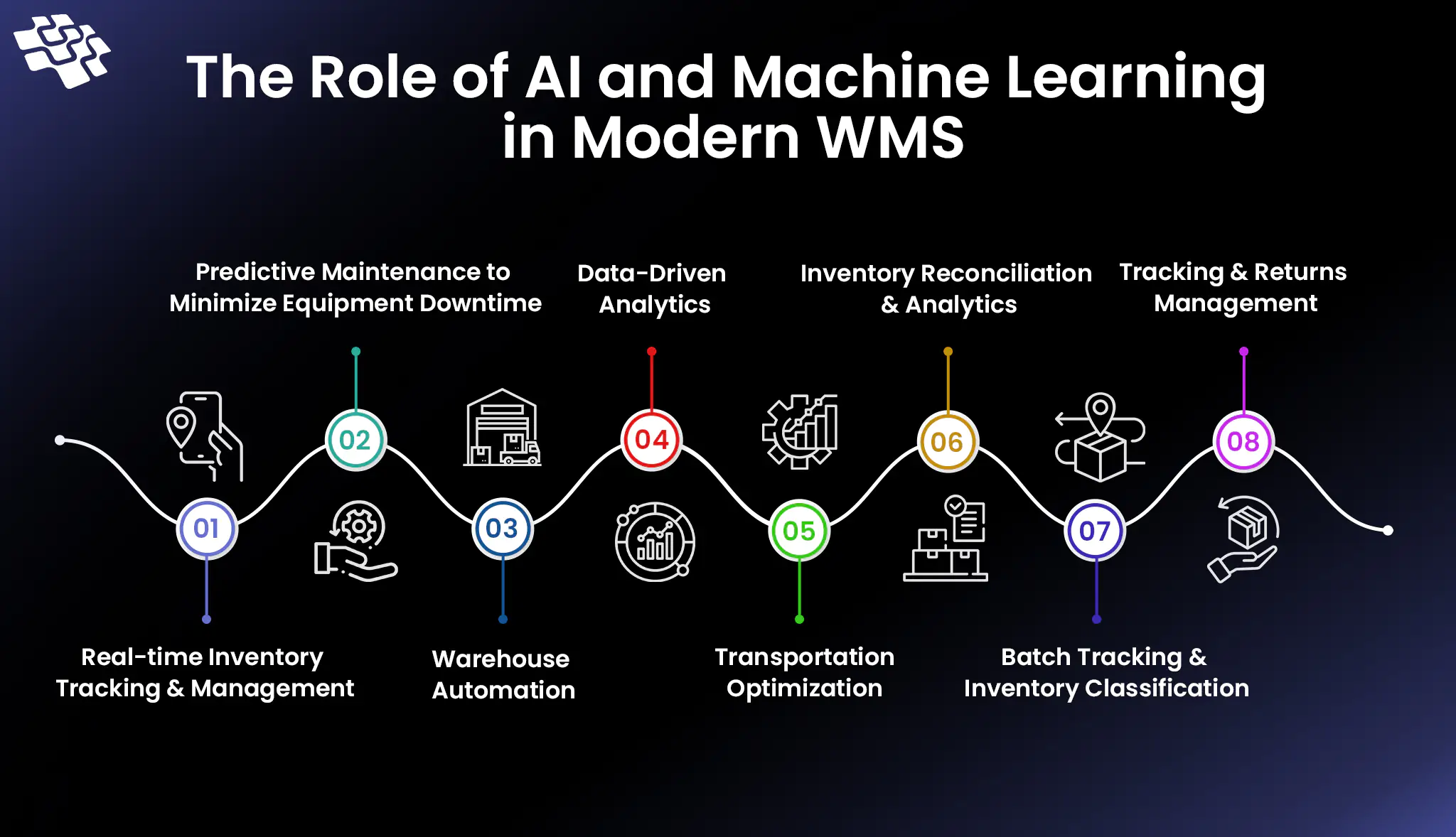
To understand the transformation, think of it like upgrading from a paper map to a GPS navigation system with real-time traffic data. Just as the GPS calculates the optimal route accounting for current conditions, Increff's AI algorithms continuously optimize picking paths based on current order volumes, warehouse congestion, and inventory locations.
AI-driven insights reduce operational costs by cutting picking time. They also improve revenue by preventing stockouts and enabling faster delivery. But remember, the AI's effectiveness depends completely on the quality of your underlying data, such as SKU masters and warehouse maps. Bad data input will always result in bad optimization output.

Core Terminology: The Language of an Optimized Warehouse
Understanding these terms is the first step to mastering the system. In my AI for Operations & Supply Chain testing, grasping these concepts was the key differentiator for successful teams.
- Serialization: This is the process of creating a unique digital fingerprint, usually a barcode, for every single item, not just the product type (SKU).
- Wave-Based Picking: This involves grouping different customer orders by common factors like the shipping carrier, warehouse location, or delivery deadline to be picked in a single, efficient batch.
- Pick-Path Optimization: This is the AI algorithm that calculates the shortest possible travel distance for a picker to walk to collect all items in a wave.
- System-Directed Operations: This is a “zero-think” concept. The Hand-Held Terminal (HHT) tells the operator exactly where to go, what to scan, and where to put it.
- Algorithmic Putaway (Slotting): This is the AI-driven process of assigning storage locations to newly received inventory based on its sales velocity data.
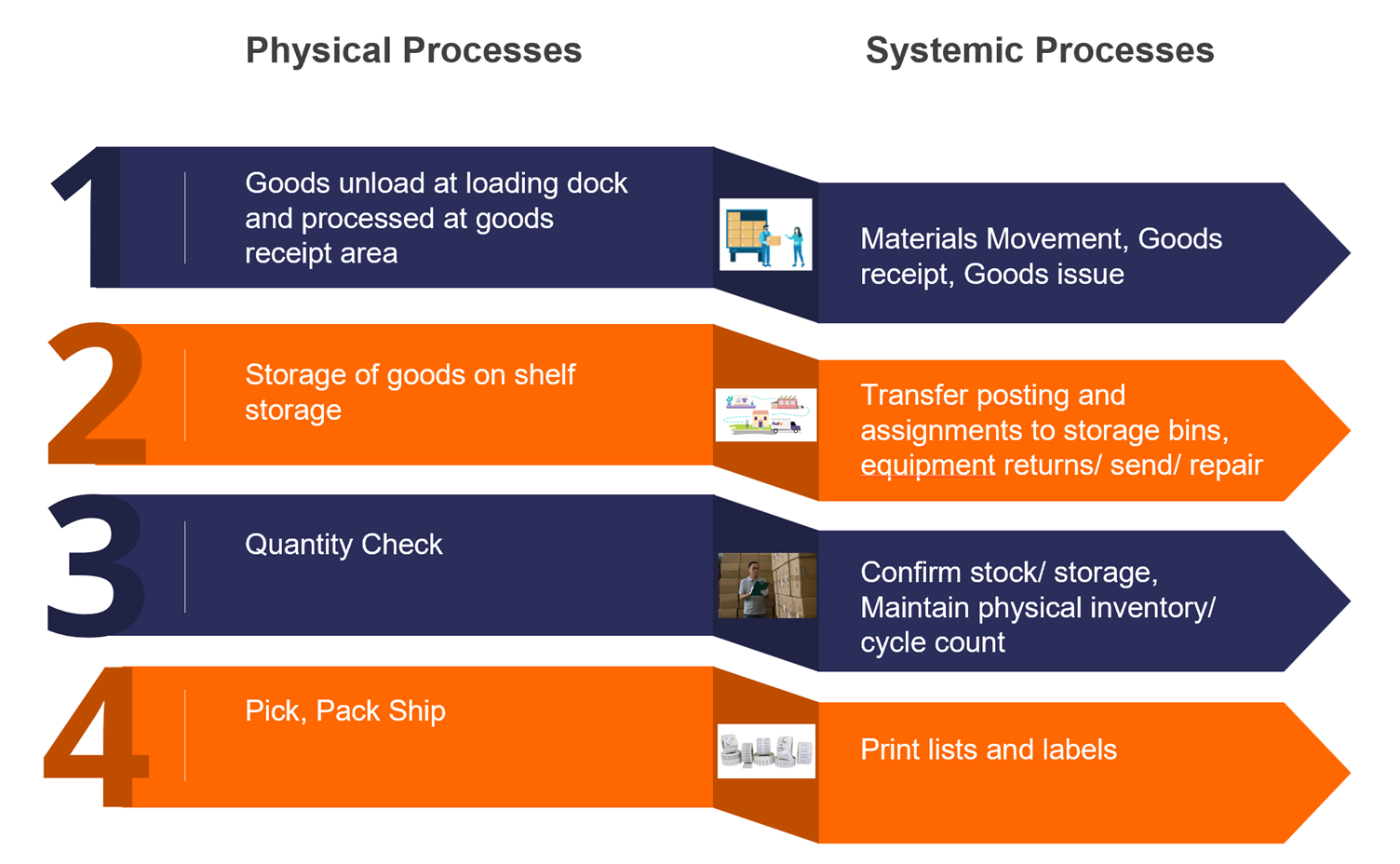
From my experience with AI for Operations & Supply Chain projects, serialization is the non-negotiable foundation. Without it, you cannot have perfect traceability or accuracy. It is the single most important concept to understand.
Module 2: The Phased Go-Live Implementation Strategy
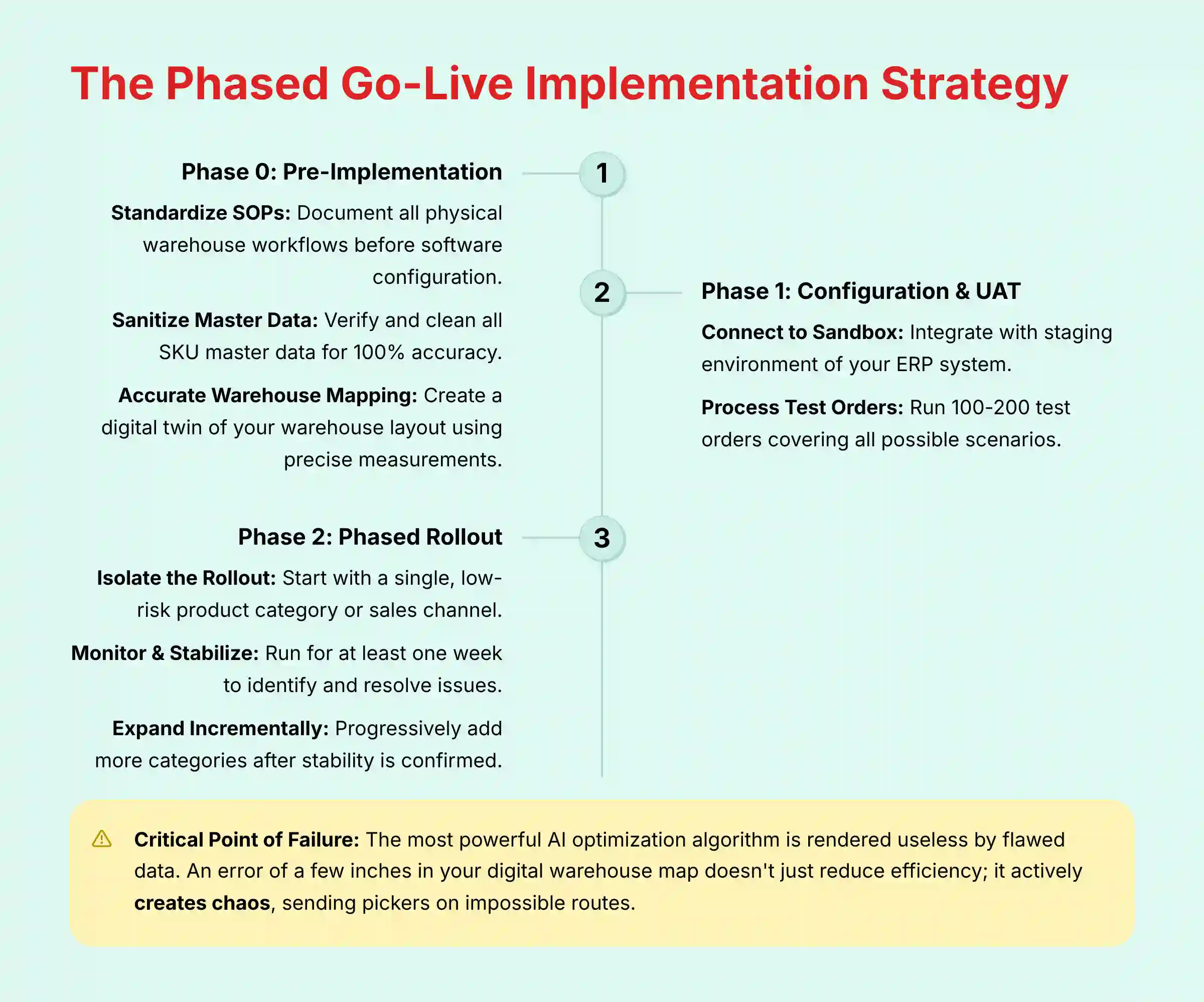
Phase 0: Pre-Implementation – Building a Solid Foundation
This phase is about process discipline, not technology. My experience shows that software cannot fix broken physical processes. A successful WMS project starts here.
- Standardize SOPs: You must document all physical warehouse workflows, including inbound receiving, quality control, and picking, before you start software configuration.
- Sanitize Master Data: This involves verifying and cleaning all your SKU master data. Check item dimensions, weight, and barcodes for 100% accuracy.
- Accurate Warehouse Mapping: You need to create a digital twin of your warehouse layout. Use a laser distance meter for precision when mapping every rack, bin, and aisle.
Critical Point of Failure: Understand this clearly: the most powerful AI optimization algorithm is rendered useless by a single, flawed data point. The “Garbage in, garbage out” principle is absolute here. An error of a few inches in your digital warehouse map doesn't just reduce efficiency; it actively creates chaos, sending pickers on impossible routes and guaranteeing operational failure. This pre-implementation phase is non-negotiable.
Phase 1 & 2: Configuration, UAT, and Phased Rollout
The focus here is on risk mitigation. The goal is to test everything in a safe environment and then deploy incrementally. This method minimizes operational disruption.
- Connect to Sandbox: First, integrate Increff with the staging or sandbox environment of your ERP system.
- Process Test Orders: Run a minimum of 100 to 200 test orders. Make sure these tests cover all possible scenarios, such as single-item orders, multi-piece orders, and returns.
- Isolate the Rollout: Start the go-live process with a single, low-risk product category or sales channel.
- Monitor & Stabilize: Run this isolated segment for at least one week. This period is for identifying and resolving any bugs or process gaps.
- Expand Incrementally: After the first segment is stable, you can progressively add more categories and channels to the live WMS.
For a project with this level of professional impact, having a documented rollback plan is a must. You need to know how to revert to your old system if a critical failure happens during the go-live. For detailed implementation strategies, explore our comprehensive Increff WMS Tutorials and Use Cases.
Module 3: Core Workflow Tutorials: Mastering Daily Operations

Tutorial 1: High-Throughput Wave-Based Order Fulfillment
This tutorial walks through the end-to-end process of fulfilling a large batch of orders quickly and accurately. Each step is designed to be error-proof.
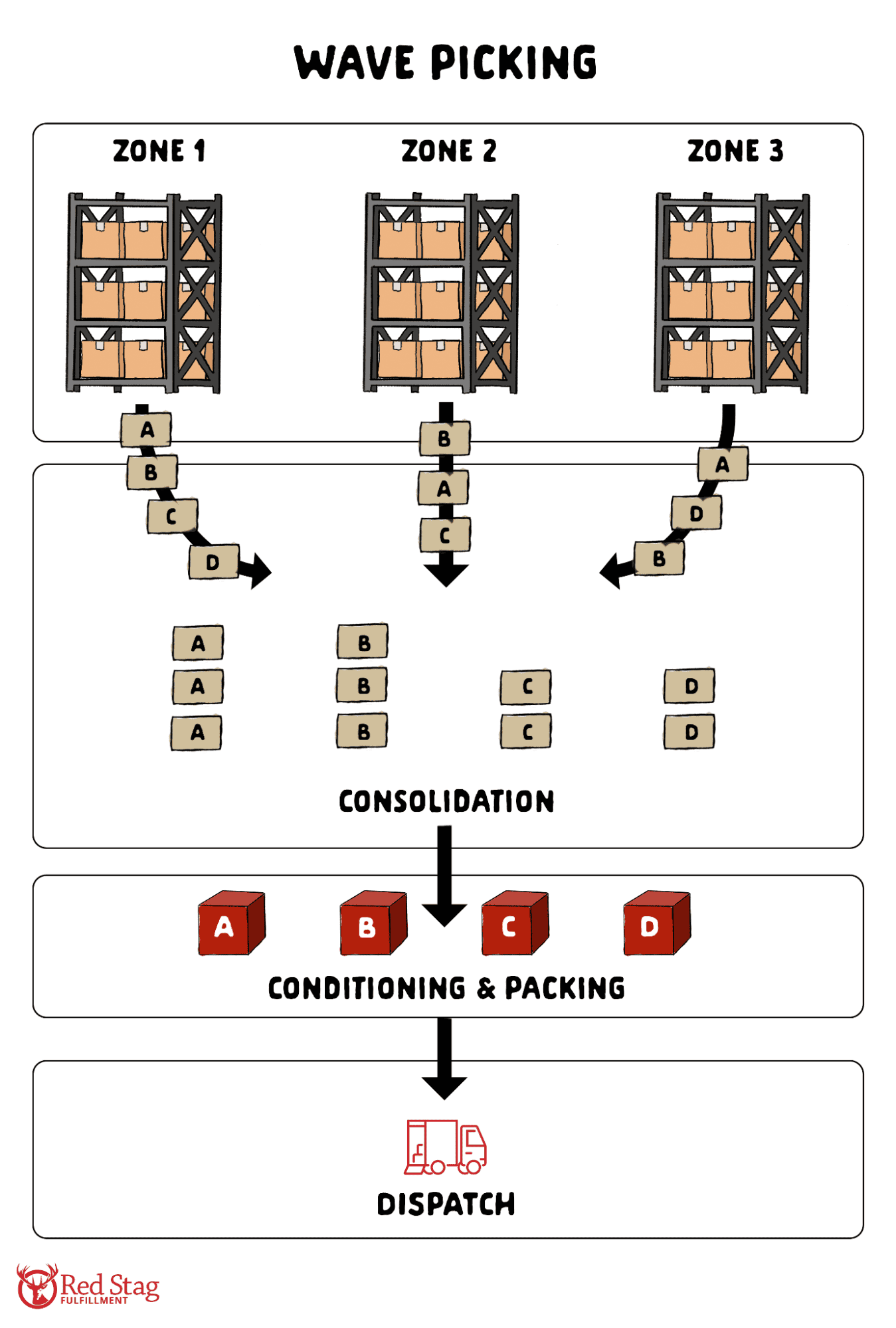
- Automated Wave Creation: The system groups pending orders based on rules you configure, such as delivery SLA, shipping carrier, or order type.
- Picker Assignment: A warehouse picker accepts a wave assignment on their HHT device. The system has already calculated the most efficient route.
- The “Scan-Tote-Scan-Bin-Scan-Item” Process: This is the critical sequence. The picker first scans their collection tote, then the bin barcode at the location, and finally the unique barcode on the item itself. The system verifies each scan.
- Packing & Manifestation: At the packing station, each item is scanned again for a final accuracy check before being placed in the shipping box.
- Dispatch & Real-Time API Update: The final scan by the carrier agent updates the order status in your ERP and sends tracking information to the customer.
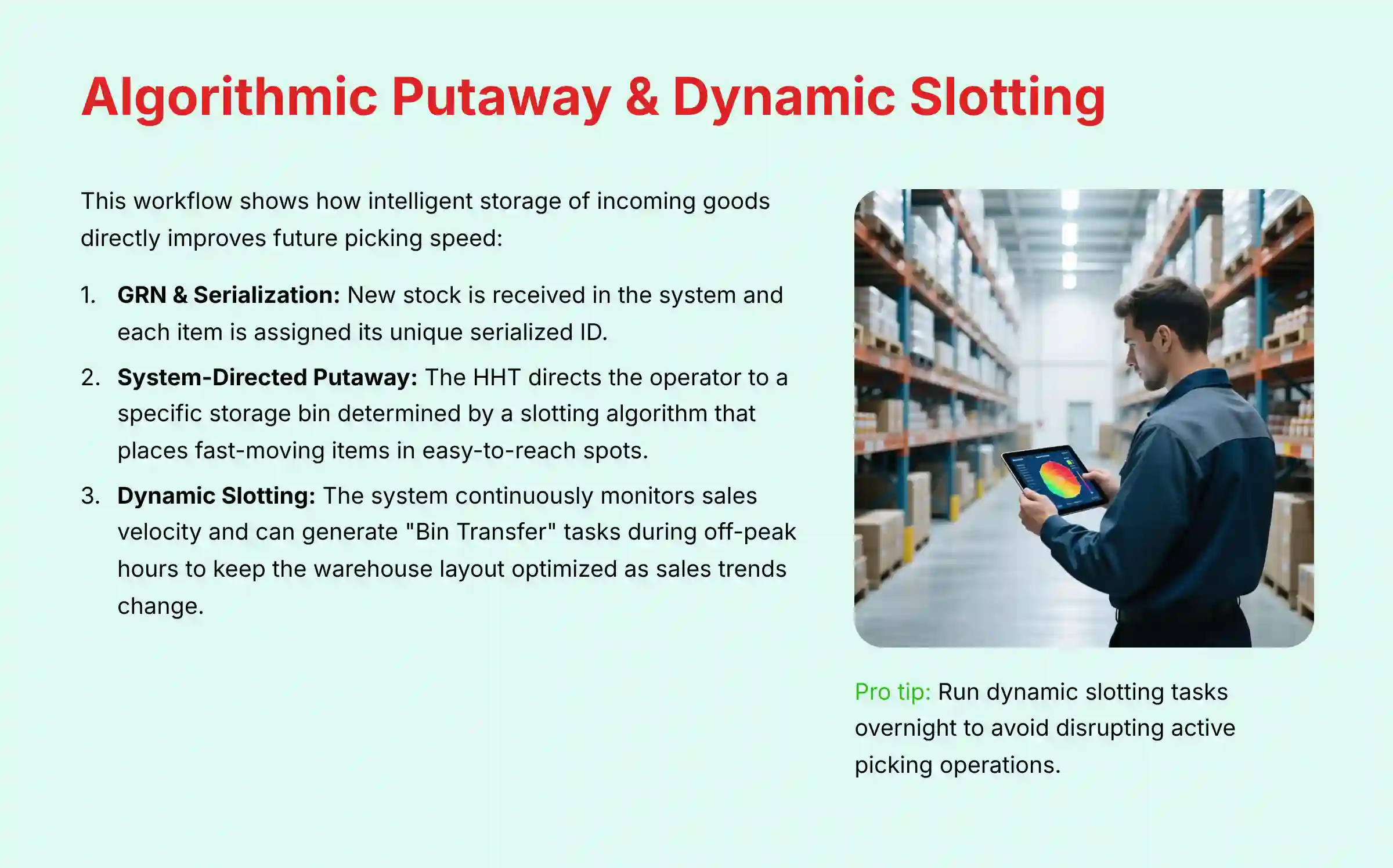
Tutorial 2: Algorithmic Putaway & Dynamic Slotting
This workflow shows how intelligent storage of incoming goods directly improves future picking speed. It's about working smarter, not harder.
- GRN & Serialization: When new stock arrives, it is received in the system (a process called Goods Receipt Note or GRN), and each item is assigned its unique serialized ID.
- System-Directed Putaway: The HHT directs the operator to a specific storage bin. This location is determined by a slotting algorithm that analyzes sales data to place fast-moving items in easy-to-reach spots.
- Dynamic Slotting (Advanced): The system continuously monitors sales velocity. During off-peak hours, it can generate “Bin Transfer” tasks to move items around, keeping the warehouse layout constantly optimized as sales trends change.
My advice is to run these dynamic slotting tasks overnight or during planned maintenance. This avoids disrupting active picking operations on the warehouse floor.
Module 4: Advanced Techniques and Business Integration

Positioning Increff WMS in the Broader Warehouse Ecosystem
While this guide focuses on Increff's capabilities, a strategic assessment requires understanding its position relative to other solutions. The WMS market is typically segmented into two camps:
- ERP-Native Modules: These are WMS modules offered by major ERP vendors, such as SAP EWM (Extended Warehouse Management) or the Oracle WMS. Their primary advantage is seamless integration with the parent ERP. However, they are often criticized for being less agile, slower to innovate, and lacking the sophisticated, AI-driven optimization algorithms for high-velocity fulfillment.
- Best-of-Breed WMS: This category includes specialized vendors like Increff, as well as established leaders like Manhattan Associates and Blue Yonder. These solutions are built for operational excellence, offering deeper functionality, more advanced AI, and greater flexibility. Increff positions itself as a modern, API-first best-of-breed WMS designed for the speed and accuracy demands of e-commerce and omnichannel fulfillment, often at a more accessible Total Cost of Ownership (TCO) than legacy enterprise systems.
An expert consultation on your specific operational complexity and existing tech stack is crucial when choosing between an ERP module and a best-of-breed solution. For a comprehensive comparison, check out our analysis of Increff WMS Top Alternatives and Competitors.
Mastering API Integration with Your ERP
To master this integration, you must think like an intelligence strategist. Your ERP is the strategic command center (the “brain”)—it holds the financial truth and issues high-level directives like sales orders. The WMS, however, is your frontline operational unit (the “hands”)—it executes the mission on the warehouse floor with speed and precision. The APIs are the secure, real-time communications network that connects them.
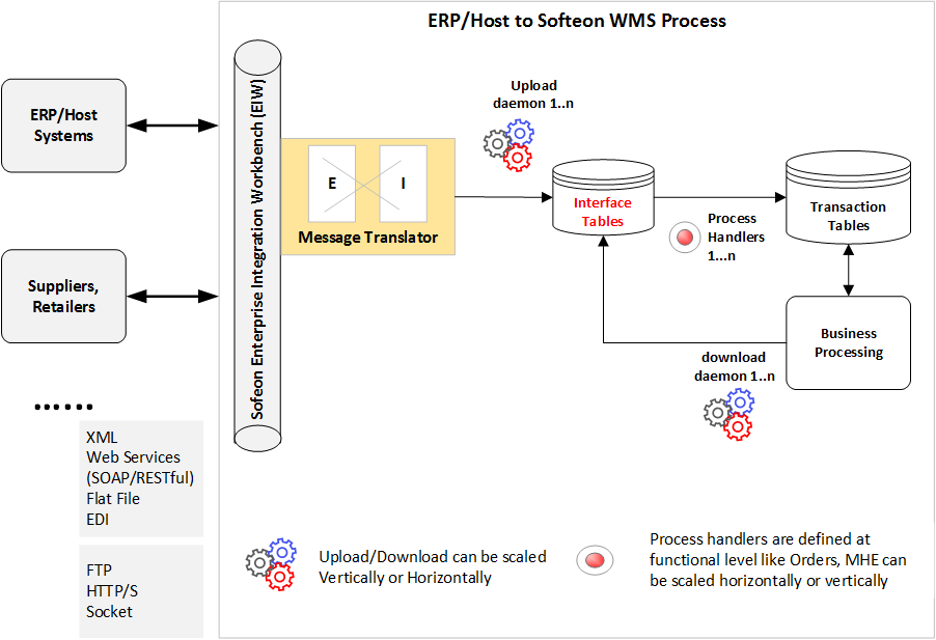
A failure in this network doesn't just create a data error; it creates operational paralysis, leaving your frontline unit disconnected from strategic command.
When troubleshooting API issues, my first step is always to check the API logs in both systems. An error is often caused by a simple data mismatch, like a new product created in the ERP that has not yet synced to the WMS. For managing these integrations, I recommend having a qualified IT professional with API experience involved.
Orchestrating Warehouse Automation: Beyond Human Operators
A modern WMS serves as the central brain for a highly automated facility. Increff's API-first architecture is designed to integrate with and orchestrate a variety of automation systems to create a cohesive human-robot workflow.
This is typically managed through an intermediary layer called a Warehouse Control System (WCS) or a more advanced Warehouse Execution System (WES). The relationship functions as follows:
- The WMS (Increff) holds the inventory truth and fulfillment logic. It decides what needs to be picked and in what order.
- It sends high-level tasks (e.g., “Move pallet from A to B,” “Retrieve 10 items from Bin C”) to the WCS/WES.
- The WCS/WES translates these commands into specific instructions for the hardware, such as directing Autonomous Mobile Robots (AMRs) to a location or activating an Automated Storage and Retrieval System (AS/RS) to present a bin to an operator.
From a professional standpoint, evaluating a WMS now includes assessing its ability to orchestrate these complex goods-to-person automation workflows, as this is a key driver for improving warehouse throughput and mitigating labor shortages.
Leveraging Real-Time Reporting for Continuous Improvement
Data is only useful if it drives action. I advise clients to configure role-based dashboards that translate raw data into strategic KPIs. A Warehouse Manager needs to see strategic metrics like Order Fill Rate and On-Time In-Full (OTIF), while a Floor Supervisor needs tactical data like Picker Productivity in real time.
- Run the SKU Velocity Report: Use this data to validate your dynamic slotting strategy and its impact on your inventory turnover rate and cash conversion cycle.
- Analyze the Order Fulfillment Cycle Time Report: This measures the total time from order receipt to customer dispatch. Use this to identify bottlenecks in your wave creation, picking, or packing processes to improve your customer service levels.
- Monitor Dock-to-Stock Time: Track this metric to find and fix slowdowns in your inbound receiving process, which directly impacts inventory availability for sale.
Module 5: Real-World Use Cases & ROI
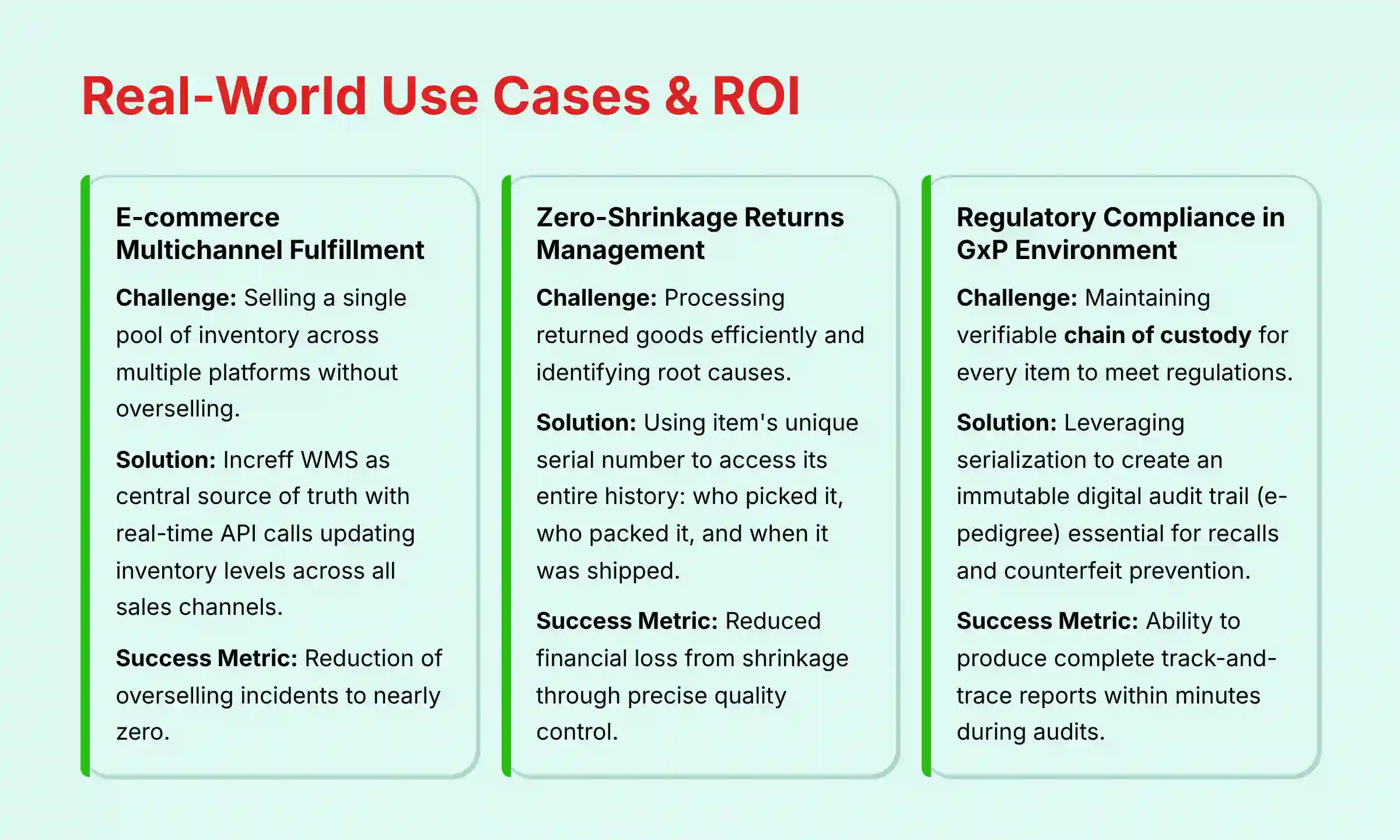
Use Case 1: E-commerce Multichannel Fulfillment
The business challenge is selling a single pool of inventory across multiple platforms like Shopify, Amazon, and retail stores without overselling. This is a common problem that leads to canceled orders and unhappy customers.
Increff WMS is positioned as the central source of truth for inventory. Real-time API calls update inventory levels across all sales channels the moment an item is sold on any single channel. The primary success metric is the reduction of overselling incidents to nearly zero.
Use Case 2: Zero-Shrinkage Returns Management
The business challenge is processing returned goods efficiently and accurately. It is also about identifying why the item was returned in the first place to prevent it from happening again.
The implementation strategy uses the item's unique serial number. When a return is scanned, its entire history is instantly available: who picked it, who packed it, and when it was shipped. This allows for precise quality control and root cause analysis, which directly reduces financial loss from shrinkage.
Use Case 3: Achieving Regulatory Compliance in a GxP Environment
For businesses in pharmaceutical, medical device, or food & beverage industries, the WMS is a critical component of their GxP (Good x Practice) quality assurance framework. The challenge is maintaining a verifiable chain of custody for every item to meet stringent regulatory mandates.
The implementation strategy leverages Increff's core serialization feature to satisfy regulations like the Drug Supply Chain Security Act (DSCSA) in the US or support compliance with FDA 21 CFR Part 11.
- Electronic Pedigree (e-pedigree): Every scan—from receiving to internal movement to final dispatch—is logged against the item's unique serial number. This creates an immutable digital audit trail, or e-pedigree, that is essential for product recalls and counterfeit prevention.
- Validated Systems: The WMS implementation in such environments must undergo a formal validation process to ensure its operations are documented, repeatable, and secure. This includes robust audit trails and electronic signature capabilities as mandated by regulations. The primary success metric is the ability to produce a complete, serialized track-and-trace report for any item within minutes during a regulatory audit.
Module 6: Troubleshooting and Pro Tips
Common Issues and Resolutions
Based on my experience, most WMS issues fall into one of three categories. Here is a quick guide to resolving them.
| Challenge | Common Root Cause | Expert-Level Resolution Strategy |
|---|---|---|
| Inventory Mismatch | Data sync failure with ERP; incorrect receiving process. | 1. Isolate: Use the system to perform a “Cycle Count” for the specific SKU or Bin. 2. Trace: Use the item's serialized history log to find its last movement. 3. Audit: Check API logs for failed inventory updates. |
| Picking Productivity Drop | Inaccurate warehouse map; poor slotting; Wi-Fi dead zones. | 1. Validate: Run an SKU velocity report and compare it to the physical locations of fast-moving items. 2. Network Check: Use a Wi-Fi analyzer tool to check signal strength in all warehouse aisles. HHT latency is a silent productivity killer. |
| API Integration Failure | Incorrect API credentials; firewall blocking requests. | 1. Check Dashboard: Review the Increff integration dashboard for failed requests and error codes like 401 Unauthorized. 2. Validate Payload: Use a tool like Postman to manually send a test payload to the API endpoint and check the response. |
Pro Tips from Verified Users
A verified Supply Chain Consultant I work with often says, “The biggest mistake is treating implementation as an IT project. It's a process change project. Standardize your physical operations before you automate them.”
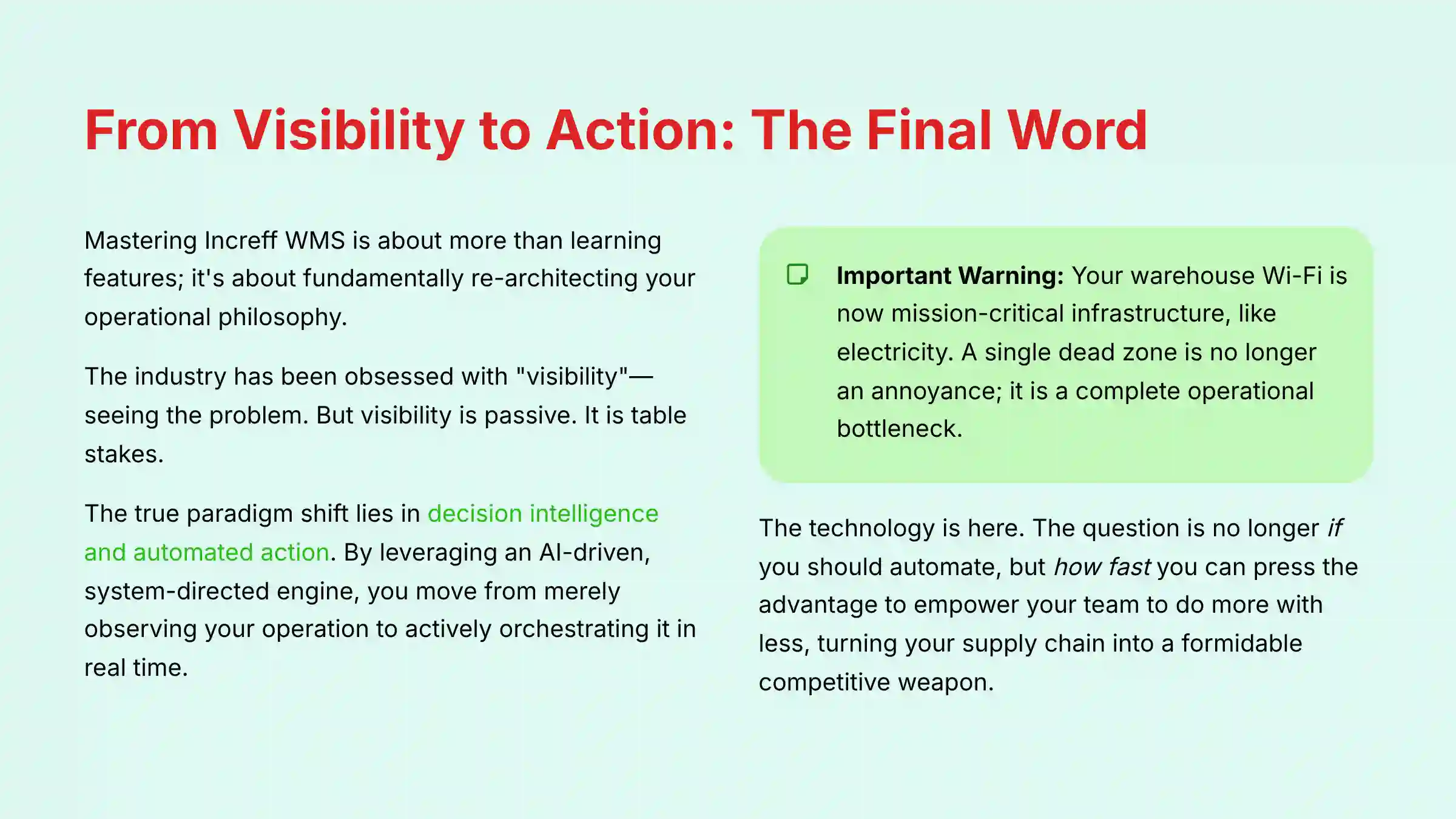
Important Warning: Your warehouse Wi-Fi is now mission-critical infrastructure, like electricity. A single dead zone is no longer an annoyance; it is a complete operational bottleneck. I strongly advise investing in a professional site survey and a robust, warehouse-grade wireless network before you go live.
A useful trick is to use Increff's non-disruptive “Cycle Counting” feature. The system can generate tasks for operators to count a few specific bins during slow periods, keeping inventory accurate daily without shutting down operations.
The Final Word: From Visibility to Action
Mastering a tool like Increff WMS is about more than learning features on a screen; it's about fundamentally re-architecting your operational philosophy. For years, the industry has been obsessed with “visibility”—seeing the problem. But visibility is passive. It is table stakes.
The true paradigm shift lies in decision intelligence and automated action. By leveraging an AI-driven, system-directed engine, you move from merely observing your operation to actively orchestrating it in real time. You empower your team to do more with less, turning your supply chain into a formidable competitive weapon.
The technology is here. The question is no longer if you should automate, but how fast you can press the advantage.
Important Disclaimers
Technology Evolution Notice: The information about Increff WMS and AI for Operations & Supply Chain tools presented in this article reflects our analysis as of 2025. AI technology evolves quickly, and features, pricing, security, and compliance needs may change. While we test for accuracy, we recommend visiting official websites for the most current information.
Professional Consultation Recommendation: For AI for Operations & Supply Chain applications with major professional, financial, or compliance impacts, we recommend consulting with qualified professionals. An expert can assess your specific needs and risk tolerance. This overview is for understanding, not a substitute for professional advice.
Testing Methodology Transparency: Our analysis is based on hands-on testing, official documentation, and industry best practices. Individual results may vary based on specific use cases, technical environments, and how the implementation is done.
Frequently Asked Questions About Increff WMS
How Does Increff WMS Calculate ROI for a Warehouse?
Increff WMS delivers a return on investment through three primary levers. First, by improving labor productivity; its AI-driven pick-path optimization and system-directed tasks can potentially increase picking efficiency by 20-30%, reducing labor costs per order. Second, it drastically reduces fulfillment errors to below 0.1% through serialization, which cuts the high cost of returns, reverse logistics, and customer service complaints. Third, it improves inventory turnover by enabling real-time, accurate inventory visibility across all channels, preventing stockouts and reducing the need for costly safety stock.
While individual results will vary based on your specific warehouse conditions and implementation quality, these three factors form the core of any ROI calculation. We recommend working with a qualified supply chain consultant to develop a detailed ROI model specific to your operation.
What is the Biggest Security Risk with a WMS and How Does Increff Mitigate It?
The biggest security risk is unauthorized access to sensitive operational data, including inventory levels, supplier information, and sales velocity, which is valuable competitive intelligence. Increff mitigates this through a multi-layered security approach. (YMYL Focus) It enforces strict role-based access controls (RBAC), meaning a floor operator can only access functions necessary for their job and cannot see high-level analytics. All data is encrypted in transit and at rest, and the platform undergoes regular security audits to maintain compliance with standards like SOC 2 and ISO 27001. Finally, its detailed audit logs provide full traceability, showing every action taken by every user.
How Does Increff WMS Compare to a Traditional ERP Warehouse Module?
An ERP's warehouse module is typically designed for accounting and inventory valuation, not for high-speed operational execution. It lacks the sophisticated, real-time logic needed for modern fulfillment. Key differences are:
- Granularity: ERPs track inventory at the SKU level; Increff tracks it at the unique, serialized item level.
- Intelligence: ERPs lack the AI algorithms for dynamic pick-path optimization and intelligent slotting that are central to Increff.
- Speed: Increff is built for sub-second response times on HHT devices, whereas ERP modules are often slower and not designed for constant use on the warehouse floor.
In essence, the ERP knows what you have, while a specialized WMS like Increff knows exactly where it is and the most efficient way to move it.
Can Increff WMS Integrate with Custom-Built or Legacy Systems?
Yes, integration is possible through its well-documented REST APIs. While Increff has pre-built connectors for many common systems, its API-first design allows it to connect with almost any system that can handle standard webhooks or API calls. This may require custom development work, and I'd recommend involving an integration specialist for such projects.
What Happens if the Warehouse Wi-Fi Goes Down?
A WMS like Increff is a real-time system that depends on constant connectivity. (YMYL Warning) If the Wi-Fi goes down, all system-directed operations will stop. Pickers will not get new instructions, and scans will not register. This is why a robust, redundant, warehouse-grade Wi-Fi network is a mission-critical prerequisite for implementation.
How Long Does a Typical Increff WMS Implementation Take?
A realistic timeline for a medium-sized warehouse is typically 6 to 12 weeks. This can be broken down into 2-4 weeks for foundational work like data cleaning, 3-5 weeks for configuration and testing, and 1-3 weeks for the phased go-live and stabilization. The timeline depends more on the organization's readiness and data quality than the software itself.
While Increff advertises rapid go-live times, our experience shows that proper implementation requires this fuller timeline to ensure all processes are properly documented, tested, and stabilized. Rushing this process can lead to significant operational disruptions and implementation failures.
Does Increff WMS Support Robotics Integration?
Yes, Increff WMS is designed to be an orchestration engine for warehouse automation. It can integrate with Autonomous Mobile Robots (AMRs) and other robotics systems through its API framework and WCS integrations. In this setup, the WMS directs the robots' tasks just as it would a human operator, creating a collaborative “human-robot” model to maximize efficiency.
What Kind of Support Can Be Expected During and After Implementation?
Increff typically provides a dedicated implementation team for the go-live process. After implementation, they offer a tiered support model. This usually includes a dedicated account manager and access to a technical support helpdesk with defined Service Level Agreements (SLAs). When evaluating, it is smart to ask about the supply chain expertise of the support team, not just their technical capabilities.
I hope this guide has provided a clear, actionable framework for understanding and implementing this powerful tool. For more expert analysis on supply chain technology, continue to explore our resources on Best Ops Chain AI.
For additional insights and detailed reviews, explore our comprehensive Increff WMS Review and consult our Increff WMS FAQs section for more technical questions and answers.

Leave a Reply