Which AI Warehouse Automation Solution Fits Your Needs? This 2-Minute Quiz Reveals Your Perfect Match!
In the high-stakes world of warehouse automation, choosing the right AI-powered robotics partner is a multi-million dollar decision with lasting operational and financial consequences. As the founder of Best Ops Chain AI, I've analyzed countless systems within the AI for Warehouse & Inventory Management space.
This in-depth analysis of GreyOrange Top Alternatives and Competitors, compliant with YMYL standards, compares the three market leaders: GreyOrange, Geek+, and Locus Robotics. My analysis dissects their core philosophies, real-world performance, and total cost of ownership to reveal which solution best fits your specific operational needs.
Key Takeaways
- Strategic Decision Framework: The choice between GreyOrange, Geek+, and Locus Robotics isn't about which is “best” – it's about which philosophy aligns with your business goals, risk tolerance, and infrastructure
- Financial Impact Analysis: GreyOrange requires high CapEx for maximum optimization, Geek+ offers modular investment flexibility, while Locus provides low-barrier RaaS entry with predictable OpEx
- Risk Assessment Critical: Centralized systems like GreyOrange offer immense optimization but create single points of failure, while distributed systems like Locus provide higher resilience
- Integration Reality Check: The quoted robot price is not the final cost – budget an additional 15-25% for skilled integrators and infrastructure upgrades like high-density Wi-Fi
Executive Summary: Three Leaders, Three Philosophies
After extensive research into expert reviews, technical specifications, and verified user experiences, a clear picture forms. The choice between these competitors is not about which is “best.” The right choice depends on which philosophy aligns with your business goals, risk tolerance, and existing infrastructure.
- GreyOrange: The End-to-End Orchestrator. This is best for enterprises seeking a powerful, centralized AI brain to command their entire fulfillment operation. Think of it as a “heart transplant” for your warehouse. It is a high-investment, high-reward choice that promises unmatched optimization if you commit to its ecosystem.
- Geek+: The Modular Powerhouse. This is ideal for complex facilities with diverse needs, such as picking, sorting, and moving. Its strength is its vast portfolio of AMR types, allowing a “one-stop-shop” approach. But success is heavily dependent on the quality of third-party integration.
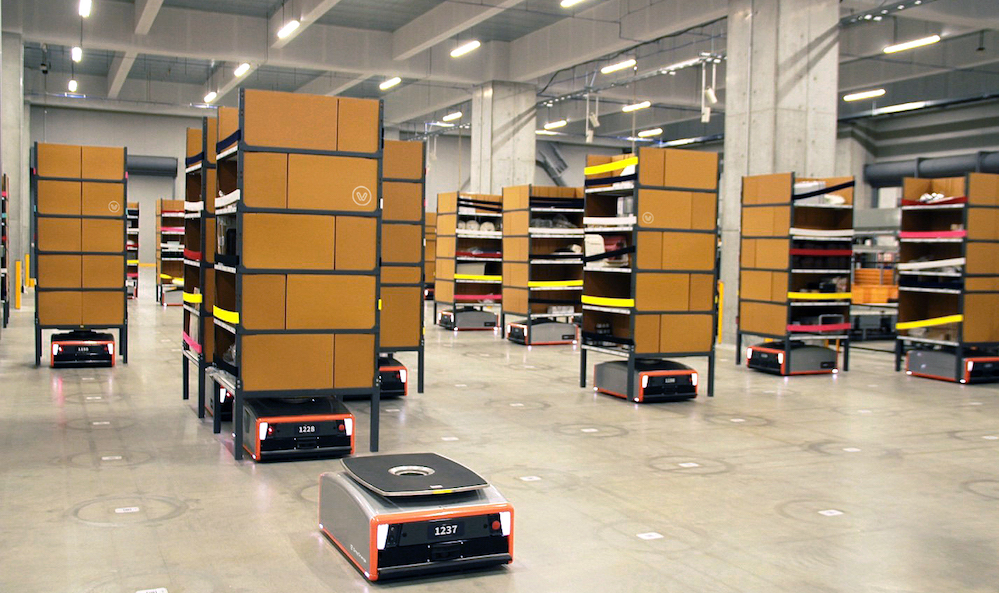
- Locus Robotics: The Collaborative Scaler. This is the definitive choice for 3PLs and e-commerce operations that prioritize flexibility, quick deployment, and low upfront capital. Its Robotics-as-a-Service (RaaS) model and exceptional user experience make it the leader in human-robot collaborative picking.
For those exploring comprehensive GreyOrange Overview and Features, understanding the competitive landscape is essential for making informed automation decisions.
1. Core Capabilities & AI Advantage
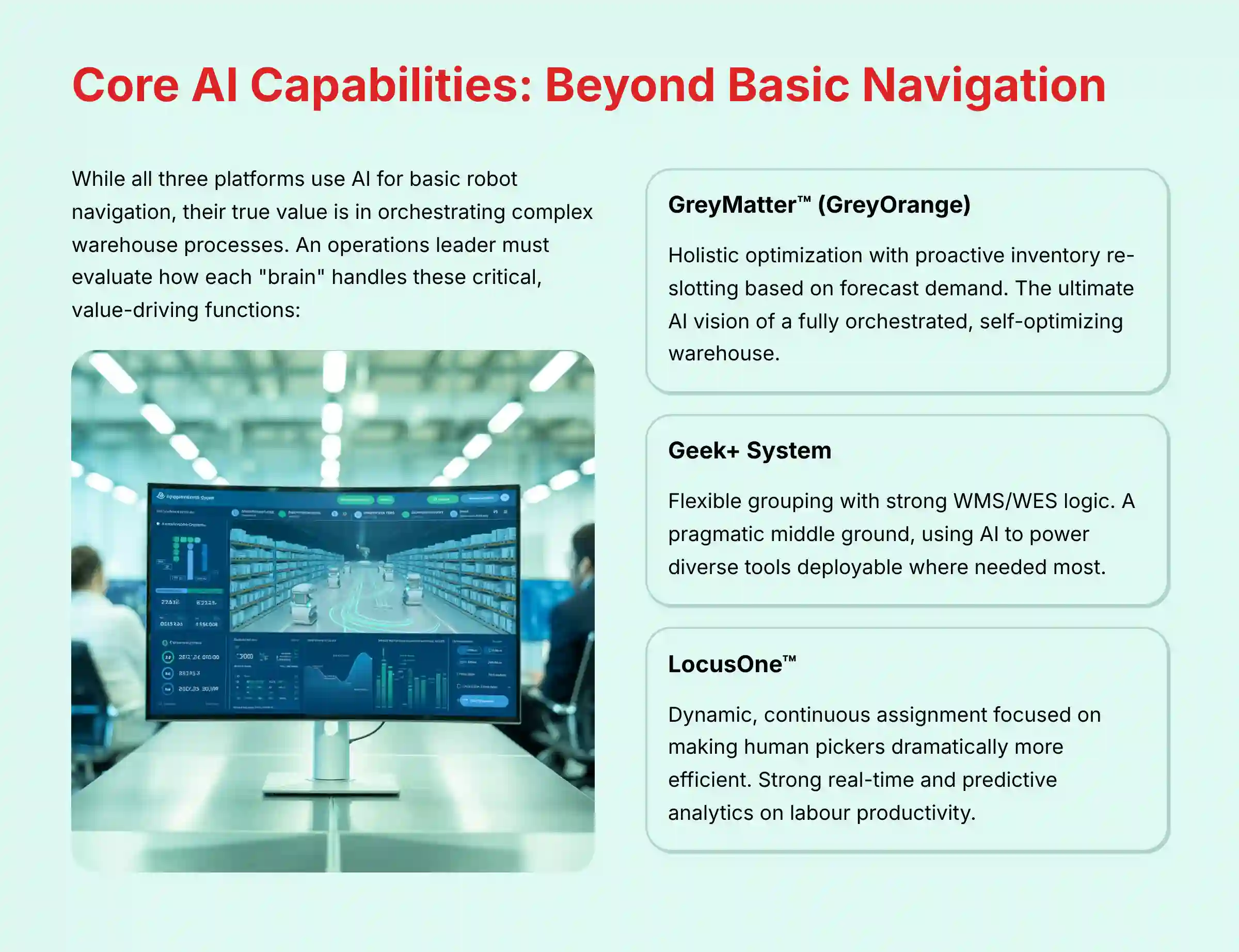
How do these platforms change a warehouse from a reactive cost center to a proactive, resilient asset? The AI platform is the central nervous system of the operation.
| Feature | GreyOrange | Geek+ | Locus Robotics |
|---|---|---|---|
| AI Platform | GreyMatter™ | Geek+ System | LocusOne™ |
| Core Philosophy | End-to-End Orchestration: A single AI platform to command all warehouse activities, from inventory to picking to sortation. It aims to be the central control tower. | Modular Automation: A full suite of software and hardware for discrete processes. Users can mix-and-match solutions under one vendor. | Collaborative Intelligence: AI optimizes tasks for a fleet of robots that work with human associates, bringing items to them to maximize picking efficiency and minimize walking. |
| Robotics | Ranger™ Robots: Goods-to-person (GTP) and sortation bots that operate as a fully coordinated fleet directed by GreyMatter. | Vast Portfolio: P-series (picking), RoboShuttle (dense storage), S-series (sorting), and automated forklifts. | LocusBots (Origin, Vector): Collaborative AMRs designed to work alongside people. Noted for their intuitive UI and approachability. |
Beyond Pathing: The AI Brain's Core Functions
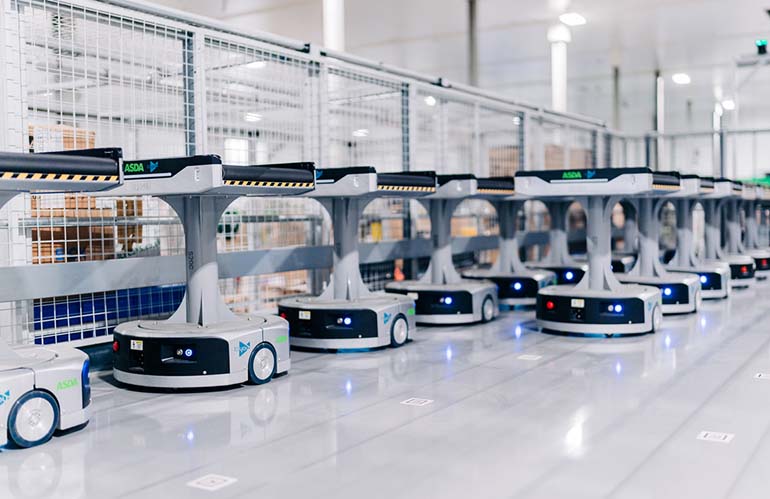
While all three platforms use AI for basic robot navigation, their true value is in orchestrating complex warehouse processes. An operations leader must evaluate how each “brain” handles these critical, value-driving functions. This is where the AI moves from just managing bots to truly optimizing the entire fulfillment engine.
| AI-Driven Process | GreyOrange (GreyMatter™) | Geek+ (Geek+ System) | Locus Robotics (LocusOne™) |
|---|---|---|---|
| Order Batching | Holistic Optimization: AI analyzes the entire order pool to create complex, multi-SKU batches for goods-to-person stations to maximize throughput. | Flexible Grouping: Can create batches for different zones or robot types. Relies on strong WMS/WES logic for initial grouping. | Dynamic & Continuous: Continuously assigns single picks to the nearest bot and directs associates on multi-bot picking missions. Optimized for speed over complex batching. |
| Dynamic Slotting | Proactive: GreyMatter's AI can recommend inventory re-slotting based on forecast demand and seasonality to reduce robot travel time. This is a core feature of its “orchestration” claim. | Typically WMS-Driven: Slotting logic usually resides in the upstream WMS. The system executes commands rather than generating the slotting strategy itself. | Not a Core Focus: The system is designed to be agile regardless of slotting. Its focus is on minimizing human travel, not optimizing inventory placement. |
| Labor Simulation | Advanced: Can model the impact of labor allocation on throughput, helping managers plan shifts for its highly integrated workstations. | Zone-Dependent: Simulation capabilities are typically focused within a specific subsystem (e.g., how many operators are needed at a RoboShuttle station). | Strong: LocusOne provides excellent real-time and predictive analytics on labor productivity and can model the impact of adding more bots to a shift. |
Professional Insight: In my experience, GreyOrange represents the ultimate AI vision of a fully orchestrated, self-optimizing warehouse. Locus focuses its AI on a more immediate, human-centric problem: making the picker dramatically more efficient. Geek+ offers a pragmatic middle ground, using AI to power a diverse set of tools that can be deployed where needed most.
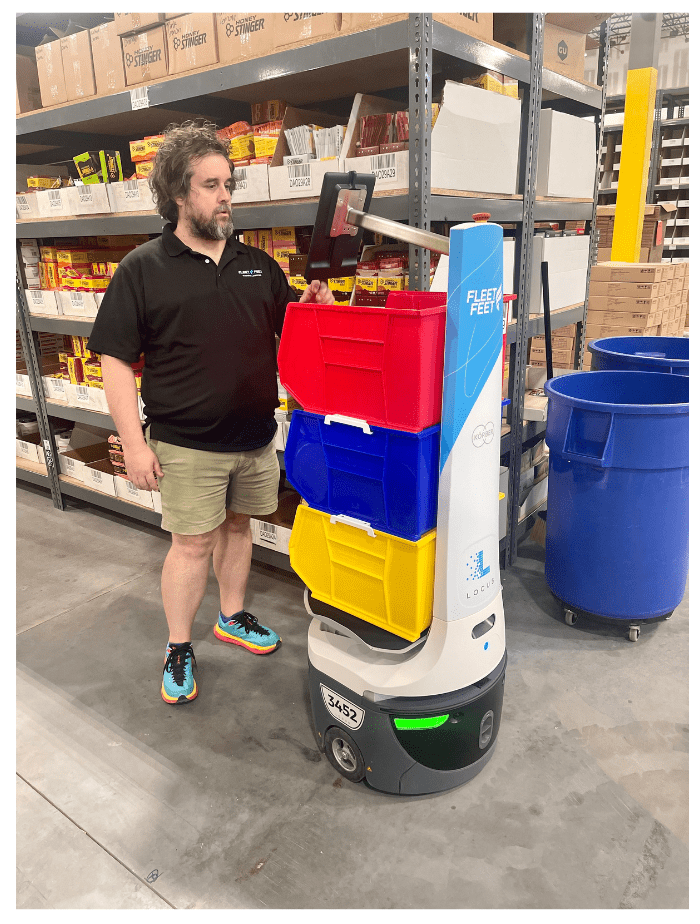
Those interested in a detailed GreyOrange Review will find these competitive insights particularly valuable for understanding market positioning.
2. Performance & Reliability
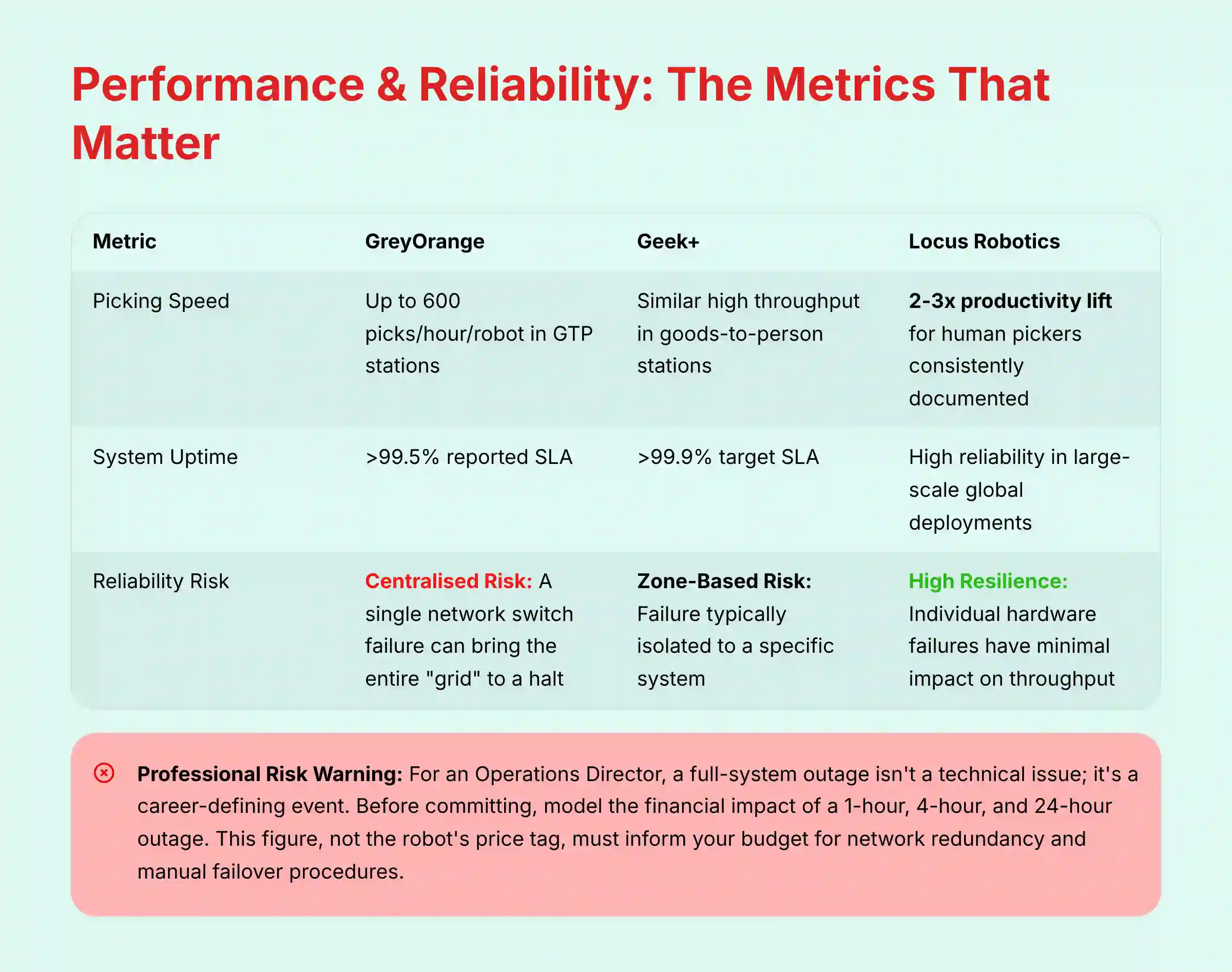
Speed, accuracy, and uptime are the metrics that matter. Downtime in these multi-million dollar systems can halt a business.
| Metric | GreyOrange | Geek+ | Locus Robotics |
|---|---|---|---|
| Picking Speed | Up to 600 picks/hour/robot in GTP stations. | Similar high throughput in goods-to-person stations. | 2-3x productivity lift for human pickers is consistently documented. |
| System Uptime | >99.5% reported SLA. | High reliability in large-scale global deployments. | >99.9% target SLA. |
| Reliability Risk | Centralized Risk: As one verified Ops Manager stated, a single network switch failure can bring the entire “grid” to a halt. This creates a catastrophic single point of failure with massive financial impact. | Zone-Based Risk: Failure is typically isolated to a specific system, but a critical hardware failure can still disable an entire zone. | High Resilience: If one bot fails, the LocusOne platform automatically reassigns its task to another. Individual hardware failures have minimal impact on overall throughput. |
YMYL Professional Risk Warning: For an Operations Director, a full-system outage isn't a technical issue; it's a career-defining event. The centralized “all or nothing” architecture of a system like GreyOrange offers immense optimization but concentrates risk into a single point of failure. Before committing, your responsibility is to model the financial impact of a 1-hour, 4-hour, and 24-hour outage. This figure, not the robot's price tag, must inform your budget for network redundancy and manual failover procedures.
3. User Experience: The Planner vs. The Operator
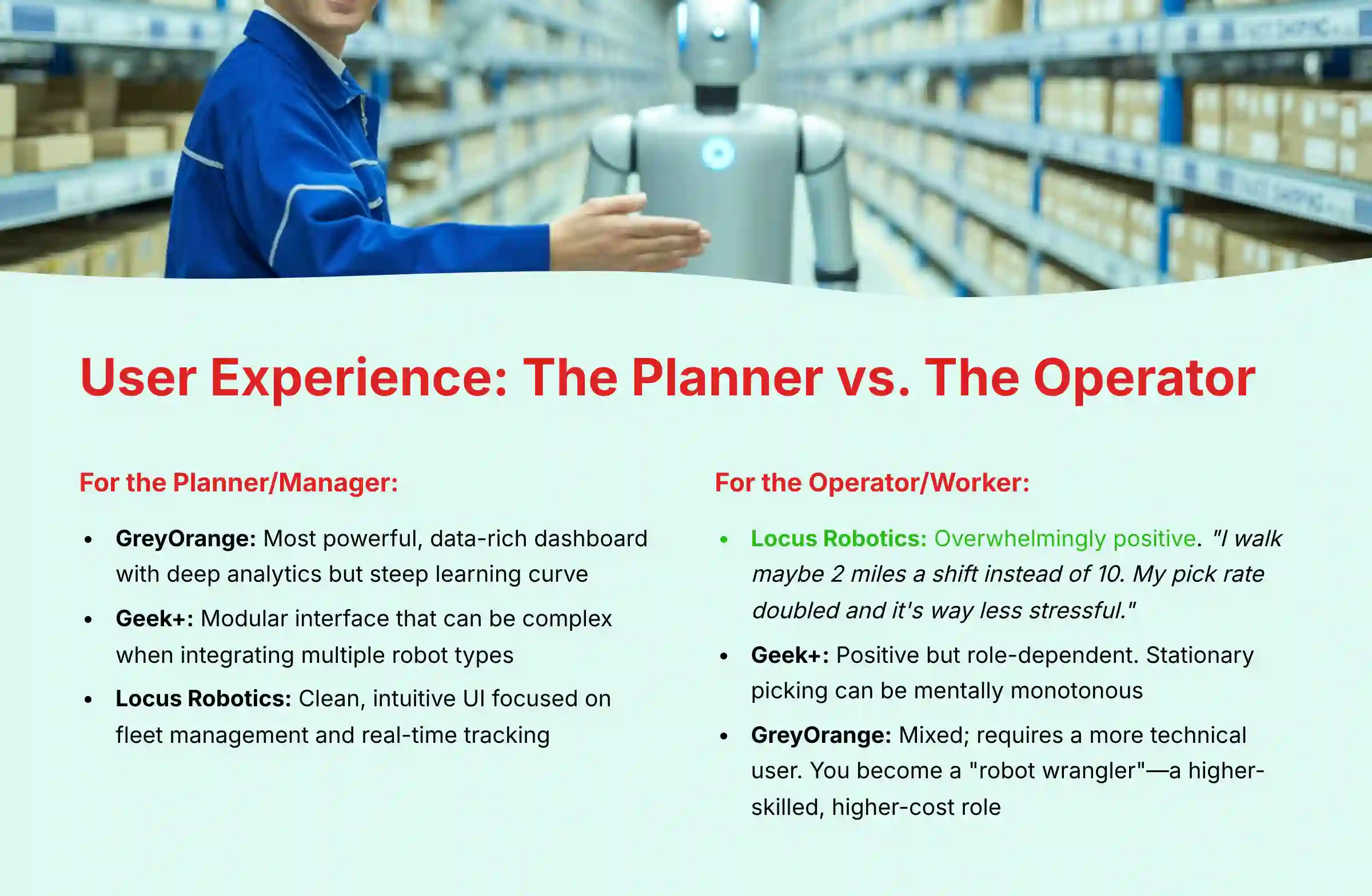
A successful system must serve both the manager in the control tower and the worker on the floor. A system that operators dislike will always underperform.
For the Planner/Manager:
- GreyOrange: Provides the most powerful, data-rich dashboard for deep analytics and end-to-end visibility. But it comes with a steep learning curve.
- Geek+: Offers a modular interface that can be complex to manage when integrating multiple robot types and workflows.
- Locus Robotics: Features a clean, intuitive UI focused on fleet management and real-time performance tracking. It is praised for its simplicity.
For the Operator/Worker:
This is where the differences are most stark, with a direct impact on employee satisfaction and retention. This is a key factor in today's tight labor market.
- Locus Robotics: Overwhelmingly positive user sentiment. Floor associates praise the gamified interface and drastic reduction in physical strain. One worker on Reddit noted: “I walk maybe 2 miles a shift instead of 10. My pick rate doubled and it's way less stressful.”
- Geek+: Positive but role-dependent. Stationary goods-to-person picking stations are ergonomic but can be mentally monotonous. This leads some managers to implement more frequent staff rotation to maintain engagement.
- GreyOrange: Mixed; requires a more technical user. The interface is less forgiving and requires a deeper understanding of the entire system's logic. As one shift lead noted, you become a “robot wrangler” or “system supervisor,” a higher-skilled and higher-cost role.
4. Integration with the Core Business Ecosystem (ERP and WMS)
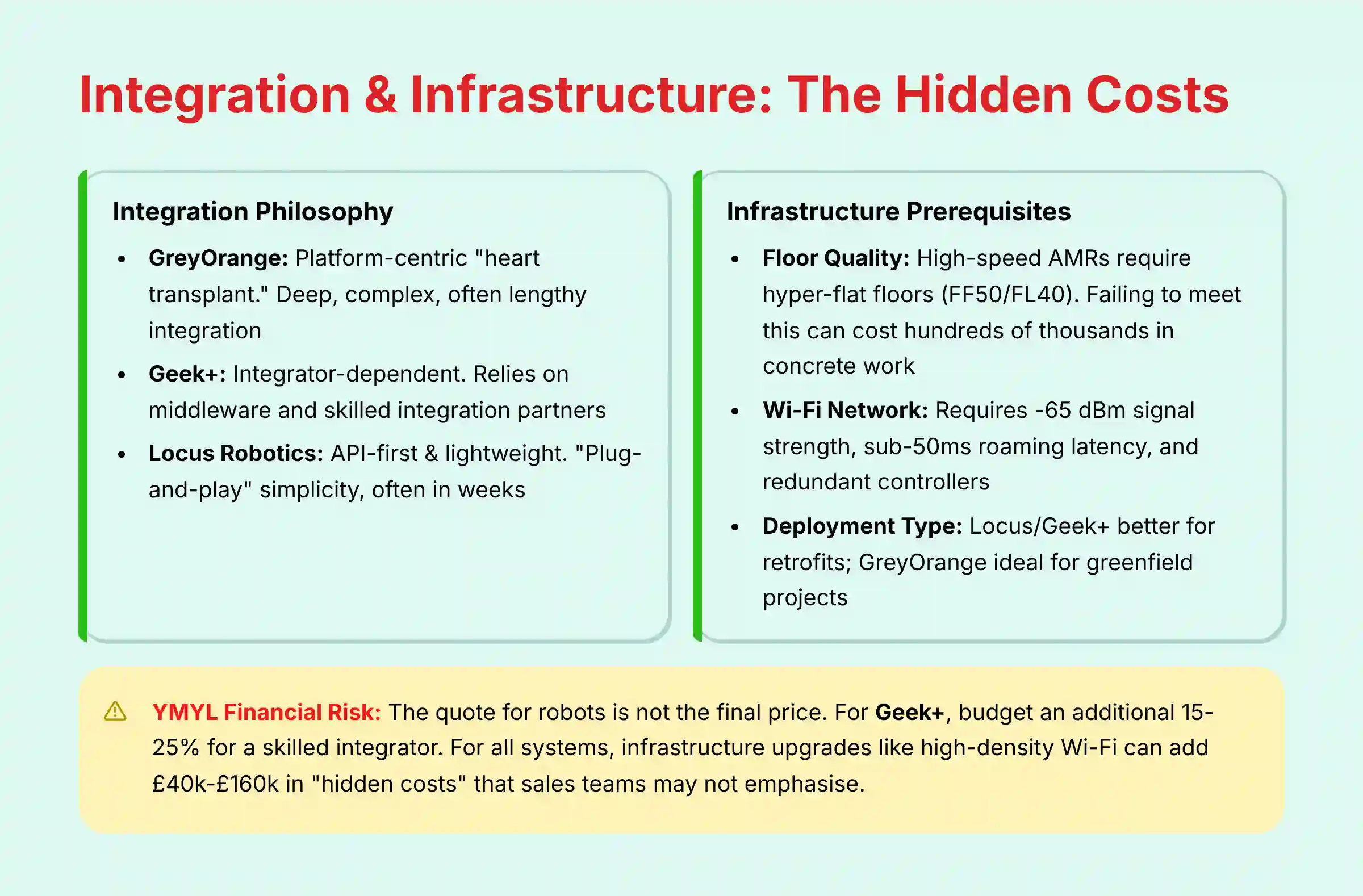
Integration is the most common point of failure, budget overruns, and professional frustration. A bad integration can destroy the ROI of a great robotics platform.
| Integration | GreyOrange | Geek+ | Locus Robotics |
|---|---|---|---|
| Philosophy | Platform-Centric: A “heart transplant.” GreyMatter is designed to take over execution, minimizing the WMS's role. It's a deep, complex, and often lengthy integration. | Integrator-Dependent: The system relies on middleware and the skill of an integration partner to bridge its diverse hardware with your ERP/WMS. | API-First & Lightweight: Designed for “plug-and-play” simplicity. The goal is to connect to your existing WMS quickly with minimal disruption, often in weeks. |
| Real-World User Feedback | “Implementing GreyOrange was a 9-month project… you're adopting their philosophy, not just their bots.” – Verified Operations Director | “Our Geek+ integration was a nightmare… until we brought in a specialized consultant. Don't cheap out on the integrator.” – Integration Architect | “We were piloting LocusBots in one zone within 6 weeks. The API integration with our Manhattan WMS was surprisingly painless.” – Verified 3PL Director |
YMYL Financial Risk: The quote for the robots is not the final price. For Geek+, users warn to budget an additional 15-25% for a skilled integrator. For all systems, infrastructure upgrades like high-density Wi-Fi can add $50k-$200k in “hidden costs” that sales teams may not emphasize.
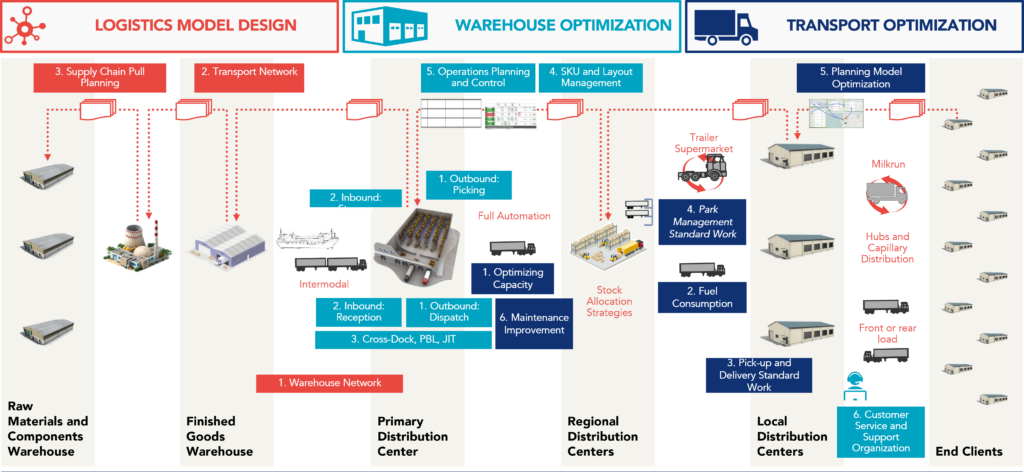
Warehouse Control System and Integration
Integration is the tradecraft of warehouse automation. Getting it wrong is like having the world's best intelligence agents who can't talk to each other—you have pockets of brilliance but no actionable intelligence. This is the #1 reason multi-million dollar projects fail, not because the robots don't work, but because they can't be seamlessly woven into your existing operational command structure (your WMS/ERP). A bad integration doesn't just hurt ROI; it creates an operational blind spot.
| Integration Layer | GreyOrange | Geek+ | Locus Robotics |
|---|---|---|---|
| Warehouse Control System (WCS) | GreyMatter serves as both WCS and WES (Warehouse Execution System), controlling the flow of work from your WMS to the robots and back. | Requires a separate WCS/WES layer, often custom-built by the integration partner. | LocusOne includes a lightweight WCS focused specifically on optimizing picking tasks received from your WMS. |
| Standard WMS Connectors | Pre-built connectors for major platforms like Manhattan, Blue Yonder, and SAP EWM. Custom connectors require development. | Depends on integration partner's expertise and pre-built connectors. Typically requires more customization. | Strong library of standard connectors for all major WMS platforms, with a focus on rapid deployment. |
| API Maturity | Comprehensive but complex API requiring deep technical expertise to leverage fully. | Modular APIs that vary in maturity across different robot types and subsystems. | Modern, RESTful APIs designed for ease of implementation and flexibility. |
For operations teams considering comprehensive warehouse transformation, exploring GreyOrange Tutorials and Usecase provides practical implementation insights.
4.5. Infrastructure Prerequisites and Deployment Realities
A successful robotics deployment is built on a solid physical and digital foundation. These non-negotiable prerequisites are often the largest source of “hidden costs” and project delays.
- Warehouse Floor Quality: High-speed AMRs require hyper-flat and level floors. Vendors specify this using Floor Flatness (FF) and Floor Levelness (FL) numbers. A typical requirement might be FF50/FL40. Failing to meet this can require grinding or replacing the concrete slab, a project that can cost hundreds of thousands of dollars and cause significant downtime. Professional Tip: Mandate a professional floor survey as part of your due diligence.
- Wi-Fi Network Integrity: This is more than just “good Wi-Fi.” It's about creating a highly redundant, low-latency network. Key requirements include:
- Signal Strength: Typically -65 dBm or better in all operational areas.
- Seamless Roaming: Sub-50ms roaming latency is essential to prevent bots from pausing or dropping commands as they move between access points.
- Redundancy: Overlapping coverage and redundant controllers are mandatory to prevent the “single network switch failure” mentioned earlier. A professional RF survey and network overhaul by a specialist is not optional.
- Brownfield vs. Greenfield Deployment:
- Brownfield (Retrofit): Locus and Geek+ are generally stronger for retrofitting existing warehouses due to their flexibility. However, challenges like navigating existing columns, mezzanines, and varying floor conditions are significant.
- Greenfield (New Build): GreyOrange is often best suited for greenfield projects where the entire building, power grid, and network can be designed around the automation from day one. This maximizes the potential of its end-to-end orchestration philosophy.
5. Security and Compliance
With sensitive supply chain data at stake, security is not negotiable. All three vendors meet enterprise-grade security standards, a mandatory YMYL checkpoint for any serious operational tool.
- GreyOrange: SOC 2 Type II, ISO 27001
- Geek+: ISO 27001, SOC 2 Type II
- Locus Robotics: SOC 2 Type II, ISO 27001, with platform support for GDPR and CCPA compliance
All platforms feature robust end-to-end encryption. They have no major publicly disclosed security breaches as of the time of this writing. This shows a mature understanding of their mission-critical role in business operations.
Professional Security Validation: Before implementation, engage a qualified security assessment team to verify that the integration between your existing systems and the robotics platform maintains your organization's security posture. Security boundaries often become vulnerabilities during integration projects, and proper hardening and testing are essential.
6. Pricing and Total Cost of Ownership (TCO)

The financial models are fundamentally different and represent a core strategic choice. Thinking about a robot system is like planning for a fleet of cars; you can buy them, or you can lease them, and each has different financial implications.
| Model | GreyOrange | Geek+ | Locus Robotics |
|---|---|---|---|
| Structure | CapEx (Capital Expenditure): Large upfront investment in bundled hardware and software. | CapEx (Modular): Upfront investment for the specific hardware and software modules you choose. | RaaS / OpEx (Operating Expenditure): A subscription model. You pay per-robot or per-pick, with minimal upfront cost. |
| Financial Impact | High Barrier to Entry: A large initial capital outlay. ROI is calculated over many years based on long-term operational savings. | Flexible Entry: Allows for more phased investment. Buy a sorting system now, add picking bots later. | Low Barrier to Entry: Preserves capital and provides predictable monthly costs. This is ideal for businesses with fluctuating demand like 3PLs. |
| Hidden Cost Warning | Specialized Staffing: The TCO must include the higher salaries of the “robot wranglers” and IT specialists required to run the system. | Integration & Infrastructure: The #1 hidden cost cited by users. Budget for a top-tier integrator and a potential Wi-Fi overhaul. | “OpEx Creep”: The predictable monthly cost can become a large long-term burden. A CFO at a retail chain noted their forecast showed that “in year 4, the cumulative OpEx for Locus would surpass the TCO of the Geek+ system.” |
TCO Beyond the Price Tag: Maintenance and Support SLAs
The long-term viability of a robotics system hinges on the vendor's ability to support it. A low initial price is irrelevant if broken robots sit idle for days waiting for repair. When negotiating your contract, these support metrics are as important as the per-bot cost.
| Support Attribute | GreyOrange | Geek+ | Locus Robotics |
|---|---|---|---|
| Support Model | Integrated & On-site: Often includes dedicated on-site technicians as part of a comprehensive support package, reflecting the system's complexity. | Partner-Led: Support is often provided by the integration partner, making their expertise and responsiveness a critical diligence item. | Centralized & Remote: Known for strong remote diagnostics and a “ship-a-spare” model. On-site support is available but may have a longer lead time. |
| Mean Time To Repair (MTTR) | Variable: Dependent on the on-site technician's skill and parts availability. A key question for reference checks. | Variable: Highly dependent on the integrator's SLA. Can be excellent or poor. | Industry Leading: Due to the high number of interchangeable bots and proactive monitoring, failed bots are often back online quickly via swap-out. |
| Spare Parts Strategy | On-site Cache: Critical spares are typically required to be stocked on-site due to the integrated nature of the hardware. | Integrator or Depot: Parts may be stocked by the integrator or at a regional depot. | Vendor-Managed: Locus often manages the spare parts inventory as part of the RaaS subscription, shipping replacements as needed. |
YMYL Professional Diligence: Your contract must have a clearly defined Service Level Agreement (SLA) for support, specifying guaranteed response times and an MTTR target. Ask reference customers about their real-world experience with downtime and the vendor's adherence to their support SLA.
Your Responsibility as a Leader: A Note on Due Diligence
This analysis is a strategic briefing designed to sharpen your thinking and frame your decision-making. As a leader, your final due diligence is non-negotiable.
- Validate Directly: The world of AI robotics evolves rapidly. Use this guide as your framework, but always verify current technical specifications, security certifications (SOC 2, ISO 27001), and pricing directly with the vendors.
- Consult the Specialists: This investment extends far beyond the robots themselves. I strongly recommend engaging a qualified systems integrator and a network architect early in your process. Their expertise is critical for de-risking the project and accurately forecasting the Total Cost of Ownership.
- Trust, But Verify on the Floor: Our analysis is grounded in real-world performance metrics and user feedback. However, your unique operational environment is the ultimate test. The most important data you will gather will come from speaking directly to the floor associates and maintenance crews at reference sites.
For teams needing specific implementation guidance, our comprehensive GreyOrange FAQs address common technical and operational questions.
Final Verdict and Use Case Recommendations
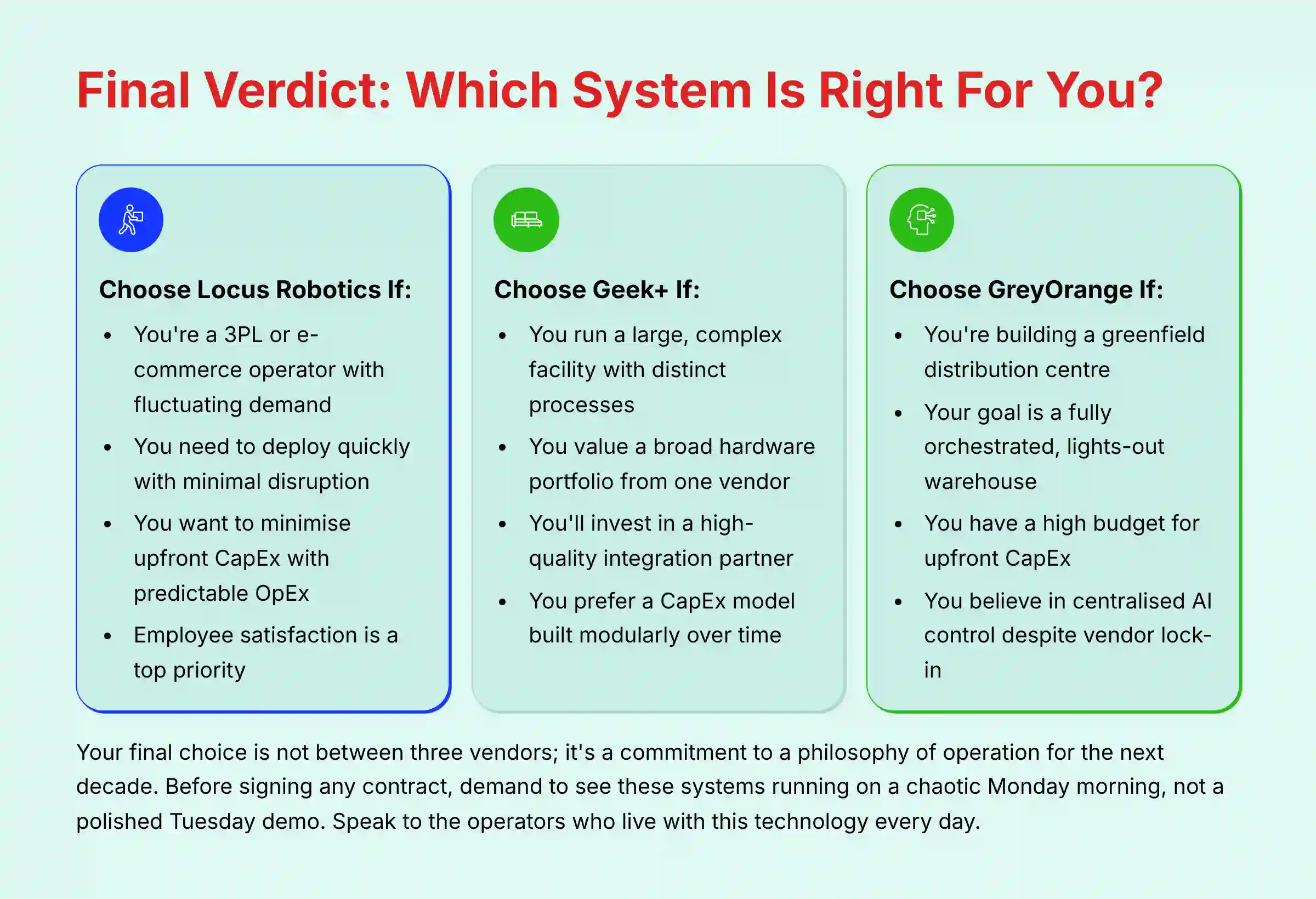
The best choice is a function of your operational profile, financial strategy, and risk tolerance. There is no single correct answer for everyone.
CHOOSE LOCUS ROBOTICS IF:
- You are a 3PL, e-commerce, or retail operator with fluctuating demand and seasonal peaks.
- You need to deploy a solution quickly (in weeks, not months) with minimal disruption.
- You want to minimize upfront CapEx and prefer a predictable OpEx model.
- Employee satisfaction and ease of use for floor associates is a top priority.
- Your primary bottleneck is picking efficiency and travel time.
CHOOSE GEEK+ IF:
- You run a large, complex facility with multiple, distinct processes.
- You value a broad portfolio of hardware from a single vendor.
- You have the budget and willingness to invest in a high-quality third-party integration partner to manage complexity.
- You prefer a CapEx model and want to build a solution modularly over time.
CHOOSE GREYORANGE IF:
- You are building a greenfield (new) distribution center or are prepared for a complete operational overhaul.
- Your goal is to create a fully orchestrated, lights-out warehouse run by a single, powerful AI platform.
- You have a high budget for upfront CapEx and the internal resources to manage a long, complex implementation project.
- You believe in a future of centralized AI control and are willing to accept the risks of vendor lock-in for the promise of maximum optimization.
Final Mandate: Press Your Advantage
Your final choice is not between three vendors; it's a commitment to a philosophy of operation for the next decade. Before you sign any contract, demand to see these systems running on a chaotic Monday morning, not a polished Tuesday demo. Speak to the operators who live with this technology every day.
The inflection point is here. The tools to build a resilient, proactive, and vastly more efficient operation are available. The only remaining question is which leaders will have the conviction to connect the dots and press the advantage.
For broader context on warehouse automation solutions, explore our comprehensive guide on Best 10 AI For Warehouse Robotics & Automation Solutions: The Definitive 2025 Guide to understand the complete competitive landscape.

Leave a Reply