Which AI Warehouse Automation System Fits Your Needs?
This 2-Minute Quiz Reveals Your Ideal Solution!
The simple truth is, we are at a major inflection point in warehouse operations, and understanding the nuances of AI-powered solutions is no longer optional. This comprehensive GreyOrange FAQs article is your essential guide, cutting through the marketing noise to deliver objective, actionable insights for operations leaders navigating the complex world of AI for Warehouse & Inventory Management.
We'll move beyond passive visibility, empowering you to make informed decisions that drive real transformation. From understanding how AI robotics dramatically improve fulfillment speed and accuracy to calculating the true ROI, you'll gain the strategic framework to transform your supply chain from a reactive cost center into a proactive, data-driven strategic asset.
Here at Best Ops Chain AI, our mission, championed by founder Hisham Serry, is to empower professionals like you to choose the right tools, reduce costs, and build resilience. Dive in to connect the dots on how GreyOrange tackles labor scarcity, ensures data security, and scales to meet unprecedented demand, ensuring you can press the advantage in a permanently volatile market.
Key Takeaways
- AI-Powered Revolution: GreyOrange combines autonomous mobile robots (AMRs) with GreyMatter™ AI platform to create fully integrated warehouse automation ecosystems
- Operational Transformation: Goods-to-Person methodology increases picking rates by 200-500% while reducing labor dependency and improving accuracy to 99.9%
- ROI Timeline: Typical payback period of 18-36 months with multiple value streams including labor reduction, accuracy improvements, and scalability benefits
- Implementation Excellence: 6-9 month implementation timeline with comprehensive integration support for existing WMS/ERP systems
- Flexible Pricing: Choice between Robotics-as-a-Service (RaaS) and Capital Expenditure models to match different business requirements and financial strategies
What is GreyOrange and how does its AI transform warehouse fulfillment operations?

GreyOrange is a global technology company specializing in AI-driven robotics solutions designed to revolutionize warehouse and fulfillment center operations. At its core, GreyOrange combines a fleet of Autonomous Mobile Robots (AMRs) with its proprietary AI software platform, GreyMatter™, to create a fully integrated warehouse automation ecosystem.
The foundation of GreyOrange's approach is the “Goods-to-Person” (G2P) methodology, which fundamentally inverts traditional warehouse operations. Rather than workers walking miles through warehouse aisles to locate products (the “Person-to-Goods” model), the GreyOrange system brings inventory directly to stationary workers at ergonomic picking stations.
This transformation is powered by two key technological components:
- GreyMatter™ AI Platform: This sophisticated software serves as the central nervous system of the entire operation. It seamlessly integrates with existing Warehouse Management Systems (WMS) and Enterprise Resource Planning (ERP) solutions to orchestrate inventory, process orders, and optimize fulfillment workflows in real-time. The AI continuously analyzes operational data to make intelligent decisions about inventory placement, order batching, and robot navigation patterns.
- Ranger™ Series Robots: These purpose-built AMRs execute the physical tasks determined by the GreyMatter AI. They navigate autonomously throughout the warehouse, locating and retrieving mobile storage units (often called pods or shelves) containing the required inventory, and delivering them to picking stations where human workers can efficiently fulfill orders.
The integrated system creates a continuous optimization loop—as the AI learns from each pick, it dynamically adjusts inventory placement, keeping high-velocity items more accessible and improving operational efficiency over time. This data-driven approach transforms traditionally labor-intensive, error-prone warehouse operations into highly efficient, scalable, and resilient fulfillment systems that can adapt to changing demand patterns with minimal human intervention.
What specific operational challenges does GreyOrange solve in modern warehouses?
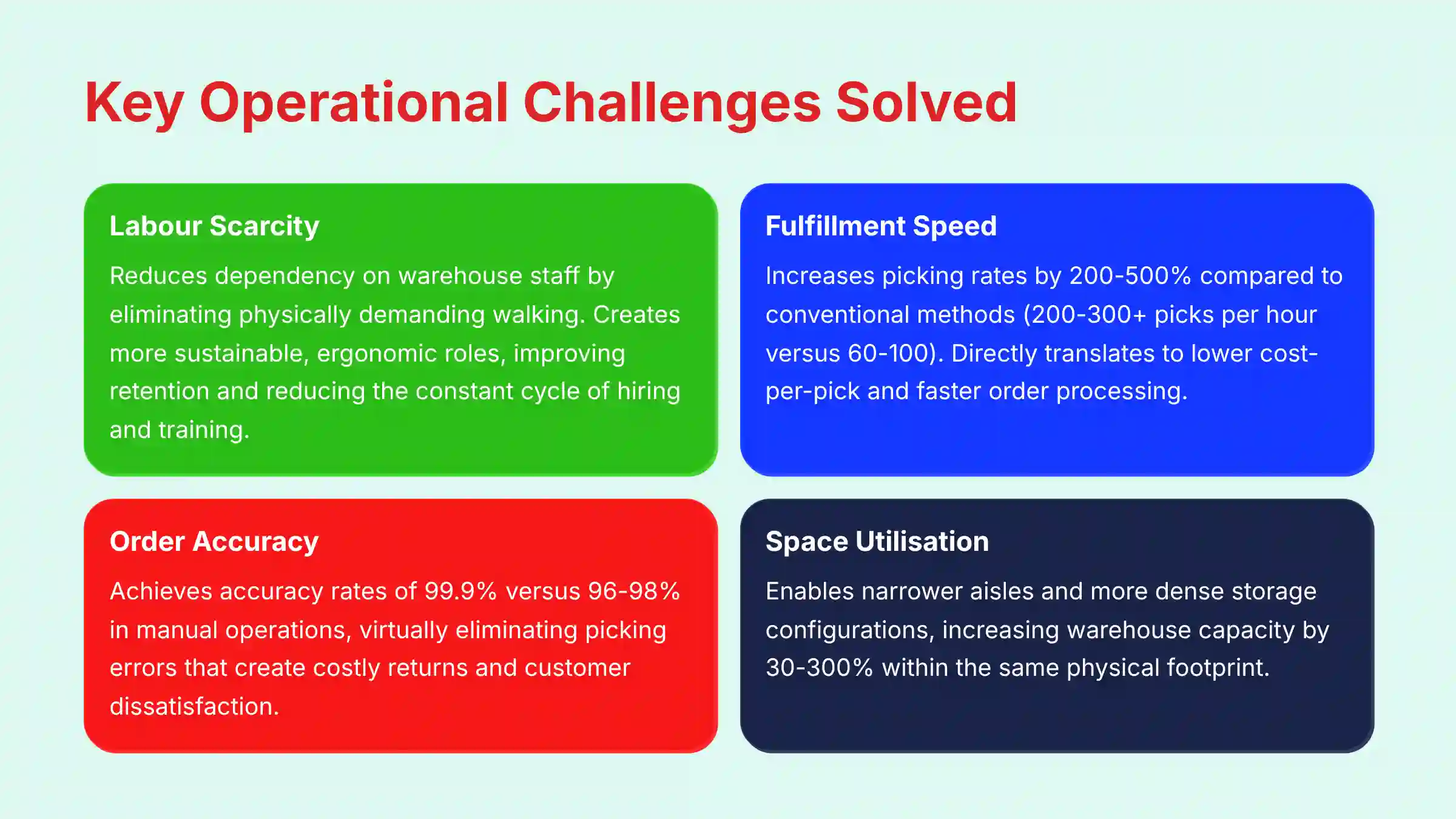
GreyOrange directly addresses the most critical operational challenges facing today's warehouses and fulfillment centers, transforming these facilities from reactive, labor-dependent operations into proactive, data-driven fulfillment engines. The solution targets five fundamental pain points that consistently impact warehouse profitability and performance:
Labor Scarcity and Volatility: The warehouse industry faces chronic staffing challenges with high turnover rates (often exceeding 40%) and seasonal labor shortages. GreyOrange's Goods-to-Person (G2P) model dramatically reduces labor dependency by eliminating the most physically demanding aspects of warehouse work—walking miles of aisles daily. This creates more sustainable, ergonomic roles for warehouse associates, improving retention and reducing the constant cycle of hiring and training.
Fulfillment Speed and Cost Inefficiencies: Traditional picking methods are inherently slow and labor-intensive. GreyOrange's system can increase picking rates by 200-500% compared to conventional methods, with operators able to process 200-300+ picks per hour versus 60-100 in manual operations. This directly translates to lower cost-per-pick and faster order processing, enabling warehouses to meet same-day and next-day delivery expectations.
Order Accuracy Challenges: Manual picking processes typically achieve accuracy rates of 96-98%, meaning 2-4% of orders contain errors. Each error creates costly returns, customer dissatisfaction, and operational disruption. GreyOrange's directed picking approach, combined with validation technologies like put-to-light systems, can achieve accuracy rates of 99.9%, virtually eliminating picking errors.
Seasonal Scalability Constraints: Most warehouses struggle to handle volume fluctuations, particularly during peak seasons like Black Friday or holiday periods when order volumes can increase 5-10x. Traditional solutions require hiring and training temporary workers, often at premium wages. GreyOrange provides flexible scalability through additional robots (often via a Robotics-as-a-Service model) without the complexities of massive temporary workforce management.
Space Utilization Inefficiencies: Conventional warehouses require wide aisles for forklifts and human pickers. The GreyOrange system enables narrower aisles and more dense storage configurations, increasing a warehouse's effective capacity by 30-300% within the same physical footprint. This space optimization can defer or eliminate the need for facility expansion, generating significant cost savings.
By addressing these interrelated challenges, GreyOrange transforms the warehouse from a cost center into a strategic competitive advantage that can adapt to evolving market demands with unprecedented agility.
How does GreyOrange's Goods-to-Person approach differ from traditional warehouse automation systems?

GreyOrange's Goods-to-Person (G2P) automation represents a fundamental departure from traditional warehouse automation systems in terms of flexibility, adaptability, and implementation methodology. Understanding these differences is crucial for operations leaders evaluating automation solutions for their fulfillment networks.
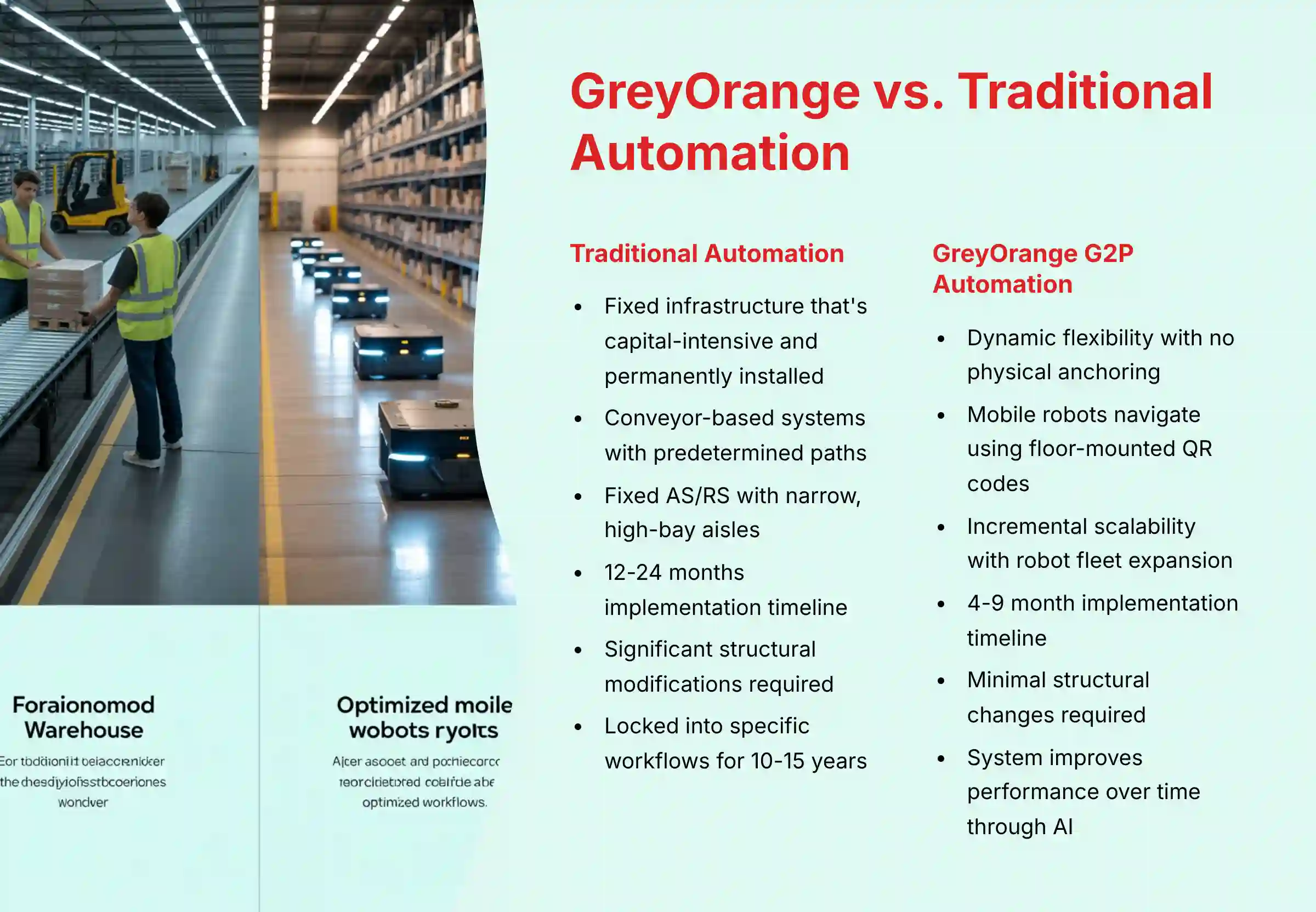
Traditional Warehouse Automation typically relies on fixed infrastructure that's capital-intensive and permanently installed:
- Conveyor-Based Systems: These extensive networks of powered belts and rollers transport products throughout the facility. While effective for high-volume movement along predetermined paths, they're inherently inflexible—once installed, changing the flow requires significant physical reconstruction. Their fixed capacity can't easily scale for seasonal peaks.
- Fixed AS/RS (Automated Storage and Retrieval Systems): These crane-based systems operate in narrow, high-bay aisles. They maximize vertical storage density but are extremely rigid in their design and operation. Their throughput is determined at construction and cannot be easily modified to accommodate changing business needs.
- Miniload and Shuttle Systems: While more modular than cranes, these systems still require permanent racking structures and fixed pickup/delivery points, limiting reconfiguration options once installed.
These traditional systems typically require 12-24 months for implementation, demand significant structural modifications to facilities, and lock operations into specific workflows for 10-15 year lifecycles.
GreyOrange's G2P Automation, by contrast, operates on fundamentally different principles:
- Dynamic Flexibility: The system isn't physically anchored to the facility. Mobile robots navigate using floor-mounted QR codes or visual SLAM technology, allowing the entire operation to be reconfigured without infrastructure changes. Workstations can be relocated, workflows adjusted, and the system can even be transferred to a different facility if needed.
- Incremental Scalability: Rather than a binary “all-or-nothing” implementation, GreyOrange can start with a smaller robot fleet and expand incrementally. Throughput can be increased by simply adding robots to the existing fleet—a process that takes days, not months. This allows operations to match capacity precisely to demand.
- Rapid Implementation: A GreyOrange system can typically be deployed in 4-9 months versus 1-2 years for traditional automation, delivering ROI much faster. The implementation requires minimal structural changes to the existing building.
- Software-Defined Performance: The GreyMatter™ AI continually optimizes robot movement patterns, inventory placement, and order batching algorithms. This means the system actually improves performance over time through software updates and machine learning, unlike fixed automation whose performance typically degrades with age.
This fundamental architectural difference gives operations leaders unprecedented agility to adapt to market changes, seasonality, and evolving business requirements—capabilities that are increasingly essential in today's volatile supply chain environment.
How does GreyOrange compare to competitors like Locus Robotics, AutoStore, and Exotec?
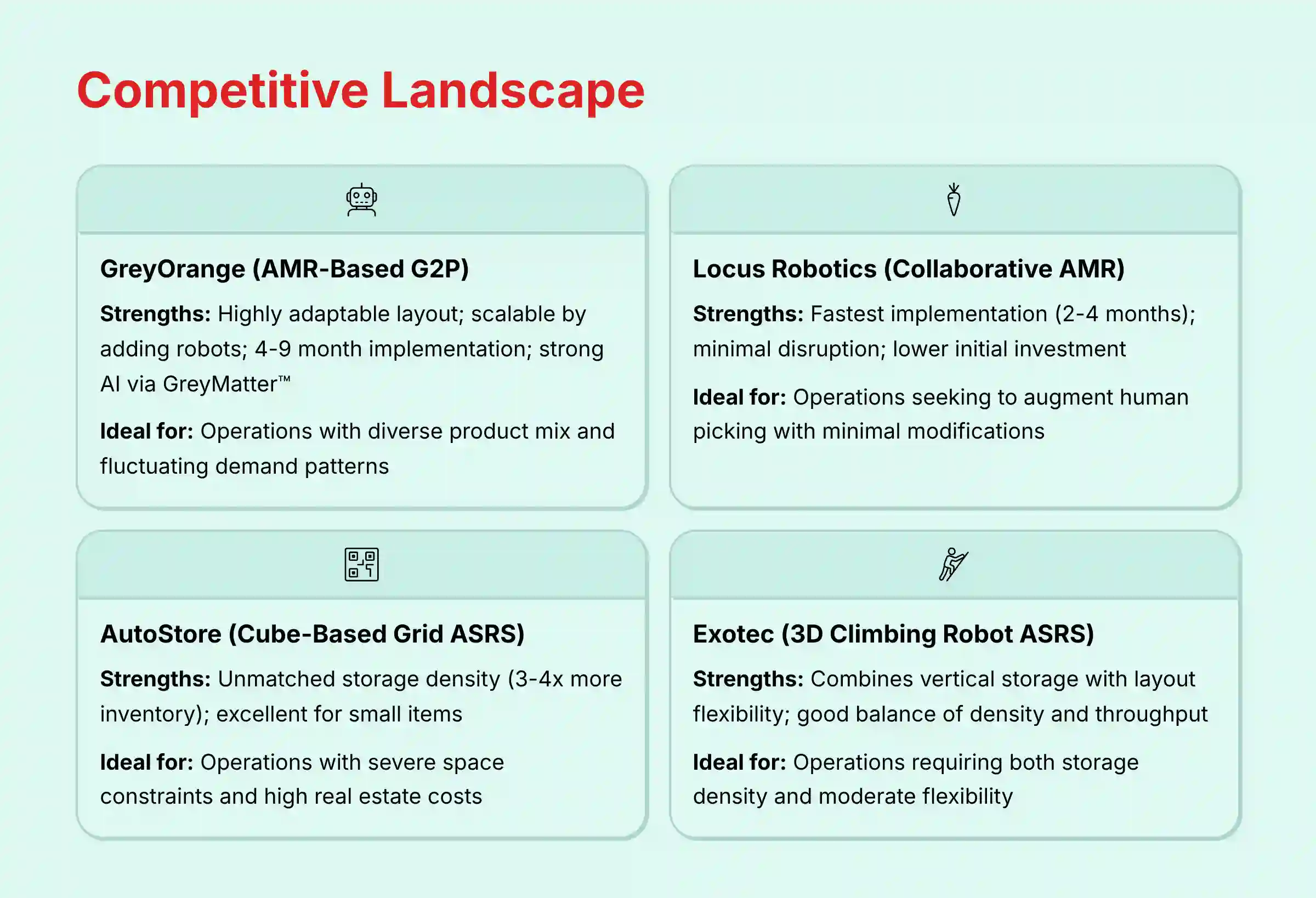
GreyOrange operates in the competitive warehouse automation landscape alongside several major players, each with distinct technological approaches and operational strengths. Understanding these differences is crucial for operations leaders to select the solution that best aligns with their specific fulfillment requirements and business objectives.
GreyOrange (AMR-Based Goods-to-Person)
- Core Technology: Autonomous Mobile Robots (AMRs) that transport entire mobile storage units to stationary pickers
- Key Strengths: Highly adaptable system layout; scalable by adding robots; moderate implementation timeline (4-9 months); strong software intelligence via GreyMatter™ platform
- Ideal Use Case: Operations with diverse product mix, moderate to high SKU count, and fluctuating demand patterns requiring adaptability
- Limitations: Requires dedicated floor space for robot movement; not optimized for extremely small items or ultra-high-density storage
Locus Robotics (Collaborative AMR)
- Core Technology: Collaborative robots that meet human pickers in the aisles, then transport picked items to packing stations
- Key Strengths: Fastest implementation (2-4 months); minimal disruption to existing operations; lower initial investment; works with existing shelving
- Ideal Use Case: Operations seeking to augment (not replace) human picking; facilities with existing infrastructure they don't want to modify; companies seeking the lowest-risk entry point to automation
- Limitations: Still requires humans to walk aisles (though less distance); lower picking density than full G2P systems; potentially higher long-term labor requirements
AutoStore (Cube-Based Grid ASRS)
- Core Technology: High-density aluminum grid system with robots operating on top, digging down to retrieve bins
- Key Strengths: Unmatched storage density (can store 3-4x more inventory in the same footprint); excellent for small to medium items; highly reliable with simple mechanics
- Ideal Use Case: Operations with severe space constraints; facilities with high real estate costs; businesses with high SKU counts of small to medium-sized items
- Limitations: Less flexible once installed; higher upfront investment; longer implementation timeline (9-18 months); challenging to relocate
Exotec (3D Climbing Robot ASRS)
- Core Technology: Robots that can both travel horizontally and climb vertically on specialized racking structures
- Key Strengths: Combines vertical storage efficiency with some layout flexibility; good balance of density and throughput; supports easy expansion of the grid
- Ideal Use Case: Operations requiring both storage density and moderate flexibility; facilities with available vertical space but limited floor space
- Limitations: Higher system complexity; specialized rack requirements; typically higher cost than standard AMR solutions
Decision Framework for Operations Leaders:
- Choose GreyOrange when flexibility, adaptability to changing product mix, and moderate implementation timeline are priorities
- Choose Locus Robotics when seeking the fastest implementation with minimal disruption to existing operations
- Choose AutoStore when maximum storage density is the absolute priority and space is at a premium
- Choose Exotec when seeking a balance between vertical storage efficiency and system adaptability
The optimal choice ultimately depends on your specific operational constraints, growth projections, and strategic priorities. Many large-scale fulfillment networks are increasingly implementing hybrid approaches, using different technologies in different zones of the warehouse based on product characteristics and throughput requirements.
What is the typical ROI timeline for a GreyOrange implementation and how should it be calculated?
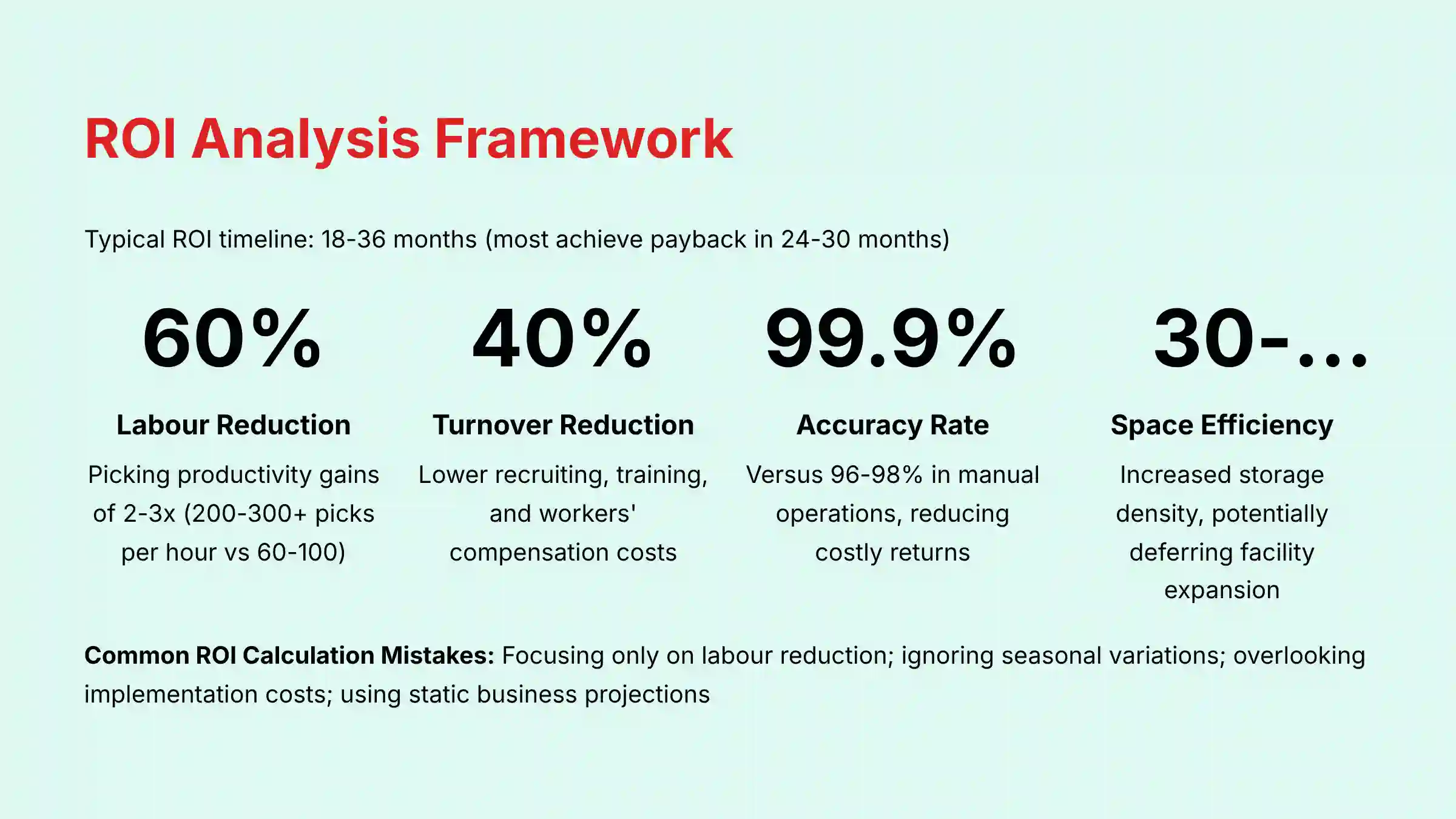
The Return on Investment (ROI) for a GreyOrange implementation typically ranges from 18-36 months, with many operations achieving payback in the 24-30 month range. However, this timeline can vary significantly based on operational specifics, labor costs in your region, and implementation scope. A comprehensive ROI analysis requires examining multiple value streams beyond simple labor reduction.
Core ROI Components to Include in Your Analysis:
1. Direct Labor Cost Reduction
- Picking Productivity Gains: GreyOrange typically enables 2-3x higher pick rates (200-300+ picks per hour vs. 60-100 in manual operations)
- Calculation Method: (Number of pickers × Average fully-loaded annual cost per picker × Reduction percentage) = Annual savings
- Example: 50 pickers × $55,000 annual cost × 60% reduction = $1.65M annual savings
2. Labor-Adjacent Cost Savings
- Reduced Recruiting & Training: With warehouse turnover often exceeding 40%, the cost of continuously recruiting, onboarding, and training new staff is substantial
- Workers' Compensation Reduction: By eliminating extensive walking and reaching, G2P systems typically reduce workplace injuries by 30-50%
- Calculation Method: (Annual recruiting cost + Annual training cost + Annual workers' comp claims) × Expected reduction percentage
3. Accuracy-Driven Savings
- Error Reduction: Manual operations typically have 2-4% error rates versus 0.1% or less with G2P systems
- Calculation Method: (Annual order volume × Error rate difference × Average cost per error) = Annual savings
- Error Cost Components: Include return shipping, processing labor, replacement shipping, customer service time, and customer lifetime value impact
4. Throughput and Capacity Benefits
- Deferred Facility Expansion: By increasing storage density 30-300% and throughput 2-3x, expansion needs can be delayed or eliminated
- Peak Season Performance: Calculate the revenue preservation from being able to process peak volume without service degradation
- Calculation Method: Quantify the cost avoidance of building/leasing additional space and the value of increased throughput during high-demand periods
5. Strategic Business Benefits
- Faster Order Fulfillment: Reducing processing time from 24+ hours to same-day can increase conversion rates and reduce cart abandonment
- Improved Customer Experience: Consistently accurate and timely delivery builds brand loyalty and increases repeat purchases
- Calculation Method: While harder to quantify, model the impact of improved service levels on customer retention and lifetime value
Common ROI Calculation Mistakes to Avoid:
- Focusing Only on Labor Reduction: The most compelling ROI cases include the full spectrum of benefits, especially throughput increases and accuracy improvements
- Ignoring Seasonal Variations: Include the value of being able to handle peak periods without massive temporary hiring
- Overlooking Implementation and Change Management Costs: Factor in not just the technology, but the process re-engineering and training requirements
- Using Static Business Projections: Your ROI model should account for projected business growth and changing customer expectations
A well-constructed ROI analysis should present multiple scenarios (conservative, expected, and optimistic) with clear assumptions that stakeholders can validate. The most convincing business cases frame the investment not simply as cost reduction but as a strategic enabler of business growth and customer satisfaction.

What are the potential limitations and risks of implementing a GreyOrange system?
While GreyOrange's AI-powered automation offers transformative benefits for warehouse operations, a successful implementation requires a clear understanding of potential limitations and risk factors. Operations leaders should proactively address these considerations in their project planning to ensure optimal outcomes.
Technical and Operational Limitations:
Product Handling Constraints: The system is optimized for items that fit within standardized storage units (typically items weighing under 30-35 pounds and smaller than 16″×24″×12″). Very large, irregularly shaped, or extremely heavy items may require separate, manual handling processes. Operations with predominantly oversized merchandise should evaluate whether enough of their SKU base fits within these parameters to justify the investment.
Floor Space Requirements: While GreyOrange significantly improves vertical storage density, the system requires dedicated floor space for robot travel paths. This typically results in less dramatic space efficiency improvements compared to high-density systems like AutoStore. Facilities with extremely limited floor space may need to carefully analyze the space utilization tradeoffs.
Wi-Fi Dependency: The robots and GreyMatter™ platform rely on robust, enterprise-grade Wi-Fi coverage throughout the facility. Warehouses with challenging RF environments (metal structures, interference sources) may require significant network infrastructure upgrades prior to implementation.
Implementation and Organizational Risks:
Integration Complexity: The depth of integration with existing WMS/ERP systems directly impacts implementation timelines and success. Companies with highly customized or legacy systems may face more complex integration challenges, requiring specialized middleware or custom development work.
Data Quality Issues: The AI's effectiveness depends entirely on accurate inventory data. Operations with poor existing inventory accuracy, incomplete product attribute data (dimensions, weights), or inconsistent location tracking will need to undertake data cleansing initiatives before automation can deliver optimal results.
Change Management Challenges: Workforce resistance can severely impact implementation success. Without proper communication and training, employees may perceive automation as a threat rather than an opportunity for role enhancement. A comprehensive change management program is essential, particularly for organizations without previous automation experience.
Financial and Strategic Considerations:
Capital Intensity (for CapEx Model): The upfront investment is substantial, typically ranging from $2-10+ million depending on scale. Organizations with limited capital availability may need to explore RaaS (Robotics-as-a-Service) models, even if the long-term TCO is higher.
Vendor Stability and Support: As with any strategic technology investment, the long-term viability of the vendor is crucial. While GreyOrange is well-established, operations leaders should conduct due diligence on financial stability, support infrastructure, and spare parts availability before committing.
Forecasting Uncertainty: Sizing the system appropriately requires accurate projections of future order volumes and patterns. Under-sizing leads to capacity constraints, while over-sizing results in underutilized assets. Organizations with highly unpredictable demand patterns face greater challenges in right-sizing their automation investment.
Risk Mitigation Strategies:
To address these potential limitations, consider a phased implementation approach, beginning with a pilot zone before full-scale deployment. Invest in comprehensive data cleansing prior to implementation, and develop clear contingency plans for system outages or performance issues. Finally, ensure executive sponsorship extends beyond the project implementation to support the organizational changes required for long-term success.
What pricing models does GreyOrange offer and how do they impact total cost of ownership?
GreyOrange offers two primary pricing models—Robotics-as-a-Service (RaaS) and traditional Capital Expenditure (CapEx) purchase—each with distinct financial implications for operations leaders. Understanding the nuances of these models is essential for making financially sound automation decisions aligned with your company's capital structure and operational strategy.
Robotics-as-a-Service (RaaS) Model
The RaaS model transforms warehouse automation from a capital-intensive investment into an operational expense with predictable monthly payments. Key characteristics include:
- Financial Structure: Monthly or quarterly subscription payments that typically include the robots, GreyMatter™ software, maintenance, and support in a single fee
- Contract Length: Usually 3-5 years, with options to extend
- Upfront Costs: Significantly lower initial investment, typically limited to site preparation, integration services, and potentially a smaller upfront payment
- Scalability Advantage: The ability to flex the robot fleet size up or down based on seasonal demand, often with 30-90 days notice
- Financial Reporting Impact: Treated as an operating expense on financial statements, which can be advantageous for companies seeking to maintain debt covenants or minimize balance sheet impact
- Typical Cost Range: Monthly fees often range from $1,500-$3,500 per robot, varying based on fleet size, contract length, and included services
Capital Expenditure (CapEx) Model
The traditional purchase model involves buying the hardware and software outright as a fixed asset. Key characteristics include:
- Financial Structure: Large upfront capital investment with separate ongoing costs for software licensing, maintenance, and support
- Asset Ownership: The company owns the hardware assets, which appear on the balance sheet and depreciate over time (typically 5-7 years for this equipment class)
- Tax Advantages: Potential for depreciation tax benefits, equipment tax credits, and Section 179 deductions (in the US)
- Scalability Considerations: Adding capacity requires additional capital investment, making it less flexible for seasonal businesses
- Typical Cost Range: $50,000-$100,000+ per robot plus infrastructure, with the GreyMatter™ software typically priced based on the number of robots, workstations, and integration complexity
Total Cost of Ownership (TCO) Analysis
When evaluating these models, a comprehensive TCO analysis should include:
- Direct Costs:
- Hardware (robots, charging stations, workstations)
- Software licensing and updates
- Implementation and integration services
- Maintenance and support
- Facility modifications (floor preparation, Wi-Fi infrastructure)
- Indirect Costs:
- Internal IT resources for integration and ongoing management
- Training and change management
- Operational disruption during implementation
- Potential productivity ramping period
- Financial Considerations:
- Cost of capital and opportunity cost of funds
- Tax implications of different acquisition models
- Balance sheet impact and covenant considerations
- Flexibility needs for seasonal or growing businesses
Strategic Decision Framework:
- Choose RaaS when: Capital preservation is priority; business has significant seasonality; you prefer technology refreshes; operations are evolving rapidly
- Choose CapEx when: Capital is readily available; utilization will be consistent; you prefer asset ownership; tax advantages are significant for your business
Many companies are increasingly adopting hybrid approaches, purchasing a base capacity and using RaaS for seasonal flex capacity. The optimal financial structure should align with both your operational requirements and broader corporate financial strategy.
How does GreyOrange's GreyMatter software integrate with existing WMS and ERP systems?
GreyOrange's GreyMatter™ software serves as an intelligent orchestration layer between your core business systems and the physical automation in your warehouse. This integration is the critical foundation that determines both implementation timeline and operational success. Understanding the technical architecture and integration methodology helps operations leaders properly scope projects and set realistic expectations.
Integration Architecture Overview
GreyMatter™ typically operates within a three-tier system architecture:
- Enterprise Systems Layer (ERP/WMS)
- Functions as the system of record for inventory, orders, and master data
- Examples include SAP, Oracle, Manhattan Associates, Blue Yonder (JDA), and HighJump
- Remains the authoritative source for financial transactions and inventory valuation
- GreyMatter™ Orchestration Layer
- Serves as the “brain” controlling the robotic fleet and optimizing execution
- Applies AI algorithms to determine optimal inventory placement, picking sequences, and robot routing
- Provides real-time visibility into system status and performance metrics
- Physical Automation Layer
- The robots, workstations, and associated hardware that execute the physical movement of goods
- Communicates continuously with GreyMatter™ to receive instructions and report status
Technical Integration Methods
The integration between your enterprise systems and GreyMatter™ can be implemented through several approaches:
- API-Based Integration: REST or SOAP APIs enable real-time, bidirectional communication between systems. This is the most common and flexible approach, allowing for granular control over data exchange.
- Pre-Built Connectors: For major WMS/ERP systems like SAP, Oracle, and Manhattan Associates, GreyOrange offers pre-configured integration packages that accelerate implementation.
- Middleware Solutions: For complex environments or legacy systems, enterprise service bus (ESB) or integration platform as a service (iPaaS) solutions may be employed to handle data transformation and routing.
- File-Based Integration: In some cases, particularly with older systems, scheduled file transfers (CSV, XML) may be used for batch processing of orders and inventory updates.
Critical Data Flows
The integration must support several essential data exchanges:
- Inbound to GreyMatter™:
- Order data (new orders, cancellations, modifications)
- Inventory receipts and adjustments
- Product master data (dimensions, weight, handling requirements)
- Workstation assignments and operator information
- Outbound from GreyMatter™:
- Order status updates (picked, packed, exceptions)
- Inventory movement confirmations
- Inventory location updates
- Performance metrics and operational data
Implementation Approach and Timeline
A typical GreyOrange integration follows these phases:
- Requirements Analysis (2-4 weeks):
- Detailed mapping of data fields and business processes
- Documentation of integration touchpoints and decision ownership
- Definition of error handling and exception procedures
- Technical Design (2-4 weeks):
- Selection of integration method based on technical constraints
- Definition of API endpoints or file formats
- Design of data transformation rules
- Development and Configuration (4-8 weeks):
- Development of custom integration components if needed
- Configuration of pre-built connectors
- Implementation of data validation rules
- Testing (4-6 weeks):
- Unit testing of individual integration points
- End-to-end process testing with test orders
- Performance and load testing
- Error recovery testing
- Go-Live and Stabilization (2-4 weeks):
- Phased cutover to production
- Monitoring of data flows and system performance
- Tuning of integration parameters
The complexity of your existing systems, the cleanliness of your data, and your internal IT resources' availability can significantly impact these timelines. For successful integration, ensure clear delineation of responsibilities between your IT team, the GreyOrange implementation team, and any third-party integrators involved in the project.
What are the data security and compliance certifications for the GreyOrange platform?
GreyOrange's approach to data security and compliance is built on a multi-layered security architecture designed to protect the confidentiality, integrity, and availability of your supply chain data. For operations leaders, understanding these security measures is crucial, as warehouse automation systems handle sensitive inventory, order, and sometimes customer data that represents significant competitive intelligence.
Core Security Framework and Certifications
GreyOrange maintains several key security certifications that validate its security controls through independent third-party audits:
- SOC 2 Type II Compliance: This critical certification verifies that GreyOrange has established and consistently follows rigorous security policies and procedures. The Type II report specifically examines controls over time (typically 6-12 months), providing assurance that security practices are not just documented but consistently implemented. The report covers security, availability, processing integrity, confidentiality, and privacy dimensions.
- ISO 27001 Certification: This internationally recognized standard confirms that GreyOrange maintains a comprehensive Information Security Management System (ISMS). The certification requires continuous risk assessment, management commitment to security, and regular audit processes to ensure ongoing compliance. It provides a framework for protecting all forms of information assets, whether digital, cloud-based, or physical.
- GDPR Compliance: For operations in Europe or handling European customer data, GreyOrange maintains compliance with the General Data Protection Regulation, implementing data minimization principles and providing mechanisms for data subject rights management when applicable to order data.
Technical Security Architecture
The GreyMatter™ platform employs multiple technical safeguards to protect data:
- Data Encryption: All data is encrypted both in transit (using TLS 1.2+) and at rest (using AES-256 encryption). This includes communication between the GreyMatter™ software and the robotic fleet, as well as integrations with your WMS/ERP systems.
- Network Security: The platform employs a defense-in-depth approach, including:
- Virtual Private Clouds (VPCs) to isolate customer environments
- Next-generation firewalls with intrusion detection/prevention capabilities
- Network segmentation separating the production environment from development and testing
- Regular vulnerability scanning and penetration testing by independent security firms
- Access Control and Authentication: The system implements robust identity and access management:
- Role-Based Access Control (RBAC) with principle of least privilege
- Multi-factor authentication for administrative access
- Single Sign-On (SSO) integration with enterprise identity providers
- Detailed audit logging of all access and actions within the system
Cloud Infrastructure Security
GreyMatter™ is typically deployed on enterprise-grade cloud infrastructure (AWS or Microsoft Azure), inheriting the robust security controls of these platforms:
- Physical Security: Data centers with 24/7 security, biometric access controls, and comprehensive physical security measures
- Redundancy: High-availability architecture with data replication across multiple geographic regions
- Compliance Inheritance: The underlying cloud platforms maintain their own extensive compliance certifications (SOC 2, ISO 27001, FedRAMP, etc.)
Operational Security Practices
Beyond technical measures, GreyOrange maintains operational security practices:
- Security Development Lifecycle: Security is embedded throughout the software development process, including threat modeling, secure coding practices, and security testing
- Incident Response: Documented procedures for security incident detection, response, and communication
- Vendor Risk Management: Assessment and monitoring of third-party service providers to ensure they meet security requirements
- Employee Security Training: Regular security awareness training for all employees, with specialized training for development and operations teams
Compliance Documentation
When evaluating GreyOrange, you should request and review these key security documents:
- The most recent SOC 2 Type II audit report
- ISO 27001 certification documentation
- Standard security questionnaire responses (e.g., CAIQ, SIG)
- Data Processing Agreement (DPA) templates
- Security incident response procedures
These comprehensive security measures ensure that implementing GreyOrange automation does not introduce new security risks to your supply chain operations, addressing a critical concern for operations leaders evaluating advanced automation technologies.
What is the typical implementation timeline and process for a GreyOrange warehouse automation system?
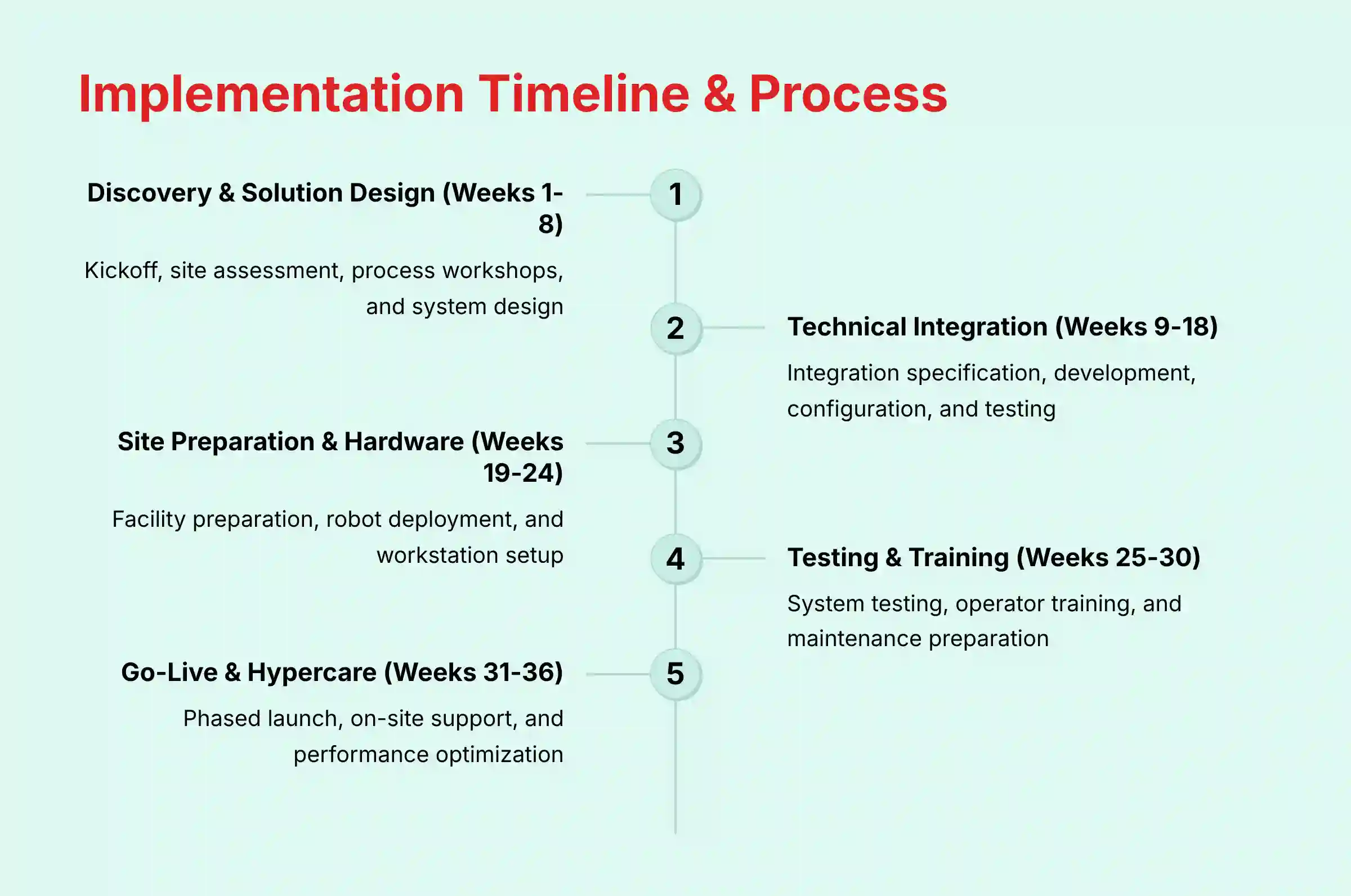
A GreyOrange implementation typically spans 6-9 months from contract signing to full operational go-live, though this timeline can vary based on facility size, implementation scope, and integration complexity. Understanding the detailed implementation process helps operations leaders set realistic expectations, allocate appropriate resources, and plan for operational transitions.
Phase 1: Discovery and Solution Design (Weeks 1-8)
This critical foundation phase establishes the technical and operational blueprint for the entire project:
- Kickoff and Team Formation (Week 1):
- Establishment of joint project team with clearly defined roles and responsibilities
- Alignment on project governance, communication protocols, and escalation procedures
- Setup of project management tools and documentation repositories
- Site Assessment and Technical Survey (Weeks 2-3):
- Detailed floor assessment (flatness, surface condition, obstacles)
- Power availability and distribution analysis
- Network infrastructure evaluation (Wi-Fi coverage, bandwidth, latency)
- Identification of facility modifications required
- Process Workshops and Workflow Mapping (Weeks 3-6):
- Current-state process documentation and pain point identification
- Future-state workflow design for each process (receiving, putaway, picking, packing)
- Exception handling procedures and manual fallback processes
- Definition of operational KPIs and success metrics
- System Design and Configuration (Weeks 6-8):
- Robotic fleet sizing and traffic pattern optimization
- Workstation layout and ergonomic design
- Hardware specification (robots, workstations, charging infrastructure)
- Initial GreyMatter™ software configuration
Phase 2: Technical Integration (Weeks 9-18)
This phase establishes the critical data connections between your enterprise systems and GreyMatter™:
- Integration Specification (Weeks 9-10):
- Detailed mapping of data fields and message formats
- Definition of integration touchpoints and transaction flows
- Documentation of business rules and data transformation requirements
- Development and Configuration (Weeks 11-15):
- Implementation of API connections or file interfaces
- Configuration of pre-built connectors for standard WMS/ERP systems
- Development of custom middleware if required
- Setup of monitoring and error handling processes
- Integration Testing (Weeks 16-18):
- Validation of data flows in test environment
- Error scenario testing and recovery validation
- Performance and load testing of integration points
- Documentation of test results and issue resolution
Phase 3: Site Preparation and Hardware Installation (Weeks 19-24)
This phase transforms the physical space to support the automation system:
- Facility Preparation (Weeks 19-22):
- Floor repairs or resurfacing if required
- Electrical infrastructure upgrades
- Network enhancements (Wi-Fi access points, cabling)
- Workstation construction and installation
- Hardware Deployment (Weeks 22-24):
- Installation of QR code grid for robot navigation
- Robot delivery, commissioning, and testing
- Charging station installation and power verification
- Setup of operating stations and peripherals (scanners, displays, put-to-light systems)
Phase 4: Testing and Training (Weeks 25-30)
This phase validates system performance and prepares your team for operation:
- System Testing (Weeks 25-27):
- Component-level testing of robotic movement and navigation
- Process-level testing of end-to-end workflows
- Performance testing under various load conditions
- Failure mode testing and recovery procedures
- User Training (Weeks 28-30):
- Operator training for picking and exception handling
- Supervisor training for dashboard monitoring and reporting
- Maintenance training for basic troubleshooting and support
- Administrator training for system configuration and management
Phase 5: Go-Live and Hypercare (Weeks 31-36)
This final phase transitions the system to production and stabilizes performance:
- Phased Go-Live (Weeks 31-33):
- Gradual ramp-up starting with a subset of SKUs or orders
- Daily performance review and issue resolution
- Incremental expansion of volume until full production
- Parallel processing with existing systems during transition
- Hypercare Support (Weeks 33-36):
- On-site GreyOrange specialists available 24/7
- Daily operational reviews and performance tuning
- Continuous optimization of robot traffic patterns and inventory placement
- Knowledge transfer to internal support team
Post-Implementation: Continuous Improvement
After the formal implementation concludes, the focus shifts to optimization:
- Quarterly system performance reviews
- Regular software updates with new features and enhancements
- Ongoing training for new staff and advanced capabilities
- Expansion planning for additional zones or facilities
This structured implementation approach ensures that both the technical system and your operational team are fully prepared for the transition to automated fulfillment, minimizing disruption while maximizing the speed to value realization.
How does GreyOrange's system scale to handle demand volatility and seasonal peaks?
GreyOrange's automation architecture offers exceptional scalability to manage demand volatility—from daily fluctuations to massive seasonal peaks—through a combination of hardware flexibility, software intelligence, and operational adaptability. This multi-dimensional approach to scalability differentiates the system from fixed automation, which typically operates at a predetermined capacity regardless of demand.
Hardware Scalability: Flexible Robot Fleet Management
The foundation of GreyOrange's scalability is its modular robot fleet, which can be expanded or contracted based on throughput requirements:
- Robot Fleet Expansion: Unlike fixed infrastructure, additional robots can be deployed rapidly—typically within days or weeks rather than months—to increase throughput capacity. Each additional robot incrementally increases the system's overall picking capacity.
- Robotics-as-a-Service (RaaS) for Seasonal Flexibility: For operations with pronounced seasonality, the RaaS model allows for temporary fleet expansion. Companies can contract for additional robots during peak periods (like Q4 holiday season) and return them afterward, transforming what would be a capital expense into an operating expense aligned with revenue patterns.
- Charge Station Management: The system intelligently rotates robots through charging cycles, ensuring maximum fleet availability during peak periods while maintaining battery health. During slower periods, a larger percentage of the fleet can be in charging status, conserving energy.
- Workstation Scalability: Additional picking stations can be rapidly deployed to accommodate more human operators during peak periods. The modular design allows for quick expansion without disrupting existing operations.
Software Intelligence: AI-Driven Optimization
GreyMatter™'s artificial intelligence continuously optimizes performance, with enhanced capabilities during high-demand periods:
- Dynamic Inventory Slotting: The AI analyzes order patterns in real-time and automatically repositions high-velocity inventory to optimize accessibility. During peak season, this capability becomes even more valuable as order patterns shift rapidly.
- Predictive Resource Allocation: The system anticipates workload patterns and proactively positions robots to minimize response time. This adaptive capability enables the system to maintain performance even as order volumes fluctuate.
- Workload Balancing: The AI distributes work evenly across picking stations to eliminate bottlenecks. During surges, it intelligently batches orders to maximize throughput while maintaining accuracy.
- Queue Management: Advanced algorithms prioritize orders based on multiple factors including shipping deadlines, order value, and resource availability, ensuring critical orders are fulfilled first during high-volume periods.
Operational Adaptability: Extending Beyond Technology
Beyond the technology itself, GreyOrange enables operational strategies that enhance scalability:
- Extended Operating Hours: The robotic fleet can operate 24/7 with minimal downtime. Many operations maintain a baseline robot fleet sized for average demand, then extend operating hours during peak periods rather than expanding the fleet.
- Multi-Shift Operations: Additional human operators can be added for second or third shifts, maximizing the utilization of the robotic infrastructure around the clock.
- Zone-Based Processing: During extreme peaks, the system can be reconfigured to operate in zone-based fulfillment mode, with different areas of the warehouse dedicated to specific order types or product categories to optimize throughput.
- Hybrid Fulfillment Models: The system supports simultaneous processing of different fulfillment models (e-commerce singles, retail replenishment, wholesale orders) and can dynamically adjust the allocation of resources between these channels based on current priorities.
Real-World Performance in Volatile Environments
In practice, GreyOrange customers typically report the ability to handle 3-5x their average daily volume during peak periods without degradation in accuracy or substantial increases in fulfillment costs. This scalability directly translates to competitive advantage in industries with significant seasonality, allowing operations to maintain service levels during critical high-volume periods without the enormous costs and challenges of temporary staffing.
What happens if a robot or the GreyOrange system experiences a failure? What redundancy measures are in place?
GreyOrange's system architecture incorporates multiple layers of redundancy and fault tolerance to ensure operational resilience, minimizing the impact of potential failures from individual robot malfunctions to larger system issues. Understanding these safeguards is essential for operations leaders evaluating the operational risk of implementing automation in mission-critical fulfillment environments.
Individual Robot Failures
The robotic fleet is designed with inherent redundancy to prevent single points of failure:
- Self-Diagnostic Capabilities: Each robot continuously monitors its own systems, including battery health, motor performance, sensors, and communication modules. When a potential issue is detected, the robot can proactively remove itself from service before a failure occurs.
- Automatic Failover: If a robot experiences a malfunction while carrying a storage unit, it automatically signals for assistance. Another available robot can be dispatched to take over the task, retrieving the storage unit and completing the delivery to the appropriate workstation.
- Hot-Swappable Design: The fleet is typically sized with 10-15% excess capacity beyond baseline requirements. This allows robots to be removed from service for maintenance without impacting overall throughput. Robots can be swapped in and out of the active fleet without system downtime.
- Battery Management: The system maintains a rotating charging schedule, ensuring that enough robots are always available with sufficient charge to maintain operations, even if individual charging stations experience issues.
Network and Communication Redundancy
The communication infrastructure supporting the robots features multiple redundancy layers:
- Mesh Network Architecture: Robots can communicate directly with each other as well as with the central system, creating a resilient mesh network that can adapt to localized communication issues.
- Wi-Fi Redundancy: Enterprise-grade wireless networks with overlapping access points ensure there are no dead zones on the warehouse floor. If one access point fails, others automatically compensate for the coverage gap.
- Graceful Degradation: In the event of temporary communication interruptions, robots are programmed to safely pause operations rather than continuing with potentially outdated instructions, minimizing the risk of collisions or errors.
GreyMatter™ Software Redundancy
The GreyMatter™ platform employs enterprise-grade high availability architecture:
- Cloud-Based Redundancy: When deployed in the cloud (typically on AWS or Azure), the platform leverages multi-availability zone architecture, with automatic failover between zones if issues arise in the primary environment.
- Database Replication: All operational data is continuously replicated across multiple database instances, ensuring that no data is lost even in the event of a database server failure.
- Application Layer Redundancy: Critical application components are deployed in a load-balanced configuration across multiple servers, eliminating single points of failure at the application level.
- Disaster Recovery: Comprehensive backup and disaster recovery procedures ensure that even in catastrophic scenarios, the system can be restored with minimal data loss (typically measured in seconds or minutes rather than hours).
Operational Continuity Measures
Beyond technical redundancy, operational protocols ensure business continuity:
- Degraded Mode Operations: If a significant portion of the robot fleet becomes unavailable, the system can transition to a prioritized operating mode, focusing the available robots on the most critical orders while maintaining accurate inventory tracking.
- Manual Fallback Procedures: Documented procedures enable the warehouse to transition to manual operations if necessary, with clear guidance on how to maintain inventory accuracy during the transition.
- 24/7 Support: GreyOrange typically provides around-the-clock monitoring and support services, with defined response time SLAs based on the severity of issues. Critical issues usually trigger immediate response and escalation protocols.
- Spare Parts Inventory: On-site spare parts kits for common replacement components enable rapid repairs without waiting for shipments, minimizing downtime for individual robots.
Service Level Agreements (SLAs)
The contractual relationship with GreyOrange includes specific performance guarantees:
- System Uptime: Typically guaranteed at 99.5% or higher, excluding scheduled maintenance windows
- Response Time: Defined timeframes for initial response and resolution based on issue severity
- Resolution Time: Committed timeframes for resolving different categories of issues
- Performance Metrics: Guaranteed minimum throughput levels under normal operating conditions
These comprehensive redundancy and continuity measures ensure that even when individual components experience issues, the overall operation maintains functionality with minimal disruption to fulfillment operations.
How does GreyOrange handle different product types and special handling requirements?
GreyOrange's system is designed to accommodate diverse product portfolios with varying handling requirements through a combination of hardware flexibility, software intelligence, and configurable workflows. Understanding these capabilities helps operations leaders assess the system's suitability for their specific product mix and identify where specialized handling processes may be required.
Storage and Handling Capabilities for Diverse Products
The core GreyOrange system can accommodate a wide range of product types within its standard configuration:
- Size Range Flexibility: Standard mobile storage units can typically handle items from as small as jewelry boxes to as large as small appliances or bulky apparel. The exact dimensions depend on the specific shelving configuration, but generally accommodate items up to 16″×24″×12″ (40cm×60cm×30cm).
- Weight Capacity: Most configurations support items weighing up to 30-35 pounds (13-16 kg) per storage location, with the total capacity of a storage unit ranging from 600-1,000 pounds (270-450 kg) depending on the specific model.
- Compartmentalized Storage: Mobile storage units can be configured with dividers, bins, and totes to create appropriate storage compartments for different product types—from small electronics requiring anti-static protection to apparel requiring gentle handling.
- Product-Specific Configurations: Specialized storage unit configurations are available for specific product categories:
- Hanging Garment Units: For apparel requiring hanging storage rather than folded storage
- Temperature-Controlled Units: For products requiring specific temperature ranges
- High-Security Units: With locking mechanisms for high-value items
- Hazmat-Compliant Units: For products requiring special handling due to regulatory requirements
Software Intelligence for Special Handling Requirements
The GreyMatter™ software incorporates sophisticated rules engines to manage special handling requirements:
- Product Attribute-Based Handling: The system processes detailed product attributes to determine appropriate handling procedures. These attributes can include:
- Fragility indicators
- Temperature sensitivity
- Expiration dates
- Serial number requirements
- Lot tracking needs
- Compliance documentation requirements
- Directed Handling Instructions: When special handling is required, the system presents specific instructions to operators at picking stations, such as:
- “Place item in protective packaging before bagging”
- “Scan serial number before confirming pick”
- “Place item directly in insulated container”
- “Handle with gloves only”
- Product Compatibility Rules: The software enforces rules regarding which products can be stored together, preventing cross-contamination or damage. For example, it can ensure that fragrant products are not stored with clothing, or that heavy items are not placed above fragile ones.
Strategies for Non-Standard Items
While the core system handles most products effectively, operations typically employ these strategies for items that fall outside standard parameters:
- Zone-Based Processing: Creating dedicated zones within the warehouse for specific product categories that require unique handling. The GreyMatter™ software can coordinate workflows between automated and manual zones, maintaining a unified view of inventory and orders.
- Bulk Storage Integration: For oversized items, integration with traditional bulk storage areas (pallet racking, oversize shelving) allows these items to be included in the same orders as standard items, with coordinated picking instructions.
- Exception Workflows: Clearly defined processes for items that cannot be handled by the automated system, ensuring these exceptions don't disrupt the primary fulfillment flow while maintaining inventory accuracy and order integrity.
- Custom Workstation Design: Specialized picking stations can be configured for specific product categories, with appropriate tools, equipment, and verification systems to ensure proper handling.
Industry-Specific Adaptations
GreyOrange has developed specialized configurations for various industries with unique requirements:
- Apparel and Fashion: Combines hanging and folded storage with specific handling protocols for delicate fabrics, accessories, and footwear
- Health and Beauty: Incorporates lot tracking, expiration date management, and special handling for liquid products
- Electronics: Features anti-static protections, serial number validation, and high-security storage for valuable components
- Pharmaceutical: Includes temperature monitoring, lot control, expiration management, and compliance documentation
- Grocery/Food: Offers temperature-controlled storage options and FIFO (First-In, First-Out) inventory management
By combining these hardware, software, and procedural adaptations, GreyOrange creates a system that can effectively handle 80-95% of most retail and e-commerce product portfolios in the automated workflow, with clear procedures for the remaining items that require specialized handling.


Transform Your Operations with Intelligent Automation
The warehouse automation landscape is evolving rapidly, and GreyOrange represents a proven, mature solution that bridges the gap between traditional fulfillment and the demands of modern e-commerce. As you've seen throughout this comprehensive guide, the technology addresses fundamental operational challenges while providing the flexibility to adapt to changing business requirements.
For operations leaders ready to take the next step, we recommend beginning with a detailed assessment of your current operational pain points and growth projections. Consider how the detailed GreyOrange Review aligns with your specific requirements, and explore the competitive landscape through our comprehensive analysis of Best 10 AI For Warehouse Robotics & Automation Solutions to ensure you're making the optimal choice for your organization.
The future of warehouse operations is here, and the question isn't whether to automate, but how quickly you can implement solutions that will drive sustainable competitive advantage in an increasingly demanding marketplace.

Leave a Reply