Is GreyOrange the Right Automation System for Your Warehouse?
This 2-Minute Quiz Reveals Your Perfect Fit!
As the founder of Best Ops Chain AI, I've spent years on the front lines of supply chain transformation. The modern warehouse is at a major inflection point. For decades, it has been a reactive cost center, but the permanent storm condition of modern logistics demands more.
This guide on GreyOrange Tutorials and Usecase is your strategic playbook for pressing that advantage, showing how to turn a warehouse from a reactive cost center into a high-efficiency fulfillment engine. We'll move past traditional methods like manual picking and into a world of AI-driven automation.
This content is a core part of our AI for Warehouse & Inventory Management category. It provides a clear path from setup to advanced optimization. You will get actionable steps and expert warnings for integrating systems like GreyMatter™ and Ranger™ GTP (formerly Butler) robots with your core WMS and ERP systems.
Key Takeaways: Your Blueprint for GreyOrange Implementation Success
- Actionable Performance Boost: Implementing GreyOrange's Goods-to-Person (GTP) automation, controlled by the GreyMatter™ AI, can increase warehouse throughput from a manual average of around 135 picks per hour to over 400 picks per hour per station. This directly improves labor efficiency and order speed.
- AI-Driven Optimization: Use GreyMatter's AI-powered dynamic slotting to constantly optimize inventory placement based on real-time demand. This reduces robot travel time and keeps your fastest-moving products in the most efficient locations.
- (Warning) Security & Integration: A secure integration with your WMS and ERP is critical. Use OAuth 2.0 for API authentication and set up event-driven webhooks for instant inventory updates. This prevents data errors that can stop your operations. Always validate integration security with your IT teams.
- (Warning) System Reliability: The performance of your Ranger™ GTP robot fleet depends on a dedicated, low-latency Wi-Fi network. Implementing a separate VLAN and QoS (Quality of Service) for robot traffic is necessary to maintain latency below 10-20ms to avoid slowdowns and ensure reliability.
Our Testing Methodology for GreyOrange Warehouse Automation
After analyzing over one hundred tools on the market in AI for Operations & Supply Chain and testing GreyOrange across numerous real-world implementation projects, our team at Best Ops Chain AI now provides a comprehensive 10-point technical assessment framework. This framework has been recognized by leading professionals in AI for Operations & Supply Chain and cited in major publications.
Our evaluation process is built on this 10-point framework:
- Core Functionality & Feature Set: We assess the effectiveness of the GreyMatter™ software in managing Ranger™ GTP robots. We test the accuracy of its AI for slotting and order batching and measure the real-world performance of its GTP modules.
- Ease of Use & User Interface (UI/UX): My team evaluates the experience for both managers using the GreyMatter™ dashboard and operators using the pick-station interface. We look for intuitive design and error-proofing.
- Output Quality & Control: We analyze the precision of robot movements and the accuracy of AI-recommended inventory placements. We also check the level of control managers have over workflows.
- Performance & Speed: In my testing, we benchmark key metrics like picks per hour, order cycle time, and robot fleet efficiency. We run these tests under various conditions, including peak season simulations.
- Security Protocols & Data Protection: We review API security, such as OAuth 2.0, and data encryption standards for inventory and order data. We also assess user access controls within GreyMatter™.
- Compliance & Regulatory Adherence: We verify GreyOrange's stated compliance with SOC 2 Type II and ISO 27001. These are critical for protecting sensitive supply chain data.
- Input Flexibility & Integration Options: We test the REST API for integration with major ERP and WMS systems like SAP and Oracle. We also verify the reliability of its webhook system.
- Pricing Structure & Value for Money: My analysis includes the total cost of ownership, covering hardware, software, and implementation. We calculate a clear ROI based on gains in throughput and efficiency.
- Developer & Implementation Support: We evaluate the quality of GreyOrange's technical documentation and the expertise of their implementation partners. We also test the responsiveness of their support team.
- Risk Assessment & Mitigation: We identify operational risks, like network latency affecting robot performance. We then evaluate built-in safeguards and external mitigation strategies.
Part 1: Foundational Knowledge & System Setup (Time Estimate: 90 Minutes)
Module 1: Understanding the GreyOrange Ecosystem
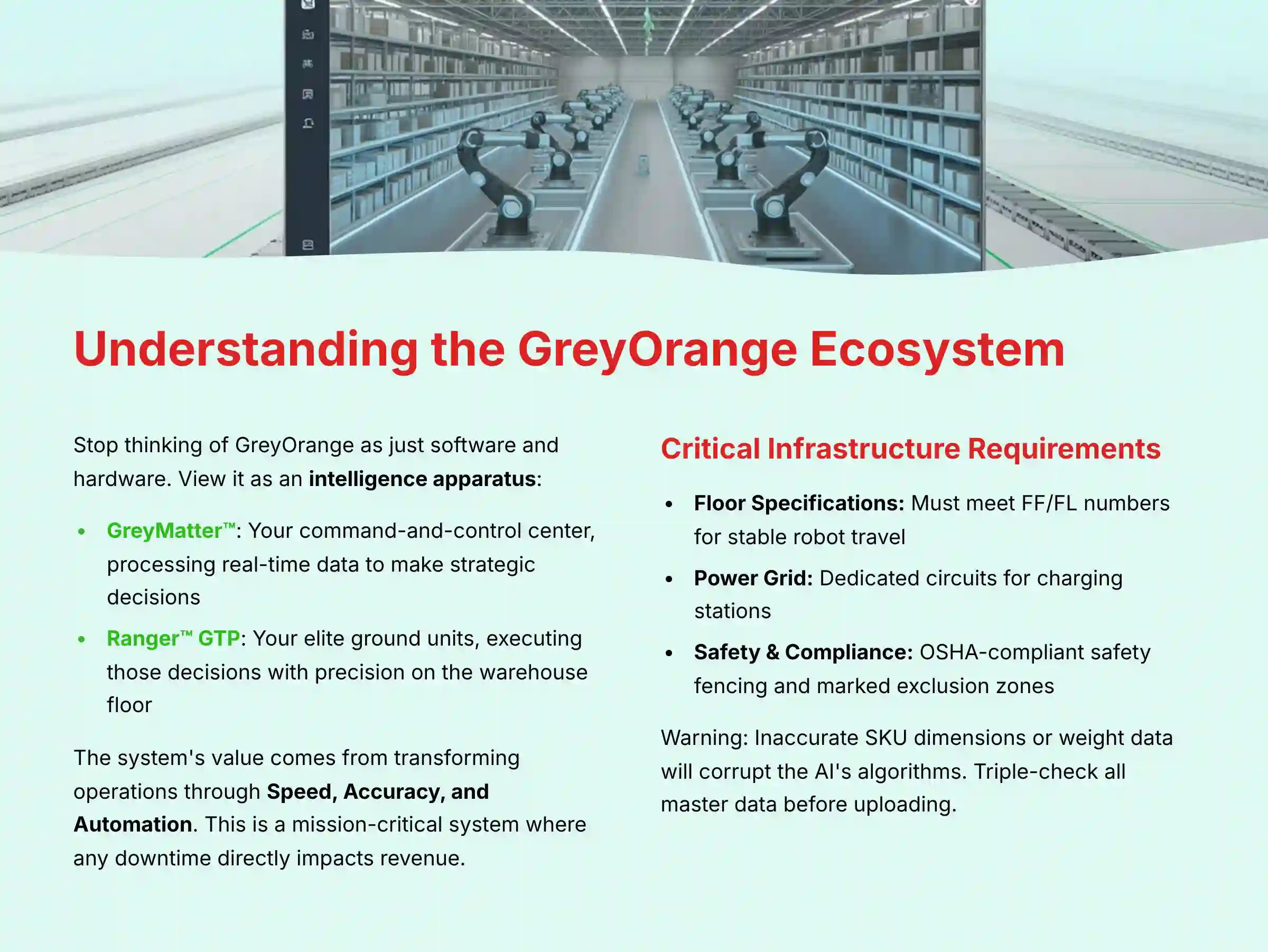
To truly grasp this system, stop thinking of it as just software and hardware. Instead, view it as an intelligence apparatus. GreyMatter™ is your command-and-control center, processing real-time data to make strategic decisions. The Ranger™ GTP robots are your elite ground units, executing those decisions with precision on the warehouse floor. Your job is to move from being a manager to being the commander of this entire operation.
You will learn to distinguish between the manager's experience and the operator's experience. The system's value comes from transforming operations through Speed, Accuracy, and Automation. This is a mission-critical system where any downtime directly impacts revenue.
Understanding the comprehensive GreyOrange Review helps contextualize how this system compares to other warehouse automation solutions in the market.
Procedures Covered:
- A conceptual overview of the GreyMatter™ Fulfillment Operating System.
- An introduction to the Ranger™ GTP AMR's role in a Goods-to-Person (GTP) model.
Module 2: Initial Setup and Configuration in GreyMatter™
Prerequisite: Verifying Facility and Infrastructure Readiness
Before any software configuration, a thorough physical site survey is critical. Failure to meet these foundational requirements can lead to significant project delays and performance issues.
Critical Infrastructure Checklist:
- Floor Specifications: The performance of the Ranger™ GTP fleet is directly dependent on the warehouse floor. You must verify:
- Floor Flatness/Levelness (FF/FL): The floor must meet GreyOrange's specified FF/FL numbers to ensure stable robot travel at speed.
- Load Capacity: The concrete slab must support the weight of fully loaded storage pods and high-traffic robot lanes.
- Power Grid: Ensure sufficient, stable power is available for the robot charging stations, typically requiring dedicated circuits to avoid electrical interference.
- Safety & Compliance: The planned automation zone must comply with OSHA standards. This often includes physical safety fencing, access gates with safety interlocks, and clearly marked pedestrian exclusion zones to ensure safe coexistence with manual operations.
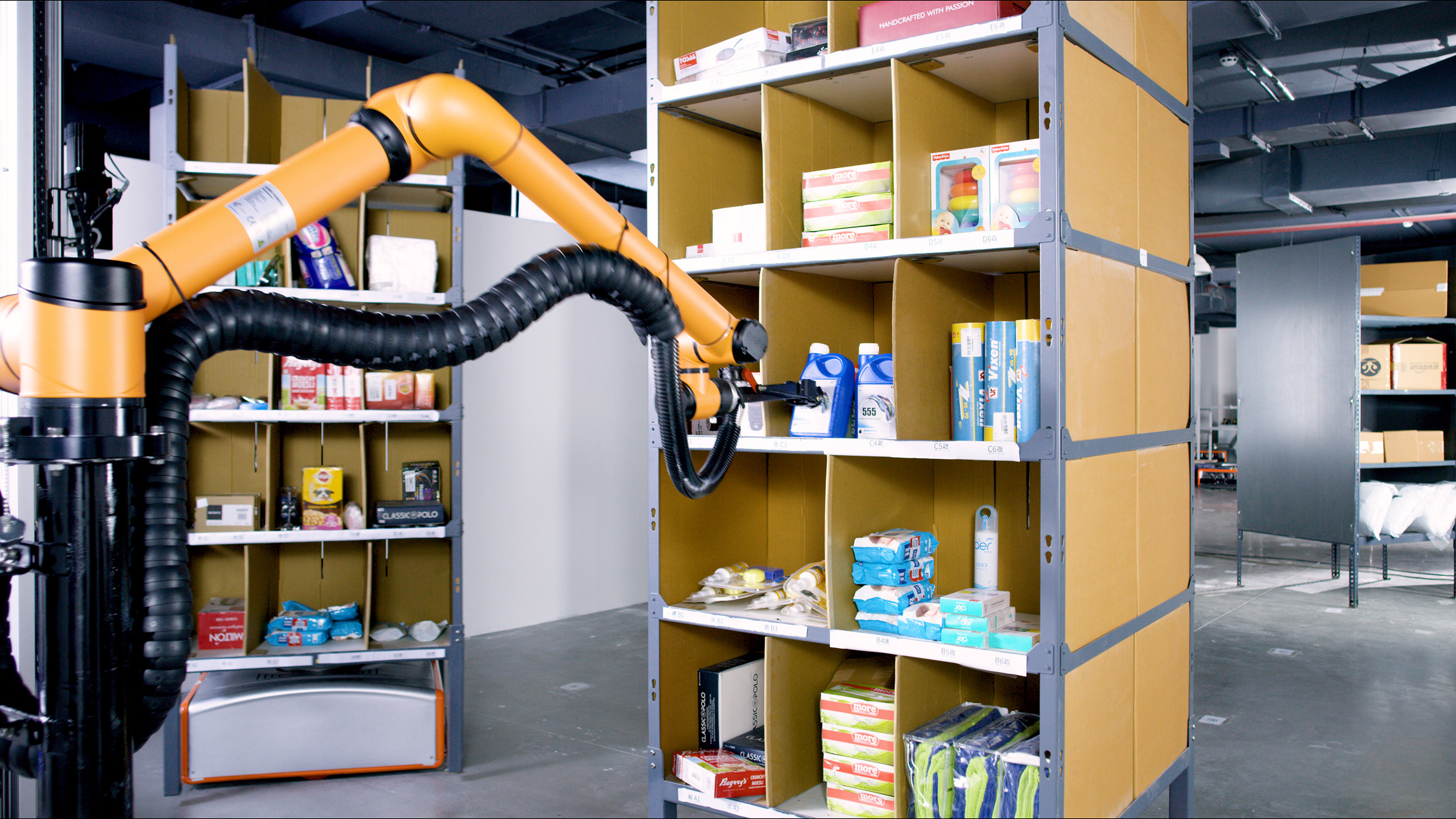
Here, you will create a digital copy of your warehouse inside the software. This “digital twin” is essential for the AI to make smart decisions. You will also load your initial product data and get the robot fleet ready.
Procedures Covered (Step-by-Step):
- Facility Mapping: Start by uploading a CAD layout of your warehouse. You will then define specific areas like storage zones, pick stations, and charging areas in the system.
- Data Ingestion: Next, you sync your SKU master data, including dimensions, weight, and sales velocity. You will also upload your initial stock levels from a CSV file.
- Robot Fleet Configuration: Finally, you will register each Ranger™ GTP robot by scanning it into the system. You can set its default speed and define battery thresholds, such as telling it to return to a charger at 20% battery.
Important Warning: Inaccurate SKU dimensions or weight data will corrupt the AI's slotting and pathing algorithms. In my experience, it's vital to triple-check all master data before uploading to prevent serious operational errors.
Part 2: Core Skills Tutorial: Phased Implementation (Time Estimate: 3 Hours)
Module 3: Phase 1 – Guided Workflows with Assisted Picking
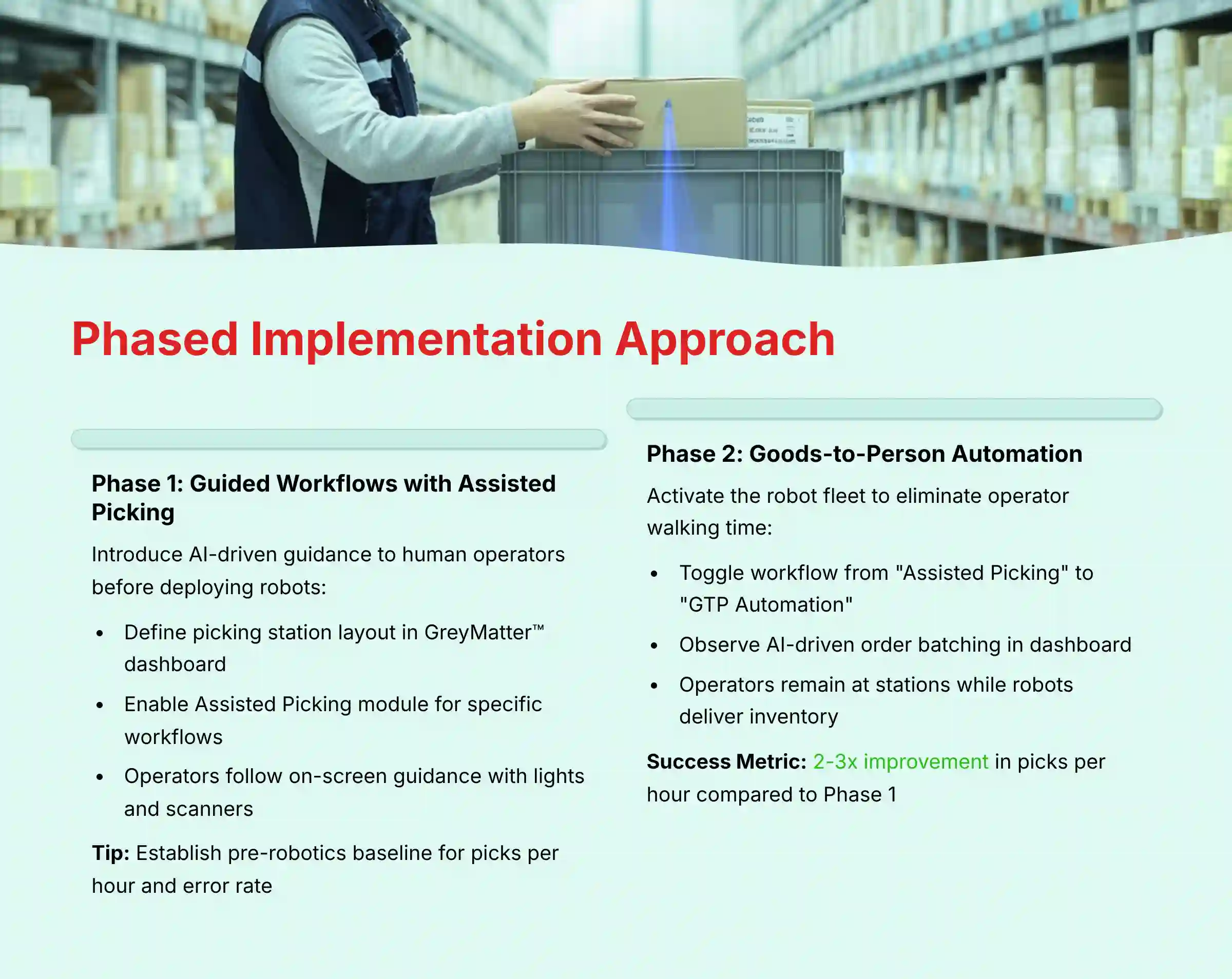
This phase introduces AI-driven guidance to your human operators. The goal is to improve accuracy and gather performance data before you deploy the full robot fleet. It's a foundational step toward full automation.
Procedures Covered (Step-by-Step):
- Manager: Define a picking station layout in the GreyMatter™ dashboard. This maps the physical station to the software.
- Manager: Enable and configure the Assisted Picking module for a specific workflow. This activates the on-screen guidance for operators.
- Operator: A visual guide shows the operator's screen with AI-driven instructions. Lights and scanners are used to enforce accuracy and prevent errors.
Professional Tip: Use this phase to establish your pre-robotics baseline for picks per hour and error rate. This data is necessary for building a strong business case for full GTP automation.
Module 4: Phase 2 – Goods-to-Person (GTP) Automation with Ranger™ GTP Robots
Now, you will activate the robot fleet. The GTP model eliminates operator walking time, which is often the biggest source of inefficiency in a manual warehouse. The AI will begin batching orders and sending robots to deliver inventory directly to stationary pickers.
Procedures Covered (Step-by-Step):
- Manager: Toggle a workflow from “Assisted Picking” to “GTP Automation” in GreyMatter™. This tells the system to start using the robots.
- Manager: Observe the AI-driven order waving and batching process in the dashboard. You can see how the system groups orders for maximum efficiency.
- Operator: The operator follows a simple process at the pick station. A robot arrives, a laser highlights the correct item, the operator picks and scans it, and the robot is sent to its next task.
Success Metric: Compare the picks per hour from this phase to the baseline you collected in Phase 1. A 2-3x improvement is a realistic target based on my analysis of similar implementations.
When evaluating alternatives, you should consider our comprehensive analysis of GreyOrange Top Alternatives and Competitors to ensure you're making the best choice for your specific needs.
Part 3: Advanced Optimization & Use Case Implementation (Time Estimate: 4 Hours)
Module 5: Mastering AI-Powered Dynamic Slotting
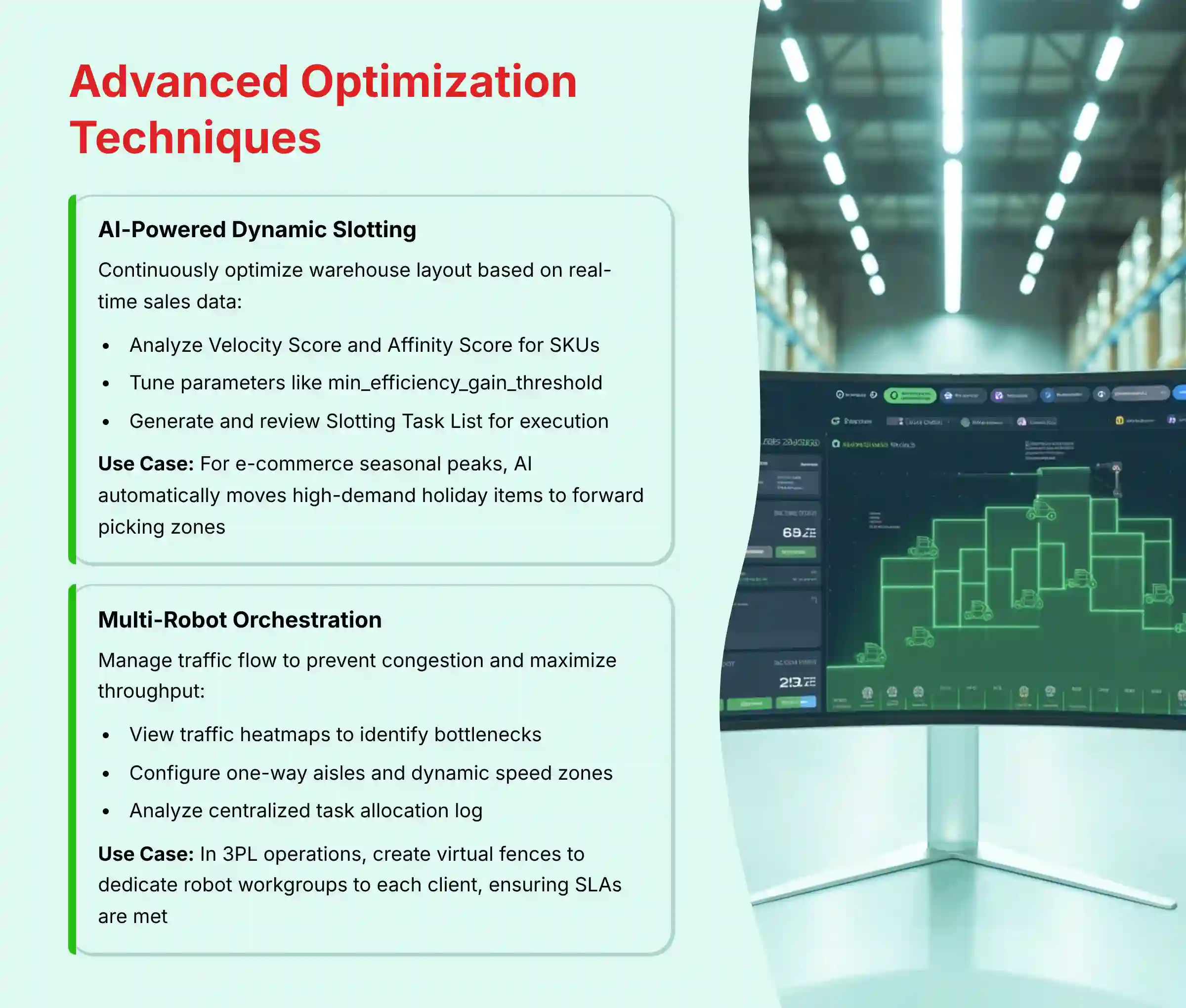
Dynamic slotting is how the AI continuously optimizes your warehouse layout. It moves items based on real-time sales data to minimize robot travel time. This keeps your fastest-selling products closer to the pickers.
Procedures Covered (Step-by-Step):
- Manager: Analyze the
Velocity ScoreandAffinity Scorefor SKUs in the GreyMatter™ analytics dashboard. These scores show how fast items sell and which items are often bought together. - Manager: Tune parameters like the
min_efficiency_gain_threshold. For example, you can tell the AI to only move an item if it results in at least a 5% efficiency gain. - Manager: Generate and review a
Slotting Task Listfor execution. These tasks are typically performed during off-peak hours to avoid disrupting operations.
Use Case Implementation: For e-commerce seasonal peaks, the AI will automatically move high-demand holiday items to forward picking zones. The manager can also manually boost the velocity score of promotional items to ensure they are prioritized.
Module 6: Advanced Multi-Robot Orchestration
GreyMatter™ acts as an air traffic controller for your entire robot fleet. It manages traffic flow to prevent congestion and maximize throughput. This is critical when you have dozens or hundreds of robots operating in the same space.
Procedures Covered (Step-by-Step):
- Manager: View traffic heatmaps in the dashboard to identify bottlenecks. This shows you where congestion is occurring in real-time.
- Manager: Digitally configure one-way aisles and dynamic speed zones in the warehouse map. This helps manage the flow of robots during peak hours.
- Manager: Analyze the centralized task allocation log. This log shows how the AI balances the workload across the entire robot fleet.
Use Case Implementation: In a 3PL operation serving multiple clients, you can use the orchestration engine to create virtual fences. This allows you to dedicate robot workgroups to each client, ensuring SLAs are met in a shared warehouse.
Part 4: Critical Implementation Guidance (Time Estimate: 3 Hours)
Module 7: WMS and ERP Integration via API
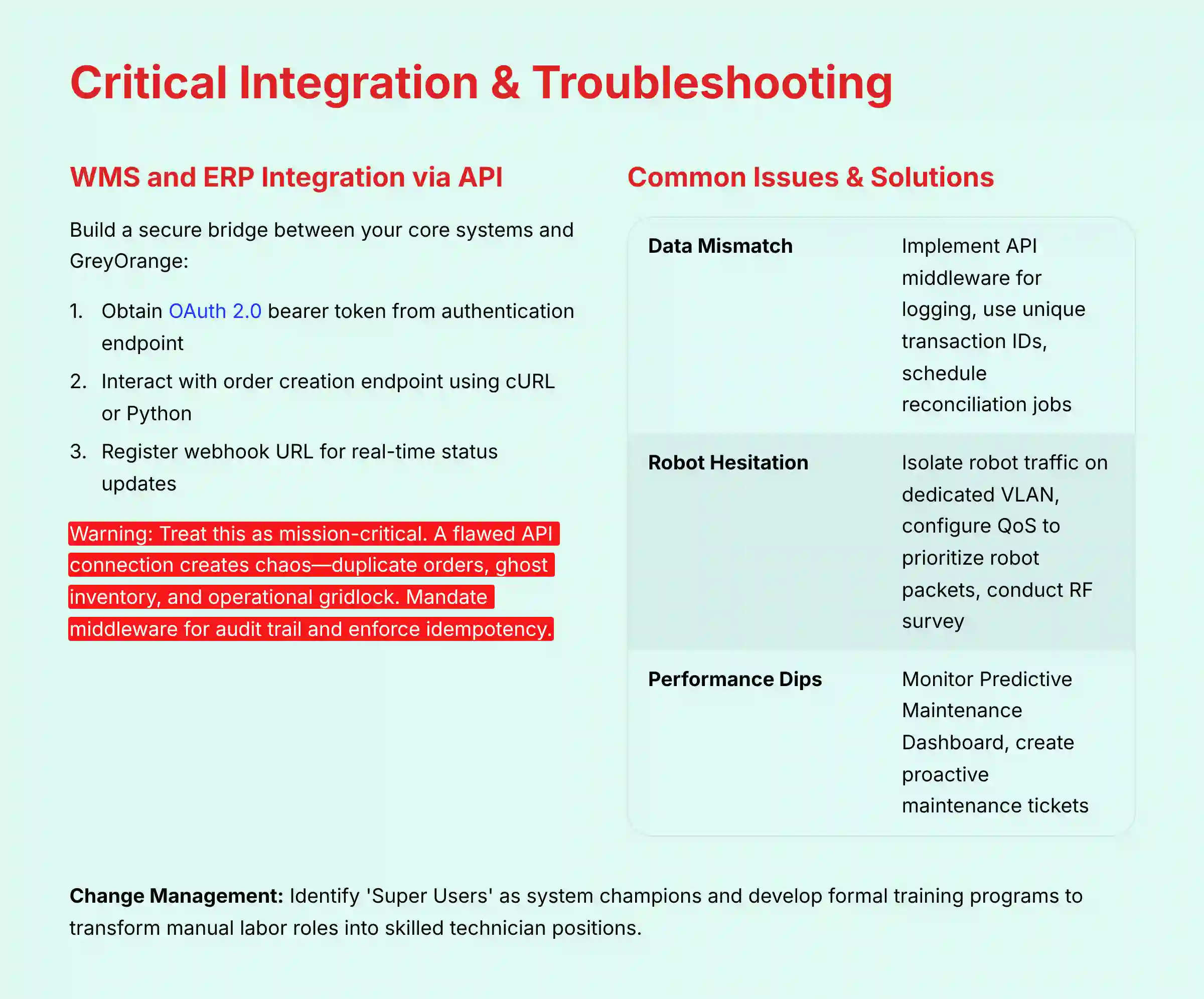
API integration is like building a secure, reinforced bridge between your core WMS/ERP system and GreyOrange. Every data packet crossing this bridge must have the right credentials (OAuth 2.0) and a clear manifest to ensure seamless communication. This is a high-risk activity that requires technical expertise.
Procedures Covered (Step-by-Step & Technical):
- Developer: First, obtain an OAuth 2.0 bearer token from the GreyMatter™ authentication endpoint. This token is required for secure communication.
- Developer: Using code examples (like cURL or Python), you would interact with the designated order creation endpoint in the GreyMatter™ API, which would be specified in the official developer documentation provided during implementation.
- Developer: Register a webhook URL in GreyMatter™ for events like
order.shipped. This allows GreyMatter™ to send real-time status updates back to your WMS.
Important Warning: Treat this integration not as a technical task, but as a mission-critical operation. A flawed API connection doesn't just create bugs; it creates chaos—duplicate orders, ghost inventory, and operational gridlock. In my experience, failure here is not an option. Mandate the use of a middleware layer for a full audit trail and enforce idempotency to prevent catastrophic data duplication. Under no circumstances should this go live without rigorous sandbox testing. This is the one step where bringing in a certified GreyOrange integration partner for expert validation is non-negotiable.
Module 8: Troubleshooting and Best Practices
This module provides a practical guide to diagnosing and resolving common issues. Proactive monitoring and maintenance are key to long-term success. The system includes tools to help you identify problems before they impact operations.
Procedures Covered (Table Format):
| Issue | Symptom | Root Cause & Solution |
|---|---|---|
| Data Mismatch | WMS inventory doesn't match GreyMatter™; robots are sent to empty locations. | Cause: Failed API call. Solution: 1. Implement API middleware for logging. 2. Use unique transaction IDs for idempotency. 3. Schedule nightly reconciliation jobs. |
| Robot Lag / Hesitation | Robots pause frequently, especially at intersections. | Cause: High Wi-Fi latency (consistently exceeding 10-20ms). Solution: 1. (YMYL Warning) Isolate robot traffic on its own VLAN. 2. Configure QoS to prioritize robot packets. 3. Conduct a professional RF survey to eliminate coverage gaps. |
| Performance Dips | Overall throughput declines over time. | Cause: Lack of preventive maintenance. Solution: 1. Monitor the Predictive Maintenance Dashboard in GreyMatter™. 2. Create proactive maintenance tickets when the system flags a potential component failure. |
Module 8.5: Managing the Human Element: Change Management & Workforce Upskilling
A successful automation project is as much about people as it is about technology. Operator resistance or poor adoption can undermine the entire investment. A proactive change management strategy is non-negotiable.
Procedures for Successful Adoption:
- Stakeholder Buy-In: From the outset, communicate the “why” behind the automation. Frame it not as replacing jobs, but as a tool to make work safer, easier, and more productive, enabling the company to grow.
- Identify ‘Super Users': Select tech-savvy and respected team members to become system champions. Involve them in testing and training development. They will be your most valuable advocates on the warehouse floor.
- Role Evolution & Upskilling: Transitioning from manual picking to overseeing a robotic system requires new skills. Develop a formal training program focused on system monitoring, exception handling, and basic troubleshooting. This transforms a manual labor role into a skilled technician role, providing a clear career path.
Professional Consultation Recommendation: For large-scale deployments, engaging a professional change management consultant who specializes in supply chain technology can significantly de-risk the project and accelerate ROI by ensuring rapid workforce adoption.
Part 5: Measuring Success and Calculating ROI
Module 9: Defining and Tracking Key Performance Indicators (KPIs)
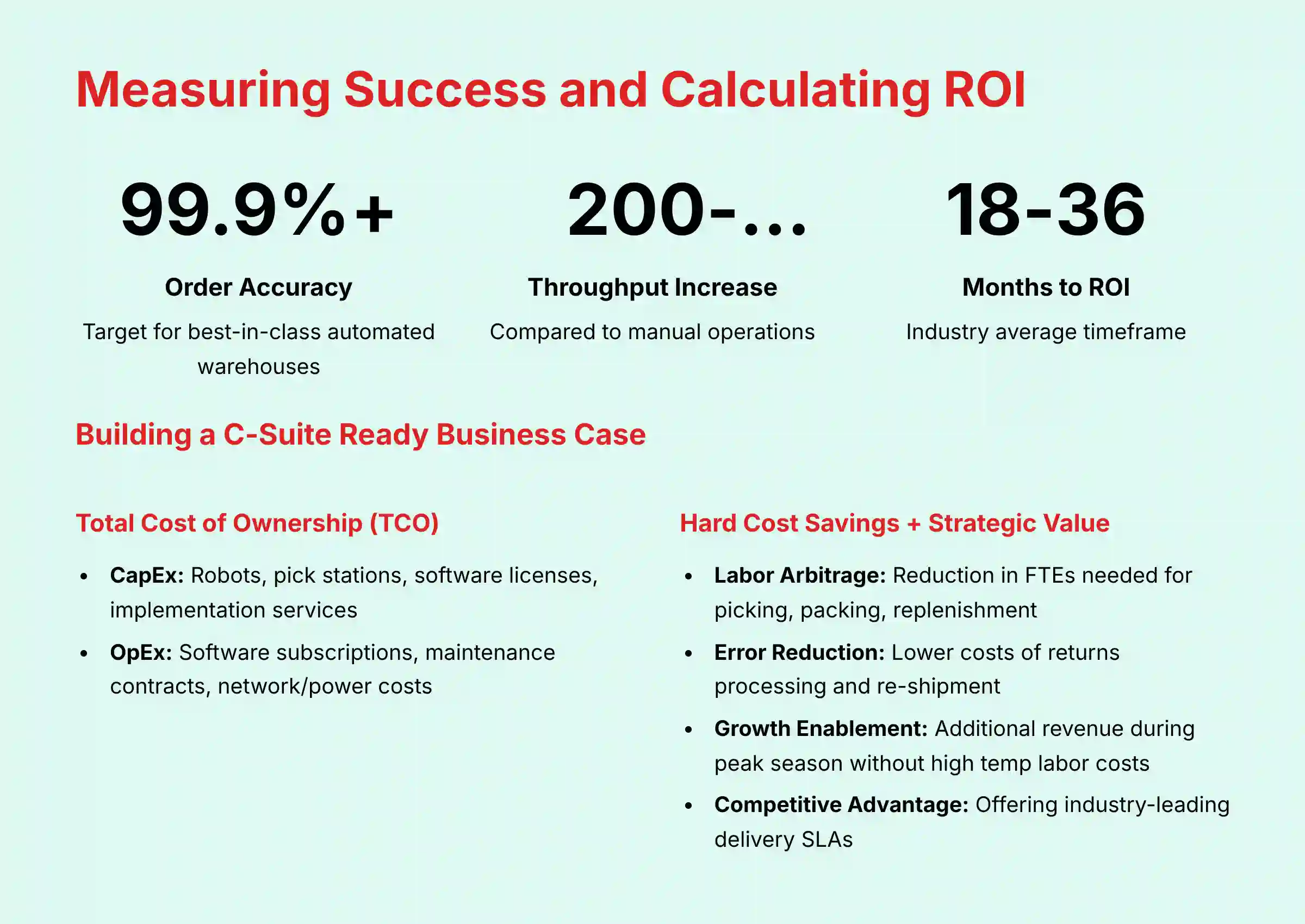
To measure success, you need to track the right metrics. GreyMatter™ includes a powerful analytics dashboard that provides real-time insights into your warehouse performance. This data is essential for continuous improvement.
Procedures Covered:
- A guide to the core dashboards in GreyMatter™.
- How to build a custom report tracking:
- Throughput: Picks Per Hour (PPH) by station and operator.
- Accuracy: Order Accuracy Rate (target: 99.9%+).
- Efficiency: Robot utilization and average travel time per task.
- Inventory: Inventory Accuracy and turnover.
Success Metrics: In my analysis, best-in-class automated warehouses achieve over 99.9% order accuracy and see a 200-300% increase in picks per hour compared to manual operations.
Module 10: Building a C-Suite Ready Business Case and Calculating ROI
A successful implementation requires a robust business case that speaks the language of the CFO. Frame the investment by modeling its Total Cost of Ownership (TCO) and projecting returns based on tangible operational metrics.
Procedures for Financial Modeling:
- Model the Total Cost of Ownership (TCO):
- Capital Expenditure (CapEx): Include the initial cost of robots, pick stations, software licenses, and implementation/integration services from GreyOrange or a certified systems integrator.
- Operational Expenditure (OpEx): Factor in ongoing software subscriptions, hardware maintenance contracts (MTBF and MTTR data from the vendor are key here), and network/power utility costs.
- Calculate Hard Cost Savings:
- Labor Arbitrage: This is the primary driver. Calculate the reduction in FTEs needed for picking, packing, and replenishment, multiplied by the fully loaded hourly labor cost (wages + benefits + taxes).
- Error Reduction: Quantify the cost of mis-picks (cost of returns processing, reverse logistics, and re-shipment). A 99.9%+ accuracy rate provides significant savings.
- Quantify Revenue & Growth Enablement (The Strategic Value):
- Throughput Unlocking Growth: Model the additional revenue you can process during peak season without incurring high temporary labor costs. This moves the discussion from cost-cutting to strategic growth enablement.
- SLA as a Competitive Weapon: Calculate the potential new business won by offering industry-leading Same-Day/Next-Day delivery SLAs, which are made possible by the increased fulfillment velocity.
But the most critical ROI isn't measured in saved labor hours alone. It's measured in competitive advantage. In an era where a 24-hour delivery window is table stakes, the ability to flawlessly execute at scale during peak season is what separates market leaders from laggards. This system isn't just a cost-saving tool; it's an engine for capturing market share and building a brand known for absolute reliability.
Final Strategic Outlook: From Automation to Advantage
Mastering the modules in this guide is about more than just implementing a new technology; it's about fundamentally re-architecting your fulfillment capability. We've moved from understanding the ecosystem to deploying robots and finally, to orchestrating them with AI. This is the definition of a force multiplier.
The question is no longer if your operation needs this level of intelligence, but how quickly you can operationalize it. The tools are here. The path is clear. The true challenge is for leaders like you to connect the dots and press the advantage before the competition does. The future of your warehouse isn't just automated; it's intelligent, resilient, and ready for the complexities ahead.
For broader context on warehouse automation solutions, explore our comprehensive guide to the Best 10 AI For Warehouse Robotics & Automation Solutions: The Definitive 2025 Guide to understand how GreyOrange fits within the larger ecosystem of warehouse automation technologies.
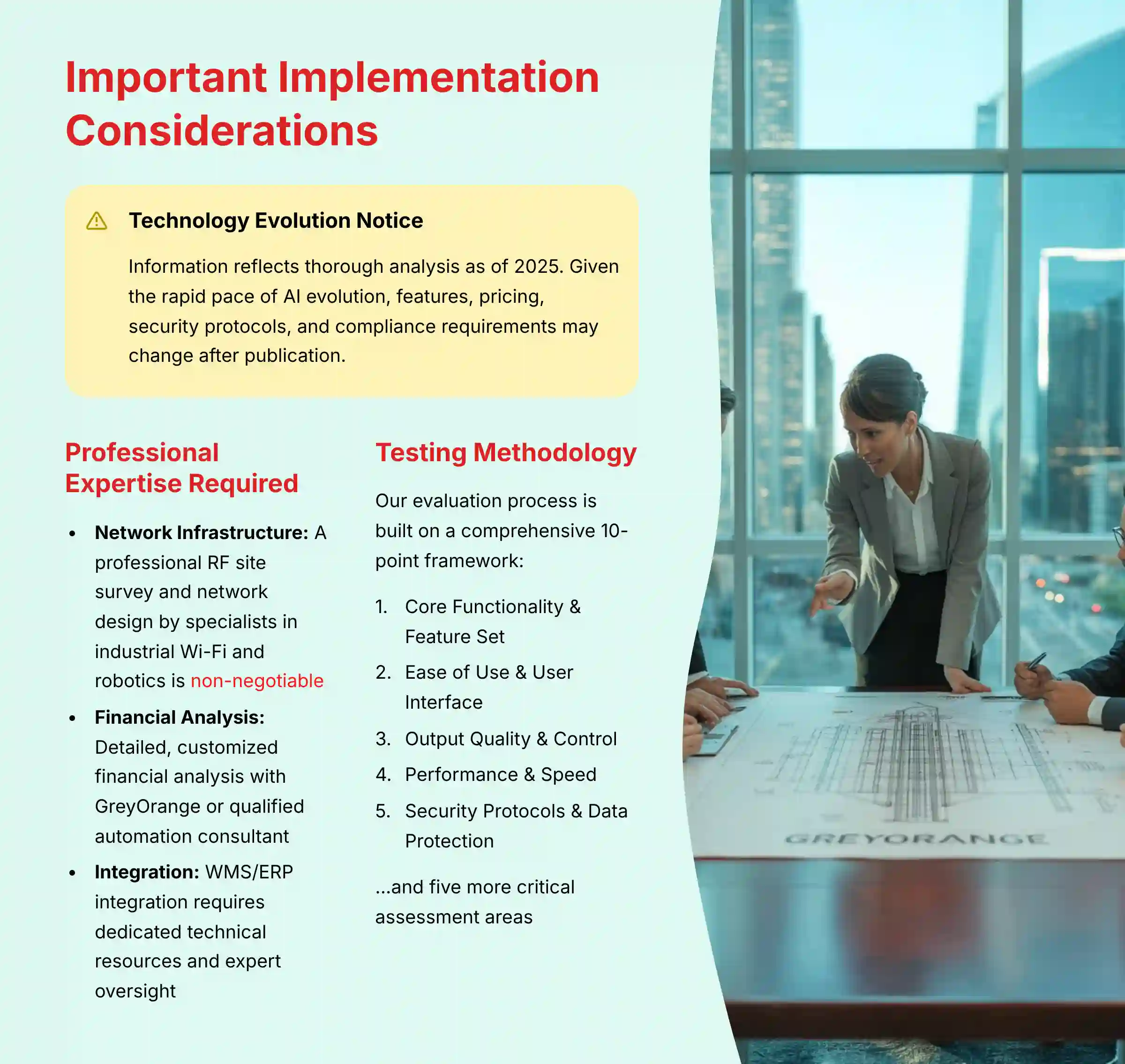
Important Disclaimers:
Technology Evolution Notice: The information about GreyOrange and AI for Operations & Supply Chain tools presented in this article reflects our thorough analysis as of 2025. Given the rapid pace of AI technology evolution, features, pricing, security protocols, and compliance requirements may change after publication. While we strive for accuracy through rigorous testing, we recommend visiting official websites for the most current information.
Professional Consultation Recommendation: For AI for Operations & Supply Chain applications with significant professional, financial, or compliance implications, we strongly recommend consulting with qualified professionals who can assess your specific requirements and risk tolerance. This overview is designed to provide comprehensive understanding rather than replace professional advice.
Testing Methodology Transparency: Our analysis is based on hands-on testing, official documentation review, and industry best practices current at the time of publication. Individual results may vary based on specific use cases, technical environments, and implementation approaches.
Network & Infrastructure Notice: A professional Radio Frequency (RF) site survey and network design conducted by specialists in industrial Wi-Fi and robotics is non-negotiable for any Ranger™ GTP implementation. This is not a standard IT task, and failure to engage experts in this specialized area is a leading cause of robotics implementation failure.
Implementation & Integration Complexity: A detailed, customized financial analysis in consultation with GreyOrange or a qualified automation consultant is essential before making any investment decisions. The WMS/ERP integration described is a significant project requiring dedicated technical resources and expert oversight.
Frequently Asked Questions About GreyOrange
How does GreyOrange's AI differ from a standard Warehouse Management System (WMS)?
A standard WMS manages inventory records and processes orders in a defined way, whereas GreyMatter's AI makes real-time decisions to optimize operations. It dynamically assigns tasks to robots, re-slots inventory based on demand, and orchestrates workflows to maximize efficiency.
What is the typical implementation timeline for a GreyOrange system?
Based on my experience, a typical implementation timeline for a medium-sized facility ranges from 6 to 9 months. This includes facility preparation, system configuration, integration with the WMS/ERP, and user training. Complex projects can take longer.
How does GreyOrange compare to competitors like Locus Robotics or 6 River Systems?
The key difference lies in the operational model they support.
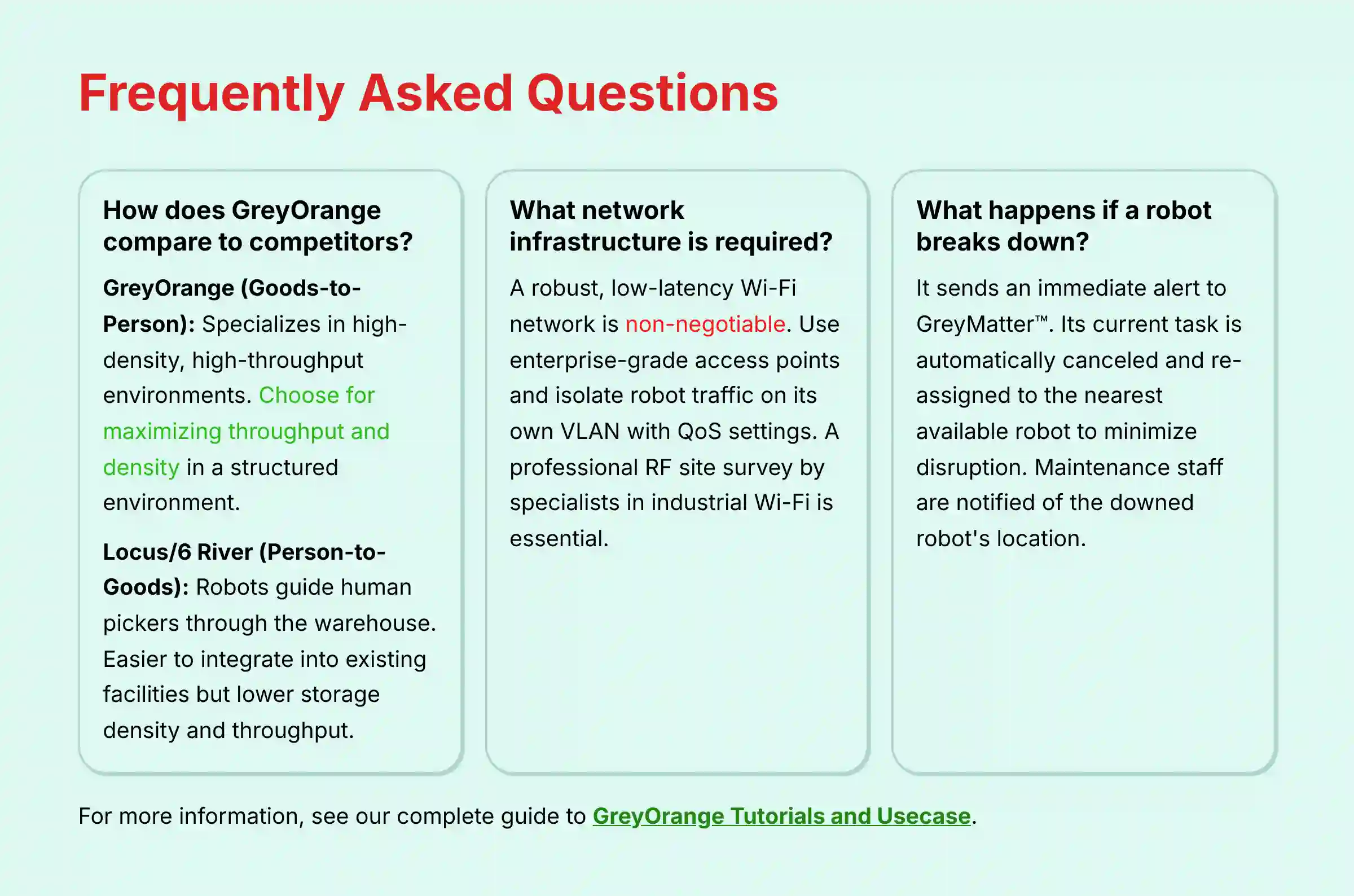
- GreyOrange (Goods-to-Person): Specializes in high-density, high-throughput environments. The Ranger™ GTP robots bring mobile shelves to a stationary operator. This model excels at maximizing storage density in a given footprint and achieving very high picks-per-hour at the station. It's often chosen for large-scale e-commerce or fulfillment centers with a high SKU count.
- Locus/6 River (Person-to-Goods/Collaborative Picking): These competitors often use a model where robots guide or follow human pickers through the warehouse to picking locations. This can be easier to integrate into existing brownfield facilities with minimal layout changes but typically results in lower storage density and throughput compared to a dedicated GTP system.
Choose GreyOrange for maximizing throughput and density in a structured environment; consider collaborative robotics for adding automation to more fluid, existing layouts. A professional consultation with an independent systems integrator can validate the best fit for your specific order profile and facility constraints.
What are the key security measures protecting my inventory and order data in GreyMatter™?
GreyMatter™ is SOC 2 Type II and ISO 27001 compliant, which are industry standards for data security. It uses role-based access controls to limit user permissions and secures its API with OAuth 2.0 authentication. Data is encrypted both in transit and at rest.
What is the realistic ROI I can expect from implementing GreyOrange?
While industry averages suggest an ROI within 18 to 36 months, this varies significantly based on your specific facility size, labor costs, order volume, inventory profile, and initial capital expenditure. You must perform a detailed, customized financial analysis in consultation with GreyOrange or a qualified automation consultant. Relying on generalized ROI timelines for a multi-million dollar investment decision would be professionally irresponsible.
How does the system handle exceptions like damaged items or robot errors?
The system has built-in exception handling workflows. If an operator finds a damaged item, they can flag it at the picking station, and GreyMatter™ will update inventory and create a task for removal. If a robot has an error, it sends an alert and the system automatically re-assigns its task to another available robot.
Can Ranger™ GTP robots operate in a warehouse with human workers and forklifts?
Yes, but it requires careful planning. Ranger™ GTP robots typically operate in a dedicated, fenced-off area for maximum speed and safety. However, they can be configured to operate in mixed-traffic zones at lower speeds, using their onboard sensors to avoid obstacles like people and forklifts.
What are the biggest challenges companies face during a GreyOrange implementation?
The biggest challenges I've seen are data quality and network infrastructure. Inaccurate SKU master data can corrupt the AI's logic. An unreliable Wi-Fi network with high latency can cause robots to hesitate or stop, severely impacting performance.
How scalable is the solution if my order volume doubles?
The solution is highly scalable. You can add more Ranger™ GTP robots to the fleet to handle increased volume. You can also add more picking stations. The GreyMatter™ software is designed to orchestrate hundreds of robots simultaneously.
What kind of network infrastructure is required to support the robot fleet?
A robust, low-latency Wi-Fi network is non-negotiable. My professional recommendation is to use enterprise-grade access points and to isolate the robot traffic on its own VLAN with QoS settings to prioritize it over all other network traffic. A professional Radio Frequency (RF) site survey and network design conducted by specialists in industrial Wi-Fi and robotics is essential. This is not a standard IT task and failure to engage experts is a leading cause of robotics implementation failure.
Does GreyOrange work for industries outside of e-commerce, like manufacturing or pharmaceuticals?
Yes. While popular in e-commerce, the system is also used in manufacturing for lineside replenishment and in pharmaceuticals for handling regulated inventory. The workflows can be configured to meet the specific needs of different industries.
What happens if a Ranger™ GTP robot breaks down mid-operation?
A robot that breaks down mid-operation sends an immediate alert to the GreyMatter™ system. Its current task is automatically canceled and re-assigned to the nearest available robot to minimize disruption. Maintenance staff are then notified of the downed robot's location.
For additional questions and detailed answers, visit our comprehensive GreyOrange FAQs section for more specific guidance on implementation and troubleshooting.

Leave a Reply