Which Cin7 Plan is Best for Your Business?
This 2-Minute Quiz Reveals Your Perfect Match!
Key Takeaways
- AI-Powered Platform: Cin7 serves as a comprehensive cloud-based inventory management solution with AI-assisted demand forecasting and multi-channel synchronization capabilities.
- Two Product Tiers: Cin7 Omni targets enterprise operations with advanced warehouse automation, while Cin7 Core serves SMBs with essential inventory management features.
- Implementation Investment: Total Cost of Ownership ranges from $20,000-$50,000 in the first year, including setup, training, and subscription fees.
- Enterprise Security: SOC 2 Type II certified with comprehensive data protection, compliance features, and robust API integration capabilities.
- Implementation Complexity: Requires significant planning, data migration, and change management to realize full benefits of the platform.
What is Cin7, and how does it use AI for inventory management?

Cin7 is a comprehensive, cloud-based inventory and order management platform designed to serve as the central operational hub for multi-channel businesses. While it contains AI-assisted components for inventory optimization, it's primarily focused on providing a robust, rules-based automation engine rather than being a fully AI-driven system.
The platform excels at synchronizing inventory levels, sales orders, and shipping data across multiple channels including e-commerce platforms (Shopify, BigCommerce), online marketplaces (Amazon, eBay), B2B wholesale portals, and physical retail points of sale. This synchronization helps prevent costly inventory errors like overselling or stockouts.
For businesses seeking comprehensive inventory management solutions, our detailed Cin7 Overview and Features guide provides in-depth analysis of the platform's capabilities and implementation strategies.

Cin7's AI capabilities are most evident in its demand forecasting module, which uses historical data analysis to predict future inventory needs. The system analyzes past sales patterns across different channels, applies seasonality factors, and generates automated replenishment recommendations. While not using deep learning or neural networks, these algorithms provide actionable intelligence for maintaining optimal stock levels.
For modern supply chain operations, Cin7 serves as the “single source of truth” for all product-related data, connecting sales channels to warehouse, purchasing, and fulfillment processes. This automated data flow eliminates the information silos that plague traditional inventory management approaches, replacing reactive, spreadsheet-based management with a proactive, data-driven system.
What is the difference between Cin7 Omni and Cin7 Core for warehouse automation?
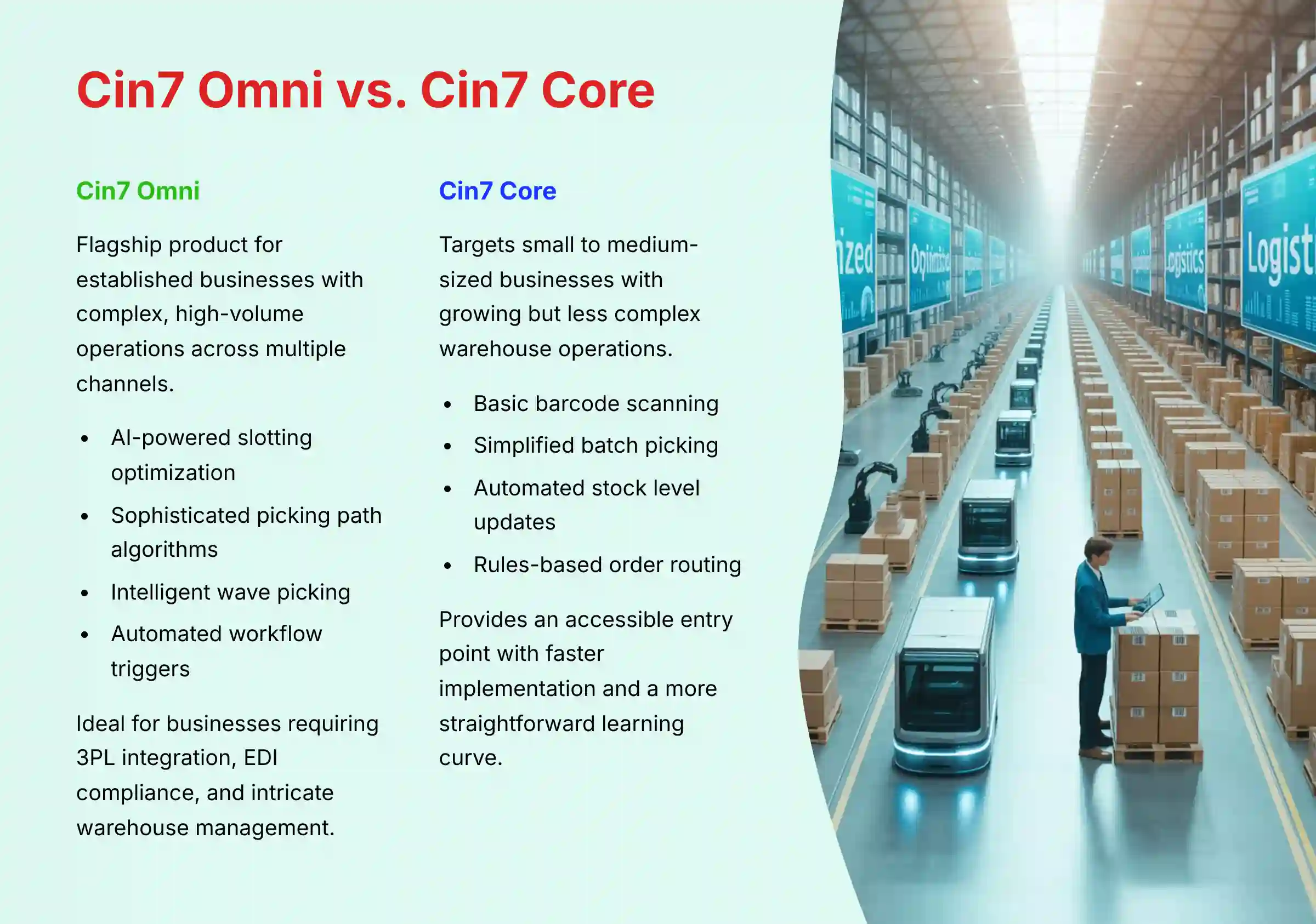
Cin7 Omni and Cin7 Core represent two distinct products within the Cin7 ecosystem, each targeting different warehouse automation needs and business complexity levels.
Cin7 Omni is the flagship product designed for established businesses with complex, high-volume operations across multiple channels. Its warehouse automation capabilities include advanced features like:
- AI-powered slotting optimization that determines the most efficient placement of products within the warehouse
- Sophisticated picking path algorithms that minimize travel time for warehouse staff
- Intelligent wave picking that groups multiple orders for more efficient fulfillment
- Automated workflow triggers that can initiate replenishment, cycle counts, or transfer orders based on predefined rules
Omni excels in complex scenarios requiring 3PL integration, EDI compliance for major retailers, and intricate warehouse management processes. The system can orchestrate inventory movements across distributed fulfillment networks, making it ideal for businesses with sophisticated supply chain operations.

Cin7 Core (formerly DEAR Systems) targets small to medium-sized businesses with growing but less complex warehouse operations. Its automation features focus on streamlining core warehouse processes with:
- Basic barcode scanning for inventory receiving and picking
- Simplified batch picking for multiple orders
- Automated stock level updates across connected sales channels
- Rules-based order routing to appropriate fulfillment locations
For warehouse operations transitioning from manual processes to their first automation system, Cin7 Core provides an accessible entry point with faster implementation timelines and a more straightforward learning curve than the more complex Omni platform.
To explore detailed comparisons with other inventory solutions, check out our comprehensive Cin7 Top Alternatives and Competitors analysis that evaluates similar platforms in the market.
Who is the ideal customer for Cin7's AI-powered inventory solutions?

The ideal Cin7 customer is a product-based business that has outgrown basic inventory management tools and needs intelligent automation to handle multi-channel complexity. These businesses typically generate annual revenues between $1 million and $100 million and face increasing operational challenges that manual processes can no longer efficiently address.
Key characteristics of businesses that benefit most from Cin7's AI-powered solutions include:
Multi-Channel Complexity: They sell through diverse channels (e-commerce, marketplaces, wholesale, retail) and struggle to maintain accurate inventory across all platforms. Cin7's AI helps create a unified inventory view, preventing the costly errors that occur when systems don't communicate effectively.
Data-Driven Decision Making: They're ready to move beyond intuition-based purchasing to a data-driven approach. Cin7's predictive analytics enable more accurate demand forecasting, reducing both stockouts and excess inventory that ties up working capital.
Warehouse Efficiency Challenges: They've reached a scale where manual warehouse processes create bottlenecks. Cin7's warehouse automation capabilities optimize picking routes, enable batch fulfillment, and maintain perpetual inventory accuracy.
Integration Requirements: Their operations rely on multiple systems that need to work together seamlessly. Cin7's extensive integration capabilities connect their entire operational ecosystem, from e-commerce platforms to accounting software.
Growth-Focused Operations: They need to scale operations without proportionally increasing headcount. Cin7's automation enables them to handle higher order volumes and SKU counts without linear increases in operational costs.
For these businesses, Cin7 serves as both an operational backbone and an AI-assisted decision support system that transforms inventory from a reactive cost center into a strategic competitive advantage.
Our comprehensive Cin7 Review provides detailed insights into real-world implementation experiences and ROI considerations for businesses evaluating this platform.
How does Cin7 use AI for demand forecasting and inventory replenishment?

Cin7's approach to demand forecasting and replenishment combines algorithmic analysis with configurable rules-based automation to transform inventory planning from a reactive to a proactive process. While not employing true machine learning that continuously improves without human intervention, the system provides powerful predictive capabilities based on historical data analysis.
The AI-assisted forecasting engine analyzes historical sales velocity across multiple dimensions, including:
- Channel-specific demand patterns (identifying how products perform differently on various platforms)
- Seasonal fluctuation detection (recognizing recurring patterns in demand)
- Trend identification (spotting emerging product performance shifts)
- Outlier filtering (excluding anomalous sales events that would skew forecasts)
This multi-dimensional analysis generates dynamic reorder points that adapt to changing market conditions. The system calculates optimal stock levels by incorporating critical supply chain variables such as:
- Supplier lead times (accounting for manufacturing and shipping durations)
- Safety stock requirements (ensuring buffer inventory based on demand volatility)
- Order minimums and economic order quantities (optimizing purchasing efficiency)
The most powerful aspect is the automated purchase order creation workflow. When inventory falls below calculated thresholds, Cin7 can automatically generate draft purchase orders and route them to the appropriate suppliers. This automation eliminates the error-prone process of manually monitoring thousands of SKUs and calculating reorder quantities.
For businesses implementing these capabilities, proper data hygiene is essential. Excluding non-representative sales anomalies (like one-time bulk orders or flash sales) from the historical analysis ensures more accurate forecasting. Most successful implementations begin with running the system in “suggestion mode” for a full sales cycle before activating fully automated purchasing.
Looking for hands-on guidance? Our detailed Cin7 Tutorials and Usecase guide provides step-by-step implementation strategies and best practices for optimizing demand forecasting workflows.
Can Cin7 manage AI-assisted inventory across multiple warehouses and 3PL partners?
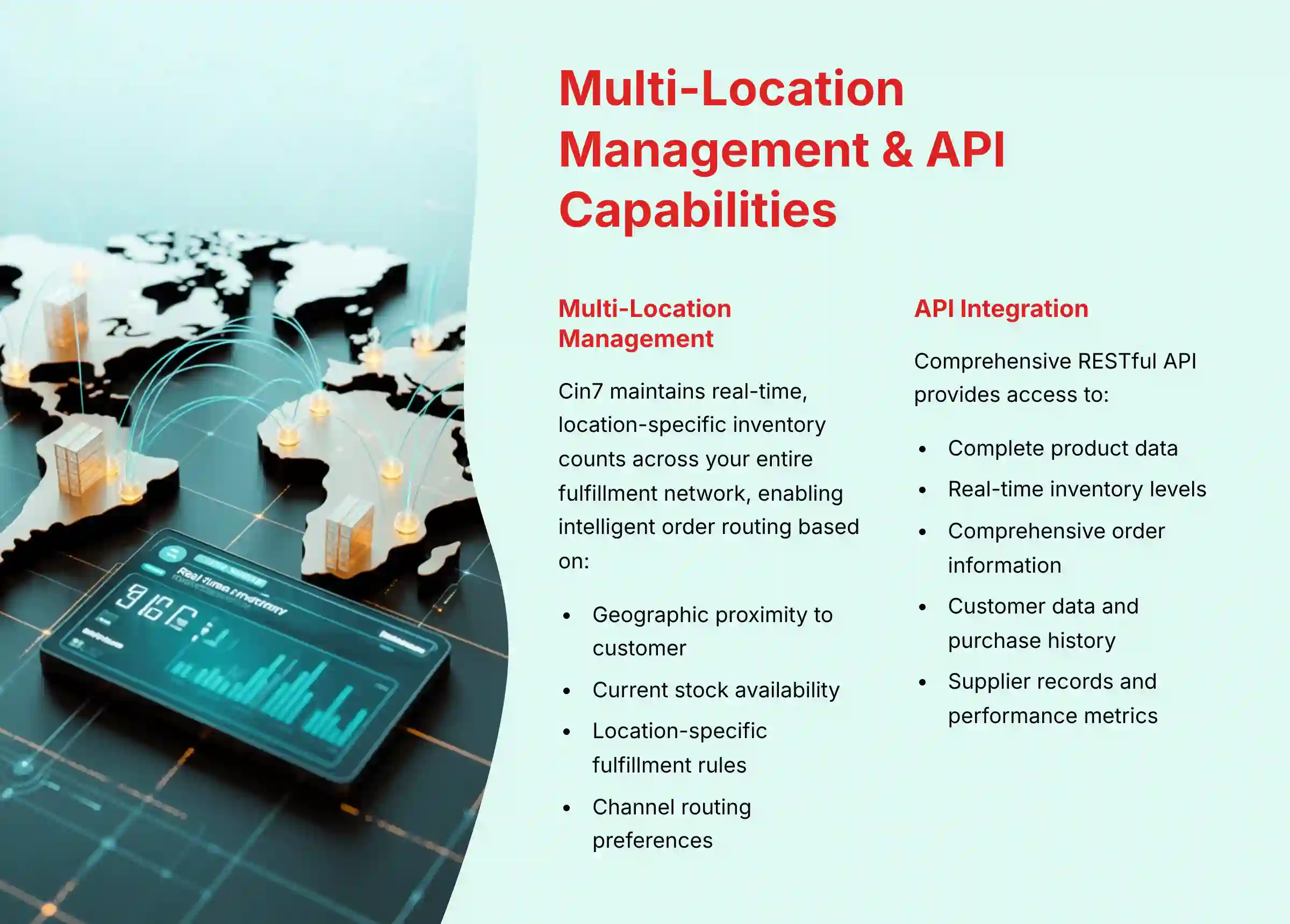
Yes, Cin7 excels at managing distributed inventory networks through its AI-assisted multi-location inventory management capabilities. The platform provides end-to-end visibility and orchestration across company-owned warehouses, fulfillment centers, and third-party logistics (3PL) partners.
The system's distributed inventory architecture maintains real-time, location-specific inventory counts for every SKU across your entire fulfillment network. This granular visibility enables intelligent order routing based on:
- Geographic proximity to customer (minimizing shipping costs and delivery times)
- Current stock availability (preventing split shipments)
- Location-specific fulfillment rules (prioritizing certain warehouses for specific products)
- Channel routing preferences (directing specific sales channels to dedicated fulfillment locations)
For 3PL management, Cin7 provides AI-enhanced integration through:
- Automated order transmission via EDI or API connections
- Real-time inventory synchronization with 3PL warehouse management systems
- Automated receipt of shipment confirmations and tracking data
- Exception flagging for fulfillment anomalies requiring attention
The system's intelligence extends to inventory balancing across locations. When stock levels fall below thresholds at one location but excess inventory exists elsewhere, Cin7 can automatically generate stock transfer recommendations to optimize overall network performance.
This distributed inventory capability is particularly valuable for businesses expanding their fulfillment networks to reduce shipping costs and delivery times. By strategically positioning inventory closer to customer concentrations and having a system that maintains perfect synchronization across all locations, businesses can achieve both cost savings and improved customer satisfaction through faster deliveries.
For businesses exploring broader automation solutions, our analysis of the Best 10 AI for Order Fulfillment & Picking 2025 provides comprehensive comparisons with other leading AI-powered warehouse management platforms.
How robust is Cin7's API for integrating with AI tools and business intelligence systems?
Cin7 provides a comprehensive RESTful API that enables deep integration with AI-powered analytics tools, custom systems, and advanced business intelligence platforms. This API serves as the foundation for extending Cin7's capabilities and incorporating it into a modern, AI-enhanced tech stack.
The API offers extensive access to core data objects within the Cin7 ecosystem, including:
- Complete product data (specifications, costs, pricing, supplier information)
- Real-time inventory levels across all locations
- Comprehensive order information (sales orders, purchase orders, transfers)
- Customer data and purchase history
- Supplier records and performance metrics
This robust data accessibility enables powerful AI-enhanced use cases:
- Advanced Demand Forecasting: Extract historical sales data to feed into specialized AI forecasting tools that incorporate external variables like economic indicators, weather patterns, or social media sentiment.
- Predictive Analytics: Connect Cin7 inventory data to machine learning models that identify emerging trends, predict stockout risks, or recommend optimal safety stock levels.
- Automated Decision Support: Build custom dashboards that combine Cin7 operational data with financial metrics to create AI-powered decision support systems.
- Custom Workflow Automation: Develop specialized automation tools that respond to inventory events in Cin7 by triggering actions in other systems.
The API employs standard authentication methods and returns data in JSON format, making it accessible to most modern development frameworks. While subject to rate limits to ensure platform stability, these are generally sufficient for most business applications.
For organizations with specialized operational requirements or advanced analytics needs, the API provides the flexibility to extend Cin7's native capabilities and integrate them into a comprehensive, AI-enhanced supply chain technology ecosystem.
What is the true Total Cost of Ownership (TCO) for Cin7, beyond the monthly subscription?
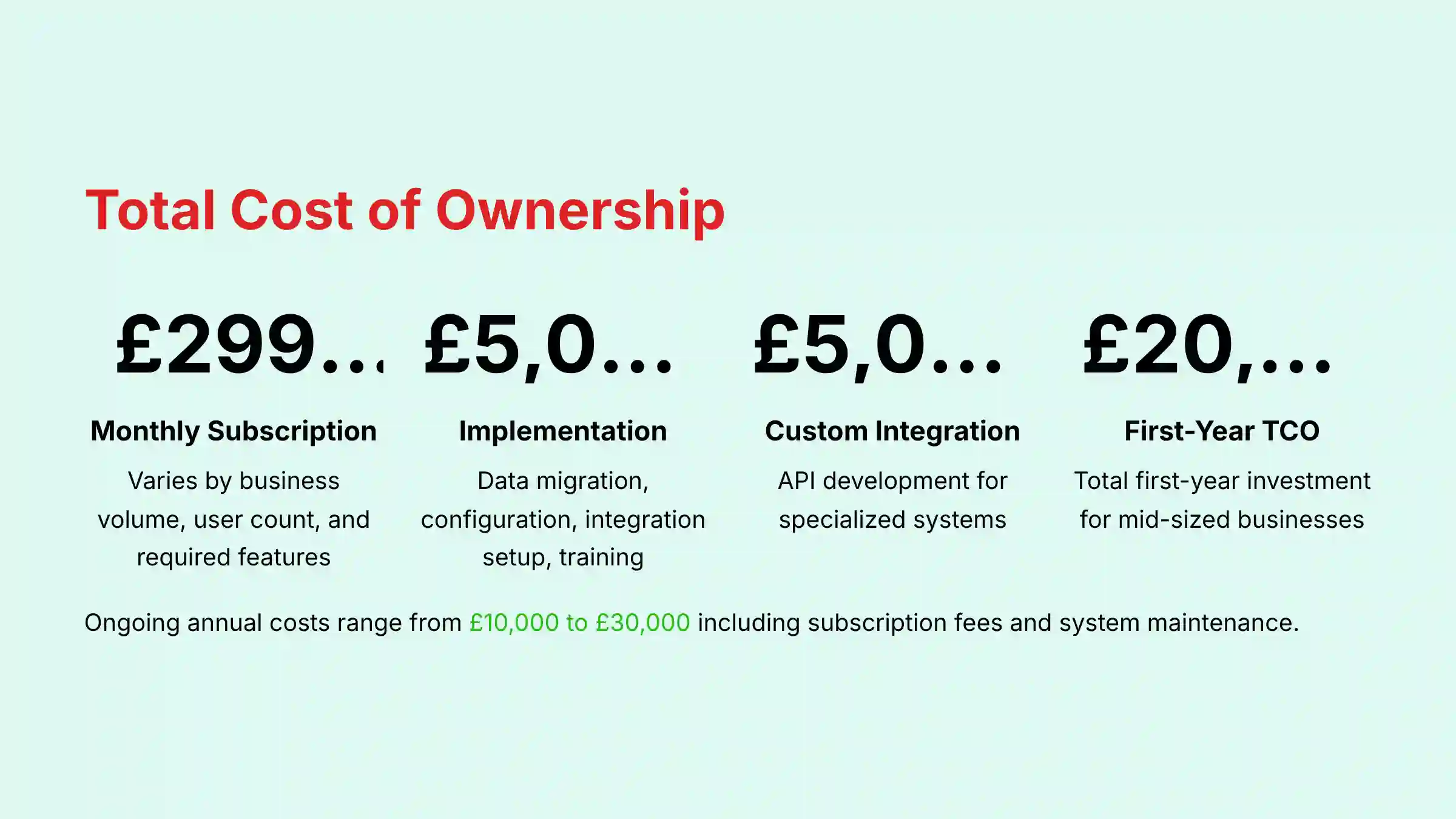
The Total Cost of Ownership for implementing Cin7 as an AI-assisted inventory management solution extends significantly beyond the monthly subscription fee. Understanding these comprehensive costs is essential for accurate budgeting and ROI calculations.
Subscription Costs: The base recurring cost typically ranges from $299 to $2,000+ monthly depending on your business volume, user count, and required features. Higher tiers unlock more advanced AI-assisted capabilities like automated demand forecasting and complex warehouse management.
Implementation and Onboarding: This represents the most substantial upfront investment, typically ranging from $5,000 to $25,000+ depending on business complexity. This cost covers:
- Data migration from legacy systems
- System configuration and workflow design
- Integration setup with sales channels and other operational systems
- User training and process documentation
Integration Development: While Cin7 offers many pre-built connections, custom integrations with specialized systems require additional development:
- API development for custom systems: $5,000-$15,000
- Data transformation for complex ERP connections: $3,000-$10,000
- Ongoing integration maintenance: $500-$2,000 annually
Internal Resource Allocation: Successful implementation requires significant commitment from your team:
- Project management: 10-20 hours weekly during implementation (3-6 months)
- Subject matter expert involvement: 5-10 hours weekly from key departmental stakeholders
- Ongoing system administration: 5-15 hours weekly for maintenance and optimization
Data Preparation: One frequently overlooked cost is data cleansing before migration. Businesses typically need to dedicate 40-80 hours to standardizing product data, resolving inventory discrepancies, and establishing consistent naming conventions before migration begins.
For most mid-sized businesses, the first-year TCO for Cin7 implementation ranges from $20,000 to $50,000, with ongoing annual costs of $10,000 to $30,000 including subscription fees and system maintenance. While substantial, these costs should be evaluated against the measurable benefits of improved inventory accuracy, reduced carrying costs, lower labor expenses, and fewer stockout-related lost sales.
How does Cin7 ensure data security and regulatory compliance for supply chain operations?

Cin7 implements a comprehensive security and compliance framework designed to protect sensitive supply chain data while meeting stringent regulatory requirements across multiple jurisdictions. This multi-layered approach addresses both technical and operational security concerns.
Infrastructure Security: The platform is hosted on Amazon Web Services (AWS), leveraging its enterprise-grade security infrastructure. This includes:
- Physical data center security with biometric access controls
- Network security with advanced firewalls and intrusion detection
- Continuous vulnerability scanning and patch management
- Regular penetration testing by independent security firms
Data Protection: All sensitive information is safeguarded through:
- End-to-end encryption for data in transit using TLS 1.2+
- AES-256 encryption for data at rest
- Secure credential management with one-way hashing for authentication
- Regular encrypted backups with point-in-time recovery capabilities
Compliance Certifications: Cin7 has achieved SOC 2 Type II certification, verifying that the company maintains rigorous controls for:
- Security: Protecting systems against unauthorized access
- Availability: Ensuring system uptime and operational resilience
- Processing Integrity: Guaranteeing accurate data processing
- Confidentiality: Safeguarding sensitive information
- Privacy: Protecting personally identifiable information
User Access Controls: The platform provides granular permission management that enables:
- Role-based access control aligned with job responsibilities
- Principle of least privilege implementation
- Detailed audit logging of all system actions
- Automated session timeouts and account lockouts
For supply chain operations handling regulated products (pharmaceuticals, food, etc.), Cin7's batch and serial tracking features support compliance with industry-specific regulations like FDA requirements. The system maintains comprehensive audit trails that document the complete chain of custody for products throughout the supply chain.
These security measures provide the foundation for maintaining data confidentiality, integrity, and availability while meeting the compliance requirements essential for modern supply chain operations.
What are the primary risks or limitations to consider before choosing Cin7 for AI-driven inventory management?

When evaluating Cin7 for AI-driven inventory management, organizations should carefully consider several limitations and potential risks that could impact implementation success and long-term satisfaction.
Implementation Complexity: Cin7 is a sophisticated platform that requires significant effort to properly configure. The most common risk is underestimating the complexity of implementation, particularly around:
- Data migration challenges when importing from legacy systems
- Process redesign requirements to align with Cin7's workflow structure
- Integration complexity with existing systems like accounting or e-commerce platforms
- Change management needs for staff adaptation to new processes
AI Capabilities vs. Expectations: While Cin7 offers intelligent automation and data-driven insights, its AI capabilities have specific limitations:
- Forecasting relies primarily on historical data analysis rather than true machine learning
- Automation is rules-based rather than adaptive or self-learning
- Predictive capabilities require clean, consistent historical data to function effectively
- Complex external factors (market disruptions, competitor actions) aren't automatically incorporated into forecasts
Scalability Considerations: For rapidly growing businesses, certain limitations may become apparent:
- Performance can degrade with extremely high transaction volumes (millions of orders)
- The standard reporting engine struggles with very large datasets
- Customization options become more constrained at enterprise scale
- API rate limits may impact real-time integration needs for high-volume operations
Operational Adjustments: Implementation often requires adapting existing processes:
- Standard workflows may not perfectly match your current operations
- Some industry-specific requirements may need workarounds
- Custom fields and reports require technical knowledge to implement effectively
- Process changes may face resistance from teams comfortable with existing systems
Resource Requirements: Successful implementation and ongoing management demand dedicated resources:
- System administrator role needed for ongoing management
- Regular training required as the platform evolves
- Process optimization is ongoing, not a one-time project
- Data maintenance is essential for forecasting accuracy
For most mid-sized businesses with standard inventory management needs, these limitations are manageable with proper planning. However, organizations with highly specialized requirements, extreme transaction volumes, or minimal IT resources should carefully evaluate whether Cin7's capabilities align with their specific operational needs and available implementation resources.
For a complete evaluation framework, our detailed Cin7 FAQs addresses common implementation concerns and provides practical guidance for making informed platform decisions.
Transform your inventory management with AI-powered automation. Cin7 provides the tools and intelligence needed to optimize your supply chain operations and drive sustainable growth.

Leave a Reply